The Brahmanical Patriarchy Narrative
How the Caste-Gender Intersection Has Been Weaponized
The 'Brahmanical Patriarchy' framework fuses caste and gender into a civilizational indictment. This lesson traces how the term was manufactured in Western academia, spread through activist networks, and mainstreamed by global tech platforms. It exposes the selective evidence machine that foregrounds Sati while erasing Gargi, Maitreyi, and Ahilyabai Holkar, distinguishes genuine women's issues from their weaponization for civilizational attack, and demonstrates that Hindu civilization's continuous internal reform tradition from the Bhakti saints to modern organizations makes external 'smashing' both unnecessary and intellectually dishonest.
See It Today: When a Hashtag Replaced History
In November 2018, Twitter CEO Jack Dorsey visited India and posed for a photograph holding a poster that read "Smash Brahmanical Patriarchy." The image went viral. Within hours, it had been shared millions of times. The global CEO of one of the world's largest social media platforms had endorsed a phrase that equates an entire civilization's spiritual and social tradition with institutionalized gender oppression.
Dorsey later called the poster a "gift" from Dalit activists he met during his visit. He did not explain when "Brahmanical" became interchangeable with "oppressive." He did not ask whether a civilization that produced Gargi Vachaknavi, who debated metaphysics in a royal court, or Maitreyi, who chose philosophical knowledge over material wealth, or Ahilyabai Holkar, who governed a kingdom for three decades with legendary competence, deserved to have its entire tradition reduced to a slogan on a protest sign.
Nobody in Dorsey's circle questioned the framing. In progressive global circles, "Brahmanical Patriarchy" had already become self-evident truth, a phrase so normalized that the CEO of a trillion-dollar tech company could hold it up without expecting controversy from his board, his shareholders, or the international media.
How did a term invented in academic papers become a casual slogan for Silicon Valley? How did an entire civilization's relationship with gender get reduced to two words on a placard? The answer involves a manufacturing process as precise as any industrial operation: raw material from colonial archives, processing in Western universities, packaging by activist networks, and distribution through global media.
The Manufacturing of a Framework
The term "Brahmanical Patriarchy" entered academic discourse through a specific lineage. Its most influential formulation came from historian Uma Chakravarti's 1993 paper "Conceptualising Brahmanical Patriarchy in Early India," published in Economic and Political Weekly. Chakravarti argued that caste and gender oppression in India were structurally inseparable. Upper-caste control over women's sexuality and reproduction, she argued, was the mechanism through which caste purity was maintained.
The argument contained a core insight: caste hierarchies did historically involve control over marriage and reproduction, particularly for women. This observation was not new. Social reformers from Jyotirao Phule to B.R. Ambedkar had analyzed how endogamy reinforced social stratification. The insight was legitimate.
What happened next was not scholarship. It was weaponization.
The specific term "Brahmanical Patriarchy" performed a precise rhetorical function. By attaching the word "Brahmanical" to patriarchy, it accomplished something that generic "patriarchy" could not. It attributed gender oppression not to universal human patterns of male dominance (found in every civilization from Greece to China to Arabia) but to a specific civilizational source: Brahmanical Hinduism. Patriarchy became uniquely Hindu. Other patriarchies were just patriarchy. Hindu patriarchy was "Brahmanical," rooted in scripture, theology, and civilization itself.
This framing had consequences. If patriarchy in India is specifically "Brahmanical," then the solution is not gender reform (which every civilization has needed and pursued). The solution is the dismantling of Brahmanical civilization itself. You cannot reform what is inherently oppressive. You can only smash it.
The framework traveled from EPW to Western university syllabi within a decade. By the 2000s, "Brahmanical Patriarchy" was a standard term in South Asian Studies programs at Columbia, Chicago, Berkeley, and the School of Oriental and African Studies (SOAS) in London. PhD candidates learned it as settled vocabulary, not as one contested framework among many. It entered dissertations, which became journal articles, which became citations in other dissertations. An academic feedback loop produced an ever-growing body of literature that treated the framework as foundational rather than debatable.
From academia, the term migrated into activist vocabulary, then into NGO reports, then into international media. By 2018, when Dorsey held up that placard, "Smash Brahmanical Patriarchy" required no explanation in progressive circles. The manufacturing process was complete.
The Selective Evidence Machine
The "Brahmanical Patriarchy" framework depends on a specific operation: the systematic foregrounding of certain historical evidence and the systematic erasure of other evidence.
What gets foregrounded: Sati (widow immolation), child marriage, dowry, restrictions on widow remarriage, denial of education to women, and Manusmriti verses that restrict women's autonomy.
What gets erased: Everything else.
Consider the evidence that must be suppressed for the framework to hold:
Women Rishis of the Vedas. The Rig Veda attributes hymns to over twenty women composers (Rishikas), including Lopamudra, Vishvavara, Ghosa, and Apala. These were not anonymous contributors. They were named, credited authors whose compositions were preserved with the same reverence as those of male Rishis. A civilization that credits women as co-authors of its foundational scripture does not fit the "inherently patriarchal" framework.
Gargi Vachaknavi. In the Brihadaranyaka Upanishad, Gargi challenges the sage Yajnavalkya in a public philosophical debate at the court of King Janaka. She asks increasingly profound questions about the nature of reality, pushing Yajnavalkya to the limits of his knowledge. The text treats her intellectual authority as unremarkable. No one questions her right to debate. No one tells her that philosophy is not for women. A civilization that preserves a woman debating metaphysics in its most sacred philosophical text is telling you something about its values.

Maitreyi. In the same Upanishad, when the sage Yajnavalkya divides his property between his two wives before renouncing the world, Maitreyi famously rejects material wealth, asking instead for the knowledge that leads to immortality. "What shall I do with that which will not make me immortal?" she asks. The text presents her choice of knowledge over wealth as the spiritually superior decision. The civilization preserved this story for three thousand years. What does that tell you about what it valued in women?
Ahilyabai Holkar. She governed the Malwa kingdom from 1767 to 1795, approximately thirty years of effective, compassionate administration. She rebuilt temples across India, administered justice personally, maintained a professional army, and was renowned for her competence and integrity. British colonial records themselves acknowledge her administrative abilities. She governed during a period when women in Britain could not own property in their own names, could not attend universities, and could not vote.
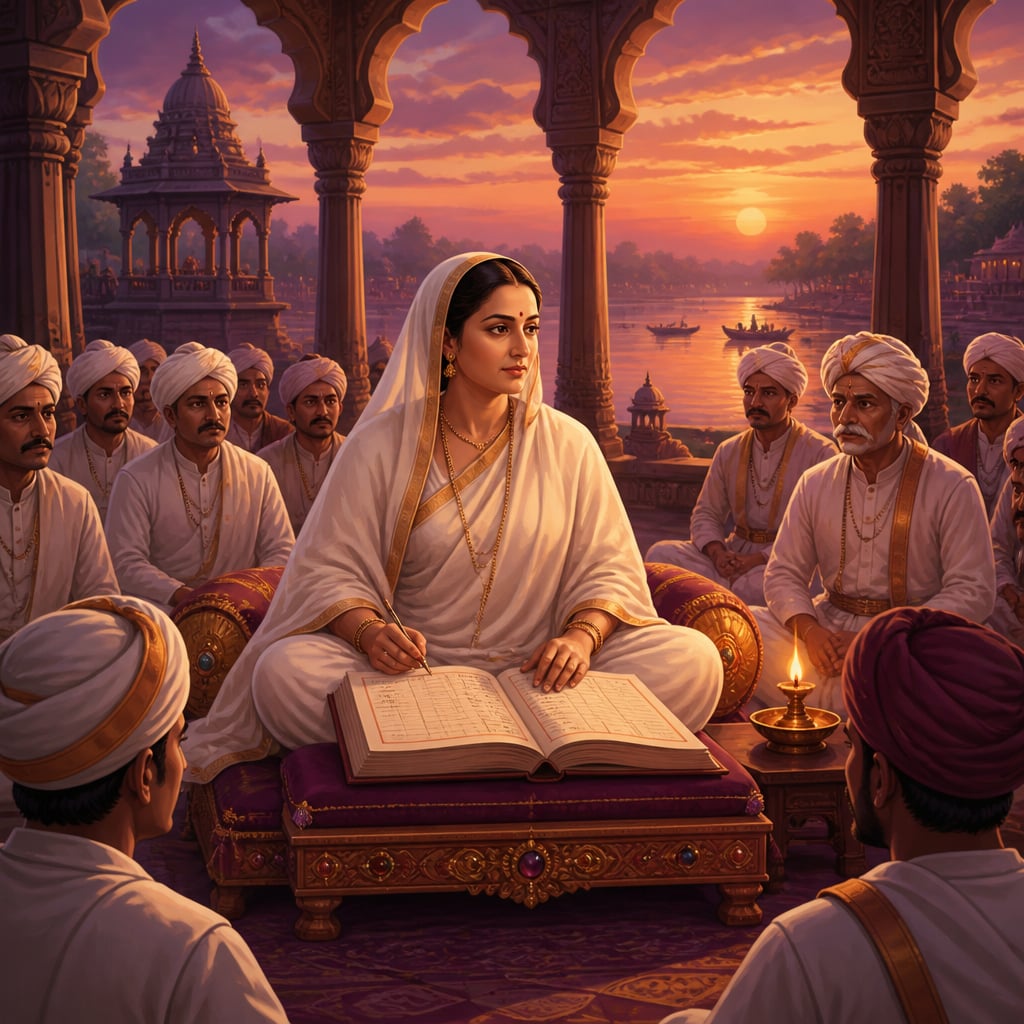
Rani Durgavati. She ruled the Gond kingdom of Garha-Mandla for fifteen years and died fighting the Mughal army of Asaf Khan in 1564 rather than surrender. She led her troops personally in battle.
Kittur Chennamma. She led an armed rebellion against the British East India Company in 1824, twenty-three years before the First War of Independence in 1857.
The list extends far further: Rani Abbakka Chowta who fought the Portuguese for four decades, the Nair warrior women of Kerala, women administrators in Vijayanagara, women scholars in medieval Kashmir. But the point is not the list. The point is the operation.
The "Brahmanical Patriarchy" framework requires you to know about Sati and not know about Gargi. It requires you to have read the Manusmriti verses about women and to have never heard of Maitreyi's rejection of wealth for knowledge. It requires you to think of Hindu civilization as one that burned widows and to never learn that it produced warrior queens who died fighting foreign invaders.
This is not a scholarly framework. It is a filtration system. It lets through evidence that supports the predetermined conclusion and blocks evidence that contradicts it. The conclusion came first. The "scholarship" was reverse-engineered to support it.
The Sati Operation: How a Local Practice Became a Civilizational Indictment
The treatment of Sati illustrates the filtration system at its most effective.
Sati (the practice of a widow immolating herself on her husband's funeral pyre) was real. It caused real suffering. It deserved to be opposed, and it was opposed, from within the Hindu tradition itself, long before any European arrived in India. Medhatithi, an early commentator on the Manusmriti, explicitly condemned the practice in the 9th century. The Padma Purana forbids it. Multiple Dharmashastra authorities across centuries argued against it.
But here is what the colonial administration did with Sati. They counted it. Between 1815 and 1828, the British colonial government in Bengal conducted detailed statistical surveys of Sati. These surveys produced numbers: 839 cases in 1818, 654 in 1825, 463 in 1826. The numbers were real. The operation was in the framing.
Bengal's population at the time was approximately 40 million. Even at the highest recorded numbers, the incidence rate was approximately 0.002%. The practice was overwhelmingly concentrated in certain communities and certain regions. It was not pan-Indian. It was not universal. It was not normative. Most Hindu communities across India did not practice Sati.
None of this mattered. The colonial administration, working with missionary societies, presented Sati to British and European audiences as the defining practice of Hindu civilization. Parliamentary debates in London cited the Bengal statistics as evidence of Hindu barbarism. Missionary publications circulated the numbers to congregations across Britain to justify continued colonial intervention. The entire edifice of "Hindu social reform" was constructed on the foundation of Sati as representative practice.
William Bentinck's Sati Prohibition Act of 1829 was a genuine moral achievement. The practice deserved abolition. But the Act served a dual purpose that its moral dimension should not obscure. It established the precedent that British colonial power was the legitimate agent of social reform in India. It created the narrative that Hindu civilization was incapable of reforming itself and required external intervention. This narrative persists intact in the "Brahmanical Patriarchy" framework: Hinduism is unreformable from within. It must be smashed from outside.
The irony is precise. Sati was already being opposed by Hindu reformers using Hindu philosophical arguments. The colonial intervention claimed credit for a reform process that was already underway, while simultaneously using that intervention to justify the continuing need for external civilizational oversight.
The Appropriation Machine: How Genuine Issues Become Civilizational Weapons
The most sophisticated dimension of the "Brahmanical Patriarchy" framework is its appropriation of genuine women's issues.
Real problems exist. Dowry harassment is real. Domestic violence is real. Gender-based discrimination in access to education and employment is real. Caste-based discrimination compounds gender disadvantage in measurable ways. Women from Dalit and Adivasi communities face intersecting oppressions that are documented and undeniable.
The appropriation works like this: take a genuine problem, attribute it exclusively to "Brahmanical" civilization (rather than to universal patterns of patriarchy found in every human society), and then prescribe civilizational demolition rather than specific reform.
Consider the logical structure. Dowry harassment occurs in India. Dowry is linked to Hindu marriage customs. Hindu customs derive from "Brahmanical" tradition. Therefore, "Brahmanical Patriarchy" is the root cause. Therefore, the solution is not dowry reform legislation, economic empowerment of women, or cultural change within communities. The solution is to "smash Brahmanical Patriarchy." The solution is civilizational.
This logic would not survive five minutes of comparative analysis. Bride price practices exist across Africa. Dowry exists in China. Foot-binding existed in China for a thousand years. Witch-burning killed tens of thousands of women in Christian Europe. Honor killings occur across the Middle East. Female genital mutilation is practiced across North Africa and the Sahel. Femicide rates in Latin America exceed those in South Asia.
Nobody speaks of "Confucian Patriarchy" as a framework requiring the smashing of Chinese civilization. Nobody uses the term "Christian Patriarchy" to argue that European civilization is inherently oppressive and must be dismantled. Nobody constructs an academic framework called "Islamic Patriarchy" and installs it in university syllabi as settled vocabulary.
Only Hindu civilization receives this treatment. Only "Brahmanical" gets attached to "Patriarchy" as a permanent compound noun. The specificity of the framing reveals its purpose: this is not gender scholarship. This is civilizational targeting using gender as the vehicle.
The Internal Reform Tradition: What the Framework Must Deny
The "Brahmanical Patriarchy" framework depends on one final denial: the denial that Hindu civilization possesses an internal reform tradition.
If Hinduism can reform itself from within, then external intervention is unnecessary. If external intervention is unnecessary, then the framework loses its prescriptive power. The framework must therefore insist that Hinduism is structurally incapable of self-reform. "Smash" is the operative word because reform is declared impossible.
The historical record says otherwise.
The Bhakti movement, spanning roughly the 7th to the 17th century, was the largest internal reform movement in Hindu history. It challenged caste hierarchies, rejected ritualistic exclusion, and elevated women's spiritual authority to the highest levels.
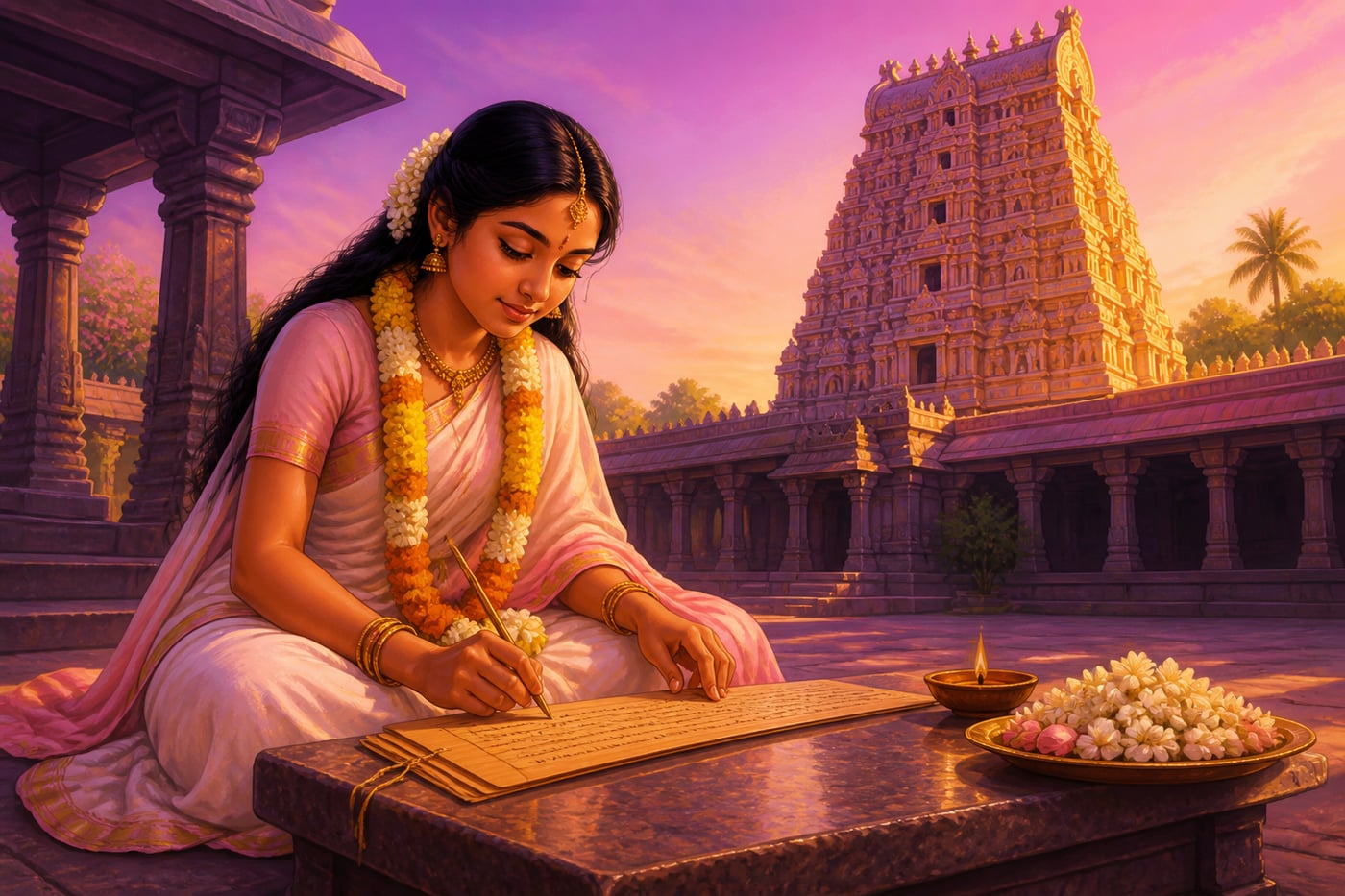
Andal (8th century Tamil Nadu) composed devotional poetry of such intensity that she is worshipped as an incarnation of Bhudevi to this day. Her Tiruppavai is recited in temples across South India every Margazhi season. A woman's spiritual compositions became canonical scripture.
Akka Mahadevi (12th century Karnataka) renounced all social conventions, composed Vachanas (prose poems) of radical spiritual insight, and debated with male saints as an equal. Her rejection of material attachment was so complete that the Lingayat tradition treats her as one of its highest spiritual authorities.
Mirabai (16th century Rajasthan) defied royal authority, caste convention, and social pressure to pursue her devotion to Krishna. Her compositions are sung across India five centuries later. A woman who rejected patriarchal authority became one of the civilization's most beloved voices.
These were not exceptions. They were products of a civilization that contained within itself the philosophical resources for continuous self-renewal. The Upanishadic tradition that recognized Gargi's intellectual authority, the Bhakti tradition that elevated Andal and Mirabai, and the administrative tradition that produced Ahilyabai Holkar were all expressions of the same civilizational capacity for internal reform.
In the modern era, Swami Dayananda Saraswati's Arya Samaj championed women's education and widow remarriage in the 19th century. Swami Vivekananda articulated a vision of women's empowerment rooted in Shakti theology. Organizations like the Rashtra Sevika Samiti and Mata Amritanandamayi Math run women's education and empowerment programs across India today, reaching millions.
The internal reform tradition is not a counter-argument. It is the primary argument. A civilization that continuously produces reformers from within its own philosophical tradition does not need to be "smashed." It needs to be supported in its own ongoing process of self-renewal. The distinction between reform and demolition is the distinction between those who genuinely care about Indian women and those who use Indian women's issues as ammunition against Indian civilization.
The Defense: Reclaiming the Caste-Gender Conversation
The weaponization of the caste-gender intersection can be countered without denying that genuine problems exist.
Acknowledge real issues without accepting the civilizational indictment. Dowry harassment, caste-based gender discrimination, and the intersection of caste and gender disadvantage are real problems that deserve serious attention. Acknowledging these problems is not the same as accepting that they define Hindu civilization. Every civilization has gender-related problems. The question is whether the prescribed solution is reform (which builds on the civilization's own resources) or demolition (which treats the civilization as irredeemable).
Restore the erased evidence. Every time someone invokes "Brahmanical Patriarchy," respond with Gargi, Maitreyi, Ahilyabai, Andal, Akka Mahadevi, and Mirabai. Not as a defensive reflex, but as a genuine correction of the historical record. The filtration system works only when the filtered evidence remains invisible. Making it visible breaks the system.
Demand comparative analysis. When "Brahmanical Patriarchy" is presented as uniquely oppressive, demand the same analytical framework applied to every civilization. Where is "Confucian Patriarchy"? Where is "Abrahamic Patriarchy"? Where is "Classical Patriarchy" for Greece and Rome, where women had fewer rights than in contemporary India? The refusal to apply the same framework universally reveals the framework's true purpose: civilizational targeting, not gender justice.
Support internal reform, oppose external weaponization. The Bhakti tradition, the Arya Samaj, and modern Hindu women's organizations represent the authentic reform tradition. Support them. Fund them. Amplify their work. Simultaneously, expose the pipeline that manufactures academic frameworks designed not to reform but to demolish. The test is simple: does this intervention strengthen Indian women's agency within their own civilizational context, or does it use Indian women's issues to attack Indian civilization itself?
The "Brahmanical Patriarchy" narrative is the caste faultline's most sophisticated product. It takes the real pain of gender inequality, packages it in civilizational language, and weaponizes it against the very civilization that produced the world's oldest tradition of women's spiritual, intellectual, and political authority. Seeing through the operation is the first step. Building the alternative narrative, grounded in historical evidence and living tradition, is the work of a generation.
Case studies
The Sati Universalization: How a Local Practice Became a Civilizational Indictment
Between 1815 and 1828, the British colonial government in Bengal conducted detailed statistical surveys of Sati (widow immolation). The surveys recorded 839 cases in 1818, declining to 463 by 1826. Bengal's population was approximately 40 million, making the incidence rate roughly 0.002%. The practice was concentrated in specific communities and specific regions. It was not pan-Indian, not universal, and not normative. Most Hindu communities across India did not practice Sati. Hindu reformers had opposed it for centuries: Medhatithi condemned it in his 9th-century Manusmriti commentary, and the Padma Purana explicitly forbids it. Ram Mohan Roy campaigned against it using Hindu philosophical arguments before any British legislative intervention. Despite its statistical rarity and the existing internal opposition, the colonial administration, working with missionary societies like William Carey's Baptist Missionary Society, presented Sati to British and European audiences as the defining practice of Hindu civilization. Parliamentary debates in London cited Bengal statistics as evidence of Hindu barbarism. William Bentinck's Sati Prohibition Act of 1829 abolished the practice, a genuine moral achievement. But the Act simultaneously established the precedent that British colonial power was the legitimate agent of social reform in India.
The Arthashastra describes how a skilled adversary identifies a target's vulnerabilities, amplifies them through selective presentation, and uses the amplified version to justify intervention. The Sati operation follows this logic precisely. A real but statistically rare practice was identified, amplified through surveys and missionary publications until it appeared universal, and then used to justify permanent civilizational oversight. Chanakya would recognize this as the weaponization of genuine weakness: find the real problem, exaggerate its scale, claim sole credit for addressing it, and use that claim to justify continued control. The internal reform tradition (Medhatithi, Padma Purana, Ram Mohan Roy) was erased from the narrative to make the colonial intervention appear not just helpful but indispensable.
The Sati narrative became the permanent foundation for the claim that Hindu civilization is inherently oppressive to women and incapable of self-reform. The 'Brahmanical Patriarchy' framework, formulated 164 years after Bentinck's Act, rests on the same logic: identify real problems within Hindu society, present them as defining rather than incidental, erase the internal reform tradition, and prescribe external intervention (now 'smashing' rather than colonial legislation) as the only solution. The template created in 1829 remains operational in 2025.
The most effective civilizational weaponization begins with a genuine grievance. Sati was real. The suffering was real. But the operation was in the framing: converting a statistically rare regional practice into a universal civilizational characteristic, erasing the internal reform tradition that was already addressing it, and using the intervention to claim permanent moral authority over the target civilization. Recognizing genuine problems does not require accepting the civilizational indictment built upon them.
The Sati template is the direct ancestor of the 'Brahmanical Patriarchy' framework. Take a real problem (caste-gender discrimination). Present it as defining the civilization rather than existing within it. Erase the internal reform tradition (Bhakti saints, Arya Samaj, modern Hindu women's organizations). Prescribe civilizational demolition rather than specific reform. The vocabulary changed from 'heathen darkness' to 'Brahmanical Patriarchy.' The operational logic is identical.
At its highest recorded incidence in Bengal (839 cases in 1818 among 40 million people), Sati affected approximately 0.002% of the population. During the same period, witch trials in parts of Europe had killed an estimated 40,000-60,000 women over the preceding three centuries. The European witch-burning tradition was never used to construct a framework declaring European civilization 'inherently' oppressive to women.
Jack Dorsey and the 'Smash Brahmanical Patriarchy' Placard: When Silicon Valley Endorsed Civilizational Warfare
In November 2018, Twitter CEO Jack Dorsey visited India for a company event. During a meeting with activists organized by Twitter India's legal and policy team, he was photographed holding a poster reading 'Smash Brahmanical Patriarchy.' The poster was presented by members of Dalit women's organizations. The photo was shared on Twitter by one of the participants and went viral instantly. The incident triggered a massive backlash in India, with critics pointing out that 'Brahmanical Patriarchy' was a framework that equated an entire civilization's tradition with systemic oppression. Dorsey did not apologize. Twitter's initial response described the poster as a 'gift' and the event as a 'learning experience.' Only after sustained pressure did Twitter India issue a partial clarification. The incident revealed that the term 'Brahmanical Patriarchy,' manufactured in a 1993 academic paper, had traveled through university syllabi, activist networks, and NGO publications to reach such normalization that the CEO of a global tech platform could endorse it without any internal warning from his communications team, legal advisors, or India-based staff that it might be controversial.
Chanakya's warning about the pot of poison with milk on the surface applies directly. The placard presented itself as progressive advocacy for women's rights (the milk). The poison was the civilizational targeting embedded in the word 'Brahmanical.' If the placard had read 'Smash Patriarchy,' it would have been an unremarkable feminist statement applicable to every civilization. The addition of 'Brahmanical' transformed it from a universal women's rights position into a civilizational attack. This is the Apavada (false attribution) described in the Sanskrit terms: attributing patriarchy uniquely to one civilization while treating identical patterns in other civilizations as merely 'patriarchy' without civilizational adjective.
The incident demonstrated that the 'Brahmanical Patriarchy' framework had achieved complete normalization in progressive global circles. A phrase that would cause immediate controversy if modified to target any other civilization ('Smash Confucian Patriarchy,' 'Smash Islamic Patriarchy,' 'Smash Christian Patriarchy') was treated as uncontroversial when targeting Hindu civilization. The backlash forced some public reckoning, but the framework's institutional power in academia, media, and tech remained intact. Twitter (now X) continued to host content using the framework without applying the same content moderation standards it would apply to equivalent phrases targeting other religious traditions.
When an academic framework achieves sufficient normalization, it can be endorsed by the most powerful figures in global technology without triggering any institutional safeguards. The Dorsey incident proved that the manufacturing pipeline from academic paper to activist slogan to mainstream endorsement was complete and operational. The defense requires working at every stage of the pipeline, not just reacting to the final product.
The Dorsey incident remains the most visible demonstration of how academic frameworks manufactured for civilizational targeting can be laundered into mainstream progressive vocabulary. As AI systems, social media algorithms, and content moderation policies increasingly embed academic frameworks into their training data and guidelines, the normalization of 'Brahmanical Patriarchy' in elite circles has downstream effects on how billions of people encounter information about Hindu civilization.
A search for 'Brahmanical Patriarchy' on Google Scholar returns over 5,000 academic papers, books, and citations. A search for 'Confucian Patriarchy' returns fewer than 200. 'Islamic Patriarchy' returns approximately 800. 'Christian Patriarchy' returns approximately 600. The 8:1 ratio between academic attention to 'Brahmanical Patriarchy' versus patriarchy in any other civilizational tradition reveals the asymmetric targeting that the framework represents.
The Bhakti Reform Tradition: Proof That Hindu Civilization Never Needed External 'Smashing'
The Bhakti movement, spanning roughly the 7th to 17th centuries, was the largest internal reform movement in Hindu civilization's history. It challenged caste hierarchies, rejected ritualistic exclusion, and elevated women's spiritual authority to the highest canonical levels. Andal (8th century Tamil Nadu) composed the Tiruppavai and Nachiyar Tirumozhi, devotional poetry of such power that she is worshipped as an incarnation of Bhudevi. Her compositions are recited in Vaishnava temples across South India every Margazhi season, over twelve centuries after she composed them. Akka Mahadevi (12th century Karnataka) composed Vachanas of radical spiritual insight, debated with male Sharana saints as an equal, and is treated by the Lingayat tradition as one of its highest authorities. Mirabai (16th century Rajasthan) defied royal authority, caste convention, and social pressure to pursue Krishna devotion, and her compositions are sung across India five centuries later. In the modern era, Swami Dayananda Saraswati's Arya Samaj (founded 1875) championed women's education and widow remarriage using Hindu philosophical arguments. Swami Vivekananda articulated women's empowerment through Shakti theology. Pandita Ramabai, though she later converted to Christianity, was initially educated in the Sanskrit tradition and was the first woman to receive the title 'Pandita' from the Faculty of Letters at the University of Calcutta in 1878. Contemporary organizations from the Rashtra Sevika Samiti to the Mata Amritanandamayi Math run women's education programs reaching millions.
The Bhakti tradition demonstrates what the Upanishads call Atma-shuddhi: self-purification from within. Just as Yoga philosophy teaches that transformation comes through internal discipline rather than external force, civilizational reform in the Hindu tradition has always been driven by saints, philosophers, and reformers working from within the tradition's own philosophical resources. Andal did not 'smash' Vaishnavism. She enriched it with devotional poetry so powerful that it became canonical. Akka Mahadevi did not attack Shaivism. She embodied its highest ideals so completely that the tradition had no choice but to recognize her authority. The reform tradition proves that the civilization contains within itself the resources for continuous self-renewal.
The Bhakti tradition produced lasting civilizational change: women's spiritual compositions became canonical scripture, caste hierarchies were challenged from within, and devotional practice became accessible to all regardless of birth. These changes were not imposed by external force. They emerged from the civilization's own philosophical principles. The modern reform movements (Arya Samaj, Vivekananda's Shakti theology) continued this tradition. The 'Brahmanical Patriarchy' framework must deny this entire history to maintain its premise that Hinduism is structurally incapable of self-reform.
The distinction between reform and demolition is the critical diagnostic. Reform works within a tradition's philosophical resources to address genuine problems. Demolition declares the tradition irredeemable and prescribes destruction. The Bhakti saints were reformers. The 'Smash Brahmanical Patriarchy' framework prescribes demolition. The existence of a continuous, effective internal reform tradition spanning over a millennium proves that external 'smashing' is not only unnecessary but intellectually dishonest.
The internal reform tradition is not a historical curiosity. It is alive and operational. Hindu women's organizations, temple-based education programs, and devotional movements continue to expand women's access to spiritual authority, education, and economic opportunity. These initiatives work within the civilizational framework rather than against it. Supporting them is the constructive alternative to the destructive prescription of 'smashing.'
Andal's Tiruppavai has been recited in South Indian temples continuously for over 1,200 years. Mirabai's bhajans are sung daily in homes and temples across India 500 years after she composed them. The Arya Samaj, founded in 1875, runs over 10,000 schools across India, many of them providing education to girls in communities where girls' education was historically limited. These are not museum pieces. They are living proof of continuous internal reform.
Reflection
- Have you ever used or encountered the phrase 'Brahmanical Patriarchy' in conversation, social media, or academic reading? Before this lesson, could you have named three women from Hindu civilization's philosophical, political, or spiritual tradition? What does the gap between the framework's ubiquity and the counter-evidence's invisibility tell you about how narratives are manufactured?
- The lesson argues that genuine women's issues exist within Indian society AND that the 'Brahmanical Patriarchy' framework weaponizes those issues for civilizational attack. How do you hold both truths simultaneously without either denying real problems or accepting the civilizational indictment?
- The phrase 'Smash Brahmanical Patriarchy' uses the word 'smash,' not 'reform.' What is the philosophical difference between reform and demolition? Does a civilization that has continuously produced internal reformers for over a millennium (from the Bhakti saints to Swami Dayananda to modern women's organizations) deserve to be 'smashed,' or does the existence of that reform tradition prove that 'smashing' is both unnecessary and dishonest?