The Colonial Construction of Caste
Risley's Racial Theory, Census Rigidification, and Legal Codification
How the British colonial census, Risley's racial theory, and legal codification transformed India's fluid jati system into the rigid 'caste system.' From the 1871 census to the Government of India Act 1935, each step froze dynamic social categories into permanent legal classifications that outlived the empire that created them.
See It Today: The Cisco Case and the Traveling Category
In 2020, California's Department of Fair Employment and Housing filed a lawsuit against Cisco Systems alleging caste discrimination. The case centered on two Indian-American employees: one identified as Dalit, the other as upper-caste. The complaint alleged that after the Dalit employee's caste background was discovered, he faced isolation, denied opportunities, and professional retaliation.

The case made global headlines. Not because caste-based prejudice in diaspora communities was new. But because American legal infrastructure was now being asked to adjudicate a classification system that the British created in the 1800s. The California complaint used the word "caste" 49 times. Each use imported, without question, a colonial British category into 21st-century American jurisprudence.
What the Cisco case revealed was not just individual prejudice. It revealed that a classification system invented by colonial administrators using discredited racial science had traveled from British India to American courtrooms, from census ledgers to corporate HR policies, across oceans and centuries. The categories Herbert Hope Risley created in 1901 were alive and operational in Silicon Valley in 2020.
This raises a question that most commentary missed entirely: how did a fluid, contextual Indian social structure become a rigid, heritable, and globally portable classification system? The answer lies not in Indian history but in colonial history. The "caste system" as the world understands it today is substantially a colonial construction.
The Mechanism: How the British Built "Caste"
Before the Census: What Actually Existed
Pre-colonial Indian society organized itself through jati (birth-based community groups) and varna (functional categories described in dharmic texts). These operated very differently from what "caste" means today.
Jatis were local, not universal: a jati's position varied from village to village, region to region. They were occupationally flexible: the same jati might be warriors in one region and traders in another. Their boundaries were porous: inter-jati marriage, adoption, and occupational shifts occurred regularly. And each jati was self-governing, with internal dispute resolution and social welfare structures.
Crucially, there was no single, pan-Indian hierarchy of jatis. No universal ranking existed. A community might hold high status in Rajasthan and lower status in Bengal. The very concept of a unified, ranked "caste system" requires a centralizing authority that pre-colonial India did not have.
Step 1: The Census as Weapon (1871-1931)
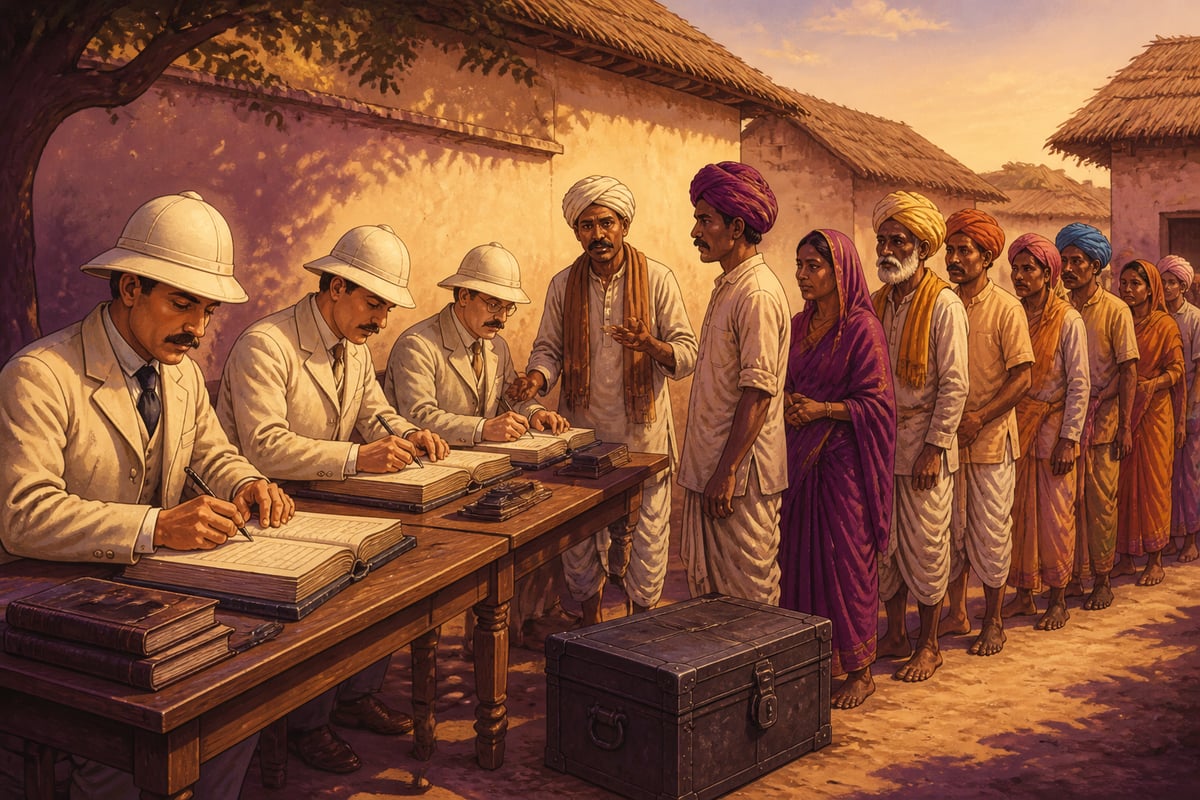
The British needed to classify India. Administrative control required categories. The first census in 1871 began asking Indians to identify their "caste." This seemingly neutral bureaucratic act set in motion the rigidification of an entire social structure.
Each decennial census forced millions of Indians into predetermined boxes. Census commissioners demanded that every Indian be assigned a single caste with a fixed rank. When Indians gave complex, contextual answers about their community affiliations, colonial administrators simplified them into neat hierarchical categories.
The census created three dynamics that had never existed before.
Competition for rank. Communities began petitioning census commissioners to be classified higher. Caste sabhas (associations) were formed specifically to lobby for reclassification. The census created the very caste consciousness it claimed to be merely recording.
Rigidification of boundaries. Categories that had been fluid became official government classifications. Once printed in census volumes and used for administrative purposes, these categories hardened. You were what the census said you were.
Pan-Indian hierarchy. For the first time, local jatis were slotted into a single national ranking system. The census created the "caste system" as a unified, hierarchical structure. This national hierarchy had never existed in pre-colonial India.
Step 2: Risley's Racial Theory (1901)
Herbert Hope Risley, Census Commissioner for the 1901 census, weaponized the classification process with racial pseudoscience. Risley had spent years measuring nasal indices (the ratio of nasal breadth to nasal height) across India. His theory was simple and catastrophic: Indian castes were racial groups. The higher the caste, the more "Aryan" the features.
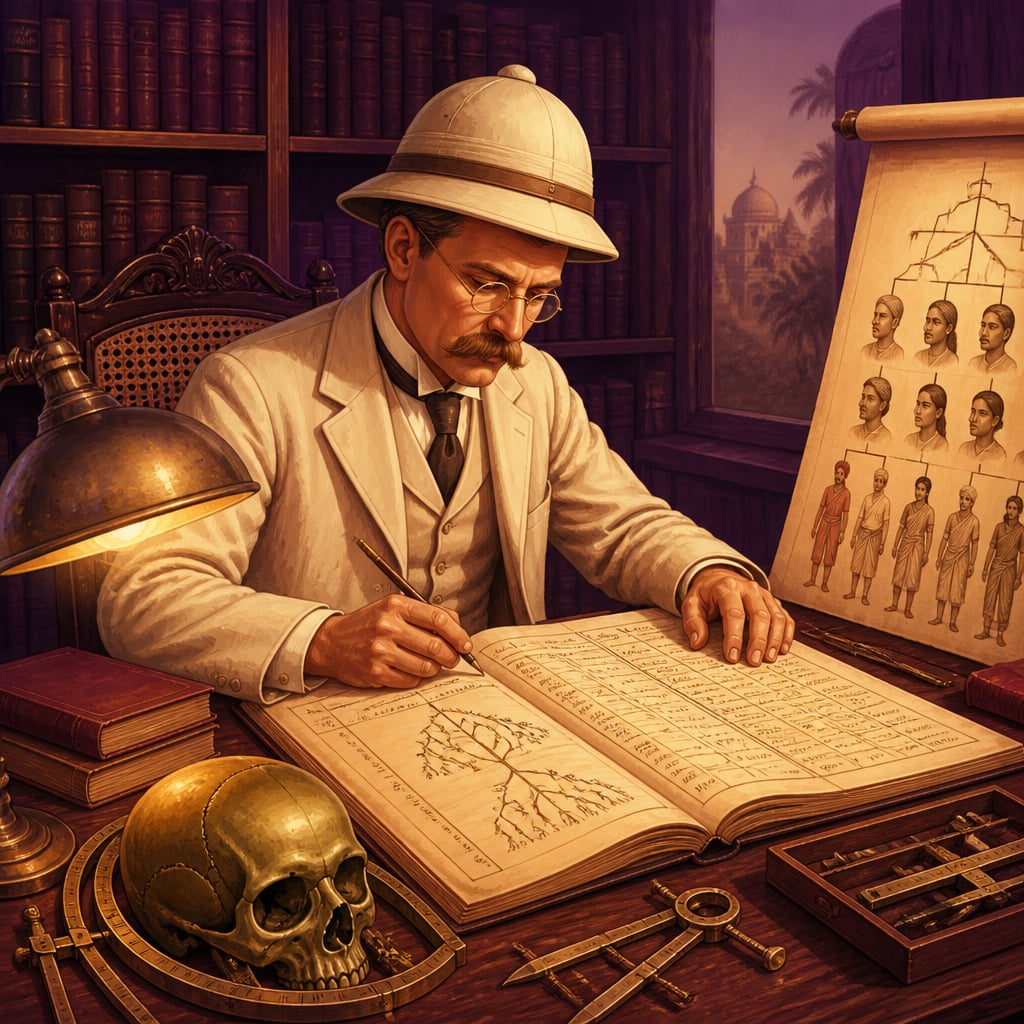
Risley explicitly connected this to the Aryan Invasion Theory: upper castes were descendants of Aryan invaders, lower castes were the conquered indigenous population. This racial framework did three things.
First, it made caste heritable and biological. If caste was race, it could never change. Social mobility was impossible by definition. Second, it aligned with European racial science. Indian social complexity was flattened into categories Europeans could understand: racial hierarchy. Third, it made the system appear natural. If caste was biological race, the British were merely documenting nature, not constructing a social order.
Risley's racial theory has been thoroughly discredited by modern genetics. Studies have shown that genetic mixing across Indian populations continued for thousands of years, with no clear racial boundaries between caste groups. But by the time science caught up, the categories were embedded in law.
Step 3: Legal Codification (1909-1950)
The census categories became legal architecture through a series of reforms. The Morley-Minto Reforms of 1909 established separate electorates for Muslims, creating the principle that identity groups deserve separate political representation. The Montagu-Chelmsford Reforms of 1919 extended communal representation, deepening identity-based politics. The Communal Award of 1932 proposed separate electorates for "Depressed Classes," making colonial caste categories into electoral constituencies. The Government of India Act of 1935 created the legal category "Scheduled Castes" with a specific list of 429 castes. For the first time, being classified as a particular caste carried legal rights and political representation.
The Indian Constitution of 1950 inherited and constitutionalized these colonial categories through the reservation system. Each step moved further from the fluid pre-colonial reality toward permanent, legally enforced caste identity. What began as an administrative census category became a constitutional category with material consequences for hundreds of millions of people.
The Pattern: Madras and the Manufacturing of Caste Politics
The most precise demonstration of how British census classifications manufactured caste politics occurred in the Madras Presidency between 1871 and 1937.
Before the census, Madras had a complex social landscape. Brahmins were a small minority (roughly 3% of the population) concentrated in temples, courts, and educational institutions. Other communities had their own social, economic, and cultural networks. Tensions existed, as they do in every society, but there was no unified "Non-Brahmin" political identity.
The census changed everything. When census operations classified the population by caste and published the results, two facts became visible simultaneously: Brahmins were numerically tiny, and they were disproportionately represented in colonial administration and modern education. This was not because of some ancient conspiracy. The British had recruited from communities already literate in English and familiar with administrative work. But the census made it look like systematic dominance.
The census created the category "Non-Brahmin" as a political identity. Before the census, a Mudaliar, a Nadar, a Chettiar, and a Vellalar had little in common politically. After the census, they were all "Non-Brahmins." A classification defined entirely by what it was not. This is colonial categorization at its most revealing: the British did not describe a pre-existing identity. They created a new one by drawing a line and putting everyone on one side.
In 1916, the Justice Party was founded explicitly as a "Non-Brahmin" political movement. Its founding document cited census data as evidence of "Brahmin domination." The party's demands were framed entirely in the categories the census had created. Census classifications had become political identities, and political identities had become electoral movements.
The Justice Party evolved into the Dravidian movement. E.V. Ramasamy (Periyar) took the census-created categories further, fusing anti-Brahmin politics with anti-Sanskrit and anti-North Indian sentiment, eventually building the demand for a separate "Dravida Nadu." Census categories, originally created by British administrators for colonial convenience, had generated a separatist political movement within four decades.
The pattern is identical to what happened in Rwanda (see Lesson 1.1). Colonial classification of fluid social categories created rigid identities. Rigid identities generated political competition. Political competition escalated into permanent faultlines. The engineers departed, but their categories remained, hardened into political infrastructure that outlived the empire.
Dharmic Wisdom: Guna-Karma, Not Janma
The Bhagavad Gita offers the most direct challenge to the colonial construction of caste as a birth-based, heritable hierarchy. Krishna declares: "Chaturvarnyam maya srishtam guna-karma-vibhagashah." The four-fold order was created according to qualities (guna) and actions (karma). Not birth. Not race. Not nasal index.
The dharmic framework recognizes that human beings have different aptitudes, inclinations, and contributions. It organizes these into four functional categories: those who teach and preserve knowledge (Brahmana), those who protect and govern (Kshatriya), those who produce and trade (Vaishya), and those who serve and support (Shudra). The framework describes function, not hierarchy fixed at birth.
The Mahabharata reinforces this through Yudhishthira's dialogue with the Yaksha at the enchanted lake. When asked "Who is a Brahmana?", Yudhishthira answers not with lineage but with conduct: truthfulness, charity, forgiveness, compassion, absence of cruelty, austerity, and meditation. Conduct, not birth, defines a person's place.
What Risley's racial theory did was replace guna-karma (quality-action) with janma (birth) as the sole determinant of social identity. The colonial framework took a dynamic, conduct-based system of social organization and froze it into a static, birth-based hierarchy that served administrative convenience. In doing so, it did not describe Indian civilization. It distorted it.
The tragedy is not just that the British imposed false categories. It is that generations of Indians have internalized these categories as if they were ancient and authentic. Decolonizing caste means recovering the dharmic understanding that social function flows from quality and action, not from census classification.
The Defense: Reclaiming the Narrative
Individual level: Know the history.
The single most powerful act of decolonization regarding caste is understanding its colonial construction. When someone says "caste system," ask: which caste system? The fluid jati system that allowed Chandragupta (born a Morya, possibly from a low-status community) to become emperor? The varna system described in the Gita as based on qualities and actions? Or the rigid, race-based, census-created hierarchy that H.H. Risley manufactured in 1901?
Knowing the difference changes every conversation about caste from "defending an ancient oppression" to "examining a colonial construction." This is not about denying that social discrimination existed in pre-colonial India. It did. Every civilization has social hierarchies. But the specific system called "the caste system" with its racial theory, rigid boundaries, heritable classifications, and pan-Indian hierarchy is substantially a colonial product.
Community level: Build identity beyond colonial categories.
The most effective counter to colonial caste categories is building community identity that transcends them. Temple-based social integration, shared festivals, inter-community economic cooperation, and educational institutions that teach civilizational history rather than caste history: all of these weaken the colonial framework.
The Bhakti traditions demonstrated this for centuries before the British arrived. Ravidas (a leather-worker), Kabir (a weaver), Andal (a woman), and Namdev (a tailor) did not deny social differences. They transcended them through shared spiritual practice. The Bhakti model of social reform worked because it offered a higher identity, devotion to the divine, that made caste identity secondary. Modern equivalents include organizations that bring people across jati lines together for shared civilizational purposes: environmental protection, educational access, healthcare, cultural preservation.
Institutional level: Challenge the framework, not just the outcomes.
Current discourse about caste operates entirely within the colonial framework. Both defenders and critics accept Risley's categories as authentic descriptions of Indian society. Both sides debate what to do about "the caste system" without questioning whether the system as described is itself a colonial construction.
The institutional challenge is to introduce the colonial construction thesis into academic, legal, and policy discourse. This means supporting scholarship that documents pre-colonial fluidity of jati, the role of census operations in creating rigid categories, and the legal codification that made temporary classifications permanent.
It also means engaging honestly with the reservation question. The reservation system is built on colonial categories. Dismantling those categories without providing alternative mechanisms for addressing genuine social disadvantage would harm the very communities the colonial system disadvantaged. The path forward requires developing new frameworks that address real disadvantage, whether economic, educational, or geographic, without reinforcing colonial classifications.
Epistemic level: Reclaim the vocabulary.
Language shapes thought. Every time we use the word "caste" (from the Portuguese "casta," meaning breed or race), we import colonial framing. The dharmic vocabulary of varna, jati, kula, and gotra carries different meanings, different assumptions, and different possibilities. Reclaiming this vocabulary is not linguistic purism. It is epistemic sovereignty. When we describe our own social structure in our own terms, we regain the ability to analyze it on our own terms rather than through the lens that Risley's racial science imposed.
Case studies
The Cisco Case: Colonial Categories in Silicon Valley
In 2020, California's Department of Fair Employment and Housing sued Cisco Systems alleging that an Indian-American engineer identified as Dalit had faced workplace discrimination from upper-caste Indian-American colleagues. The complaint alleged that after the employee's caste background was discovered through his college affiliation, he was isolated from projects, denied promotion opportunities, and subjected to professional retaliation. The case used the word 'caste' 49 times, importing a colonial British classification into American corporate jurisprudence without once questioning the category's origins.
The Arthashastra's concept of Bheda describes how divisions, once institutionalized, become self-perpetuating regardless of the original engineers' intentions. Risley's 1901 racial categories were designed for colonial administrative control, yet they traveled across oceans and centuries to shape workplace dynamics in a Silicon Valley technology company. The dharmic framework of guna-karma (quality-action) would evaluate individuals by their professional contributions, not by a census classification invented by a British bureaucrat measuring noses.
The case remained in litigation for years and catalyzed a wave of caste-related legislation across the United States. Seattle became the first US city to add 'caste' as a protected category in 2023. California's SB 403 passed both chambers before being vetoed by Governor Newsom. In each instance, the colonial British category was treated as an authentic description of Indian society rather than as a colonial construction.
Colonial classifications do not stay within their country of origin. Once rigidified into identity categories, they become globally portable instruments that shape law, policy, and social relations far beyond the empire that created them.
The Cisco case demonstrates that Risley's categories have outlived not just the British Raj but British India itself. The colonial construction of caste has become a global framework, now being codified into American law with the same uncritical acceptance that marked the original census operations.
Between 2020 and 2024, at least 7 US cities, states, and universities introduced caste-based anti-discrimination measures, all using the colonial British category 'caste' without acknowledging its constructed origins. The word 'caste' itself comes from the Portuguese 'casta' (breed/race), not from any Indian language.
Madras Presidency: From Census Category to Separatist Movement
Before the British census, the Madras Presidency had no unified 'Non-Brahmin' political identity. Mudaliars, Nadars, Chettiars, Vellalas, and dozens of other communities had distinct social and economic networks. When the census classified the population by caste and published the results, it simultaneously revealed that Brahmins (roughly 3% of the population) were disproportionately represented in colonial administration and English education. The census did not describe an existing political division. It created one. By 1916, the Justice Party was founded as an explicitly 'Non-Brahmin' movement, citing census statistics as its foundational evidence.
This follows the Arthashastra's five-step Bheda process with bureaucratic precision. The British identified jati as a social structure, amplified it through racial science, rigidified it through census classification, funded the division through separate administrative preferences, and provided the ideological framework (racial hierarchy) that made the categories feel permanent. The census did not record caste politics. It manufactured them.
The Justice Party evolved into the Self-Respect Movement under Periyar, which fused anti-Brahmin politics with anti-Sanskrit and anti-North Indian sentiment. By the 1940s, this had generated the demand for a separate 'Dravida Nadu.' Census categories created by British administrators for colonial convenience had produced a separatist political movement within four decades. The Dravidian parties that dominate Tamil Nadu politics today trace their origins directly to the political identities the census created.
Classification is not neutral observation. When a colonial power creates categories, publishes statistics, and embeds them in administration, it manufactures the very political identities it claims to be merely recording.
The Madras pattern is the clearest proof that census categories create political movements. Every demand for a modern caste census echoes the original British project: counting people by colonial categories, publishing the data, and watching as groups mobilize around the classifications.
Brahmins constituted roughly 3% of the Madras Presidency's population but held approximately 70% of university positions and government appointments under British administration. The census made this statistic visible, and the Justice Party was founded within 15 years of its publication.
The Government of India Act 1935: When a List Became a Constitution
In 1935, the British Parliament passed the Government of India Act, which for the first time created the legal category 'Scheduled Castes.' A specific list of 429 castes was compiled and appended to the Act as a 'Schedule,' hence the name. The list was assembled by British bureaucrats, primarily Census Commissioner J.H. Hutton, based on the census classifications that Risley's racial framework had established. Inclusion on the list carried concrete consequences: reserved seats in provincial legislatures and access to educational concessions. Being on or off the list became a matter of material survival.
The Arthashastra warns that Danda (coercive state power) shapes social reality. The 1935 Act demonstrated this principle. By attaching legal rights and political representation to census-created caste categories, the British transformed bureaucratic classifications into lived identities with material stakes. Once a category carries legal benefits, it becomes almost impossible to dissolve, because communities now have concrete incentives to maintain the classification.
The 'Schedule' of 429 castes, compiled by British officials using Risley's discredited racial framework, became the foundation of independent India's reservation system. The Indian Constitution adopted and expanded these categories. The colonial list, with modifications, continues to determine access to educational seats, government jobs, and political representation for over 200 million Indians in 2026.
Legal codification is the final step in the colonial construction of caste. Once fluid social categories are embedded in constitutional law with material benefits attached, they become permanent fixtures that no government can easily dismantle without harming the communities they were created to classify.
Every debate about expanding or modifying reservation categories operates within the framework that the 1935 Act established. The question is never 'should we use colonial categories?' but always 'which colonial categories should receive what benefits?' The framework itself remains unquestioned.
The original 1935 Schedule listed 429 castes. By 2026, the combined Scheduled Castes and Scheduled Tribes lists include over 1,200 communities covering approximately 25% of India's population. The colonial classification mechanism, far from being dismantled, has expanded.
Reflection
- When you think about your own community identity, how much of your understanding comes from the colonial 'caste' framework versus the dharmic concepts of jati, varna, kula, and gotra? In conversations about social identity, which vocabulary do you default to, and why?
- Why did the colonial census succeed in rigidifying India's social structure when centuries of invasion and political upheaval had failed to freeze it? What made bureaucratic classification more powerful than military conquest?
- If the colonial construction of caste has caused real suffering and created real disadvantage for specific communities, can we dismantle the colonial categories without abandoning the communities those categories were built to classify? How does the dharmic principle of guna-karma offer a path forward that neither reinforces colonial categories nor ignores their consequences?