The Captured Education System & Judicial Dimension
NCERT Narratives, JNU Pipeline, and Asymmetric Secularism
India's education system and judiciary perpetuate colonial knowledge frameworks through institutional inertia. From Wood's Despatch replacing gurukuls to NCERT textbook curation and asymmetric temple control laws, this lesson traces how external capture became internal condition.
See It Today: What Your Textbook Didn't Tell You
In 2023, NCERT revised its Class 12 political science textbook. Among the changes: a passage describing the 2002 Gujarat riots was shortened. Within days, newspaper editorials, TV debates, and social media campaigns erupted. "NCERT is rewriting history," declared headlines. "Saffronization of education," warned op-eds.
But here is the question almost nobody asked: who wrote the version being defended?
The textbooks that dominated NCERT from 2005 to 2017 were authored under the National Curriculum Framework (NCF) 2005, overseen by a specific set of academics. The NCF 2005 advisory group was chaired by Professor Krishna Kumar of Delhi University, and its social science subcommittee drew heavily from JNU's Centre for Historical Studies and School of Social Sciences. The history textbooks produced under this framework made specific editorial choices: Mughal architecture received extensive coverage while systematic temple destruction received a single qualifying sentence. The Vijayanagara Empire, which controlled most of peninsular India for over 300 years, received less space than the Delhi Sultanate. Aurangzeb's administrative innovations were highlighted; the reimposition of Jizya and documented temple demolition orders were contextualized as "political, not religious" acts.
These were not neutral choices. They were editorial decisions made by specific academics from specific institutions with specific intellectual commitments. When those textbooks were revised in 2023, the outrage assumed the earlier version was the "original" and the revision was the "distortion." But every textbook is a curation. The question is always: who curates, and with what intent?
This pattern, where one ideological capture of institutions is treated as the natural baseline and any correction is treated as politicization, is the architecture of institutional capture. It operates across India's education system, judiciary, and cultural institutions. And its roots go far deeper than 2005.
The Mechanism: The Education-Judiciary Capture Pipeline
Phase 1: The Colonial Administrative Blueprint
Chapter 3 traced how Macaulay's 1835 Minute on Education aimed to create "a class of persons Indian in blood and colour, but English in tastes, in opinions, in morals, and in intellect." What Chapter 3 did not cover is the administrative machinery that made this vision permanent.

In 1854, Sir Charles Wood, President of the Board of Control for India, issued what became known as Wood's Despatch. This was not merely a proposal for English education. It created an entire institutional framework: grants-in-aid that made government funding contingent on adopting English-medium instruction, a university system modeled on the University of London, and a graded school system designed to systematically replace indigenous education institutions.
Before Wood's Despatch, India had approximately 100,000 indigenous schools: pathshalas, tols, gurukuls, and madrasas serving communities through locally funded, locally controlled education. Dharampal's research, compiled in "The Beautiful Tree" (1983), documented this using British administrative records themselves. By 1882, the Hunter Commission found that indigenous schools had been decimated, not by prohibition but by economic strangulation. Government grants went exclusively to English-medium schools. Village communities that had funded pathshalas for generations redirected their resources to the government system to give their children economic opportunity under the new regime.
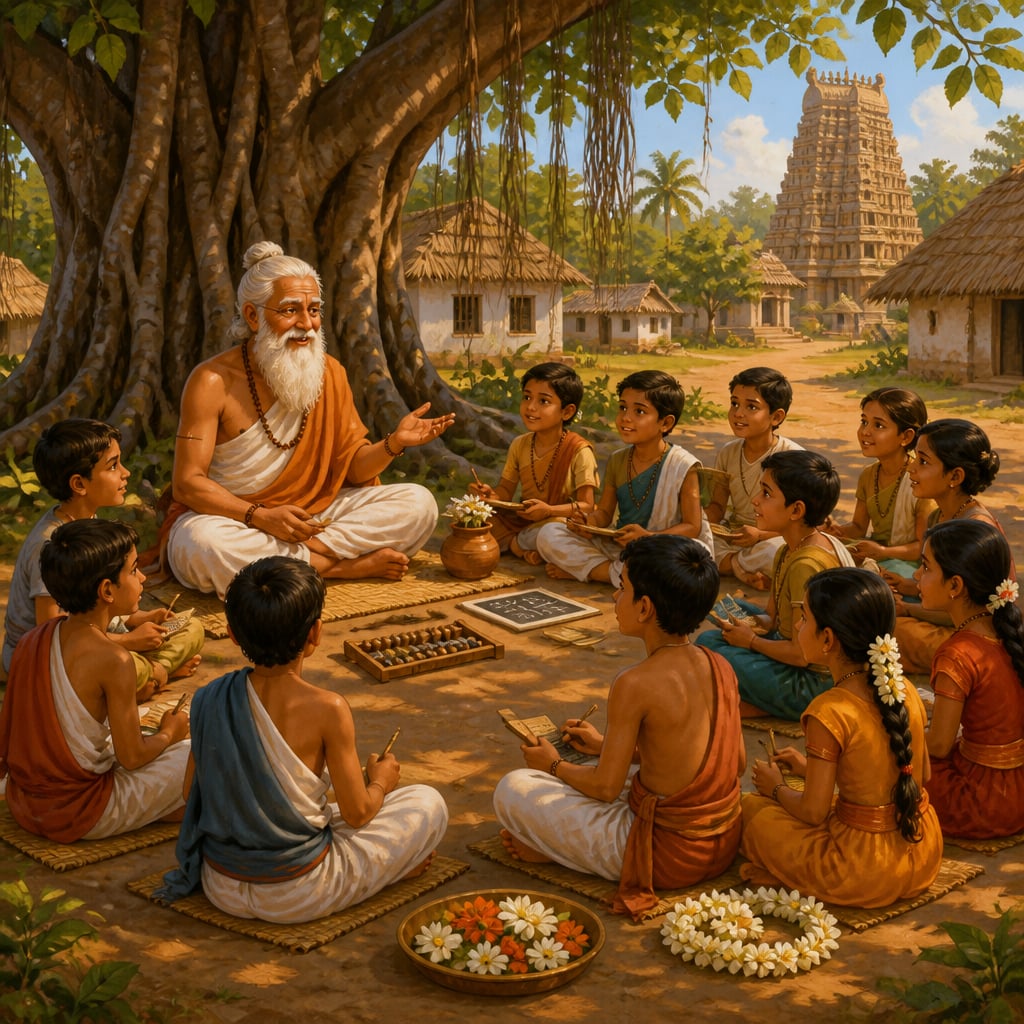
This is the critical mechanism: capture through incentive structure, not through force. Nobody banned the gurukul. The colonial administration simply made it economically irrelevant. The knowledge these institutions transmitted, Sanskrit literary traditions, mathematical sciences (ganita), astronomical calculations (jyotisha), philosophical logic (nyaya), medical sciences (ayurveda), did not disappear because it was proven wrong. It disappeared because it no longer led to employment under the colonial economy.
Phase 2: The Self-Perpetuating Academic Pipeline
When India became independent in 1947, the education system it inherited was Wood's system, not the indigenous system it had replaced. The first generation of Indian academics and administrators were themselves products of the colonial education pipeline. They did what any institutional ecosystem does: they reproduced themselves.
The university system that expanded after independence followed the colonial template. History departments adopted European historiographical methods. Social science departments adopted Western theoretical frameworks: Marxist analysis, subaltern studies, post-colonial theory, all developed in Western academic contexts and applied to Indian material.
The pipeline became self-sustaining through specific institutional nodes. JNU's Centre for Historical Studies, established in 1969, became arguably the most influential history department in India. Chapter 4 documented how Western academic institutions shaped the intellectual frameworks applied to India. The JNU pipeline is the domestic terminus of that same network: faculty trained in or intellectually aligned with Western Indology departments shaped NCERT textbooks, their graduates became professors at universities across the country, who trained the next generation of historians, who wrote the next round of textbooks, who provided expert commentary to media outlets. The Centre's intellectual orientation, broadly Marxist historiography with emphasis on material conditions and structural skepticism toward religious and civilizational narratives, became the default framework for "serious" academic history in India.
This is not an accusation of bad faith against any individual. It is a description of how institutional ecosystems function. An academic department produces PhD graduates who become professors elsewhere, who produce their own PhD graduates, who write textbooks, who shape public discourse. The pipeline is self-reinforcing. Whoever controls the training pipeline controls the intellectual output. Wood understood this principle in 1854. The pipeline he created still operates on the same logic.
The result is measurable. A 2019 analysis of NCERT history textbooks found that across Classes 6-12, approximately 60% of the medieval history content focused on Indo-Islamic political history, while the Chola maritime empire, the Maratha confederacy's administrative innovations, and the Ahom kingdom's 600-year resistance to Mughal expansion received a fraction of that space. Vijayanagara's sophisticated hydraulic engineering, urban planning, and economic systems were compressed into a few pages. The editorial pattern consistently foregrounded the political history of invading dynasties while compressing the history of civilizational continuity and resistance.
Phase 3: The Judicial Architecture of Asymmetry
Education captures what people know. The judiciary determines what people can do about it. When both operate within the same epistemological framework, institutional capture becomes structurally complete.

India's constitutional framework creates a documented asymmetry in how the state treats different religious institutions. Under Hindu Religious Endowments Acts passed by various state legislatures, government authorities control Hindu temples, including their finances, priest appointments, and property management. No equivalent legislation controls mosques, churches, gurudwaras, or other religious institutions. The Waqf Board manages Islamic religious properties autonomously. Church properties are managed by diocesan trusts. Only Hindu institutions are subject to direct state administrative control.
The scale is significant. In Tamil Nadu alone, the Hindu Religious and Charitable Endowments Department (HR&CE) administers approximately 44,000 temples. Government-appointed officials manage temple funds, decide on renovations, and control temple lands. Audit reports have documented temple lands being encroached upon, temple jewels going missing, and revenue from wealthy temples being redirected. The Tirumala Tirupati Devasthanams, which manages India's richest temple and collects over Rs 3,000 crore annually, operates under a government-appointed board.
The judiciary has consistently upheld this asymmetry. When challenged on the grounds that temple control violates Article 26 (freedom to manage religious affairs), courts have applied the "essential religious practices" doctrine. Under this framework, courts determine which practices are "essential" to a religion and which are merely "secular" or administrative functions that the state can regulate. This doctrine has been applied extensively to Hindu institutions. In the 2018 Sabarimala case, the Supreme Court used the essential religious practices test to override the centuries-old tradition restricting women of menstruating age from entering the temple, ruling it was not "essential" to Hindu worship. In contrast, when the question of women entering mosques reached courts, no equivalent essential practices test was applied to Islamic tradition. The doctrine functions as a one-way ratchet: it gives courts jurisdiction to override Hindu religious practices while leaving other religions' practices under the protection of their own institutional authorities. No court has attempted to define the "essential practices" of Islam or Christianity to justify equivalent state control of mosques or churches.
The Places of Worship (Special Provisions) Act of 1991 adds another structural layer. This Act freezes the religious character of every place of worship as it existed on August 15, 1947, with the single exception of the Ram Janmabhoomi-Babri Masjid dispute. The practical effect: temples destroyed during medieval invasions and converted into mosques or other structures cannot be legally reclaimed. The invasion-era status quo is treated as the legal baseline. The 2022 Gyanvapi mosque proceedings, where a court-ordered survey revealed structures consistent with Hindu temple architecture beneath the mosque, tested the boundaries of this Act. But the legal framework inherently privileges the post-invasion status quo over documented pre-invasion history.
This judicial architecture creates a system where Hindu religious institutions are state-controlled and their historical claims are legally frozen, while other religious institutions enjoy both autonomous management and legal protection of their current holdings. This is not a conspiracy. It is the documented outcome of specific laws, specific judicial doctrines, and specific institutional incentives. The proper term is asymmetric secularism: a framework that applies "secular" state control to one set of religious institutions while granting protective autonomy to all others.
The Pattern: From Pathshala to NCERT, a 170-Year Institutional Continuity
The thread connecting 1854 to the present is institutional reproduction. Wood's Despatch created the administrative framework. The university system reproduced the framework's intellectual assumptions. Post-independence expansion deepened the framework's reach. The judiciary protected the framework from structural challenge.
At each stage, the people operating within the system were not villains. They were products of the system doing what it trained them to do. A historian trained in Marxist historiography writes Marxist history. An administrator trained in colonial law administers colonial legal frameworks. A judge trained in English common law applies English judicial reasoning to questions about Indian religious practices.
The pattern is one of self-perpetuating institutional capture. The original colonial intention, to replace indigenous knowledge systems with European ones, succeeded not because of any ongoing conspiracy but because institutions reproduce themselves. The gurukul did not lose to the university because the university proved its intellectual superiority. It lost because Wood's economic framework made it irrelevant, and then the university system produced generations of graduates who had never experienced the alternative and therefore could not imagine restoring it.
This is why institutional capture persists long after the original captors have departed. The British left in 1947. Their educational, legal, and administrative frameworks stayed. The academics and administrators who inherited those frameworks did not need external direction. The system runs itself. Chapter 3 documented how colonialism planted the seeds. This lesson documents how those seeds grew into a self-sustaining ecosystem. The external attack became an internal condition.
Dharmic Wisdom: Vidya as the Root of Civilizational Continuity
The Arthashastra places Vidya (knowledge, education) as the absolute foundation of statecraft. Kautilya's statement that Vidya gives discipline, discipline gives competence, and competence gives prosperity is not merely pedagogical advice. It is a strategic observation: whoever controls Vidya controls the civilization's future trajectory.
In the dharmic tradition, the Acharya (teacher) held extraordinary authority precisely because education was understood as civilizational reproduction. The Guru-Shishya Parampara was not simply a teaching method. It was the mechanism by which a civilization transmitted its accumulated wisdom, values, and self-understanding across generations. The knowledge transmitted was not merely information. It was Samskara: the shaping of a person's fundamental orientation toward the world.
When Wood's Despatch replaced the Acharya with the government schoolteacher and the gurukul with the English-medium school, it did not merely change pedagogy. It severed the civilizational transmission mechanism. The new system transmitted British civilizational values, English literature, European history, Western scientific paradigms, while treating indigenous knowledge as antiquarian curiosity. Students learned about Newton but not Aryabhata. They studied Locke but not Kautilya. They read Shakespeare but not Kalidasa.
The Bhagavad Gita's teaching on Avidya (ignorance of one's true nature) takes institutional meaning here. A civilization taught to see its own history through foreign analytical frameworks, to dismiss its own knowledge systems as pre-scientific mythology, to feel cultural inferiority about its own intellectual heritage, is a civilization suffering from institutionalized Avidya. The cure is not counter-propaganda or ideological capture in the opposite direction. It is the restoration of genuine Vidya: the capacity to understand oneself through one's own epistemological traditions while engaging honestly with the knowledge of others.
The Defense: Reclaiming the Civilizational Transmission Mechanism
Diagnosing capture without a recovery plan is intellectual entertainment. Three fronts require sustained action.
Education: Build parallel systems while reforming existing ones. The National Education Policy (NEP) 2020 represents the first structural attempt to decolonize Indian education since independence. Its emphasis on mother-tongue instruction, integration of Indian Knowledge Systems (IKS), multidisciplinary education, and flexibility in learning paths directly challenges Wood's framework. But policy documents do not teach children. The textbooks, teacher training programs, and university curricula that operationalize NEP will determine whether it transforms or merely renames the existing system. Citizens can engage with state-level education boards, participate in textbook review processes, and support educational institutions that genuinely integrate indigenous knowledge systems rather than offering them as decorative additions.
Judiciary: Demand constitutional symmetry. The temple control asymmetry persists because it has not been comprehensively challenged as a constitutional violation. The "Free Hindu Temples" movement, active across multiple states, seeks legislation based on a simple principle: all religious institutions should enjoy equal autonomy under Article 26. Supporting legal challenges to asymmetric religious institution control, engaging with legislative representatives, and building public awareness of the documented asymmetry are concrete steps toward institutional correction.
Knowledge: Become a civilizational transmission node. Institutional reform takes decades. Individual action begins today. Every person who learns Sanskrit, studies the Arthashastra or Thirukkural, practices classical arts, visits and financially supports temples, teaches their children civilizational history alongside school history, or creates digital content that transmits dharmic knowledge becomes a node in a distributed civilizational transmission network. Wood's system concentrated knowledge transmission in government institutions that could be captured. The defense is to distribute transmission across millions of individual and community nodes that no single institution can control. The institutions were captured over 170 years. They will not be liberated in a single electoral cycle. But the civilizational immune system activates one informed individual at a time.
Case studies
Wood's Despatch: The Administrative Kill-Switch for Indigenous Education (1854)
In 1854, Sir Charles Wood issued the Education Despatch, the most consequential administrative order in the history of Indian education. Before Wood's Despatch, India had approximately 100,000 indigenous schools: pathshalas, tols, gurukuls, and madrasas, documented by Dharampal using British survey records from the 1820s-30s. These institutions were locally funded, locally controlled, and transmitted knowledge systems spanning mathematics, astronomy, logic, medicine, and literary traditions. Wood's Despatch did not ban these schools. It created a grants-in-aid system that funneled all government education funding exclusively to English-medium institutions modeled on the University of London. Indigenous schools were not prohibited. They were economically strangled. By 1882, the Hunter Commission documented that indigenous education had been decimated. Communities redirected funding to the government system because it was the only path to employment under colonial administration.
Kautilya's Arthashastra identifies Vidya as the root of the entire civilizational chain: knowledge produces discipline, discipline yields competence, competence generates wealth, wealth enables dharma, and dharma sustains well-being. Wood's Despatch targeted this root with surgical precision. By controlling the economic incentive structure around education, the British captured the civilizational transmission mechanism without firing a shot. This is Bheda (division) applied not to communities but to a civilization and its knowledge base. The Arthashastra also warns that the most effective attacks are those the target does not recognize as attacks. Nobody experienced Wood's system as an attack on Indian knowledge. They experienced it as an opportunity for employment.
Within three decades, India's indigenous education ecosystem was functionally extinct. The knowledge systems these institutions transmitted did not die because they were disproven. They died because they no longer led to economic opportunity. The university system that replaced them produced generations of administrators, lawyers, and teachers trained in European frameworks, who then reproduced the system without needing external direction. The colonial education pipeline became self-sustaining.
The most durable form of civilizational capture operates through economic incentive structures, not force. When employment depends on adopting the colonizer's knowledge system, the colonized population will abandon its own traditions voluntarily. Reversing this requires building economic value around indigenous knowledge, not merely defending it ideologically.
NEP 2020's integration of Indian Knowledge Systems faces the same structural challenge Wood exploited: unless indigenous knowledge leads to tangible economic opportunity (employment, research funding, professional recognition), it will remain a cultural ornament rather than a living system. The mechanism of capture through incentive structure remains active.
Dharampal's research documented that in the Madras Presidency alone, a British survey in 1822-25 found 11,575 indigenous schools and 1,094 colleges. By 1882, the Hunter Commission recorded that most had disappeared, replaced by fewer than 3,000 government-aided English-medium institutions serving the same region.
NCERT Textbook Wars: Who Curates the Nation's Memory? (2004-2023)
In 2004, the newly elected UPA government ordered a comprehensive revision of NCERT textbooks under the National Curriculum Framework (NCF) 2005. The advisory group, chaired by Professor Krishna Kumar of Delhi University, drew heavily from JNU's Centre for Historical Studies. The resulting textbooks made specific editorial choices that shaped how an entire generation understood Indian history. Mughal architectural achievements received extensive treatment. The Vijayanagara Empire, which ruled most of peninsular India for over 300 years, received significantly less coverage than the Delhi Sultanate. Aurangzeb's reimposition of the Jizya tax and documented temple demolition campaigns were framed as 'political acts' rather than religious persecution. The Chola maritime empire's trade networks spanning Southeast Asia, the Maratha confederacy's administrative innovations, and the Ahom kingdom's 600-year resistance to Mughal expansion were compressed into brief mentions. When the post-2014 government attempted revisions in 2017-2023, including shortening passages on the 2002 Gujarat riots and restoring coverage of certain Hindu contributions, the revisions were widely condemned as 'saffronization' while the 2005 framework was defended as the neutral baseline.
The Arthashastra's concept of Kutayuddha (covert warfare) applies directly: the most effective capture is one the target does not recognize as capture. By establishing the 2005 editorial framework as the 'neutral default,' the captured institution made any correction appear as politicization. This is epistemological Bheda: not dividing communities, but dividing a civilization from its own historical memory. Chanakya Niti's warning about the liquor vessel applies. Water placed in a colonial-framework vessel absorbs the vessel's character. Indian history written through Marxist historiographical methods carries the epistemological assumptions of that framework regardless of the Indian names on the author list.
A generation of Indians educated between 2005 and 2017 absorbed a curated version of their own history that systematically foregrounded invading dynasties while compressing civilizational continuity and resistance. The textbook framework also influenced state boards that adopted NCERT templates. The pipeline extended from JNU faculty to NCERT committees to state education boards to classroom teaching, creating a self-reinforcing narrative ecosystem.
Textbooks are not neutral records of history. They are curated narratives that shape civilizational self-understanding. Whoever controls the editorial committee controls what a generation believes about itself. The defense requires not counter-propaganda but transparent, evidence-based curation with diverse academic perspectives.
The NCF 2023 revision process is currently underway. Whether it produces genuinely balanced history or merely replaces one ideological capture with another depends on the transparency and intellectual diversity of the committees producing the content. Citizens can engage by reviewing draft curricula and providing feedback through public consultation processes.
A 2019 content analysis of NCERT history textbooks across Classes 6-12 found that approximately 60% of medieval history content focused on Indo-Islamic political history, while Hindu kingdoms that controlled larger territories for longer periods received a fraction of the coverage.
Tamil Nadu HR&CE: 44,000 Temples Under State Control
Tamil Nadu's Hindu Religious and Charitable Endowments Department (HR&CE) administers approximately 44,000 Hindu temples across the state. Government-appointed officials, often non-Hindu bureaucrats, manage temple finances, decide on renovations, appoint priests, and control temple lands. CAG audit reports and RTI responses have documented systematic issues: temple lands encroached upon without legal consequence, temple jewelry inventories with unexplained discrepancies, and revenue from wealthy temples redirected to state treasuries rather than temple maintenance. Smaller temples under HR&CE administration have fallen into disrepair, with crumbling structures, broken idols, and suspended daily rituals. Meanwhile, mosques in Tamil Nadu operate under autonomous Waqf Board management, and churches are managed by independent diocesan trusts. No equivalent government department administers non-Hindu religious institutions. The Tirumala Tirupati Devasthanams (TTD), India's richest temple institution collecting over Rs 3,000 crore annually, operates under a government-appointed board in neighboring Andhra Pradesh, following the same model.
The Arthashastra prescribes that the state must protect religious institutions, not capture them. Kautilya explicitly lists Devasthana (temple) protection as a core function of governance. The current system inverts this: the state does not protect temples but administers them as revenue-generating assets. The Mahabharata's concept of Rajadharma (the duty of the ruler to protect the people's dharmic institutions) is violated when the state controls the finances of one religion's institutions while granting full autonomy to others. This is not secularism. It is the documented, structural opposite of equal treatment.
Temples that historically functioned as civilizational institutions offering education, arts patronage, community welfare, and economic activity have been reduced to government-administered 'places of worship' with their broader civilizational functions stripped away. The 'Free Hindu Temples' movement has gained momentum across multiple states, filing legal challenges and seeking legislative reform. Some progress has occurred: courts in several states have returned specific temples to community management, but the systemic framework of state control remains intact.
Asymmetric institutional treatment creates a structural faultline that no amount of 'secularism' rhetoric can conceal. When one religion's institutions are state-controlled while others enjoy autonomous management, the system produces documented inequality regardless of intent.
The Uttarakhand Char Dham Devasthanam Board, created in 2019 to bring 51 temples under state control, was dissolved in 2021 after massive public opposition, demonstrating that organized civic engagement can reverse temple capture. The Tamil Nadu model remains the primary battleground for the broader temple liberation movement.
Of the approximately 44,000 temples under Tamil Nadu HR&CE control, fewer than 10% receive adequate maintenance funding from the department. The remaining 90%+ suffer from structural neglect while their lands and endowments are administered by the same department that fails to maintain them.
Reflection
- Think about your own school and college education. What did you learn about the Vijayanagara Empire, the Chola maritime networks, or Aryabhata's mathematics compared to what you learned about the Mughals, British industrial revolution, or Newton? What does that ratio tell you about which civilizational framework shaped your textbooks?
- The lesson argues that institutions reproduce themselves without needing external direction. If this is true, can institutional capture ever be fully reversed through policy reform alone, or does it require building entirely new institutions outside the captured system?
- The judiciary applies the 'essential religious practices' doctrine to determine which Hindu practices the state can regulate, but has never applied the same test to mosques or churches. Is asymmetric application of a legal doctrine a form of institutional bias, or is it a natural consequence of Hinduism's decentralized structure making it more susceptible to state intervention?