Temple Decline & Cultural Erosion
Temples Reduced from Civilizational Institutions to Places of Worship
Indian temples were never just places of worship. They were universities, banks, performing arts academies, and welfare systems rolled into one. Colonial legal frameworks redefined them as 'religious property,' post-independence governments inherited and expanded that control, and the civilizational functions that made temples irreplaceable have been quietly, systematically hollowed out. This lesson traces how institutional capture, art severance, and tradition erosion work as a connected pattern of cultural decline.
See It Today: A Balance Sheet Nobody Reads
In 2020-21, the Tirumala Tirupati Devasthanams (TTD) reported an annual income exceeding Rs 3,100 crore. That makes it one of the wealthiest religious institutions on the planet. It runs hospitals, publishes books, and feeds nearly 100,000 pilgrims daily through its anna prasadam program.
Now consider this: TTD's board of trustees is appointed by the Andhra Pradesh state government. The executive officer is an IAS bureaucrat. In 2021, questions were raised in public forums when board members who were reportedly not Hindu were appointed to oversee the temple's administration. The temple that houses Lord Venkateswara, arguably the most visited pilgrimage site in the world, is managed not by its devotee community but by a rotating cast of political appointees.
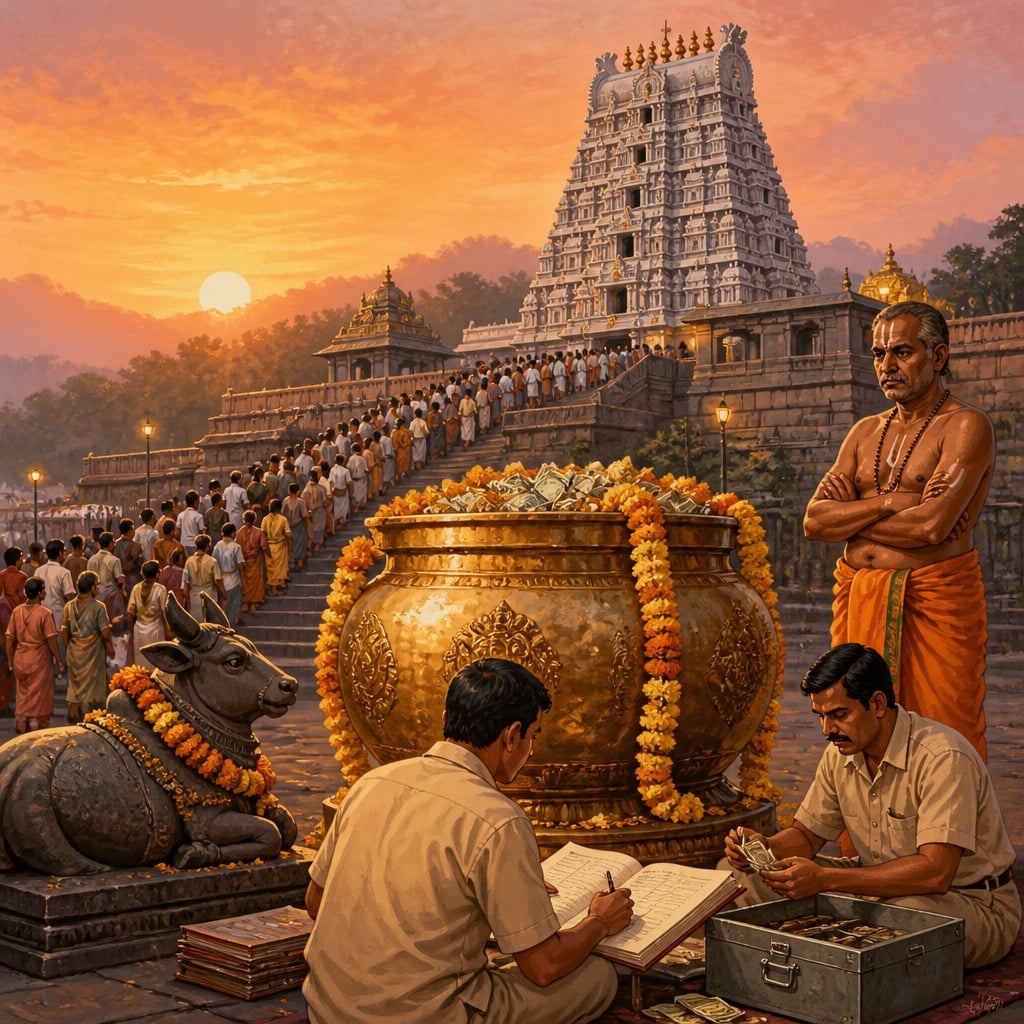
This arrangement would be extraordinary in any other context. Imagine the Vatican administered by the Italian civil service, or the Masjid al-Haram in Mecca managed by bureaucrats appointed by the Saudi tourism ministry. The comparison sounds absurd. But for Hindu temples in India, this is simply the status quo.
How did temples, once the central institutions of Indian civilization, become government-managed properties? And what was lost in that transformation?
The Mechanism: From Civilizational Hub to "Place of Worship"
To understand what happened, you first need to understand what temples were. The modern English word "temple" maps poorly onto the Sanskrit concept of a devasthana or kshetra. In contemporary usage, "temple" means a place where people go to pray. A house of worship.
Historically, an Indian temple was something far more expansive. It was simultaneously an educational institution (the temple school or pathashala), an economic engine (owning and managing agricultural land, funding local commerce), a center of arts and performance (where dance, music, sculpture, and literature were practiced and preserved), a social welfare body (feeding the poor, maintaining water systems, running hospitals), and a repository of astronomical, mathematical, and philosophical knowledge.
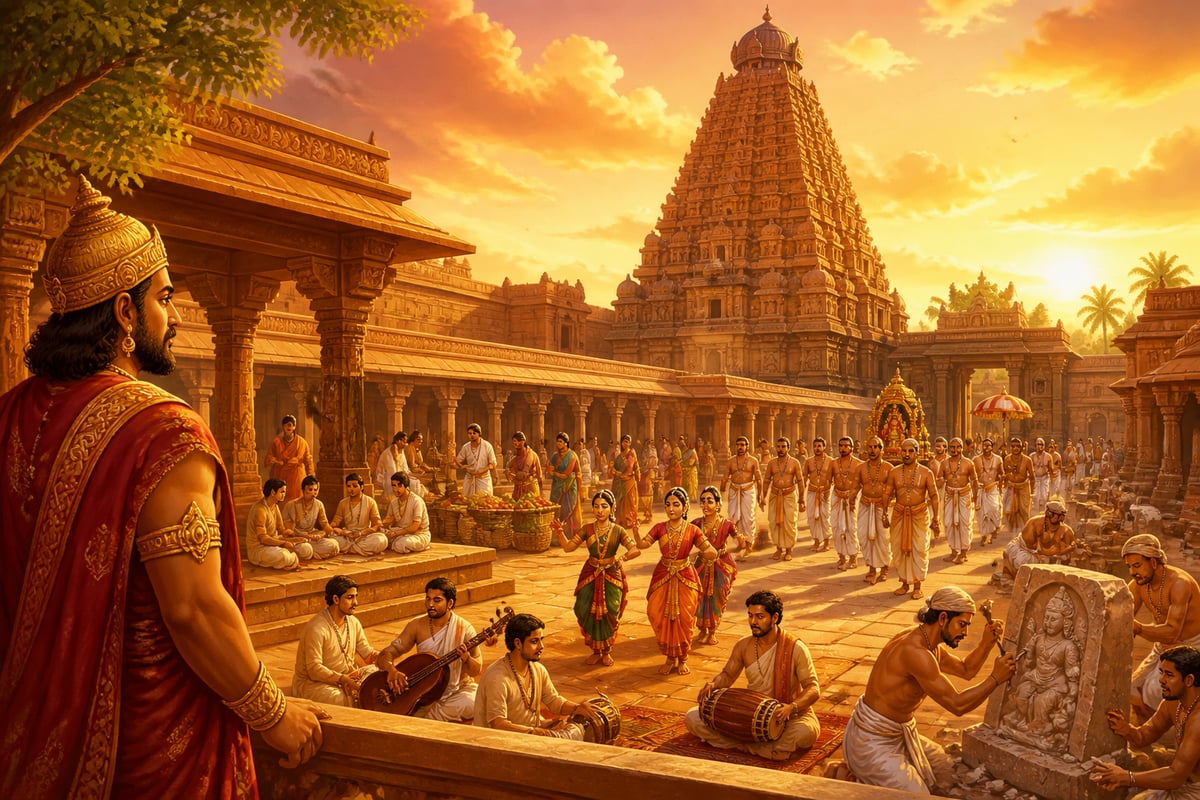
The Brihadeeswarar Temple in Thanjavur, built by Raja Raja Chola in 1010 CE, was not merely a place to worship Shiva. It was an institution that employed hundreds of dancers, musicians, teachers, and scholars. It held land grants that funded an entire regional economy. It was, in modern terms, a university, a bank, a performing arts academy, and a welfare state in a single institution.
Reducing this to a "place of worship" is not a neutral act of translation. It is a civilizational redefinition.
Phase 1: Colonial Extraction and Redefinition (1800s-1947)
The British East India Company initially managed Hindu temples directly, collecting revenue from temple lands. The Madras Regulation VII of 1817 gave the colonial government explicit control over temple properties and funds. The stated purpose was to prevent "mismanagement." The practical effect was revenue extraction.
When Christian missionary groups protested that the British government was entangled with "heathen" institutions, the colonial administration shifted strategy. Rather than relinquishing control, they reframed the relationship. The Religious Endowments Act of 1863 created a framework that separated temple "religion" from temple "property." Religion was left to the priests. Property, land, and revenue fell under government administration.
This legal architecture rested on a specific assumption: that a temple's essential function was worship, and everything else (education, economy, arts, welfare) was incidental. That assumption was imported wholesale from the Protestant Christian framework, where a church is primarily a place of congregational worship and property is managed separately.
The Chidambaram Nataraja Temple offers a telling example. The Dikshitars, a community of Shaiva Brahmins, had managed the temple for centuries under a hereditary system. Colonial courts repeatedly intervened in their administration. The legal battles over Chidambaram continued well past independence, with the state government attempting to bring it under the Hindu Religious and Charitable Endowments (HR&CE) Department. The Dikshitars argued, with considerable historical evidence, that their stewardship was integral to the temple's ritual and institutional identity. The state argued that temples are public property requiring government oversight.
The underlying tension was never resolved. It was simply decided in favor of the state.
Phase 2: Post-Independence Institutionalization (1947-1990s)
Independent India did not dismantle the colonial framework. It expanded it.
The Hindu Religious and Charitable Endowments Acts, passed by various state governments (Tamil Nadu in 1951, Andhra Pradesh in 1966, Karnataka and Kerala following), gave state governments sweeping powers over Hindu temples. These acts allowed the government to appoint administrators, manage temple finances, take over temple lands, and redirect temple revenue.
The constitutional basis was Articles 25 and 26, which guarantee freedom of religion but also allow the state to regulate "economic, financial, political, or other secular activity which may be associated with religious practice." Since temple economy, education, and arts had already been classified as "secular" activities by colonial-era law, the state had legal grounds to control them.
Here is where the numbers become important. According to various reports and RTI responses over the years, the Tamil Nadu HR&CE Department controls over 36,000 temples. Revenue from these temples flows into government accounts. A significant portion is reportedly used for purposes unrelated to the temples that generated it. In contrast, churches and mosques in India operate under the management of their own communities, with no equivalent government oversight body.
This asymmetry is not hidden. It is simply rarely examined in public discourse.
The TTD case makes the scale visible. TTD's hundi collections (devotee offerings) run into hundreds of crores annually. The temple owns gold deposits, land, and financial assets that make it wealthier than many listed corporations. Yet every rupee is managed under government authority. Periodically, controversies surface: temple lands allegedly sold below market value, funds reportedly diverted to non-temple purposes, gold reserves questioned. Whether each specific allegation is fully substantiated is beside the point. The structural vulnerability is the point. An institution generating thousands of crores in community offerings is governed by political appointees with no accountability to the devotee community.
Phase 3: The Current Condition (2000s-Present)
The consequences of this seven-decade arrangement are now visible across multiple domains.
Temple infrastructure across India tells its own story. While major pilgrimage sites like Tirupati and Vaishno Devi receive attention (and generate revenue), tens of thousands of smaller temples under HR&CE control have fallen into disrepair. A 2012 CAG audit of Tamil Nadu's HR&CE found significant irregularities in property management and financial record-keeping. Temple lands had been encroached upon or leased out at nominal rates. Hereditary priests in many temples receive monthly stipends so low that they cannot sustain their families, let alone maintain the ritual traditions they were trained in.
Meanwhile, the knowledge systems these temples once sustained are eroding rapidly. Agama shastra, the body of literature governing temple rituals, architecture, and iconography, is known fully by a shrinking number of practitioners. The oral traditions of temple priests, passed through guru-shishya parampara, require years of dedicated study. When the priest's son becomes a software engineer in Bengaluru because temple service cannot feed his family, that chain of transmission breaks. It does not merely pause. It ends.
The Pattern: Three Faces of Cultural Erosion
TTD Tirupati illustrates institutional capture. The wealthiest Hindu temple in the world cannot appoint its own governing body. Its devotees, who collectively contribute thousands of crores, have no formal mechanism to influence how that money is spent. The institution functions. The autonomy does not exist.
The Devadasi Tradition and Bharatanatyam illustrates the severance of art from sacred context. The Devadasi system, as practiced in temples across South India, involved women dedicated to temple service who were trained from childhood in music, dance, and ritual. The system had genuine problems: exploitation, lack of consent, social stigma. The Madras Devadasis (Prevention of Dedication) Act of 1947 sought to address these problems by abolishing the practice entirely.
What happened next is instructive. The dance form itself was "rescued" by reformers, most notably Rukmini Devi Arundale, who renamed it Bharatanatyam and presented it on the secular stage. The art survived. The sacred context did not. Temple dance had been an offering, inseparable from specific rituals, specific deities, specific times of day. Bharatanatyam, as reconstituted, became a performing art. Beautiful, technically rigorous, and detached from the devotional ecosystem that created it.
The women who had been the living repositories of this tradition were pushed to society's margins. Their knowledge was extracted, sanitized, and repackaged. The reformers received the acclaim. This is not a polemical interpretation. Dance historian Davesh Soneji's work, "Unfinished Gestures" (2012), documents this process in careful detail.
The pattern repeats with other temple arts. Carnatic music, Odissi dance, bronze sculpture traditions in Swamimalai. Each has survived as an art form. Each has been progressively disconnected from the institutional ecosystem that sustained it.
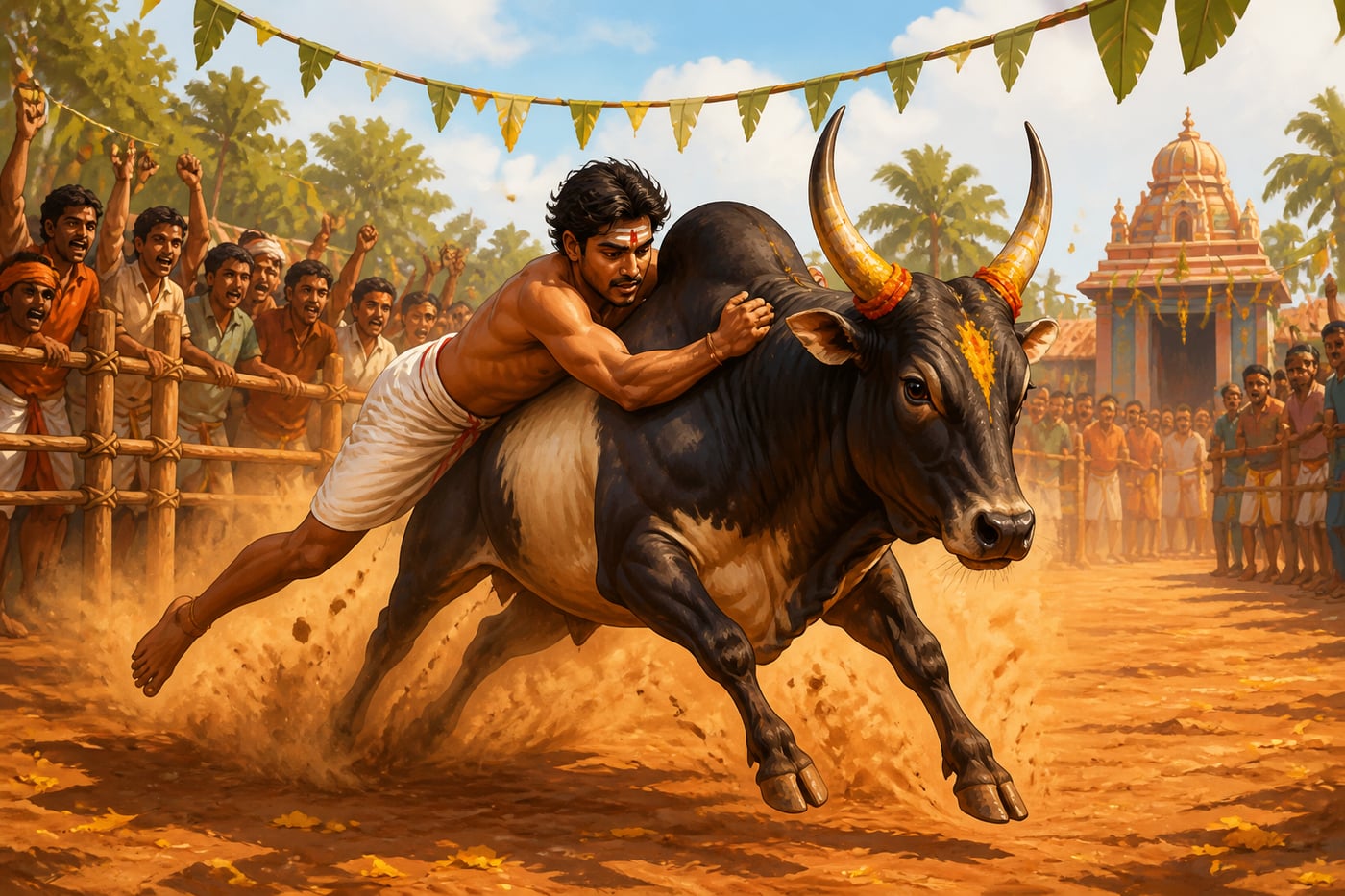
Jallikattu illustrates the vulnerability of living traditions to external intervention. In 2014, the Supreme Court of India banned jallikattu, the Tamil bull-taming sport, following a campaign led by PETA India and the Animal Welfare Board. The ban triggered massive protests in January 2017, with millions gathering at Marina Beach in Chennai in what became one of the largest peaceful demonstrations in Indian history.
The protesters' argument was not merely cultural nostalgia. Jallikattu is integral to the native cattle breeding ecosystem. Bulls that perform well in jallikattu are preferred for breeding, which maintains the genetic diversity of indigenous breeds like Kangayam and Pulikulam. The ban, protesters argued, would accelerate the replacement of native breeds with foreign commercial breeds, undermining the entire rural agricultural system.
What makes the case significant for pattern recognition is the funding trail. PETA India's campaigns were backed by international donors. The Animal Welfare Board's composition and positions during this period drew scrutiny. A tradition practiced for over 2,000 years was nearly ended by organizations whose institutional base, funding, and ideological framework were entirely foreign to the community practicing it.
The Tamil Nadu government eventually passed a state amendment to permit jallikattu. The tradition survived. But the episode revealed how easily a living practice with deep civilizational roots could be targeted by well-funded campaigns deploying universalist frameworks ("animal rights") that were structurally incapable of recognizing context-specific meaning.
Dharmic Wisdom: Kshetra as Living Organism
The Agama texts describe a temple not as a building but as a living body. The garbhagriha (sanctum) is the heart. The gopuram (tower) is the crown. The prakarams (enclosures) are the limbs. The rituals performed at specific times are the breath. The arts practiced within its walls are its voice. The community it sustains is its lifeblood.
This is not metaphor. It is an architectural and ritual philosophy. Every element is connected. Remove the education, and the ritual knowledge fades. Remove the economic base, and the priests cannot sustain themselves. Remove the arts, and the temple loses its cultural magnetism. Remove community governance, and the institution loses its responsiveness to the community it serves.
The concept of kshaya (civilizational decay) appears across dharmic literature. The Mahabharata's description of Kali Yuga is not a prophecy of inevitable doom. It is a diagnostic framework. It describes specific symptoms: when institutions lose their purpose, when rituals become empty performance, when knowledge is held by those who do not understand it, when wealth flows away from those who generate it. These are not mystical predictions. They are structural observations about how civilizations erode.
What makes the temple decline particularly significant is that temples were the integration points. They held together education, economy, arts, governance, and spiritual practice in a single institutional framework. No other Indian institution performed this function. When the temple was reduced to a "place of worship," it was not one function that was lost. It was the connective tissue between all of them.
The Stakes: What Is Actually Being Lost
The common framing of temple decline focuses on religious sentiment. "Hindus should be allowed to manage their temples." This framing, while valid, understates the problem.
What is at stake is not merely religious freedom. It is civilizational infrastructure. Every temple that loses its pathashala is a node of traditional education that disappears. Every temple whose lands are diverted loses the economic independence that allows it to function as a welfare institution. Every priest who cannot feed his family from temple service is a break in a knowledge transmission chain that may be centuries old. Every festival that becomes a commercial event without ritual grounding is a community gathering that has lost its organizing principle.
The question is not whether Indians still visit temples. They do, in extraordinary numbers. The question is whether the institution called "temple" in 2026 bears any functional resemblance to the institution that shaped Indian civilization for two millennia.
The diagnosis, when assembled, is straightforward. Colonial legal frameworks redefined temples as properties. Post-independence governments inherited and expanded that control. Revenue flows out. Knowledge erodes. Arts survive in disconnected forms. Community governance does not exist. And the civilizational functions that made temples irreplaceable have been quietly, systematically hollowed out.
The building stands. The deity is worshipped. The institution, in its fullest sense, is a shadow of what it was built to be.
Case studies
TTD Tirupati: The World's Richest Temple Under Government Control
The Tirumala Tirupati Devasthanams (TTD) manages the Sri Venkateswara Temple, the most visited pilgrimage site in the world, with annual revenue exceeding Rs 3,100 crore. Its hundi collections alone run into hundreds of crores. The temple owns gold deposits worth thousands of crores, extensive land holdings, and financial assets that rival listed corporations. Yet TTD's governing board is appointed by the Andhra Pradesh state government. The executive officer is an IAS bureaucrat on deputation. In 2021, public controversy erupted when board members who were reportedly not Hindu were appointed. Temple lands have periodically been sold or leased at below-market rates, and allegations of revenue diversion to non-temple purposes have surfaced repeatedly. The devotees who collectively fund the institution have no formal governance voice.
Kautilya's Arthashastra establishes that institutional resources must serve the community that generates them. The principle 'praja-sukhe sukham rajnah' (the king's welfare lies in the people's welfare) means that temple governance must answer to devotees, not to political appointees. The current model inverts this: wealth flows from community to institution to government, with no accountability loop returning to the source. In traditional temple governance, the community that sustained the temple also governed it, whether through hereditary trusteeship, merchant guild patronage, or royal protection that came with contractual obligations.
TTD continues to function as a pilgrimage site, but its civilizational functions have been progressively hollowed out. The temple's vast resources are managed by officials who rotate through postings every few years, with no deep institutional knowledge or long-term accountability. Multiple RTI requests and legal petitions have documented irregularities in land management and fund allocation. The devotee community's only recourse is public protest or litigation, not institutional governance.
When an institution's governance structure is disconnected from its sustaining community, the institution may continue to operate but loses its civilizational purpose. TTD shows that wealth and visitor numbers can coexist with institutional capture. The building stands. The autonomy does not.
TTD represents the structural template replicated across India: government control of Hindu temple finances with no equivalent mechanism for mosques, churches, or gurudwaras. The asymmetry is not merely legal but civilizational. It means one tradition's institutional infrastructure is uniquely vulnerable to political extraction.
TTD's annual revenue exceeds Rs 3,100 crore, making it wealthier than many listed Indian corporations, yet its devotees have zero formal governance rights over how this money is spent.
From Devadasi to Bharatanatyam: When 'Reform' Severs Sacred Art
The Devadasi system in South Indian temples involved women dedicated to temple service, trained from childhood in music, dance, and ritual. The system carried genuine problems: exploitation, lack of consent, and social stigma that worsened under colonial-era moral reformism. In 1947, Dr. Muthulakshmi Reddi's Madras Devadasis (Prevention of Dedication) Act abolished the practice entirely. In the decades preceding and following, Rukmini Devi Arundale and E. Krishna Iyer 'rescued' the dance component by renaming it Bharatanatyam and presenting it on secular stages. The art form was sanitized, aestheticized, and separated from its temple context. The women who had been the living repositories of the tradition were pushed to society's margins.
The Agama tradition treats temple arts as integral to the temple's living body, not as detachable 'cultural products.' Dance was an offering (naivedya of movement) performed at specific ritual times for specific deities. Carnatic music accompanied specific pujas. Bronze sculpture followed Agamic specifications for each deity. Severing these arts from their temple context is analogous to removing organs from a living body: each organ may be preserved in isolation, but the organism dies. The parampara that carried this knowledge was not merely an educational method. It was the knowledge itself, embodied in living practitioners.
Bharatanatyam thrives today as a globally celebrated performing art. It fills auditoriums and wins awards. But the temple dance ecosystem is extinct. The nadaswaram accompaniment, the ritual calendar that governed which pieces were performed when, the theological content embedded in specific compositions, the community of women who held this knowledge: all gone. Dance historian Davesh Soneji's 'Unfinished Gestures' (2012) documents how the original practitioners were marginalized while the reformers received acclaim. The pattern repeats with Carnatic music, Odissi, and bronze sculpture traditions.
Preserving the form of a tradition while destroying its institutional context is not preservation. It is extraction. The Devadasi-to-Bharatanatyam transformation shows that 'saving' an art form by severing it from its civilizational roots creates something beautiful but fundamentally different from what it replaced.
This pattern continues wherever traditional practices are 'reformed' by separating their acceptable components from their civilizational context. Yoga studios without dharmic philosophy, meditation apps without contemplative tradition, Ayurvedic products without the diagnostic framework: each follows the same template of extraction and repackaging.
The Brihadeeswarar Temple in Thanjavur employed over 400 temple dancers and musicians during the Chola period. Today, not a single devadasi tradition dancer performs in any South Indian temple.
Jallikattu: When Foreign NGOs Nearly Killed a 2,000-Year-Old Tradition
Jallikattu, the Tamil bull-taming sport practiced during the Pongal harvest festival, has been documented in Sangam-era literature dating back over 2,000 years. In 2014, the Supreme Court of India banned it following a sustained campaign by PETA India and the Animal Welfare Board. The ban triggered one of the largest peaceful protests in Indian history in January 2017: millions gathered at Marina Beach, Chennai, and across Tamil Nadu for weeks. Protesters argued that jallikattu was not mere entertainment but integral to the native cattle breeding ecosystem. Bulls that perform well are preferred for breeding, maintaining the genetic diversity of indigenous breeds like Kangayam and Pulikulam. Without jallikattu, farmers have no incentive to maintain breeding bulls, accelerating the replacement of native breeds with foreign commercial varieties.
Dharmic traditions embed practical functions within cultural and ritual practices. Jallikattu is simultaneously a festival celebration, a breeding selection mechanism, a community bonding event, and a test of courage. The Western 'animal rights' framework that PETA deployed sees only one dimension (animal treatment) and is structurally incapable of recognizing the others. This is the same reductionism that converted devasthanas into 'places of worship': a complex, integrated civilizational practice is evaluated through a single-variable lens imported from an entirely different cultural context.
The Tamil Nadu government passed a state amendment in 2017 to permit jallikattu, overriding the Supreme Court ban. The tradition survived, but only because of unprecedented popular mobilization. The episode exposed a vulnerability: a 2,000-year-old practice was one court order away from extinction, targeted by organizations whose funding base, institutional framework, and ideological assumptions were entirely foreign to the practicing community. Many less visible traditions lack the mass mobilization capacity that saved jallikattu.
Well-funded external campaigns deploying universalist frameworks can dismantle context-specific civilizational practices with remarkable efficiency. The tradition's survival depended not on institutional protection but on mass popular resistance. This is not a sustainable defense model for the thousands of living traditions that lack jallikattu's visibility.
The jallikattu pattern applies to multiple Hindu traditions facing legal and activist pressure: Dahi Handi height restrictions, Ganesh visarjan environmental regulation, firecracker bans during Diwali. In each case, universalist frameworks (safety, environment, animal rights) are applied asymmetrically to Hindu practices, while comparable impacts from non-Hindu activities face no similar scrutiny.
The January 2017 Marina Beach protest drew an estimated 2-3 million participants over two weeks, making it one of the largest peaceful demonstrations in Indian history, triggered by the ban on a tradition practiced for over 2,000 years.
Reflection
- Think about a temple, festival, or cultural practice in your own family or community. What functions does it serve beyond the purely 'religious'? Does it connect people socially, transmit knowledge, support local economies, or preserve artistic traditions? Now ask: if someone reduced it to just its 'worship' component, what would be lost?
- The Devadasi abolition addressed genuine exploitation but destroyed an entire artistic ecosystem in the process. How do you think about the difference between reforming an institution's problems and abolishing the institution entirely? When does 'reform' become 'erasure'?
- The lesson argues that temples were 'integration points' holding together education, economy, arts, governance, and spiritual practice. If the temple served this function, what, if anything, has replaced it? Is modern India's civilizational infrastructure more resilient or more fragile for having lost these integration points?