Media Capture & The Deep State
Foreign Ownership, Lutyens Ecosystem, and Bureaucratic Inertia
How India's media, entertainment, bureaucracy, and NGO ecosystem were captured by forces working against civilizational continuity. From the Radia Tapes to OTT content patterns, from the Lutyens ecosystem to the NAC model, this lesson maps the invisible infrastructure of institutional capture.
The Invisible Editor
What you read, what you watch, what you believe about your own civilization. Someone chose all of it for you. Not through force or censorship. Through something far more effective: ownership.
In a democracy, media is supposed to be the fourth estate, the watchdog that keeps power honest. But what happens when the watchdog wears someone else's collar? What happens when the institutions meant to preserve a civilization's memory are staffed by people who consider that memory embarrassing?
This lesson maps the capture of India's informational and institutional infrastructure. Not by foreign armies, but by something harder to see: ownership patterns, funding networks, bureaucratic culture, and the quiet power of people who control what stories get told.
Foreign Hands on Indian Pens
India's media landscape looks diverse on the surface. Hundreds of channels, thousands of newspapers, millions of social media accounts. But trace the money, and patterns emerge.
Foreign Direct Investment in Indian media has created structures where editorial independence and foreign financial interests coexist uneasily. When a media house's funding flows through complex holding structures involving foreign entities, the question isn't whether editorial lines are dictated. The question is whether the incentive structure makes certain stories easier to tell and others harder.

Consider the ownership patterns: media houses with significant foreign investment, advertising revenue dependent on multinational corporations, and editorial positions that align remarkably well with narratives preferred by foreign foundations and think tanks. Correlation isn't causation. But when the correlation is consistent across decades and outlets, it deserves scrutiny.
The deeper issue isn't any single outlet. It's that India's information ecosystem lacks civilizational sovereignty. The frameworks through which Indians understand their own country are often shaped by entities whose interests do not align with India's civilizational continuity.
The Lutyens Ecosystem
Delhi's Lutyens zone isn't just a neighborhood. It's a civilization within a civilization. A small ecosystem of journalists, politicians, retired bureaucrats, think tankers, and NGO heads who operate as an informal but powerful network.
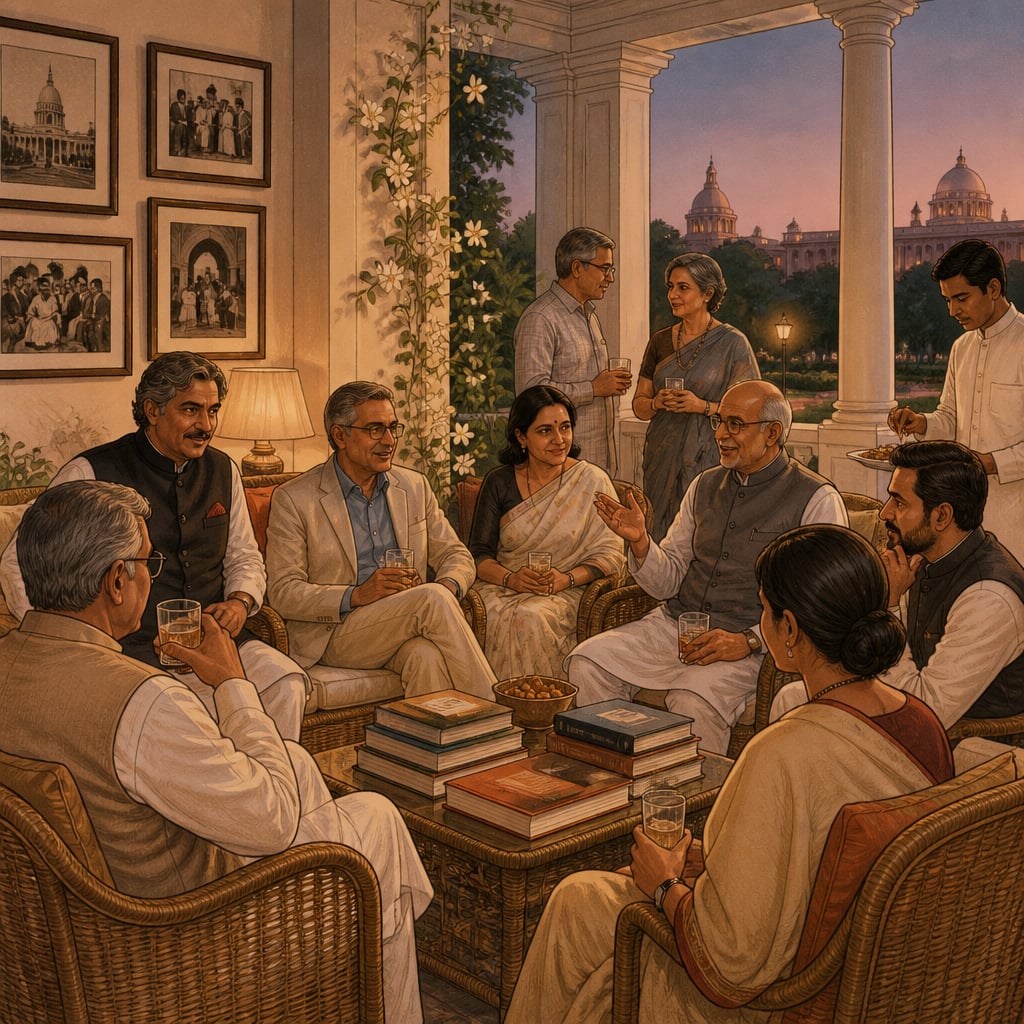
They attend each other's book launches. They give each other awards. They sit on each other's boards. Their children attend the same schools. They vacation in the same places. Through this web of social connections, a remarkably uniform worldview emerges: cosmopolitan, English-speaking, dismissive of traditional India, and aligned with Western liberal frameworks.
This isn't a conspiracy. It's something more durable: a culture. When everyone in your social circle thinks the same way, dissent becomes socially costly. When your career advancement depends on approval from this network, ideological conformity becomes professional survival.
The Lutyens ecosystem operates as a gatekeeper. Who gets published, who gets airtime, who gets called an "expert," who gets invited to policy discussions. For decades, this network determined which ideas were "respectable" and which were "communal," which movements were "progressive" and which were "regressive." The terms of debate were set before the debate even began.
Bollywood: When Soft Power Turns Inward
India possesses one of the world's largest entertainment industries. In theory, this is a civilizational asset. Korean dramas sell Korean culture globally. Hollywood projects American values worldwide. Japan's anime industry creates millions of cultural ambassadors.
But India's entertainment industry, for decades, did something unusual: it turned against its own civilizational source material.
The patterns are documented. The Hindu priest as comic relief or villain. Temple settings used as backdrops for crime and horror. Festival scenes associated with chaos, superstition, or tragedy. Inter-faith romance narratives flowing in one direction. Ancient traditions portrayed as backward while Western lifestyles are presented as aspirational.
No one issued a directive. The incentive structure did the work. When the people who greenlight scripts, fund productions, and decide distribution share a worldview that considers traditional Indian civilization embarrassing, the output reflects that worldview. When awards, critical acclaim, and international festival selection favor "social critique" of Hindu practices, filmmakers learn what sells.
The OTT Offensive
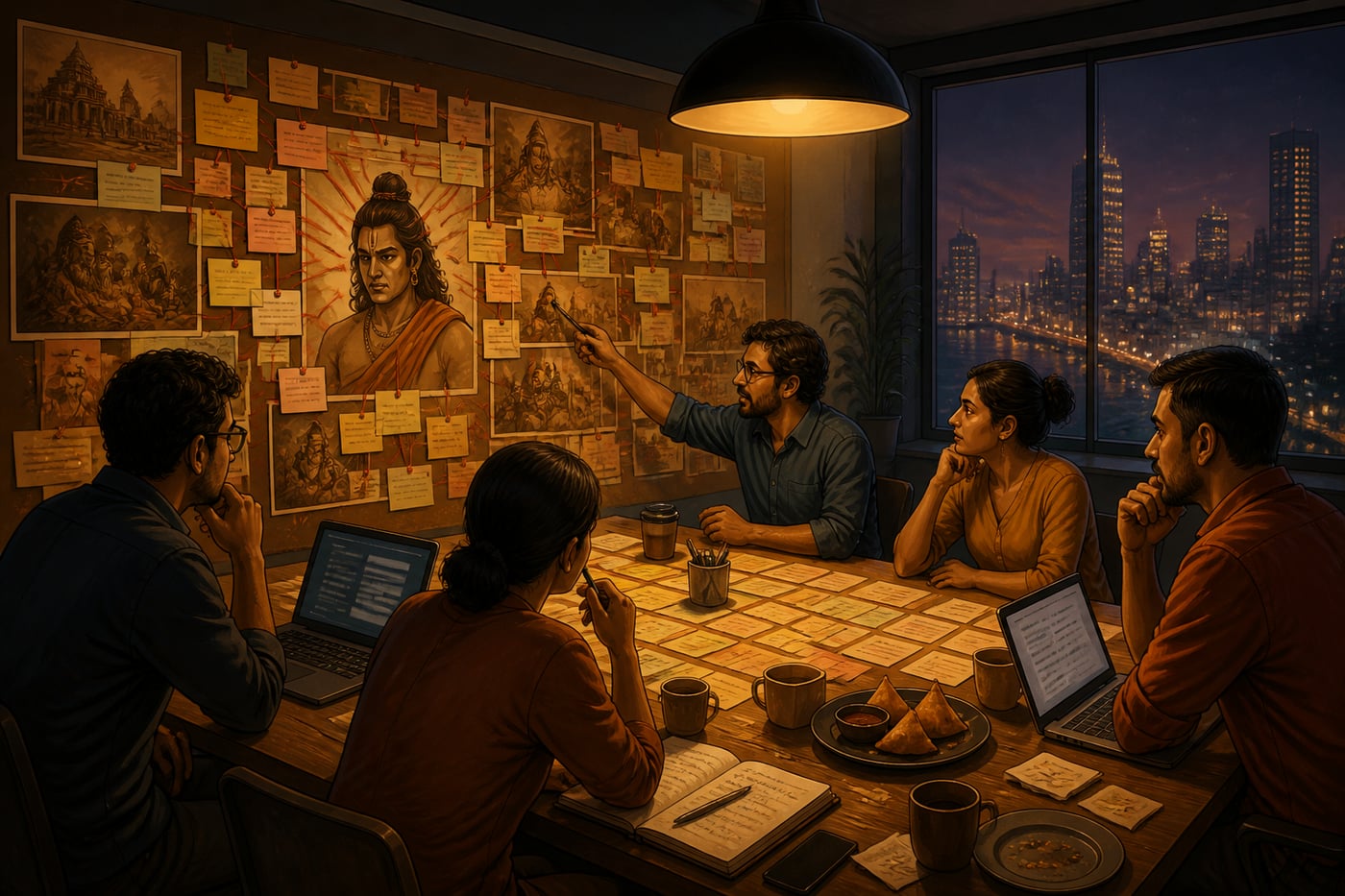
The arrival of streaming platforms added a new dimension. Netflix, Amazon Prime, and others entered India with deep pockets and global content strategies. Their platforms became spaces where content pushed boundaries that cinema censorship boards had previously restrained.
Examine the patterns. Series set in dystopian Hindu futures. Shows where temple rituals serve as horror elements. Content where Hindu characters embody prejudice while characters from other traditions embody enlightenment. The "progressive" framing that treats Hindu practices as the obstacle and Westernization as the solution.
Individual examples can be debated. But the aggregate pattern tells a story: India's own cultural traditions are systematically positioned as problems to be overcome, not wisdom to be engaged with.
This matters because entertainment shapes attitudes more effectively than news. A news article is read critically. A series is absorbed emotionally. When millions of young Indians consume stories that consistently position their civilizational heritage as backward, the psychological impact compounds over years.
Compare this with China's approach. Beijing ensures that its streaming platforms promote Chinese civilization positively. Content that undermines Chinese cultural confidence faces regulatory obstacles. India's open market approach, combined with captured cultural institutions, has produced the opposite outcome.
The Deep State: Colonial Machinery in Democratic Clothing
The British didn't just build railways. They built an administrative system designed for extraction and control. The Indian Civil Service (ICS) was engineered to produce administrators loyal to the Crown, trained in British frameworks, and culturally distanced from the populations they governed.
After independence, the ICS became the IAS (Indian Administrative Service). The name changed. The culture didn't.
The "steel frame" that Sardar Patel preserved was meant to hold a newly independent nation together. It succeeded at that. But it also preserved colonial habits of mind: the assumption that traditional knowledge is inferior, that Western administrative frameworks are universal, that the role of government is to modernize (meaning Westernize) the population.
This institutional culture creates a structural bias. When a file about temple freedom reaches a bureaucrat trained in "secular" frameworks, the default response is caution or rejection. When a proposal to revive traditional education enters the system, it faces skepticism that a proposal for "modern" education never would. The bias isn't personal. It's institutional. It's in the training, the promotion criteria, the peer culture.
The result: government machinery that defaults to the colonial position on civilizational questions. Not from malice, but from inertia. The machinery was built to serve one civilization's interests. It was never re-engineered to serve another's.
The Shadow Legislature
Non-governmental organizations play a legitimate role in any democracy. But when NGOs funded by foreign entities gain direct access to legislative power, the line between activism and governance dissolves.
The most striking example was the National Advisory Council (NAC) model during 2004-2014. Unelected individuals, many with histories of foreign-funded activism, gained direct influence over legislation. Major laws passed through this channel, shaped by people with no electoral accountability.
The intent behind individual policies can be debated. What cannot be debated is the structural innovation: a parallel legislative pathway where foreign-funded activists shaped laws affecting a billion people, outside the regular parliamentary process.
Simultaneously, some of these same networks opposed development projects: nuclear plants, mining, infrastructure. The Intelligence Bureau's 2014 report estimated that foreign-funded NGO activism was reducing India's GDP growth by 2-3% annually.
The pattern is about a system where foreign money creates domestic pressure groups that shape policy in directions aligned with foreign interests. Environmental groups funded by nations that industrialized without such constraints, telling India to slow down. Human rights groups applying frameworks developed in Western contexts to Indian civilizational practices.
The Undefended Frontier
Civilizations that understand soft power protect and weaponize their entertainment and sports ecosystems. South Korea invested strategically in the Hallyu wave, knowing that K-dramas and K-pop would create global cultural affinity. China maintains strict oversight of how Chinese civilization is portrayed in entertainment.
India's approach has been remarkably passive. IPL, one of the world's most valuable sports properties, functions as a business asset rather than a civilizational vehicle. Broadcast rights flow to the highest bidder. The sport that could unite a billion people around shared identity is optimized purely for revenue.
This isn't about rejecting commerce. It's about recognizing that in civilizational competition, every platform is a potential asset or vulnerability. When your entertainment industry portrays your civilization negatively, when your sports properties are disconnected from civilizational purpose, and when your media is funded by entities with different civilizational interests, you've left your soft power undefended.
Seeing the Matrix
The lesson here isn't that every journalist is corrupt, every bureaucrat is anti-national, or every filmmaker is an agent. That kind of thinking misses the point entirely.
The lesson is about systems. Systems create incentives. Incentives shape behavior. When the ownership, funding, training, and cultural incentive structures of your information and institutional ecosystem are aligned against civilizational continuity, you don't need a conspiracy. You just need everyone following their incentives.
Kautilya understood this. In the Arthashastra, he devoted extensive attention to information warfare, the role of intelligence networks, and the manipulation of public opinion. He knew that the real battlefield isn't physical. It's perceptual. The kingdom that controls what its people believe controls everything.
Recognizing the matrix is the first step. The counter-strategies come in Lesson 08_07. But recognition must come first. You cannot defend against a threat you refuse to see.
Institutional Capture as Civilizational Warfare - Understanding how control over information, bureaucratic, and cultural institutions constitutes a form of warfare more effective than military conquest.
Sun Tzu wrote that 'the supreme art of war is to subdue the enemy without fighting.' Kautilya went further, detailing precisely how information control, agent networks, and institutional infiltration could achieve what armies could not. Modern concepts like 'manufacturing consent' (Chomsky), 'soft power' (Joseph Nye), and 'institutional capture' (public choice theory) formalize insights that the Arthashastra explored two millennia ago.
The key innovation in Kautilya's thinking was recognizing that controlling the narrative is more valuable than controlling territory. A kingdom whose people believe their own civilization is inferior will surrender without a fight. This is precisely the mechanism documented in this lesson: media, entertainment, bureaucracy, and NGOs working in concert (not through conspiracy, but through aligned incentives) to undermine civilizational confidence.
The Arthashastra's framework for analyzing institutional threats remains directly applicable. Kautilya categorized threats as external (para) and internal (abhyantara), and argued that internal threats were always more dangerous because they were harder to detect. The media capture, bureaucratic inertia, and NGO infiltration documented here are classic abhyantara threats: they operate within the system, using the system's own legitimacy against it.
Verses
अभ्यन्तरः कोपो बाह्यकोपाद्गरीयान्।
abhyantaraḥ kopo bāhya-kopād garīyān |
The enemy within is deadlier than the enemy at the gates.
This sutra is the foundational warning of Chapter 8. Kautilya recognized that foreign armies announce themselves; captured institutions do not. Media that undermines civilizational confidence, bureaucracies that preserve colonial frameworks, NGOs that channel foreign interests into domestic policy: these are all forms of abhyantara kopa. They operate within the system's own legitimacy, making them far harder to identify and counter than any external threat.
Book 8, Chapter 1, Verse 2 (R.P. Kangle)
गूढपुरुषैश्चक्षुष्मान् भवति नृपः।
gūḍha-puruṣaiś cakṣuṣmān bhavati nṛpaḥ |
Through his intelligence network, the king gains true sight.
Kautilya understood that information sovereignty is the prerequisite for all other sovereignty. A king without independent intelligence is blind, regardless of how powerful his army. This directly parallels the lesson's core theme: when a civilization's information ecosystem is captured by foreign ownership, funding networks, and cultural gatekeepers, the civilization loses its ability to see clearly. It becomes blind to its own interests.
Book 1, Chapter 12, Verse 18 (R.P. Kangle)
अमात्यकोपो हि नृपस्य नाशः सर्वप्रकृतीनां प्रकृतिक्षयश्च।
amātya-kopo hi nṛpasya nāśaḥ sarva-prakṛtīnāṃ prakṛti-kṣayaś ca |
When the ministers turn, the king falls, and every pillar of the state crumbles with him.
This sutra explains the 'deep state' phenomenon through Kautilyan logic. When the administrative apparatus (amātya, the ministers and bureaucrats) is culturally or ideologically captured, it doesn't just fail to serve the state. It actively works against civilizational interests while wearing the state's own uniform. The IAS inheriting colonial institutional culture, NGO activists entering policy machinery, media acting as gatekeepers rather than watchdogs: all are forms of amātya-kopa.
Book 8, Chapter 1, Verse 29 (L.N. Rangarajan)
Case studies
The Radia Tapes: When the Watchdogs Were Caught on Tape
In 2010, income tax authorities released recordings of over 5,800 intercepted phone conversations of corporate lobbyist Niira Radia, spanning 2008-2009. The tapes revealed senior journalists from India's most prominent English-language media houses actively discussing which politicians should receive which cabinet portfolios, coordinating messaging strategies, and acting as intermediaries between corporate interests (particularly the Tata Group) and political power. These weren't anonymous sources. They were recognizable voices from newsrooms that millions of Indians trusted, caught on tape functioning as participants in power-brokering rather than as independent reporters covering it.
Kautilya warned that when a kingdom's intelligence apparatus is compromised, the king becomes blind. The Radia Tapes revealed something worse: India's informational 'eyes' were actively working for other masters. In Arthashastra terms, this is amātya-kopa applied to the fourth estate. The cāras (intelligence agents) meant to help the public see reality were instead constructing a curated version of it. Kautilya prescribed that the king must maintain multiple independent intelligence networks precisely to prevent any single channel from becoming captured. India's information ecosystem lacked exactly this redundancy.
Despite initial public outrage, the media ecosystem largely closed ranks. A few journalists were temporarily sidelined, but most faced no lasting career consequences. The structural conditions that enabled the nexus remained unchanged. The episode confirmed what critics had long alleged: India's English-language media elite functioned less as an independent press and more as a coordinated ecosystem with shared interests, access, and loyalties.
When the watchdogs serve the same masters they are supposed to watch, accountability becomes theater. Media capture doesn't require formal censorship. It only requires that journalists' social, financial, and career incentives align with power rather than truth.
The Radia Tapes pattern of journalists coordinating with corporate and political interests persists in India's media landscape. Social media has partially disrupted this gatekeeping, but the structural incentives that align journalistic careers with power networks remain largely unchanged.
Over 5,800 phone conversations were intercepted, involving at least two dozen prominent journalists, politicians, and corporate figures across India's most influential media organizations.
The OTT Offensive: Streaming Platforms and Civilizational Framing
Between 2018 and 2023, major OTT platforms entering India produced content with observable patterns. Netflix's 'Leila' (2019) depicted a dystopian Hindu-supremacist future India. Amazon's 'Tandav' (2021) portrayed Hindu deities in ways that triggered massive public backlash and legal cases. Multiple series across platforms used temple settings for horror sequences, portrayed Hindu priests as corrupt or villainous characters, and framed Hindu festivals as occasions for violence or superstition. Meanwhile, content involving other religious traditions received notably more cautious and respectful editorial treatment. India's OTT market grew from $0.5 billion in 2018 to over $4 billion by 2023, reaching 500+ million subscribers.
Kautilya understood kūṭayuddha: covert warfare conducted through cultural means rather than military force. OTT content follows this pattern precisely. No one issues explicit anti-civilizational directives. Instead, the incentive structure does the work: international acclaim for 'progressive' critique of Hindu traditions, algorithm-driven distribution that rewards controversy, and commissioning editors trained in Western academic frameworks that view Indic traditions as subjects for deconstruction rather than engagement. The result is systematic cultural warfare that its own practitioners may not recognize as warfare.
The content shaped attitudes at scale among young urban Indians, normalizing civilizational self-doubt through emotional storytelling rather than argument. Some platforms faced public backlash and legal challenges. The government introduced IT rules for OTT content in 2021. But the underlying commissioning biases, editorial frameworks, and algorithm design that produced the content remained largely intact.
Entertainment shapes civilizational attitudes more effectively than any textbook because it bypasses critical thinking and works on emotions. When a civilization's own entertainment ecosystem consistently portrays its traditions negatively, the resulting self-doubt is a form of cultural warfare whether or not anyone intended it as such.
India's OTT content regulation debate intensified after 2023, with growing public awareness that streaming platforms shape civilizational attitudes at scale. The pattern of internationally acclaimed content that portrays Indian traditions negatively continues to generate both commercial success and grassroots backlash.
India's OTT market reached 500+ million subscribers by 2023, making streaming platforms among the most powerful cultural influence channels in the country, particularly among the 18-35 demographic.
The NAC Model: When NGOs Became the Shadow Legislature
The National Advisory Council (NAC), established in 2004 and chaired by Congress Party president Sonia Gandhi, created an unprecedented structure: an extra-constitutional body with direct influence over legislation. The NAC included prominent activists and academics, many with long associations with foreign-funded NGOs. Through this body, individuals without electoral mandate helped draft and shape major legislation including the Right to Information Act (2005), NREGA (2005), the Forest Rights Act (2006), and the Food Security Act (2013). Simultaneously, members of the broader NGO ecosystem that overlapped with the NAC actively opposed nuclear energy projects, mining operations, and infrastructure development.
Kautilya's Arthashastra dedicates extensive attention to preventing what he called the corruption of the king's council: outsiders gaining influence over royal decisions through proximity rather than mandate. The NAC created precisely what Kautilya warned against: a parallel power center where unelected individuals shaped laws for 1.2 billion people. This is amātya-kopa in its most sophisticated modern form. Not a coup, but institutional capture that maintained democratic appearances while bypassing democratic accountability. The foreign funding connections added another Kautilyan dimension: the influence of para (foreign) interests operating through abhyantara (internal) channels.
The NAC era produced legislation that expanded government welfare programs while simultaneously slowing industrial development. The Intelligence Bureau's 2014 report estimated that foreign-funded NGO activism was reducing India's GDP growth by 2-3% annually. The structural precedent of extra-constitutional legislative influence set a template that could be replicated in the future.
Democratic institutions can be hollowed out while maintaining their external form. The NAC demonstrated how foreign-funded activism can translate into domestic legislation through proximity to power. The question is not whether individual policies were good or bad, but whether a democracy's laws should be shaped by unelected individuals with foreign funding.
The NAC model of extra-constitutional influence through proximity to power has parallels globally, from think-tank capture in Washington to NGO influence in EU policymaking. India's experience demonstrates how foreign-funded activism can translate into domestic legislation when institutional guardrails are weak.
The 2014 IB report estimated that foreign-funded NGO activism was stalling development projects worth over Rs 2 lakh crore and reducing India's GDP growth by 2-3% annually.
Reflection
- What are the three news sources you consume most frequently? Can you trace who owns them, who funds them, and what frameworks their journalists were trained in?
- The lesson argues that the Lutyens ecosystem isn't a conspiracy but a culture. What is the difference between those two things, and why might a culture be harder to dismantle than a conspiracy?
- Kautilya argued that internal threats are more dangerous than external ones. If this is true, can a civilization be conquered without a single soldier crossing its borders?