Knowledge System Collapse
Traditional Sciences Abandoned and Commentary Traditions Broken
India once had one of the most sophisticated knowledge ecosystems on earth. Gurukulas in every village. Traditional sciences from surgery to calculus. A commentary tradition (bhashya parampara) that kept ancient texts alive and evolving across centuries. A debate culture (shastrartha) that stress-tested every idea in public. All of it was dismantled. Not by ignorance, but by deliberate policy: Macaulay's 1835 Minute defunded indigenous schools, redefined 'literacy' as English literacy, and replaced a holistic knowledge system with a factory for colonial clerks. The destruction was so thorough that independent India's own leaders, products of that colonial system, continued the pattern. This lesson traces the full arc: what was lost, how it was lost, and why it hasn't been recovered.
The Civilization That Forgot What It Knew
In the 1820s, British surveyors made a discovery that embarrassed the colonial narrative. William Adam, sent to survey education in Bengal and Bihar, found over 100,000 indigenous schools. Pathshalas, gurukulas, tols, and madrasas dotted every village. Thomas Munro reported from Madras Presidency that 'every village had a school.' Collector A.D. Campbell wrote that India's proportion of educated people was 'not inferior to most European countries.'
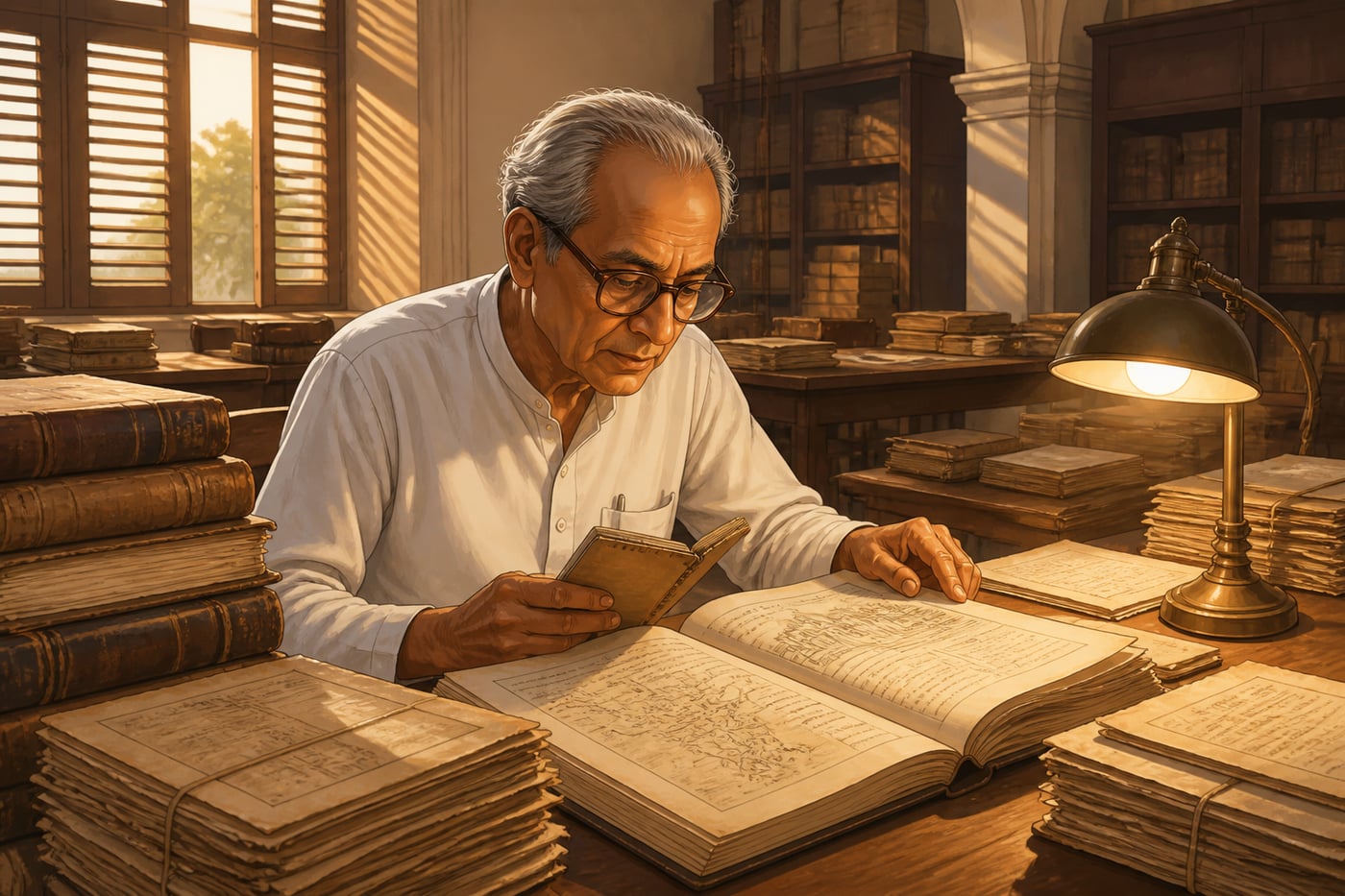
This was not the 'backward, illiterate India' the colonizers needed to justify their rule.
The solution was not to educate India. India was already educated. The solution was to replace India's education with something else entirely.
Macaulay's Minute: The Blueprint for Knowledge Destruction
In 1835, Thomas Babington Macaulay delivered his infamous Minute on Education to the Supreme Council of India. His stated goal was explicit: 'We must at present do our best to form a class of persons Indian in blood and colour, but English in tastes, in opinions, in morals, and in intellect.'
The mechanism was funding. Government grants were redirected from Sanskrit colleges and pathshalas to English-medium institutions. Indigenous schools, which had survived for centuries on royal patronage and community land grants, were systematically defunded. Teachers who had been respected community pillars found themselves without income. Students who would have learned Ayurveda, Jyotisha, Ganita, and Dharma were now channeled into schools that taught English grammar and British history.
Within fifty years, India's indigenous education system was in ruins. And then the final stroke: 'literacy' was redefined to mean 'can read and write English.' By this definition, a pandit who could recite the entire Vedas was illiterate. A vaidya who could diagnose from pulse examination was illiterate. A sthapati who could construct a temple using sacred geometry was illiterate. The 1901 Census recorded India's literacy rate at 5.3%, and the colonial project had its justification: see, they were always backward.
The Five Knowledge Systems That Were Destroyed
The damage was not limited to reading and writing. Entire branches of traditional science were severed from their transmission chains.
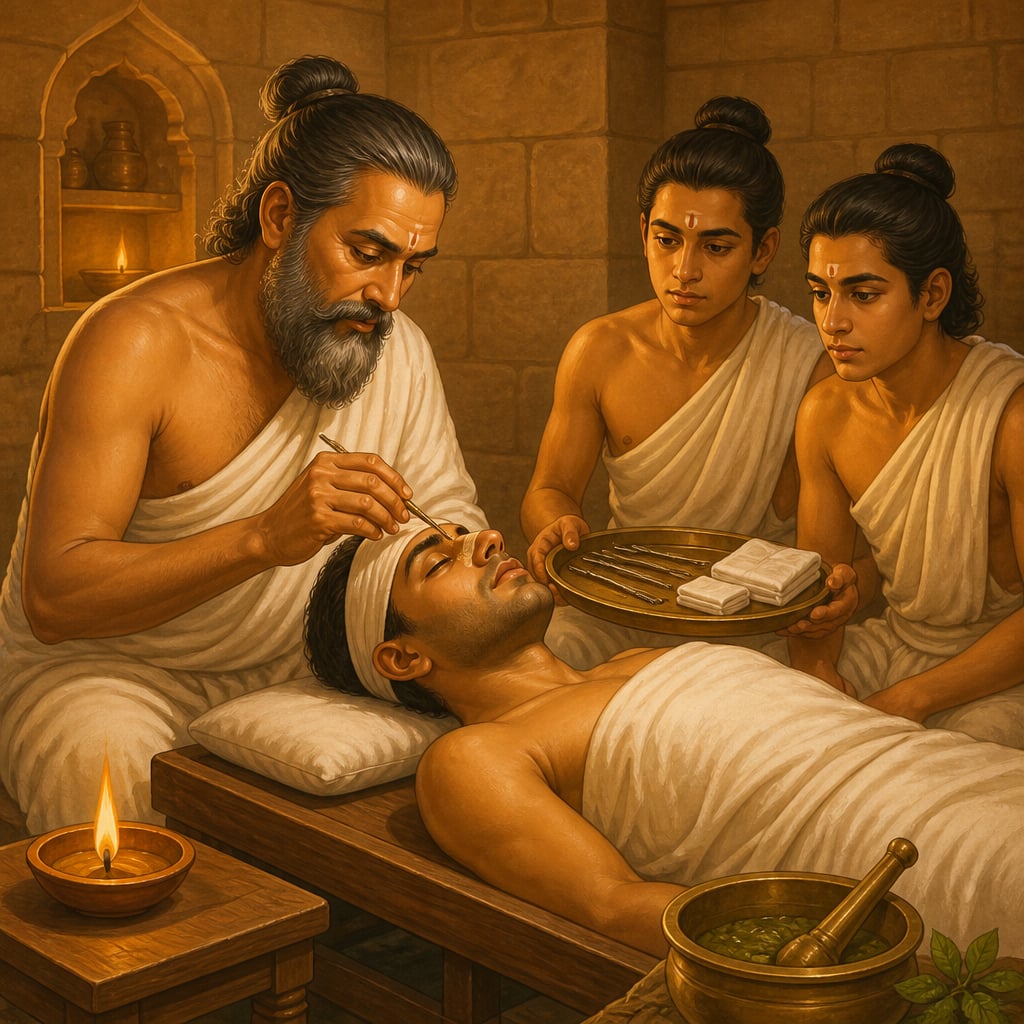
Ayurveda: Sushruta's Samhita described over 300 surgical procedures, including rhinoplasty, cataract removal, and cesarean sections, centuries before comparable Western developments. The 1835 Bengal Medical Act removed Ayurvedic practitioners from government hospitals. By the early 1900s, Ayurveda had been pushed to the margins of Indian healthcare.
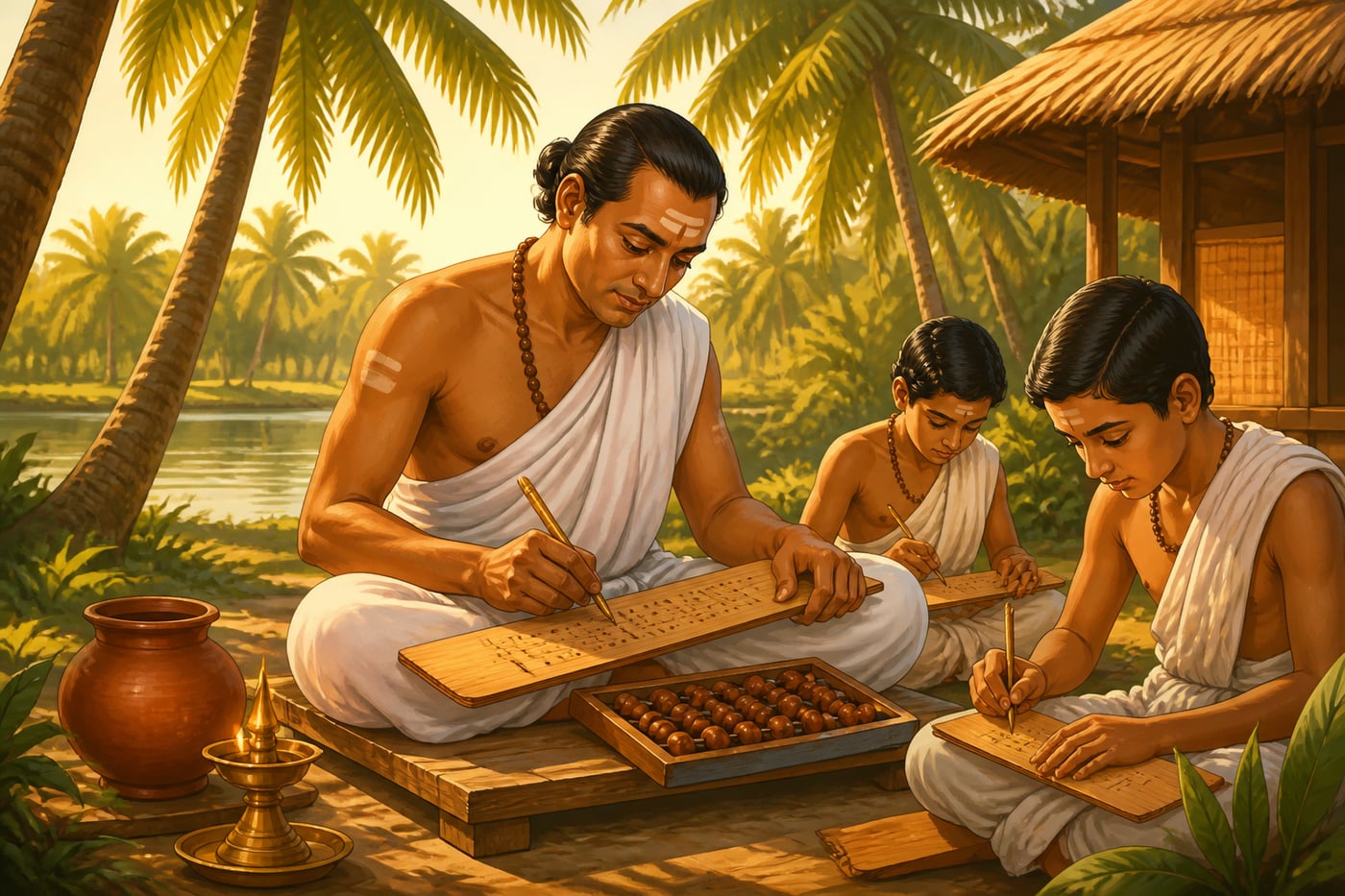
Ganita (Mathematics): The Kerala School of Mathematics, led by Madhava of Sangamagrama around 1350 CE, developed infinite series expansions for trigonometric functions roughly 250 years before Newton and Leibniz. Baudhayana's Sulba Sutras contained geometric principles predating Pythagoras. Yet Indian students learn 'Pythagoras theorem,' not 'Baudhayana theorem.'
Jyotisha (Astronomy/Timekeeping): India's astronomical tradition, from Aryabhata's heliocentric model (499 CE) to the precise calendrical calculations that still govern Hindu festivals, was dismissed as 'astrology' and 'superstition' by colonial administrators who did not distinguish between its scientific and predictive traditions.
Dhanurveda and Sthapatya Shastra: Military science and temple architecture, both highly systematized knowledge traditions, lost their institutional support when kingdoms fell and temples came under colonial and later government control.
Vaidyaka (Clinical Medicine): The clinical traditions of Charaka, Sushruta, and Vagbhata, which included sophisticated diagnostic methods, pharmacopoeia, and surgical techniques, were replaced by an imported medical system. Not because the imported system was always superior, but because the imported system had state backing and the indigenous one did not.
The Broken Commentary Chain
Perhaps the most devastating loss was not any single science, but the meta-system that kept all sciences alive: the bhashya parampara, India's commentary tradition.
For millennia, Indian knowledge was kept living through a cycle of commentary. Vyasa composed the Brahma Sutras. Shankaracharya wrote a bhashya (commentary) interpreting them through Advaita Vedanta. Ramanujacharya wrote a counter-bhashya from the Vishishtadvaita perspective. Madhvacharya wrote yet another from the Dvaita perspective. Each generation's commentary was not mere footnoting; it was a complete philosophical re-engagement with the source text.
This tradition applied to every field. Medical texts received commentaries that updated clinical knowledge. Mathematical texts received commentaries that extended theorems. Legal texts received commentaries that adapted principles to changing social conditions.
When the gurukula system collapsed, this commentary chain broke. Texts that had been living, evolving documents became dead manuscripts. Scholars who would have written the next generation's bhashya were instead learning English and applying for clerical positions. The tradition of re-interpretation, which is what kept Sanskrit knowledge adaptive and relevant, simply stopped.
The Death of Shastrartha
Alongside the commentary tradition, India lost its culture of shastrartha: formal scholarly debate.
Shastrartha was not casual argument. It was a rigorous, structured, public process with formal rules. Two scholars would debate a philosophical, scientific, or legal question before an audience. The debate had a judge (often a scholar of equal or greater standing). The loser was expected to genuinely accept the winner's position, or become the winner's student.
Adi Shankaracharya's eighteen-day debate with Mandana Mishra, judged by Mandana's wife Ubhaya Bharati, is the most famous example. But shastrartha was not reserved for philosophical giants. It was a regular feature of intellectual life, happening in temples, courts, and gurukulas across India.
Shastrartha served a civilizational function that nothing in modern Indian intellectual life replaces. It was a stress-testing mechanism for ideas. A theory that could not survive public debate was refined or discarded. A scholar who could not defend their position in shastrartha did not get to teach that position to students.
When shastrartha died, Indian intellectual culture lost its quality control system. Ideas could now spread not because they survived rigorous challenge, but because they had institutional backing, political support, or colonial approval.
Dharma Separated from Education
The colonial education system did not just replace Indian subjects with English ones. It performed a deeper surgery: it separated dharma from education entirely.
In the gurukula, there was no division between 'secular' and 'religious' education. A student learning mathematics was also learning the dharmic framework within which mathematical knowledge had meaning. A student learning medicine was also learning the ethical obligations of a healer. Knowledge was embedded in a value system.
The colonial and later 'secular' Indian education system stripped this away. Knowledge became 'information,' disconnected from any ethical or civilizational framework. You could learn chemistry without learning responsibility for how chemical knowledge is used. You could study history without understanding dharma's role in historical decision-making.
The result is what we see today: a technically skilled population that is civilizationally illiterate. IIT graduates who can build world-class software but cannot name a single Indian mathematician before Ramanujan. Medical professionals who have never heard of Sushruta. Architects who have never studied Vastu Shastra or the principles behind India's great temples.
The knowledge was not lost because it was inferior. It was lost because the transmission system was destroyed and never rebuilt.
Why Independent India Continued the Pattern
The deepest tragedy is what happened after 1947. India gained political independence, but its educated class remained mentally colonized. The leaders who built modern India were themselves products of the Macaulay system. They had been taught to admire Western knowledge and distrust Indian knowledge.
Nehru's vision of 'temples of modern India' meant dams, steel plants, and IITs modeled on MIT. Not the actual temples, gurukulas, and knowledge traditions that had sustained Indian civilization. AIIMS was designed as a Western hospital, not as a fusion of Ayurvedic and modern medicine. NCERT textbooks taught the European Renaissance but not the Gupta Golden Age. Students learned about the 'Greek miracle' of philosophy but not the six darshanas of Indian philosophy.
The contrast with China is instructive. China faced similar colonial pressure to abandon its traditional knowledge. Mao Zedong, despite being a modernist, declared: 'Chinese medicine is a great treasure house.' TCM was preserved, modernized, and integrated into national healthcare. Today it is a $130 billion global industry. India's Ayurveda, with a longer documented history and richer pharmacopoeia, languishes at $18 billion.
The difference was not in the quality of the knowledge. It was in civilizational confidence. China believed its traditions were worth modernizing. India, or rather India's English-educated elite, believed its traditions were obstacles to modernity.
What Was Really Lost
The full scale of the loss becomes clear only when you understand what a knowledge system is. It is not a library. A library stores information. A knowledge system transmits capability.
When Sushruta's surgical tradition was broken, what was lost was not the text of the Sushruta Samhita. That text survives. What was lost was the chain of surgeons who had practiced those techniques, refined them, and passed them on with their accumulated clinical intuition. You cannot learn rhinoplasty from a manuscript. You learn it from a teacher who has performed it, who learned from a teacher who performed it, stretching back generations.
When the bhashya tradition was broken, what was lost was not the texts being commented upon. The Brahma Sutras survive. What was lost was the living practice of re-interpretation that kept those texts relevant. A text without a commentary tradition becomes a museum piece. Beautiful, but unable to speak to new questions.
When shastrartha died, what was lost was not any particular debate. What was lost was the civilizational habit of subjecting ideas to rigorous, public, intellectual challenge. Without this habit, bad ideas can persist indefinitely.
Knowledge system collapse is not about forgetting facts. It is about losing the ability to generate, transmit, refine, and apply knowledge within a civilizational framework. India lost not just what it knew, but how it knew.
Case studies
Dharampal's Lost Schools: How India Was Made 'Illiterate'
In the 1960s, Gandhian historian Dharampal began digging through British East India Company archives in London. What he found upended the colonial narrative of a 'backward, illiterate India.' British surveyors themselves had documented a vast indigenous education system. William Adam, commissioned by the Bengal Presidency in 1835, surveyed just five districts of Bengal and Bihar and found over 100,000 indigenous schools (pathshalas, gurukulas, madrasas). Extrapolating across India, the numbers were staggering. Thomas Munro's 1826 survey of Madras Presidency found that 'every village had a school.' Collector A.D. Campbell reported that 'the proportion of the population receiving education in India was not inferior to that in most European countries.' Then came Macaulay's Minute on Education (1835): 'We must at present do our best to form a class of persons Indian in blood and colour, but English in tastes, in opinions, in morals, and in intellect.' Government funding was redirected from indigenous schools to English-medium institutions. Sanskrit colleges were defunded. Pathshalas lost their land grants. Within fifty years, a civilization with near-universal village-level education had been statistically transformed into one of the most 'illiterate' nations on earth. The trick was simple: redefine 'literacy' to mean 'knows English.'
The gurukula and pathshala system was not just 'schooling.' It was vidya-parampara in action. A village pathshala taught reading, writing, arithmetic, local sciences, medicinal knowledge, agricultural techniques, dharmic values, and oral literary traditions. The teacher was a community pillar, compensated through land grants and community support. The colonial replacement taught one thing well: obedience. Students learned to read and write English, memorize British-approved curricula, and aspire to clerical positions in the colonial administration. Education was severed from dharma, from local knowledge, from community life. It became a factory for producing what Macaulay wanted: brown Englishmen. The most devastating aspect was not what was taught but what was untaught. When the pathshala closed, the local vaidya's son stopped learning Ayurveda. The jyotishi's grandson never learned to read a kundali. The sthapati's lineage forgot temple architecture. Each closed school severed dozens of knowledge chains simultaneously.
By the 1901 Census, India's literacy rate was recorded at approximately 5.3%. This was not because Indians had become less educated. It was because the definition of 'educated' had been changed to exclude everything Indians actually knew. A pandit who could recite the Vedas, a vaidya who could diagnose from pulse, a sthapati who could build a temple using sacred geometry, all were classified as 'illiterate' because they could not write English. Dharampal published his findings in 'The Beautiful Tree' (1983). The book was largely ignored by India's English-educated intelligentsia. The irony was precise: the very class Macaulay created could not recognize the civilization Macaulay destroyed.
Knowledge systems are not destroyed by ignorance alone. They are destroyed by replacement. The British did not simply close Indian schools. They built a parallel system, redirected all funding to it, redefined 'education' to mean their system, and then pointed at the ruins and said: 'See? They were always illiterate.' This is the template for civilizational knowledge destruction.
Dharampal's findings are now cited by India's National Education Policy (2020), which explicitly acknowledges the need to integrate indigenous knowledge systems into formal education. The 170-year project of making Indians forget their own educational heritage is being systematically reversed for the first time.
William Adam's survey of just five districts in Bengal and Bihar found over 100,000 indigenous schools in the 1830s. By 1901, the British recorded India's literacy rate at 5.3%, having redefined 'literate' to exclude all non-English education.
China Preserved TCM, India Abandoned Ayurveda
Two ancient civilizations. Two sophisticated medical traditions stretching back thousands of years. Two encounters with Western colonial pressure to abandon 'primitive' indigenous medicine. Two opposite choices. China chose preservation. In 1958, Mao Zedong, despite being a committed modernist, declared: 'Chinese medicine is a great treasure house.' TCM was integrated into the national healthcare system as a parallel track alongside Western medicine. TCM universities were established. Research institutes were funded. The result: Tu Youyou, trained in both TCM and Western pharmacology, discovered artemisinin (an anti-malarial compound) from a traditional Chinese herb in 1972. She won the Nobel Prize in 2015. India chose abandonment. The 1835 Bengal Medical Act removed Ayurvedic practitioners from government hospitals. Post-independence, India modeled its premier medical institution, AIIMS (1956), entirely on Western hospital design. Ayurvedic colleges were classified as a separate, lower tier of medical education. A BAMS (Ayurveda) graduate is paid less, respected less, and legally restricted compared to an MBBS graduate, despite Ayurveda being India's indigenous system with over 3,000 years of clinical documentation.
The contrast reveals something deeper than a policy difference. China treated its traditional knowledge as a civilizational asset to be modernized. India treated its traditional knowledge as a civilizational embarrassment to be overcome. This is psychological colonization in action. No one forced independent India to marginalize Ayurveda. The British had left. But Macaulay's 'class of persons Indian in blood but English in intellect' now ran the country. They built the India they had been taught to admire: a Western one. Nehru's vision of 'temples of modern India' meant dams and steel plants, not the actual temples and gurukulas that had sustained Indian civilization for millennia. China had its own trauma (the Century of Humiliation), but it never internalized the belief that Chinese knowledge was inherently inferior. India did. That internalized inferiority is the deepest wound of knowledge system collapse.
Today, China's TCM industry is valued at over $130 billion globally. Over 200,000 practitioners graduate from TCM universities annually. TCM hospitals operate alongside Western hospitals in every major Chinese city. The WHO formally included TCM diagnoses in its International Classification of Diseases in 2019. India's Ayurveda sector, despite having a longer documented history and a richer pharmacopoeia, is valued at approximately $18 billion. BAMS graduates often seek 'bridge courses' to practice allopathic medicine because their own degree carries less prestige. The Ministry of AYUSH was created only in 2014, nearly seven decades after independence.
The difference between China and India was not the quality of the traditional knowledge. Ayurveda's clinical literature is at least as rigorous as TCM's foundational texts. The difference was civilizational confidence. China believed its traditions were worth modernizing. India believed its traditions were obstacles to modernization. Knowledge systems survive or die based on whether their own people consider them worth preserving.
India's AYUSH Ministry, established in 2014, represents the first institutional attempt to follow China's TCM model of state-backed modernization for traditional medicine. The gap remains enormous: China's TCM industry is seven times larger, illustrating the compounding cost of decades of civilizational neglect.
China's TCM industry is valued at over $130 billion with 200,000+ annual graduates from dedicated universities. India's Ayurveda industry, despite a longer documented tradition, is valued at approximately $18 billion. Tu Youyou's Nobel Prize-winning artemisinin discovery came directly from TCM research.
Reflection
- What traditional knowledge, skill, or practice from your own family or community has disappeared in your lifetime? A grandmother's remedy, a grandfather's craft, a festival ritual no one remembers the meaning of anymore?
- Why did India's post-independence leaders continue the colonial education system almost unchanged, rather than reviving indigenous knowledge traditions? What does this tell us about the depth of psychological colonization?
- If a civilization's knowledge transmission chains are broken for multiple generations, can the original knowledge truly be recovered, or can it only be reconstructed from fragments? What is the difference?