Economic Displacement & Psychological Colonization
Artisan Economy Collapse, Cultural Inferiority, and Supply Chain Weaponization
How India's artisan economies were systematically destroyed and replaced with dependency, while a psychological colonization engine ensures each generation internalizes civilizational shame. From Dhaka muslin to Sivakasi fireworks, from village guilds to international schools.
See It Today: The Economy That Forgot Itself
Walk through any Indian bazaar during Diwali season and count the diyas. Most are now made of plastic, imported from Guangzhou. The clay diya makers of Kumartuli, whose families shaped lamps for centuries, now drive auto-rickshaws. This is not a market outcome. It is the final stage of a two-century process that first destroyed India's productive capacity and then convinced Indians that what was destroyed was never worth keeping.
India was not always a consumer economy dependent on foreign supply chains. Before colonial intervention, the subcontinent produced 24.4% of global GDP (Angus Maddison's data, 1700). Indian textiles clothed the world. Indian steel was the planet's finest. Indian ships outnumbered British fleets five to one. The destruction of this productive base was deliberate colonial policy. But here is what makes this lesson different from the colonial story we covered earlier (Lesson 03_04): the British left in 1947. The destruction continued.
Today, India imports over $100 billion worth of goods annually from China alone. Sivakasi's fireworks artisans face regulatory campaigns that specifically target Diwali. International schools charge premium fees to teach children curricula that never mention Aryabhata or Panini. The economic displacement and the psychological colonization are not separate phenomena. They are two halves of the same engine. One destroys your ability to produce. The other destroys your desire to.
This lesson traces how that engine works, why it keeps running seven decades after independence, and what it would take to shut it down.
The Mechanism: How Production and Pride Were Destroyed Together
Phase 1: The Colonial Dismantling
The template for economic displacement was set in Bengal with the muslin industry. Dhaka muslin, so fine it was called "woven air" (abrawan), was the world's most valuable textile. A single sari could pass through a finger ring. European traders paid fortunes for it. And then the East India Company decided that Bengal's weavers were competitors to Manchester's mills.
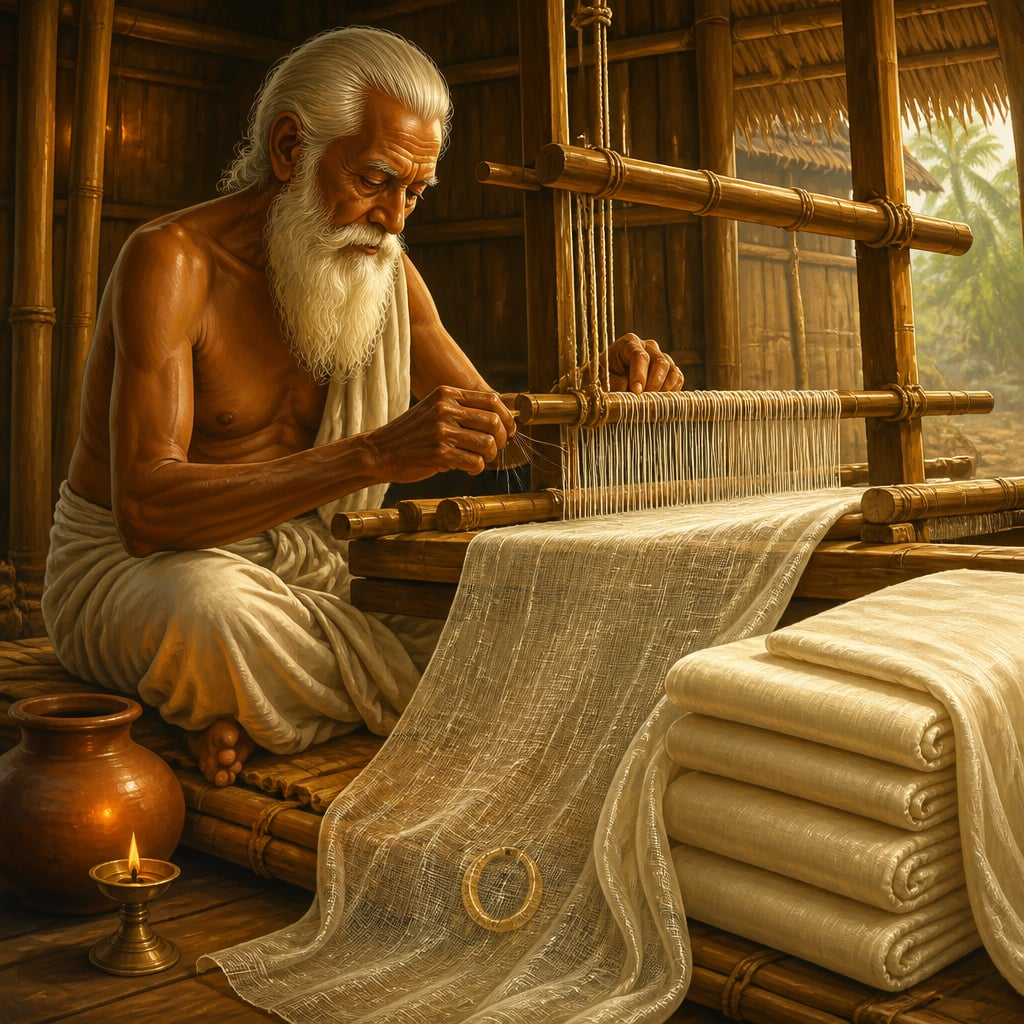
The destruction was systematic. Import duties on Indian textiles entering Britain were raised to 70-80% between 1700 and 1720. Raw cotton was forced out of Bengal at below-market prices to feed Lancashire. Weavers who tried to sell to other buyers had their thumbs cut off, a practice documented by William Bolts in 1772. By 1813, when the Company's trade monopoly was partially lifted, the damage was complete. Dhaka's population fell from several hundred thousand to roughly 30,000 by the 1840s. A city that once rivaled London was reduced to a provincial town.
But the muslin story is not just about economics. It is about knowledge. The 300-thread-count weaving technique that produced muslin required a specific variety of cotton (Phuti karpas) grown only along the Meghna river, specific humidity conditions, and skills transmitted across generations. When the weavers were destroyed, the knowledge chain broke. Today, despite multiple revival attempts, no one can reproduce true Dhaka muslin. The product did not just go out of production. It went out of existence.
This pattern repeated across industries. Wootz steel, Indian shipbuilding, indigo production, silk weaving. In every case, the colonial approach was identical: impose tariffs to block Indian goods, force raw material exports to feed British factories, destroy the artisan class, then sell finished goods back to India at a markup. India went from producing 24.4% of world GDP to 4.2% by 1947.
Phase 2: The Post-Independence Continuation
Here is where the story gets uncomfortable. After independence, India had the opportunity to rebuild its productive base. In some areas, it did. Heavy industry, space technology, nuclear capabilities, IT services. But in the artisan economy, the traditional knowledge systems, the cultural production infrastructure, the destruction not only continued but accelerated.
Consider the guild system. Pre-colonial India had Shrenis (guilds) that functioned as self-governing economic units. They set quality standards, trained apprentices, managed capital, and maintained inter-generational knowledge transfer. Colonial policy dismantled them. But independent India never rebuilt them. Instead, the artisan sector was placed under bureaucratic control through bodies like the Khadi and Village Industries Commission, which turned self-governing producers into subsidy-dependent beneficiaries.
The temple economy tells a similar story (see Lesson 08_04). Temples were not just places of worship. They were economic hubs that funded education, arts, and social welfare. The Tirumala temple alone had an annual revenue system that supported thousands of families. Government takeover of Hindu temples post-independence converted these economic engines into revenue sources for state treasuries. The pilgrim networks that once created trade corridors became government-managed tourism circuits.
Village self-governance, the Panchayati system that Kautilya documented in the Arthashastra, was another casualty. Colonial administration centralized decision-making. Independent India's Panchayati Raj system attempted revival but layered bureaucratic control over what was once organic self-governance. Village economies that were designed to be self-sufficient became dependent on government schemes.
Phase 3: Supply Chain Weaponization
The modern phase of economic displacement operates through global supply chains and regulatory frameworks. This is not a conspiracy. It is structural. But the effect is the same as colonial tariff manipulation: Indian producers are priced out of their own markets.
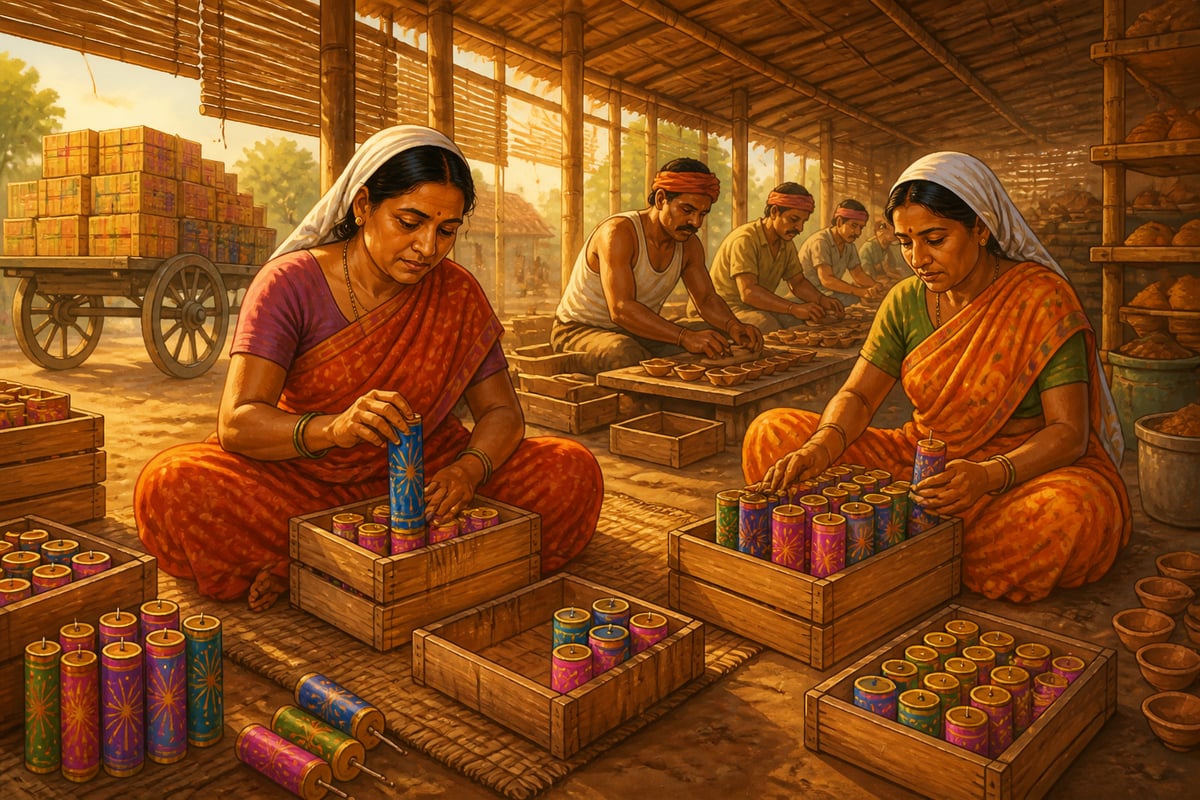
Sivakasi in Tamil Nadu illustrates this perfectly. The town's fireworks industry employs over 300,000 workers and has been the backbone of Diwali celebrations for generations. In recent years, this industry faces a three-pronged attack. First, cheap Chinese fireworks flooding the market at prices no domestic producer can match. Second, regulatory restrictions that specifically target Diwali crackers (the Supreme Court's 2018 order banned conventional firecrackers and mandated "green crackers" with no established manufacturing process). Third, sustained cultural campaigns framing Diwali fireworks as environmentally irresponsible, while Christmas and New Year celebrations in the same cities face no equivalent scrutiny.
The Sivakasi case is instructive because it shows how economic displacement, regulatory capture (Lesson 08_01), and cultural erosion (Lesson 08_04) work together. You don't need to ban an industry. You just need to make it economically unviable while simultaneously making the culture ashamed of using its products.
The food sovereignty dimension adds another layer. Traditional Indian dairy farming, ghee production, and agricultural practices face delegitimization campaigns funded by organizations promoting lab-grown alternatives. India is the world's largest milk producer, with over 80 million rural families depending on dairy. Campaigns framing traditional dairy as "cruel" or "unsustainable" while promoting venture-capital-funded synthetic alternatives are not just about food. They are about dismantling a production system that sustains rural India's economic independence.
WTO rules compound the problem. Traditional knowledge (Ayurvedic formulations, indigenous seed varieties, textile techniques) often cannot be protected under Western intellectual property frameworks. The result is biopiracy, where traditional Indian knowledge is patented abroad and sold back as "innovation." Turmeric, neem, basmati rice have all faced patent challenges. India wins some battles but the system itself is designed for knowledge extraction.
The Pattern: When The Colonized Becomes The Colonizer
The economic displacement creates dependency. But it is the psychological dimension that makes the dependency permanent. This is where 08_05 diverges sharply from 03_04. The British planted the seeds of cultural inferiority through Macaulay's education policy. But independent India built an entire greenhouse to nurture those seeds.
The pattern operates through three self-reinforcing loops.
Loop 1: The Education-Aspiration Pipeline. India's education system, as we covered in Lesson 08_01, was designed by colonial administrators to produce clerks. After independence, the system was never decolonized. Instead, it was upgraded. The new aspiration was not to serve the British but to leave India. The IIT-to-Silicon Valley pipeline, the medical-college-to-US-residency track, the MBA-to-MNC pathway. These are not neutral career choices. They are the output of a system that teaches every ambitious young Indian that success means leaving.

The international school phenomenon makes this explicit. India now has over 5,000 schools following international curricula (IB, Cambridge, AP). Parents pay anywhere from Rs. 5 lakh to Rs. 25 lakh annually for an education that systematically excludes Indian civilizational content. Children in these schools celebrate Halloween but not Pongal. They read Shakespeare but not Kalidasa. They can name all the American presidents but cannot identify Chandragupta Maurya. They are fluent in English but cannot read Devanagari. This is not cultural exchange. This is cultural replacement, paid for by Indian parents who believe they are giving their children the best possible education.
The cruelest part: they are probably right, given the current system. An IB diploma opens more doors than a CBSE certificate. English fluency pays better than Sanskrit scholarship. The incentive structure rewards deracination. The system is not broken. It is working exactly as designed.
Loop 2: The Consumer Identity Shift. When you destroy a civilization's productive capacity, you also destroy its identity as a producer civilization. India today is positioned in the global economy primarily as a consumer market and a services provider. The "Make in India" campaign is an attempt to reverse this, but the cultural current runs deep. Indian consumers routinely prefer foreign brands over domestic equivalents, even when quality is comparable. "Imported" is still a selling point. "Local" still carries connotations of inferiority.
This consumer identity shapes everything from fashion choices (Western formal wear as default professional dress) to dietary aspirations (fast food chains as aspirational dining) to entertainment consumption (Hollywood and Korean content over Indian regional cinema). Each individual choice seems trivial. Collectively, they represent a civilization that has been trained to consume rather than create, to import rather than produce, to admire others rather than build its own.
Loop 3: The Self-Colonizing Intellectual. Perhaps the most damaging loop is the intellectual one. India produces a significant number of scholars, writers, and public intellectuals who actively work to delegitimize Indian civilizational knowledge. They are not doing this under colonial coercion. They do it voluntarily, often from prestigious positions at Indian universities funded by Indian taxpayers.
This is not about disagreement or criticism, both of which are healthy and have deep roots in Indian intellectual tradition (Shastrartha, the structured debate tradition, is one of India's greatest civilizational innovations). This is about a specific pattern: the adoption of external frameworks to interpret and usually dismiss Indian knowledge systems. The Marxist historian who treats Indian religious texts as superstition but treats European Enlightenment texts as universal truth. The sociologist who applies Western critical theory to Indian society but never applies Indian analytical frameworks to Western societies. The economist who measures India's village economies by GDP metrics designed for industrial nations.
These intellectuals are not villains. They are products of the education system described in Loop 1. They studied in institutions built on colonial foundations, earned credentials by mastering Western frameworks, and now reproduce those frameworks in the next generation. The colonizer went home. The colonized kept the machinery running.
Dharmic Wisdom: Swadeshi as Civilizational Principle
The Dharmic response to economic displacement and psychological colonization is not protectionism or xenophobia. It is Swadeshi, a concept far deeper than its modern political usage suggests.
Swadeshi literally means "of one's own country" (swa + desh). But in Dharmic thought, it operates at multiple levels. At the economic level, it means building productive capacity rooted in local knowledge and local resources. At the psychological level, it means grounding identity in civilizational self-knowledge rather than borrowed frameworks. At the spiritual level, it means recognizing that Dharma requires Artha (economic capacity) as its foundation. You cannot practice Dharma if you are economically dependent on those who may not share your civilizational values.
The Arthashastra is explicit about this connection. Kautilya's framework treats economic sovereignty as a prerequisite for political sovereignty. A kingdom that depends on foreign trade for essential goods is a kingdom that has already surrendered strategic autonomy. The modern equivalent is supply chain dependency. When India imports 80% of its electronics components, 70% of its solar panel materials, and significant portions of its pharmaceutical raw materials from a single country, it has created exactly the kind of strategic vulnerability Kautilya warned against.
But Swadeshi is not just about trade policy. It is about epistemic sovereignty, the right and capacity to understand yourself through your own frameworks. When Indian children learn Western history as "world history" and Indian history as "area studies," when Indian philosophy is taught as "Eastern thought" (implying Western thought is the default), when Indian economic practices are measured against Western theoretical models, the epistemic dependency mirrors the economic dependency.
The Bhagavad Gita offers a powerful frame: "Shreyan swa-dharmo vigunah, para-dharmat svanushthitat" (3.35). Better to follow one's own dharma imperfectly than another's dharma perfectly. This is not about rejecting other knowledge systems. It is about knowing your own first. Integration without foundation is absorption. Learning without rootedness is displacement.
The Defense: Rebuilding the Production-Pride Loop
If economic displacement and psychological colonization are two halves of one engine, the defense must address both simultaneously. Neither economic policy alone nor cultural revival alone will work. The engine must be reversed: rebuild production capacity AND rebuild civilizational pride, creating a virtuous cycle where each reinforces the other.
Economic Defense: Strategic Self-Reliance. Identify critical supply chains where dependency creates civilizational vulnerability. Electronics, pharmaceuticals, defense components, and agricultural inputs are strategic sectors where import dependency is unacceptable. The Atmanirbhar Bharat framework is a start, but it needs to extend beyond heavy industry to artisan economies. Policies that protect traditional producers (GI tags, procurement preferences, market access) should be treated as civilizational defense, not welfare.
Educational Defense: Civilizational Literacy. Every Indian child should graduate knowing their civilizational heritage at least as well as they know Western history. This does not mean replacing Western content. It means ensuring Indian content has equal depth and rigor. Kalidasa alongside Shakespeare. Arthashastra alongside Adam Smith. Panini alongside Chomsky. The goal is not chauvinism but completeness. (See Chapter 9 for the full education reform blueprint.)
Consumer Defense: Conscious Swadeshi. Individual consumer choices aggregate into civilizational outcomes. Choosing a handloom sari over factory-made synthetic, a local brass lamp over a Chinese plastic one, an Ayurvedic formulation over a rebranded foreign equivalent: these are not nostalgic gestures. They are acts of economic resistance that sustain production ecosystems. The key is making Swadeshi aspirational rather than sacrificial, associating it with quality and pride rather than austerity and obligation.
Intellectual Defense: Epistemic Decolonization. The most difficult and most important defense. Indian scholars, writers, and thinkers need frameworks rooted in Indian intellectual traditions to analyze Indian realities. This does not mean rejecting Western scholarship. It means developing Indian scholarship with equivalent rigor and confidence. When an Indian economist can analyze village economies using Kautilyan frameworks with the same sophistication that a Western economist uses Keynesian ones, the intellectual colonization begins to break.
The engine of displacement runs on two fuels: economic dependency and civilizational shame. Cut either fuel line and the engine sputters. Cut both and it stops. The work of rebuilding is not romantic. It is strategic, specific, and urgent.
Case studies
The Death of Dhaka Muslin: When Knowledge Dies With Its Makers
Dhaka muslin was the most valuable textile in the world for centuries. European traders called it 'woven air' (abrawan) because a full-length sari could pass through a finger ring. The fabric achieved a thread count of 300 per inch, a feat unmatched by any modern textile. The East India Company saw Bengal's weavers as competitors to Manchester's mills. Between 1700 and 1720, import duties on Indian textiles entering Britain were raised to 70-80%. Raw cotton was forced out of Bengal at below-market prices. Weavers who attempted independent trade had their thumbs severed. By the 1840s, Dhaka's population had collapsed from several hundred thousand to approximately 30,000. The weaving technique required a specific cotton variety (Phuti karpas) grown only along the Meghna river, specific humidity conditions, and skills transmitted across generations. When the weavers were destroyed, the entire knowledge system disappeared.
In the Dharmic framework, the destruction of Dhaka muslin represents a violation of the Shreni (guild) system's role in preserving Vidya (knowledge). The Arthashastra recognizes artisan guilds as carriers of civilizational knowledge, not merely economic units. Destroying the guild did not just eliminate a product. It severed a Parampara (tradition of transmission) that carried encoded knowledge about materials, techniques, and environmental relationships. This is why Kautilya treated the protection of productive communities as a sovereign duty, not an economic preference.
Despite multiple modern revival attempts, including a 2020 project using the original Phuti karpas cotton variety, no one has been able to reproduce true Dhaka muslin. The knowledge died with its carriers. Bengal went from being the world's textile capital to one of India's poorest regions. The product did not merely go out of production. It went out of existence.
Economic displacement is also knowledge destruction. When you destroy a producing community, you do not just lose their output. You lose the accumulated knowledge that made that output possible. Some knowledge, once lost, cannot be reconstructed.
The same pattern threatens Indian artisan communities today. When Varanasi silk weavers or Moradabad brassworkers are priced out by mass-produced imports, the centuries-old techniques they carry are at risk of the same irreversible loss.
India's share of global GDP dropped from 24.4% in 1700 to 4.2% by 1947, one of the largest wealth transfers in human history, driven primarily by the destruction of India's artisan-based productive economy.
Sivakasi Under Siege: When Economics, Regulation, and Culture Attack Together
Sivakasi in Tamil Nadu has been India's fireworks capital for over a century, employing more than 300,000 workers across approximately 1,000 manufacturing units. The industry is deeply intertwined with Diwali, India's largest festival. In recent years, Sivakasi faces a coordinated three-pronged assault. First, cheap Chinese fireworks flood Indian markets at prices domestic producers cannot match, undermining the economic viability of local manufacturing. Second, the Supreme Court's 2018 order banned conventional firecrackers in Delhi-NCR and mandated the use of 'green crackers,' a product category that had no established manufacturing process at the time of the ruling. Third, sustained media and activist campaigns frame Diwali fireworks as environmentally irresponsible, while equivalent scrutiny is not applied to Christmas, New Year, or other celebrations involving fireworks, bonfires, or light pollution in the same cities.
The Arthashastra's framework of Kosha (treasury) and Janapada (economic base of the people) treats the prosperity of productive communities as essential to state strength. Sivakasi's fireworks industry represents exactly the kind of localized, skill-based production ecosystem that Kautilya considered foundational. The three-pronged attack on Sivakasi mirrors a classic Kautilya concept: using Sama (persuasion, through cultural shaming), Dana (economic pressure, through cheap imports), and Danda (coercion, through regulatory action) simultaneously. The Dharmic framework would ask: is the environmental concern genuine and equally applied, or is it selectively weaponized against a Hindu cultural practice?
Sivakasi's production has declined significantly since 2018. Many smaller units have shut down permanently. Workers have migrated to other industries or become day laborers. The 'green cracker' mandate created a compliance burden that favored larger manufacturers while eliminating smaller artisan producers. Meanwhile, Chinese fireworks imports continue through informal channels.
Economic displacement in the modern era does not require colonial-era brute force. A combination of supply chain flooding, selective regulation, and cultural delegitimization can achieve the same result. The key indicator of weaponized concern versus genuine concern is whether the standard is applied equally across communities.
The Sivakasi pattern is visible across multiple Indian industries where traditional production is being squeezed by the same three-pronged combination: cheap imports, regulatory pressure, and cultural campaigns that specifically target Hindu practices.
Sivakasi's fireworks industry was valued at approximately Rs. 6,000 crore annually before the 2018 restrictions. The town's production units dropped from over 1,000 to fewer than 700 within three years of the Supreme Court order.
The International School Gap: Paying Premium for Civilizational Disconnection
India now has over 5,000 schools following international curricula (IB, Cambridge IGCSE, Advanced Placement), with annual fees ranging from Rs. 5 lakh to Rs. 25 lakh per student. These schools represent the aspirational pinnacle of Indian education. Their curricula are globally standardized, which means they are designed in Geneva, Cambridge, and New York. The result is a generation of Indian children who celebrate Halloween but not Pongal or Baisakhi. Who read Shakespeare, Dickens, and Fitzgerald but not Kalidasa, Bharavi, or Bankim Chandra. Who can name American presidents in chronological order but cannot identify Chandragupta Maurya, Vikramaditya, or Krishnadevaraya. Who are fluent in English but cannot read Devanagari or their own regional script. These are not failures of the system. The system is working exactly as designed: it produces globally mobile individuals with no civilizational rootedness.
The Bhagavad Gita's teaching on Svadharma (3.35) provides the clearest lens. These children are being trained to perform Paradharma (another's dharma) with perfection. They excel at Western curricula, Western cultural references, Western analytical frameworks. But they have no equivalent depth in their own civilizational tradition. The Gurukul model that India's education was historically built on emphasized both universal knowledge and civilizational rootedness. A student learned mathematics, astronomy, and logic alongside Dharmashastra, Kavya, and Itihasa. The international school model offers the former while systematically excluding the latter.
Graduates of international schools in India disproportionately pursue higher education abroad and settle in Western countries. They become high-earning professionals but often lack the civilizational vocabulary to engage with Indian intellectual traditions. More significantly, they become consumers and advocates of Western cultural frameworks, reproducing the psychological colonization cycle in the next generation through their own parenting and educational choices.
The most effective form of psychological colonization is voluntary. When parents willingly pay premium prices to have their children educated out of their civilizational heritage, the colonization becomes self-sustaining. No external force is needed. The incentive structure of the global economy does the work.
NEP 2020 attempts to address this gap by emphasizing Indian knowledge traditions alongside global content. The challenge is implementation: can Indian civilizational content be taught with the same rigor and appeal as the international curriculum, or will it be treated as a token addition?
India's international school market is projected to grow to over 10,000 schools by 2030. The average IB student in India spends 12 years in a curriculum that allocates less than 5% of content to Indian civilizational knowledge, history, or languages.
Reflection
- Look at the products in your own home. What percentage comes from local artisans versus mass-produced imports? What would it take to shift even 10% of your spending toward Indian artisan producers?
- Is it possible to be genuinely rooted in one's own civilizational tradition while also being globally integrated? Or does deep engagement with one necessarily come at the cost of the other?
- Kautilya argued that economic sovereignty is a prerequisite for civilizational survival. In a globalized world where supply chains cross every border, is true economic self-reliance even possible? And if complete self-reliance is impossible, how do you determine which dependencies are acceptable and which are civilizationally dangerous?