Transmission Networks & Cultural Infrastructure
Guru-Shishya Parampara, Oral Systems, and Cultural Software
India built the most sophisticated system of cultural transmission in human history: six distributed networks that carry knowledge, values, and identity across generations without any central authority. This lesson reveals how guru-shishya chains, oral traditions, spiritual lineages, epics, festivals, and artistic traditions form a civilizational mesh network that explains why India survived when every other ancient civilization of comparable age collapsed.
See It Today: The Ramayana Breaks the Internet
In March 2020, India went into its first COVID lockdown. Doordarshan, the state broadcaster that most urban Indians had forgotten existed, made an unusual decision: re-telecast the 1987 Ramayan serial, originally produced by Ramanand Sagar.
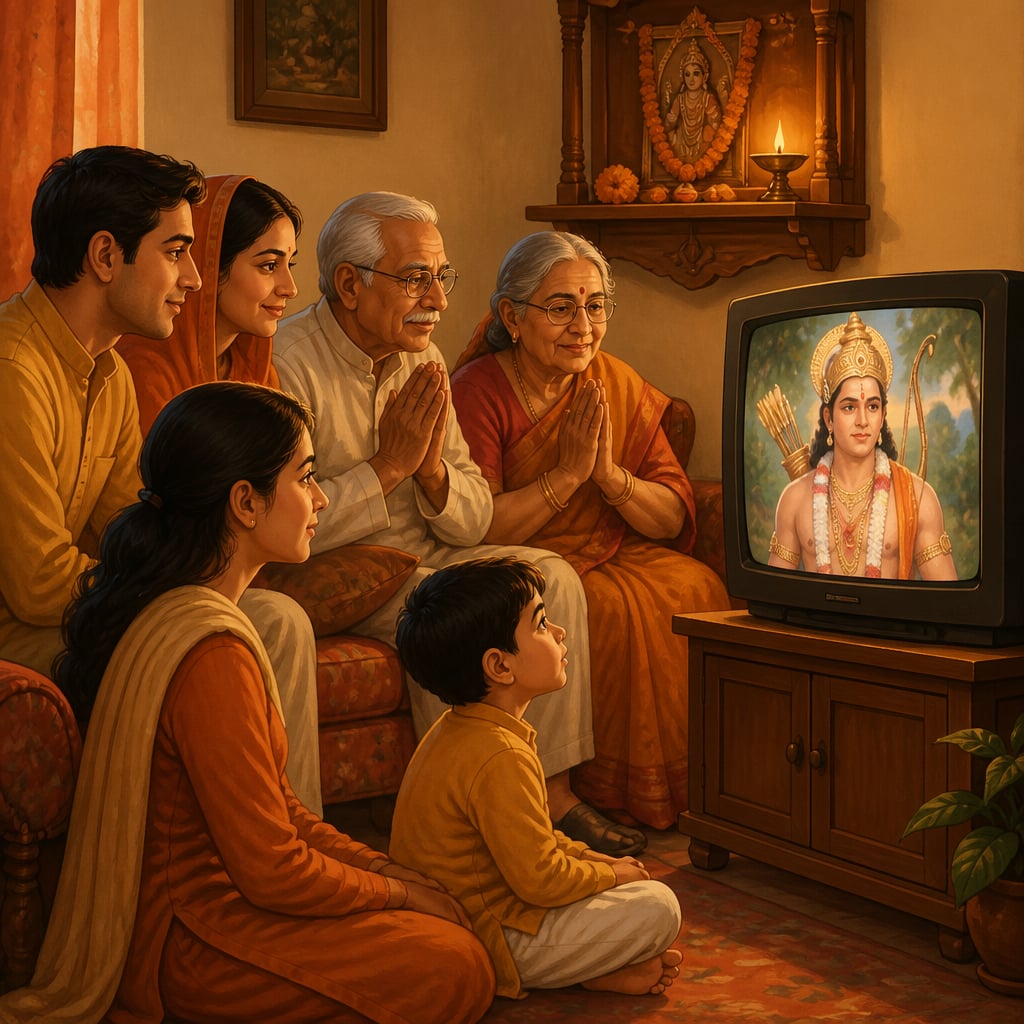
What happened next stunned media analysts worldwide. The re-telecast drew 77 million viewers for a single episode, making it the most-watched entertainment program on the planet at that moment. Over its run, the show accumulated 7.7 billion viewing minutes. Families gathered around television screens exactly as their parents had done 33 years earlier. Social media exploded with memes, discussions, and emotional reactions from a generation experiencing the show for the first time.
No marketing campaign produced this. No algorithm engineered it. A 33-year-old television serial, based on a story composed over two millennia ago, commanded more attention than any Netflix original, any Bollywood release, any cricket match.
This was not nostalgia. This was a demonstration of something far more significant: civilizational software running on new hardware.
The Ramayana is not simply a story. It is a transmission technology. It carries within it ethical frameworks, social models, governance philosophy, and civilizational identity. Every generation receives it, internalizes it, and transmits it forward. The medium changes (oral poetry to manuscripts to television to streaming), but the transmission continues.
The 2020 phenomenon revealed what this lesson examines: India built the most sophisticated system of cultural transmission in human history. Not through centralized institutions that could be captured or destroyed, but through distributed networks that replicate themselves across time, geography, and media. These networks are the reason Indian civilization still exists when every other ancient civilization of comparable age has either vanished or survives only in museums.
The Mechanism: Six Networks That Run a Civilization
India's cultural infrastructure operates through six interconnected transmission networks. Each is independently resilient. Together, they form a civilizational operating system that has proven almost impossible to shut down completely.
1. Guru-Shishya Parampara: The Personalized Knowledge Chain
The most fundamental transmission network is the guru-shishya (teacher-student) relationship. Unlike institutional education, where knowledge is standardized and delivered through curricula, the guru-shishya model transmits knowledge as a living relationship. The guru does not merely teach information. The guru transmits a way of seeing, thinking, and being.
This model creates knowledge chains (paramparas) that stretch across centuries. A student of Carnatic music today can trace their musical lineage through their guru, their guru's guru, and so on, back through centuries to the originators of the tradition. The knowledge is not stored in a library. It lives in the chain of human relationships.
The strategic significance is profound. You can burn a library. You can demolish a university. You cannot destroy a knowledge chain distributed across thousands of teacher-student pairs scattered across an entire subcontinent. When Bakhtiyar Khilji's forces destroyed Nalanda in 1193, the institutional infrastructure was lost. But the knowledge traditions survived because they existed in guru-shishya chains that stretched far beyond any single institution.
2. Oral Knowledge Systems: Engineering Precision Without Writing
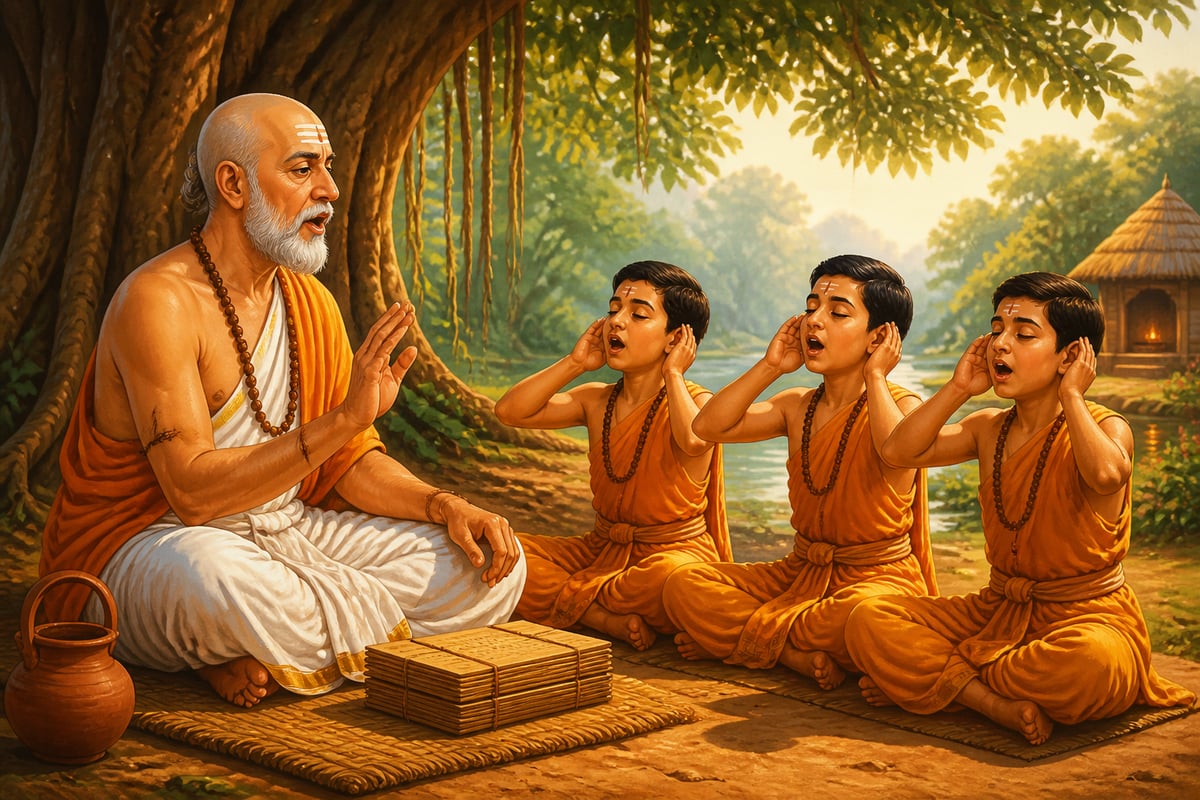
The Rigveda was composed roughly 3,500 years ago. It was transmitted orally for over two millennia before being written down. When scholars finally compared written manuscripts from different regions of India, separated by thousands of kilometers, they found the texts matched with extraordinary precision.
This was not accidental. Vedic oral transmission developed sophisticated error-correction techniques that function like checksums in modern computing. The Pada-patha breaks verses into individual words. The Krama-patha recites words in overlapping pairs (word 1-2, word 2-3, word 3-4). The Jata-patha recites forward and backward in patterns. The Ghana-patha combines multiple patterns simultaneously. Each method cross-verifies the others. If a single syllable is altered, the mathematical patterns break.
This is not mere memorization. It is an engineered information preservation system that maintained data integrity across three millennia without any physical storage medium. No other civilization achieved this level of oral transmission precision.
3. Spiritual Lineages: The Pan-Indian Philosophical Network
In the 8th century CE, Adi Shankaracharya established four mathas (monastic institutions) at the four corners of India: Sringeri in the south, Puri in the east, Dwaraka in the west, and Jyotirmath in the north. Each matha became the anchor of a spiritual lineage that maintained philosophical discourse, trained scholars, and preserved traditions.
This was civilizational architecture, not just religious organization. The four mathas created a network that connected every region of India through shared philosophical frameworks while allowing regional diversity in practice. A Shaiva tradition in Tamil Nadu and a Vaishnava tradition in Bengal could maintain their distinct identities while remaining connected to a common civilizational discourse through these institutional networks.
Other spiritual lineages, including the Nath Sampradaya, the Ramanuja tradition, the Madhva tradition, and the various Sufi-Bhakti synthesis traditions, added layers to this network. No single lineage controlled the whole. The authority was distributed across multiple competing and cooperating traditions.
4. Epics as Self-Replicating Cultural Software
The Ramayana exists in over 300 documented versions across South and Southeast Asia. Valmiki's Sanskrit original, Kamban's Tamil retelling, Tulsidas's Awadhi Ramcharitmanas, Ezhuthachan's Malayalam version, the Thai Ramakien, the Javanese Kakawin Ramayana, and the Cambodian Reamker are each distinct works of literature. Yet they all transmit a common civilizational framework: dharmic governance, familial duty, the ideal of righteous conduct, the consequences of adharma.
This is what makes the epics function as cultural software rather than merely as stories. Each region does not just receive the Ramayana passively. It actively retells it, adapts it, and makes it local. The story replicates itself through voluntary adoption, not imperial imposition. Every retelling reinforces the core civilizational values while incorporating local culture, language, and geography.
The Mahabharata operates identically. Regional traditions, folk performances, Yakshagana, Kathakali, Therukoothu, and countless local theater forms retell Mahabharata episodes in local languages, keeping the civilizational narrative alive in villages that may never have read a Sanskrit text.
5. Festival Networks: Shared Civilizational Rhythm
Diwali is celebrated from Kashmir to Kanyakumari, from Gujarat to Assam. The specific traditions vary. In the north, it celebrates Rama's return to Ayodhya. In the south, it marks Krishna's victory over Narakasura. In Bengal, it honors Kali. In Jain traditions, it commemorates Mahavira's nirvana. In Gujarat, it marks the new financial year.
The festival is the same. The stories differ. The civilizational function is identical: creating a shared rhythm of celebration that connects hundreds of millions of people across linguistic, regional, and sectarian boundaries.
Navaratri operates similarly. Nine nights of celebration with regional variations: Durga Puja in Bengal, Garba in Gujarat, Golu in Tamil Nadu, Bathukamma in Telangana. Each is locally distinct. Each connects to the same civilizational cycle. No central authority mandates this. The festival network is self-organizing.
This shared calendar creates what political scientists would call "civilizational synchronization." When hundreds of millions of people celebrate the same occasions, they are participating in a distributed coordination mechanism that maintains civilizational coherence without central control.
6. Artistic Traditions: Knowledge Encoded in Movement and Sound
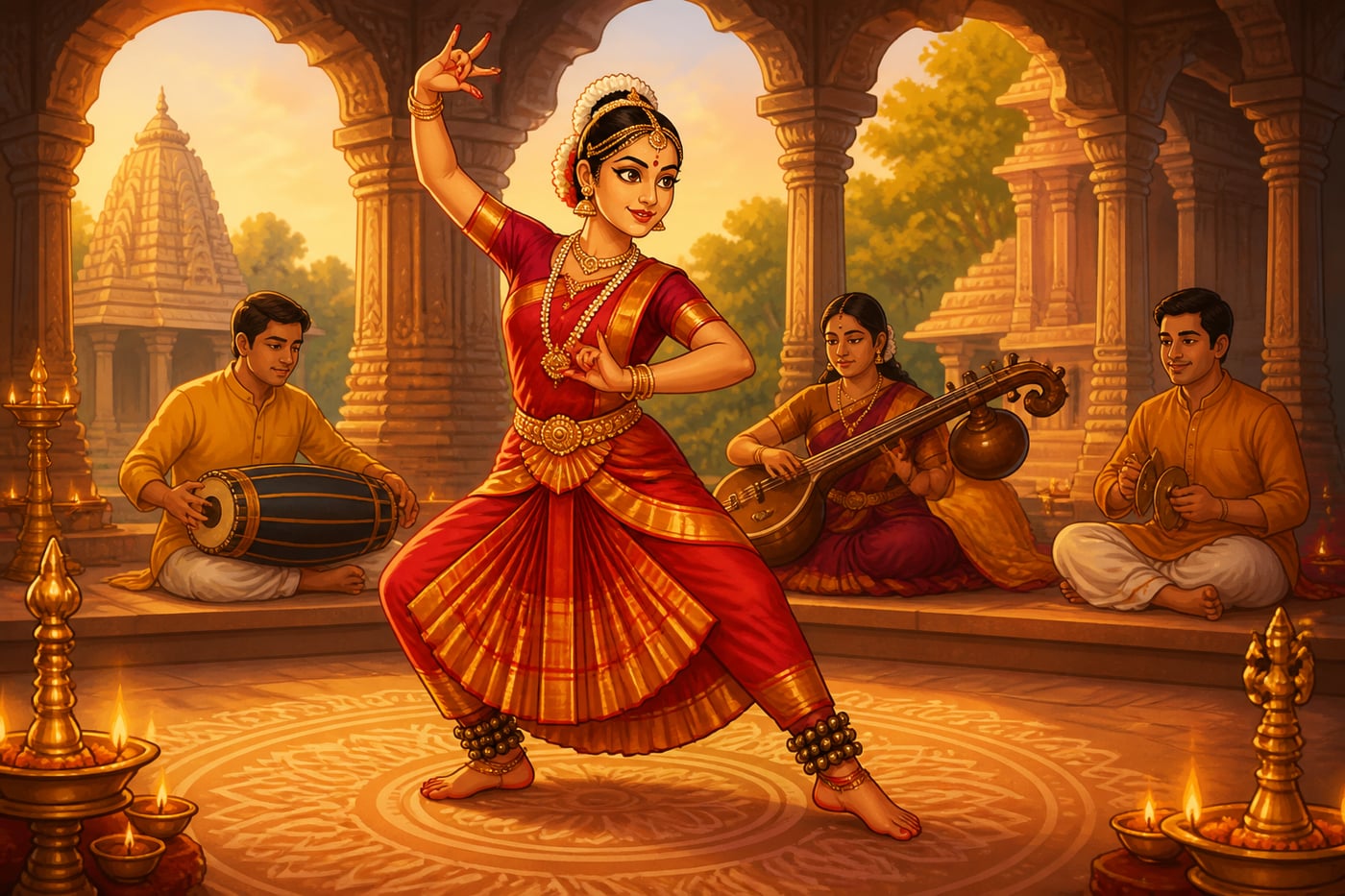
Bharatanatyam is not just dance. It is a knowledge system. The Natyashastra, attributed to Bharata Muni, codifies 108 karanas (dance movements), nine rasas (emotional essences), and elaborate systems of hand gestures (mudras) that encode narrative meaning. A trained dancer carries within their body a library of philosophical, mythological, and aesthetic knowledge.
Carnatic and Hindustani music traditions similarly encode mathematical precision (raga structures, tala cycles) and spiritual philosophy within musical forms. These traditions are transmitted through the guru-shishya model, creating parallel knowledge chains that preserve civilizational content in artistic form.
The strategic function is redundancy. The same philosophical ideas encoded in Sanskrit texts are also encoded in dance movements, musical compositions, temple sculptures, and textile patterns. Destroying one medium does not destroy the knowledge, because it exists simultaneously in multiple transmission formats.
The Key Insight: Distributed, Not Centralized
The critical feature of all six networks is that they are distributed. No single node controls the system. There is no pope, no central committee, no single institution whose capture or destruction can shut down the transmission.
This is why Indian civilization survived when other ancient civilizations did not. Egyptian civilization had centralized knowledge in its priesthood and temples. When those fell, the civilization's knowledge systems collapsed. Mesopotamian civilization depended on centralized scribal traditions. When the institutions were destroyed, the knowledge vanished. Rome's civilizational identity was embedded in its imperial institutions. When the empire fell, the civilizational infrastructure fell with it.
India's transmission networks, by contrast, operate like a mesh network in modern computing. Remove any node, and the network routes around the damage. Destroy a university, and the guru-shishya chains continue. Demolish a temple, and the festivals carry the tradition. Ban a language, and the oral traditions preserve the content in other forms.
The Pattern: Survival Through Distributed Resilience
The historical evidence for this distributed resilience is extensive.
When Mahmud of Ghazni raided Somnath in 1025 CE, he destroyed the temple and looted its wealth. The temple was rebuilt. Not by a central authority issuing an order, but by distributed networks of devotees, merchants, and local rulers who considered the site sacred. The same temple has been destroyed and rebuilt at least six times. The destruction was centralized. The rebuilding was distributed.
When the great universities of Nalanda, Vikramashila, and Odantapuri were destroyed in the 12th and 13th centuries, institutional learning suffered a devastating blow. But the philosophical traditions those universities taught did not die. They survived in guru-shishya chains across South India, in Tibetan monasteries that had received Indian scholars, and in the manuscripts carried by fleeing monks to Nepal and Southeast Asia. The institutional nodes were destroyed. The network persisted.
The Bhakti movement (roughly 12th to 17th century) demonstrates this resilience most powerfully. During centuries when political power across much of India was hostile to Hindu and syncretic traditions, civilization was renewed from below. Bhakti saints used every transmission network available. They composed poetry in local languages (bypassing Sanskrit institutional gatekeepers). They sang in public spaces (using artistic traditions as transmission medium). They established new guru-shishya lineages. They created new festivals and pilgrimage routes.
Kabir in the north, Basavanna in Karnataka, the Alvars and Nayanars in Tamil Nadu, Chaitanya in Bengal, Mirabai in Rajasthan, Tukaram in Maharashtra. These figures did not coordinate with each other. They emerged independently from the same distributed cultural infrastructure. The civilization's immune system activated across multiple regions simultaneously, without central direction.
Consider the contrast with Zoroastrianism in Persia. Zoroastrian civilization was deeply tied to the Sasanian imperial structure. When the Arab conquest dismantled that structure in the 7th century, Zoroastrian civilization largely collapsed in its homeland. It survived only in small diaspora communities (Parsis in India) precisely because those communities established their own guru-shishya equivalent (the priestly lineage system) and festival networks (Navroz, Sadeh) in a new geography.
The pattern is consistent across civilizational history: transmission networks determine survival. Centralized civilizations are efficient but fragile. Distributed civilizations are messy but resilient.
Dharmic Wisdom: The Sacred Chain of Knowledge
The concept of Parampara (lineage, succession, that which flows from one to another) is not merely a social arrangement in dharmic thought. It is a sacred principle.
The Bhagavad Gita opens its fourth chapter with Krishna telling Arjuna:
"I taught this imperishable yoga to Vivasvan (the Sun god). Vivasvan taught it to Manu. Manu taught it to Ikshvaku. Thus, received through succession, the royal sages knew this." (Gita 4.1-2)
Knowledge, in this framework, is not something you discover independently. It is something you receive through a chain of transmission that stretches back to its original source. The guru is not merely a teacher who conveys information. The guru is a link in a chain that connects the student to the source of knowledge itself. Breaking this chain does not just lose information. It severs a connection.
The Mundaka Upanishad distinguishes between Para Vidya (higher knowledge, knowledge of the imperishable) and Apara Vidya (lower knowledge, the sciences and arts). Both require transmission through qualified teachers. But Para Vidya specifically requires the guru-shishya relationship because it involves transformation, not just information. You cannot read your way to it. You must receive it from someone who has realized it.
This philosophical framework explains why Indian civilization invested so heavily in human transmission networks rather than relying solely on written texts. The written text preserves information. The guru-shishya chain preserves understanding. The festival preserves lived experience. The artistic tradition preserves embodied knowledge. Together, they transmit not just what a civilization knows, but what it is.
The Arthashastra, always practical, frames this differently. Kautilya emphasizes that a ruler's first duty is to protect the institutions of learning and cultural transmission. Not because they are ornamental, but because they are infrastructure. A kingdom without roads cannot move goods. A civilization without transmission networks cannot move knowledge, values, or identity across generations.
The Defense: Becoming a Node in the Network
The six transmission networks described in this lesson are not historical curiosities. They are active infrastructure. But infrastructure requires maintenance, and several of these networks are weakening.
Reconnect to a living tradition. The most direct action is to become a student in the guru-shishya model. Learn a classical art form, a musical tradition, a philosophical system, or a Sanskrit text from a qualified teacher. Not from YouTube. From a person who received the knowledge from their teacher, who received it from theirs. When you do this, you become a node in a transmission chain. You are not just learning a skill. You are keeping a civilizational network alive.
Celebrate with understanding. Participate in festivals not as commercial events but as civilizational practices. Know why Navaratri has nine nights. Know what the lighting of lamps on Diwali signifies beyond the surface narrative. Teach children the stories behind the celebrations. Every family that transmits festival knowledge with meaning is functioning as a micro-guru for the next generation.
Support the arts as infrastructure. Classical arts are not entertainment. They are knowledge systems encoded in aesthetic form. Attend concerts and dance performances. Support artists and institutions that maintain traditional teaching methods. When a Bharatanatyam dancer has no students, a transmission chain that may be centuries old dies. When a Carnatic music guru has no shishyas, a raga tradition disappears from the living network.
Learn one oral tradition. Memorize a Suktam, a Stotra, or a set of shlokas in the traditional chanting method. Experience firsthand the precision engineering of oral transmission. Even a small personal practice connects you to the oldest continuous knowledge transmission system in human history.
The insight from this lesson is structural: India's civilizational resilience comes not from any single institution, text, or leader, but from the distributed network of transmission systems that carry knowledge, values, and identity across generations. Every individual who participates in these networks strengthens the mesh. Every tradition that dies weakens it. The defense of civilization is not abstract. It is the daily practice of receiving, holding, and transmitting.
Case studies
The Rigveda: 3,500 Years of Error-Free Transmission Without Writing
The Rigveda was composed roughly 3,500 years ago and transmitted orally for over two millennia before being written down. To preserve absolute fidelity, Vedic scholars developed an interlocking system of recitation methods. The Pada-patha breaks verses into individual words. The Krama-patha recites words in overlapping pairs (1-2, 2-3, 3-4). The Jata-patha reverses and repeats pairs in a woven pattern. The Ghana-patha combines multiple patterns simultaneously, creating a multi-layered error-detection system. When manuscripts from regions separated by thousands of kilometers (Kerala, Kashmir, Varanasi, Odisha) were finally compared by European scholars in the 19th century, the texts matched with near-perfect accuracy across all traditions. No other civilization achieved this level of oral precision over such a duration.
The Vedic tradition classified this knowledge as Shruti ('that which is heard'), not Smriti ('that which is remembered'), because the transmission was designed to be exact reproduction rather than approximate recall. The Mundaka Upanishad's insistence that knowledge must be received from a qualified guru (shrotriyam brahma-nishtham) reflects the engineering requirement: the oral system works only when the transmission chain is unbroken and each link is properly trained. This was not faith. It was information engineering using human beings as the storage and transmission medium.
UNESCO recognized the tradition of Vedic chanting as a Masterpiece of the Oral and Intangible Heritage of Humanity in 2003. The oral tradition proved more durable than clay tablets, papyrus scrolls, or stone inscriptions. Mesopotamian cuneiform, Egyptian hieroglyphics, and Roman texts all required physical media that degraded, were destroyed, or became unreadable. The Vedic oral tradition survived because its medium was human consciousness, distributed across thousands of practitioners.
The most durable knowledge preservation technology is not physical media but properly engineered human transmission networks. When the medium is human and the network is distributed, no single act of destruction can erase the knowledge.
In the digital age, we assume that digital storage is permanent. But digital formats become obsolete (floppy disks, CDs, proprietary formats), servers fail, and data rots. The Vedic oral tradition, operating for 3,500 years, has outlasted every physical and digital storage medium ever invented. This raises a fundamental question about knowledge preservation strategy.
The Ghana-patha recitation method for a single verse generates 13 permutations of the original word sequence, creating redundancy comparable to modern RAID storage systems. A 10-syllable verse requires reciting approximately 130 syllables in precise mathematical patterns, making undetected errors statistically near-impossible.
ISKCON and Chinmaya Mission: Guru-Shishya Parampara Goes Global
In 1965, A.C. Bhaktivedanta Swami Prabhupada arrived in New York at age 69 with forty rupees and a trunk of books. By 2025, the organization he founded (ISKCON) operates 800+ temples and centers across 100+ countries, runs the world's largest vegetarian food distribution network (serving over 1.2 million free meals daily in India alone through the Akshaya Patra partnership), and has published the Bhagavad Gita in over 80 languages. Separately, Chinmaya Mission, founded by Swami Chinmayananda in 1953, runs 300+ centers worldwide, operates structured Vedanta study programs, and has trained thousands of acharyas (teachers) through its residential Sandeepany Sadhanalaya institutes. Both organizations adapted the guru-shishya model for the modern world: systematic curricula, teacher training programs, institutional governance, and digital platforms, while maintaining the core parampara transmission mechanism.
Both organizations function as modern sampradayas. ISKCON operates within the Gaudiya Vaishnava parampara, tracing its lineage through Chaitanya Mahaprabhu to Madhvacharya. Chinmaya Mission operates within the Advaita Vedanta tradition of Shankaracharya. The guru-shishya mechanism is identical to what operated two millennia ago: a qualified teacher transmits knowledge, practice, and realization to students who then become teachers themselves. What changed is the institutional format, not the transmission technology. Kautilya, who treated knowledge institutions as civilizational infrastructure, would recognize these as strategic assets operating beyond state borders.
By 2025, these two organizations alone have created a global network of trained teachers transmitting Vedantic philosophy, Sanskrit knowledge, and dharmic practice to millions who would otherwise have no access to these traditions. ISKCON's Bhaktivedanta Book Trust has distributed over 500 million books. Chinmaya Mission's Bala Vihar program reaches tens of thousands of children worldwide. The parampara model proved scalable across languages, cultures, and continents.
The guru-shishya parampara is not a historical relic but a scalable, adaptable transmission technology. It works in 21st-century New York as effectively as it did in 8th-century Sringeri, provided the core mechanism (qualified teacher to committed student) is maintained.
At a time when institutional religion is declining globally, organizations built on the guru-shishya model are growing. This suggests that the parampara transmission format meets a fundamental human need that centralized, impersonal institutions cannot: personalized knowledge transmission through a living relationship.
ISKCON's Akshaya Patra Foundation serves over 1.2 million free meals daily to schoolchildren across India, making it the world's largest NGO-run midday meal program. A single organization, built on the guru-shishya model, now feeds more children daily than the entire food aid operations of several UN agencies.
The Talmud: How Oral Transmission Preserved a Civilization Without a Homeland
In 70 CE, Roman forces under Titus destroyed the Second Temple in Jerusalem, the central institution of Jewish civilization. The Jewish people lost their homeland, their political structure, and their primary place of worship. Over the next 2,000 years, Jews were scattered across every continent, facing repeated persecution, expulsion, and genocide. Yet Jewish civilizational identity survived intact. The mechanism of survival was the Oral Torah, a body of legal, ethical, and philosophical knowledge transmitted through rabbi-student chains (Mesorah) remarkably similar to the guru-shishya parampara. This oral tradition was eventually compiled as the Mishnah (c. 200 CE) and the Talmud (c. 500 CE), but its transmission continued through living teacher-student relationships in every community, from Baghdad to Cordoba to Vilnius to New York.
The Jewish experience is the strongest external validation of this lesson's thesis. The Mesorah (chain of tradition, from rabbi to student) mirrors parampara in both structure and function. The rabbi, like the guru, does not merely teach information but transmits a way of life, a method of interpretation, and a civilizational identity. Jewish festivals (Passover, Sukkot, Shabbat) function identically to Hindu festival networks: creating shared civilizational rhythm across dispersed communities without central coordination. The Torah reading cycle, recited aloud in synagogues weekly, parallels the oral Vedic tradition. Both civilizations invested in human transmission networks rather than centralized institutions, and both survived millennia as a result.
Jewish civilization survived 2,000 years of diaspora, repeated expulsions, pogroms, and the Holocaust, ultimately reconstituting a nation-state in 1948. By contrast, Mesopotamian civilization, ancient Egyptian civilization, and the Greco-Roman pagan tradition, all of which relied on centralized institutions (temples, priesthoods, imperial structures), disappeared when those institutions were destroyed. The civilizations with distributed transmission networks survived. The civilizations without them did not.
A civilization's survival depends not on the strength of its political power or the size of its territory, but on the resilience of its transmission networks. Distributed human-to-human knowledge chains are the most robust civilizational survival technology ever developed.
India today faces pressures on its transmission networks (declining guru-shishya traditions, commercialized festivals, dying artistic lineages) but retains its geographic homeland and political sovereignty. The Jewish example shows both the power of transmission networks (they alone can preserve a civilization) and a warning: if India's networks weaken while it still has a homeland, recovery will be far harder than maintaining what exists.
Despite never exceeding 0.2% of the world's population, the Jewish people have produced approximately 22% of all Nobel Prize winners, a direct result of a civilizational culture built on knowledge transmission through unbroken teacher-student chains over millennia.
Reflection
- Map your personal connection to each of the six transmission networks described in this lesson: (1) Guru-Shishya (do you learn anything from a living teacher in a lineage?), (2) Oral traditions (can you recite any stotra, suktam, or shloka from memory?), (3) Spiritual lineages (are you connected to any sampradaya?), (4) Epics (how did you first encounter the Ramayana or Mahabharata?), (5) Festivals (do you know why you celebrate what you celebrate?), (6) Artistic traditions (does anyone in your family practice a classical art form?). Which connections are alive? Which have weakened or broken within your generation?
- The Mundaka Upanishad insists that the highest knowledge must be received from a living guru, not merely read from a text. Why might Indian civilization have invested so heavily in human-to-human transmission rather than relying primarily on written preservation? What is the difference between reading about a raga in a musicology textbook and learning it from a guru who learned it from their guru? What exactly is lost when a parampara breaks that cannot be recovered from manuscripts alone?
- This lesson argues that India survived because its civilizational infrastructure was distributed rather than centralized. Rome, Egypt, and Mesopotamia were more orderly but collapsed when their central institutions fell. India was messier but survived because no single point of failure could bring down the whole network. Is there an inherent tradeoff between efficiency and resilience in civilizational design? Can India's distributed model serve as a conscious template for civilizational survival, or does the modern world's demand for standardization and central coordination make this model obsolete?