The Economic and Political Architecture
Sacred Geography, Temple Ecosystems, and Village Self-Governance
India's pre-colonial civilization ran on five interconnected pillars: sacred geography binding regions through pilgrimage, temples functioning as banks-schools-hospitals-employers, cultural guilds preserving advanced knowledge, village assemblies governing themselves democratically, and pilgrim trade networks connecting it all. This distributed architecture made India resilient for millennia.
See It Today: The Billion-Dollar Temple That Runs Like a City
Every day, roughly 75,000 people climb the seven hills of Tirumala in Andhra Pradesh to visit the shrine of Lord Venkateswara. On peak days, that number crosses 150,000. The Tirumala Tirupati Devasthanams (TTD) processes over $1 billion in annual revenue from donations alone, making it one of the wealthiest religious institutions on the planet.
But the wealth is not the point. The system is.
TTD operates hospitals, schools, and colleges. It runs a massive free meal program, the Anna Prasadam, that feeds over 100,000 people daily. It employs thousands of cooks, priests, administrators, security personnel, florists, and logistics workers. It manages accommodation for millions of annual visitors. It funds publishing houses that produce dharmic literature. It maintains satellite temples across South India.
This is not a "place of worship." It is a civilizational institution. One that provides education, healthcare, employment, food security, cultural preservation, and economic circulation to an entire region. Strip away the religious framing, and what you have is a self-sustaining ecosystem that rivals small nations in organizational complexity.
Now consider this: TTD operates under direct government control through the Andhra Pradesh Endowments Act. Its trustees are political appointees. Its surplus revenue has historically been diverted to government coffers. Despite these constraints, the institution generates enough economic and social output to sustain an entire pilgrimage economy.
If a single temple complex under government control can still generate this much civilizational output, imagine what the full temple ecosystem looked like when thousands of such institutions operated independently across the subcontinent. That is the architecture this lesson maps.
The Mechanism: Five Pillars of India's Economic-Political Architecture
India's pre-colonial economic and political system was not a simplified version of European feudalism. It was a distributed network architecture built on five interconnected pillars, each reinforcing the others. Together, they created a civilization that could function without centralized command.
Sacred Geography: The Civilizational Grid
India's sacred geography is not a random collection of holy sites. It is a deliberate network that connects every corner of the subcontinent into a single civilizational space.
The Char Dham circuit (Badrinath, Dwarka, Puri, Rameswaram) stretches from the Himalayas to the southern tip, from the western coast to the eastern. The twelve Jyotirlingas are distributed across what are now twelve different states. The Shakti Peethas span from Balochistan to Assam, from Nepal to Sri Lanka. The Sapta Puri (seven sacred cities) dot the Gangetic plain and beyond.
This was not accidental. Sacred geography created a reason for people in Tamil Nadu to travel to Varanasi, for Kashmiris to journey to Rameswaram, for Gujaratis to visit Puri. Centuries before railways, highways, or a common political administration, pilgrimage circuits created a pan-Indian consciousness. A Tamil Brahmin and a Bihari farmer who had never met shared the same mental map of Bharatavarsha because they recognized the same sacred sites.
The tirtha (pilgrimage crossing) network was India's civilizational internet: a distributed system for transmitting culture, identity, and economic activity across vast distances without centralized control.
Temple Ecosystems: Civilizational Institutions, Not Just Shrines
The modern Western category of "place of worship" captures perhaps five percent of what an Indian temple historically was. Temples were the anchor institutions of Indian civilization, performing functions that the modern world distributes across dozens of separate institutions.
A major temple complex was simultaneously a school (with pathshalas teaching Sanskrit, mathematics, astronomy, and dharmic texts), a bank (accepting deposits, making loans, managing endowments), an arts academy (employing and training dancers, musicians, sculptors, painters), a hospital (with vaidyas providing Ayurvedic treatment), a food distribution center (annadana as daily practice, not occasional charity), an employment hub (employing hundreds to thousands of people across dozens of specialized roles), and a welfare institution (providing shelter, clothing, and support to the destitute).
Temple endowments functioned as the financial backbone of local economies. Land grants, cattle endowments, gold deposits, and grain reserves created a diversified asset base that sustained operations across generations. The temple was not dependent on a single revenue stream. It was a portfolio institution.
This is why the systematic targeting of temples during invasions and later under colonial rule was not incidental religious persecution. It was strategic economic warfare. Destroying a temple meant destroying the school, the bank, the hospital, the arts academy, and the employment center simultaneously. One strike, six institutions destroyed.
Cultural Guilds: The Knowledge Economy
India's craft guilds, known as shrenis, represented one of the world's most sophisticated systems for organizing production, preserving knowledge, and maintaining quality.
Guilds of weavers, metalworkers, stone carvers, jewelers, potters, dyers, and dozens of other crafts operated with their own governance structures, quality standards, dispute resolution mechanisms, and training systems. A weaver's guild did not simply produce textiles. It managed apprenticeship programs, maintained design archives (through pattern memory and sample preservation), negotiated with traders, set prices, and provided social insurance to members.
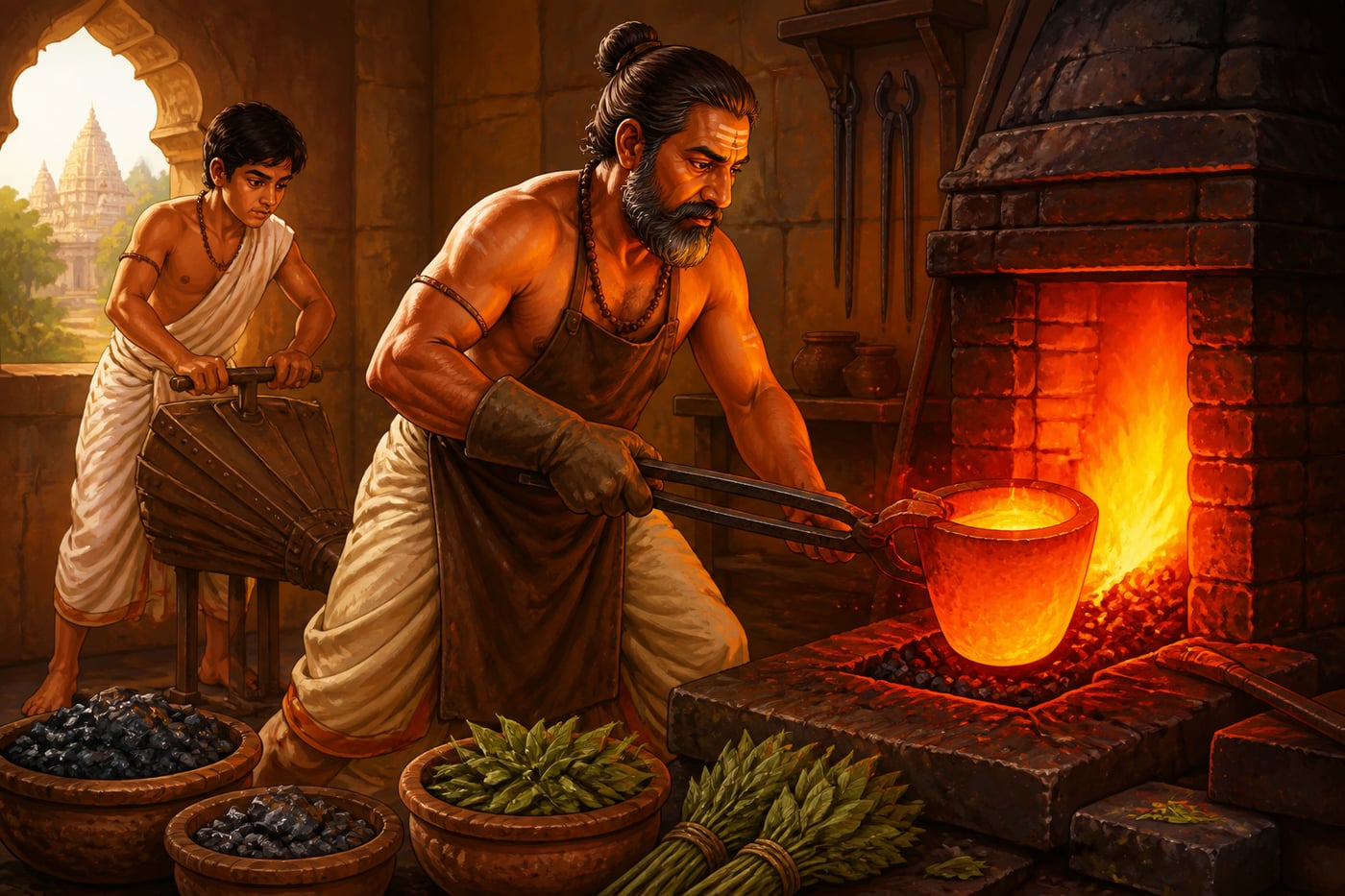
The metallurgical guilds deserve special attention. Indian smiths produced Wootz steel, recognized across the ancient world as the finest steel available. The process involved precise temperature control, specific carbon content management, and techniques transmitted within guild families across generations. This was not artisanal simplicity. It was industrial sophistication organized through guild networks rather than factories.
Guild knowledge was transmitted through a combination of family lineage, formal apprenticeship, and community practice. The guild was simultaneously an economic unit, a knowledge institution, and a social welfare system. Like the temple, it bundled multiple modern institutional functions into a single organic structure.
Village Self-Governance: Distributed Political Architecture
India's political architecture was never purely top-down. The village, or grama, functioned as a self-governing republic that operated largely independent of whatever kingdom or empire claimed sovereignty over the region.
Village assemblies (gram sabhas) managed land allocation, tax collection, dispute resolution, water management, common property resources, and local law enforcement. They appointed committees for specific functions: irrigation, temple maintenance, education, public works. Leadership rotated. Accountability was to the community.
This distributed governance meant that when empires fell, as they regularly did, village life continued with minimal disruption. The political architecture was designed for resilience. It did not depend on a single point of authority. A Maratha kingdom might replace a Mughal governor, and the village assembly would continue managing its irrigation tanks and resolving its property disputes exactly as before.
Kautilya's Arthashastra formalized this distributed model. The state existed not to control the village but to protect it. The king's dharma was to maintain conditions under which villages could self-govern: defense against external threats, maintenance of trade routes, and adjudication of disputes beyond village capacity. Governance was a service to the civilizational network, not domination over it.
Pilgrim Trade Networks: The Connecting Tissue
Pilgrimage was not merely spiritual practice. It was the circulatory system of the Indian economy. Pilgrims traveling from Bengal to Dwarka or from Kerala to Kashi carried more than devotion. They carried goods, currency, techniques, stories, artistic styles, and market information.
Along every major pilgrimage route, dharmashalas (rest houses), chatrams (feeding houses), and market towns emerged to service pilgrim traffic. These became permanent commercial centers. Artisan guilds clustered around temple towns because that was where the customers were. Banaras became a textile center partly because millions of pilgrims needed cloth. Thanjavur became a bronze-casting center partly because temples needed murtis.
The pilgrim trade network connected sacred geography, temple economies, guild production, and village commerce into a single integrated system. Disrupt any one node, and the others compensated. Destroy a temple, and pilgrims found alternative routes. Displace a guild, and its members reconstituted in another temple town. This was the network resilience that the next lesson will examine in detail.
The Pattern: Inscriptions That Speak
The architecture described above is not theoretical reconstruction. It is documented in thousands of stone and copper-plate inscriptions across the subcontinent.
The Chola Temple Economy
The Brihadeshwara Temple at Thanjavur, built by Rajaraja Chola I around 1010 CE, left behind detailed inscriptions recording its economic operations. The temple employed 400 devadasis (temple dancers), 57 music instructors, hundreds of priests, cooks, garland-makers, accountants, and security personnel. It managed extensive agricultural lands whose output funded daily operations. It maintained detailed accounts of gold, silver, and jewel endowments. It operated what modern economists would recognize as a sophisticated asset management system, with different endowments earmarked for specific functions: one set of lands for feeding Brahmins, another for maintaining lamps, another for festival expenses.
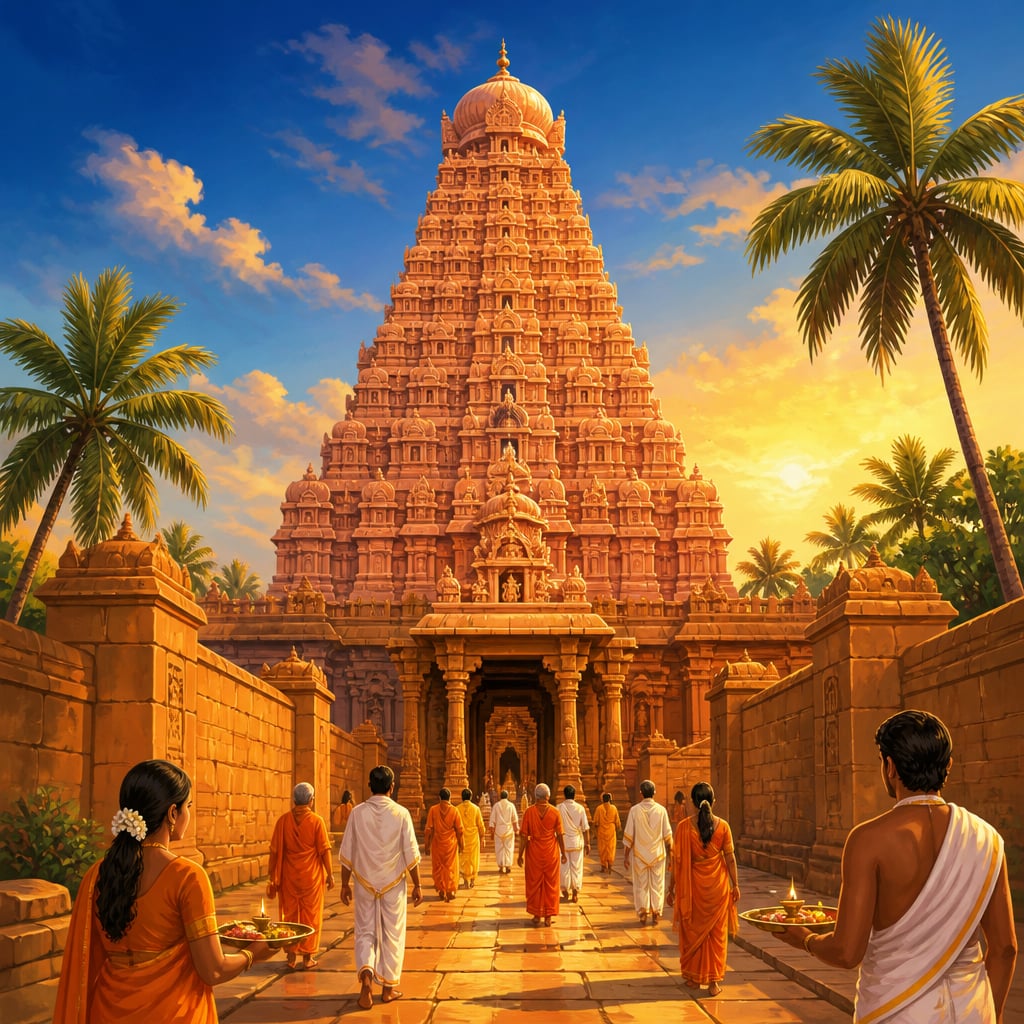
The Chola temple inscriptions reveal an institution managing an economic portfolio more complex than most medieval European towns.
Uttaramerur: Democracy Before the Word Existed
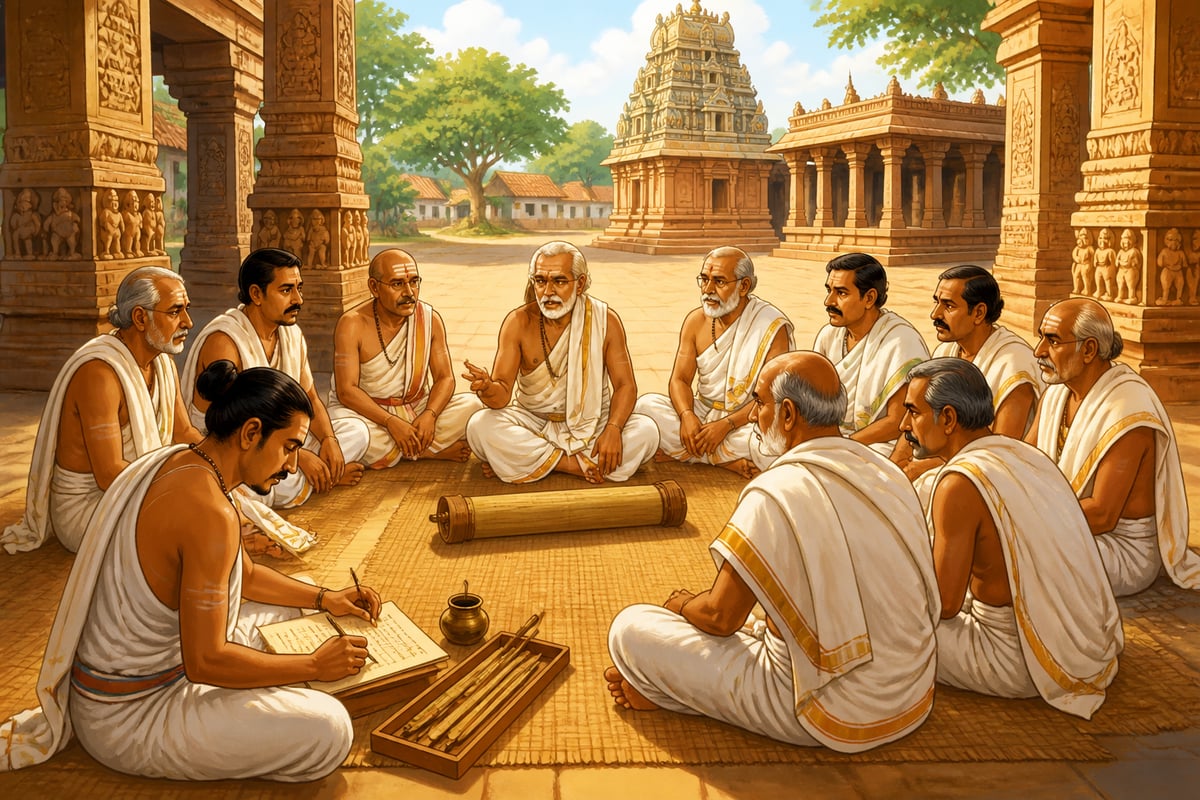
The Uttaramerur inscriptions from the Chola period (circa 920 CE) document village governance procedures that would impress a modern political scientist. The inscription specifies: candidates for the village council must own property, be between 35 and 70 years of age, have knowledge of the Vedas, and possess good character. Those who have failed to submit accounts from previous terms are disqualified. Selection was by lot from qualified candidates, ensuring rotation and preventing entrenchment.
The inscription describes specialized committees for irrigation management (eri-variyam), garden maintenance, and temple administration. Each committee had defined terms, reporting requirements, and accountability mechanisms. This was not primitive village life. It was constitutional self-governance, documented in stone six centuries before the Magna Carta.
Guild Power in Stone
Inscriptions from across India document guild autonomy and sophistication. The Mandsaur inscription (5th century CE) records a guild of silk weavers that had migrated from Gujarat to Malwa, maintaining their craft identity, governance structure, and social organization across hundreds of kilometers. They funded temple construction, maintained their own courts, and operated as a self-contained economic and social unit.
These inscriptions demonstrate that India's economic architecture was not a crude subsistence system awaiting European modernization. It was a sophisticated, distributed, self-governing network that produced some of the world's finest goods, managed complex financial instruments, and maintained democratic governance at the village level.
Dharmic Wisdom: Where Artha Meets Dharma
The Western intellectual tradition separates economics from ethics, governance from religion, the sacred from the commercial. Indian political thought never made this separation.
In the Arthashastra, Kautilya defines the king's primary duty as Yogakshema: providing conditions for both the spiritual and material welfare of the people. The treasury (kosha) is not the king's personal wealth. It is the civilizational resource, maintained through dharmic governance and deployed for collective welfare. Kautilya writes that a king who drains his people's wealth is like a person who poisons the water they need to drink.
The concept of Dharma-Artha integration means that economic activity and ethical conduct are not separate domains to be balanced against each other. They are aspects of a single civilizational practice. The temple was simultaneously sacred and commercial because Indian thought did not recognize these as contradictions. A weaver producing fine silk was practicing both his craft dharma (varna-dharma in its original sense of duty aligned with capability) and contributing to economic welfare.
This integration explains why the temple was the natural institutional center. It was the one institution where dharmic purpose and economic function were inherently unified. Education served both spiritual development and practical skill. Arts honored the divine and generated economic value. Food distribution fulfilled ritual obligation and addressed social welfare.
When colonial administrators separated "religion" from "economics" and "governance," they did not modernize India. They broke the integrating principle that held the entire architecture together.
The Defense: Seeing the Architecture to Rebuild It
Understanding India's economic and political architecture is not an exercise in nostalgia. It is a strategic necessity.
When the British destroyed India's textile guilds through industrial policy, they were not simply competing in the marketplace. They were dismantling a civilizational weapon. When they seized temple endowments and placed temples under bureaucratic control, they were not "reforming" religious institutions. They were neutralizing the anchor institutions of Indian civilization. When they replaced village self-governance with centralized district administration, they were not bringing efficiency. They were destroying the distributed resilience that had allowed Indian civilization to survive centuries of political upheaval.
The lesson for civilizational defense is precise: each of these five pillars must be understood as a civilizational weapon before it can be rebuilt as one.
First, recognize the architecture. Most Indians today do not know that their temples were banks, schools, and hospitals. They do not know that their villages governed themselves through constitutional procedures. They do not know that their craftsmen organized into guilds more sophisticated than medieval European merchant houses. Recovering this knowledge is the first act of civilizational defense.
Second, recognize that destruction was strategic. The colonial dismantling of this architecture was not random. It targeted the specific institutional nodes that gave Indian civilization its distributed resilience. Understanding this pattern helps identify what needs rebuilding and in what priority.
Third, recognize that fragments survive. Tirumala still functions as a civilizational institution despite government control. GI-tagged craft communities still preserve guild knowledge. Village panchayats still operate, however weakened. The architecture is damaged, not destroyed. The question for Act III of this course is whether it can be restored.
The next lesson examines the deeper principle behind this architecture: why India is a civilizational network, not a centralized state, and why that makes it both remarkably resilient and uniquely vulnerable to the faultline engineering that Act II will reveal.
Case studies
Brihadeshwara Temple: The Chola Economic Engine
In approximately 1010 CE, Rajaraja Chola I completed the Brihadeshwara temple at Thanjavur. Far from being a purely religious monument, the temple functioned as a comprehensive economic ecosystem. Stone inscriptions on the temple walls document an institutional architecture of remarkable sophistication: 400 devadasis (temple dancers who preserved classical art forms), 57 music instructors, hundreds of priests, cooks, accountants, flower suppliers, lamp-oil merchants, and security personnel. The temple managed endowments of agricultural land across multiple villages, maintained inventories of gold and jewels with precise weights recorded in the inscriptions, and operated a redistributive economy that cycled wealth from royal and merchant donations through salaries, procurement, and festival expenditures back into the surrounding communities.
The Brihadeshwara inscriptions reveal a system that integrated artha (wealth generation and management) with dharma (sacred duty and social obligation). The temple was not extractive. It received endowments and redistributed them as employment, artistic patronage, and community services. This mirrors the Arthashastra's concept of Yogakshema, where the state's duty is to maintain both the prosperity and the security of its people. The Chola temple economy achieved this through an institution that was simultaneously sacred, administrative, and commercial, all governed by transparent accounting carved in stone for public verification.
The Brihadeshwara inscriptions represent one of the most detailed economic records from the medieval world. The documented payroll system, land management protocols, and supply chain logistics demonstrate institutional sophistication that contemporaneous medieval European institutions rarely matched. The temple sustained its economic functions for centuries after Rajaraja's reign.
Dharmic civilization did not separate the sacred from the economic. Temples were engines of wealth creation, employment, artistic preservation, and community welfare, all integrated within a single institutional framework.
Post-independence temple nationalization laws transferred management of Hindu temples to state governments, severing the economic self-governance that sustained these institutions for a millennium. Understanding what temples actually did economically reframes the debate about temple management from 'religious sentiment' to institutional sovereignty.
The Brihadeshwara inscriptions record the temple's gold inventory down to individual items: 60 pounds of gold jewellery, with each piece described by weight and type. The temple employed over 600 people directly, functioning as the largest employer in the Thanjavur region for centuries.
GI-Tagged Indian Crafts: Guild Knowledge Finds New Markets
Since India's Geographical Indications of Goods Act (1999), traditional craft communities have begun registering their products for legal protection and market recognition. Pochampally ikat (Telangana), Chanderi silk (Madhya Pradesh), Banarasi weaves (Uttar Pradesh), Thanjavur paintings (Tamil Nadu), Kanchipuram silk, and hundreds of other products now carry GI tags. By 2023, India had registered over 400 GI-tagged products. These products trace their origins to specific artisan communities whose production knowledge was transmitted through guild-like family and community structures across centuries. The GI framework provides legal protection against imitation, creates brand recognition in domestic and international markets, and formally acknowledges that the knowledge behind these products belongs to specific communities.
India's traditional shreni (guild) system organized production knowledge within communities that maintained quality standards, trained apprentices, and regulated market access. Colonial deindustrialization shattered these guilds as institutions, but the knowledge itself persisted within families and communities. The GI tag represents the shreni principle adapting to modern legal frameworks. The community still owns the knowledge collectively. The production standards are still maintained through transmitted skill. The market mechanism has changed from guild-regulated local bazaars to legally protected global commerce, but the underlying architecture of community-held specialized knowledge remains intact.
GI-tagged products have shown measurable economic impact. Darjeeling tea's GI tag helped maintain premium pricing in global markets. Pochampally ikat weavers saw income increases after GI registration. The framework has created a legal pathway for traditional knowledge communities to participate in modern markets without surrendering their intellectual heritage to corporate appropriation.
The civilizational architecture of guilds was damaged by colonialism but not destroyed. Traditional knowledge communities are proving capable of adapting ancient production systems to modern market mechanisms when given appropriate legal frameworks.
India's 400+ GI tags represent the largest formal recognition of traditional community knowledge in any country. Each tag is evidence that the village and guild economic architecture described in pre-colonial accounts continues to function, adapting its form while preserving its substance.
India had 432 registered GI-tagged products as of 2023, the third-highest count globally. Karnataka alone has over 40 GI-tagged products, from Mysore silk to Byadagi chilli, each traceable to specific artisan or agricultural communities with centuries of documented production history.
Wootz Steel: The Guild Secret That Conquered Global Markets
For over 2,000 years, Indian metallurgical guilds produced a crucible steel known as Wootz (derived from the Kannada word 'ukku', meaning steel). Manufactured primarily in present-day Karnataka, Tamil Nadu, and Telangana, Wootz steel was traded across the Indian Ocean to the Middle East, where it was forged into the legendary 'Damascus steel' blades prized by warriors from Saladin's armies to the Crusaders. The production process required precise temperature control during smelting, specific ratios of carbon content, and techniques for introducing trace elements like vanadium and titanium. These closely guarded methods were transmitted within guild families across generations without written manuals, relying entirely on apprenticeship and embodied knowledge.
Wootz steel exemplifies the shreni system's capacity to develop and protect high-technology knowledge. The guilds maintained what modern economists would call 'trade secrets' through social institutions rather than patent law. Knowledge transmission through family apprenticeship ensured quality control. Guild governance regulated production volumes and pricing. The integration of metallurgical science with sacred ritual (specific prayers and timing for smelting operations) created a cultural framework that protected the knowledge from casual extraction. This was not superstition. It was intellectual property protection through cultural encoding.
British colonial deindustrialization, combined with competition from Sheffield's industrial steel production, systematically destroyed India's metallurgical guilds in the 18th and 19th centuries. The knowledge of Wootz production was lost by approximately 1900. The civilizational cost was not merely economic. It was the destruction of a 2,000-year knowledge tradition that modern science is still working to fully understand.
Guild knowledge represents civilizational capital accumulated over centuries. Its destruction is not merely an economic event but a civilizational amputation. What took 2,000 years to develop was lost in a century of colonial disruption.
In 2006, researchers at the Technical University of Dresden discovered that Wootz steel blades contained carbon nanotubes and cementite nanowires, structures that modern materials science only learned to produce in the late 20th century. Ancient Indian guild metallurgists had achieved nanotechnology through empirical mastery centuries before the underlying science was understood.
Analysis published in the journal Nature (2006) confirmed carbon nanotubes in a 17th-century Wootz steel blade. These nanostructures, which modern laboratories produce using sophisticated equipment, were achieved by Indian guild metallurgists through empirical processes refined over 2,000 years of continuous practice.
Reflection
- Think about the last temple you visited. Beyond worship, what other functions did it serve? Did it run a school, feed visitors, employ artisans, host cultural events, or manage land? How does your experience compare to the multi-dimensional temple ecosystems described in this lesson?
- What does it mean that temples like Brihadeshwara were simultaneously places of worship, banks, employers of thousands, centers of education, patrons of the arts, and anchors of regional economies? What is lost when we reduce them to 'religious buildings'?
- The Dharmic framework integrates artha (material prosperity) with dharma (ethical order) as complementary rather than contradictory. The modern Western framework separates the sacred from the secular, treating economics and spirituality as fundamentally different domains. Which model produces a more resilient civilization, and why?