The Knowledge Architecture
Sanskrit, Philosophical Pluralism, and the Debate Tradition
India's knowledge architecture is a five-pillar system: Sanskrit's formal precision, philosophical pluralism across competing schools, the Shastrartha debate tradition, extraordinary knowledge diversity from mathematics to medicine, and a commentary tradition that preserved intellectual dialogue across millennia. This distributed network produced, stress-tested, and transmitted knowledge with a resilience that survived even the destruction of its greatest institutions.
See It Today: When AI Rediscovered Panini
In December 2022, Dr. Rishi Rajpopat, a PhD student at the University of Cambridge, made headlines worldwide. He had solved a grammatical problem that had stumped Sanskrit scholars for over 2,500 years.
The problem lay in Panini's Ashtadhyayi, a text written around 400 BCE containing exactly 3,996 rules for generating grammatically correct Sanskrit. For centuries, scholars had struggled with a fundamental question: when two of Panini's rules conflict, which one wins? The traditional answer, proposed by the ancient commentator Katyayana, was that the rule appearing later in the text takes precedence. But this produced errors. Sanskrit scholars had spent millennia patching these errors with exceptions and workarounds.

Rajpopat discovered that Panini's actual meta-rule was different and far more elegant. When rules conflict, the rule applying to the right-hand side of a word takes precedence over the rule applying to the left-hand side. With this single insight, Panini's grammar suddenly worked perfectly, generating thousands of correct forms without a single exception.
The discovery sent shockwaves through computational linguistics. Here was a 2,500-year-old system that functioned like a complete programming language, with a level of formal precision that modern computer science had spent decades trying to achieve. Noam Chomsky's generative grammar, the foundation of modern linguistics, was anticipated by Panini by two millennia.
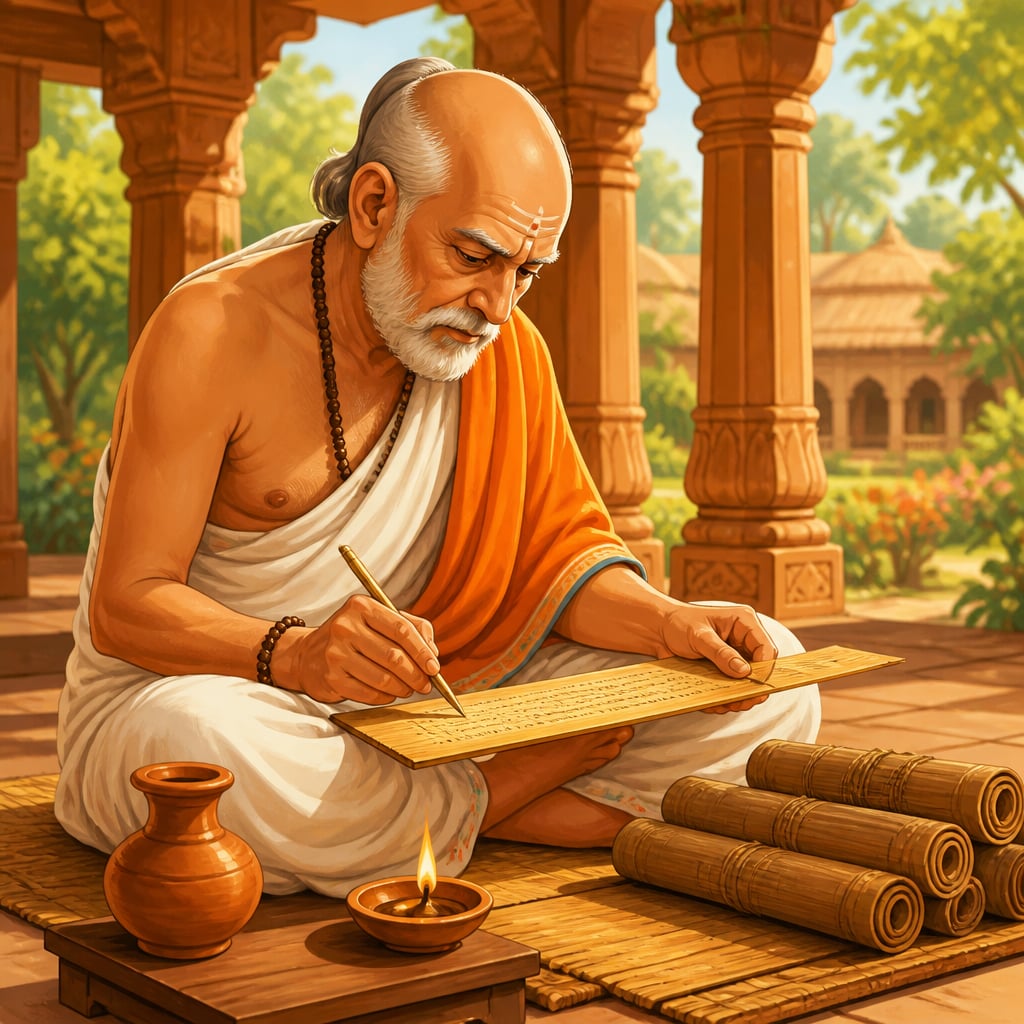
But Panini was not an isolated genius. He was a product of India's knowledge architecture: a civilizational system that produced, debated, refined, and transmitted knowledge across thousands of years and millions of square kilometers. Sanskrit was its language. Philosophical pluralism was its method. The debate tradition was its quality control. And the commentary tradition was its version control system.
This lesson maps that architecture.
The Mechanism: Five Pillars of India's Knowledge Architecture
India's knowledge system was not a single tradition but an interconnected architecture of five reinforcing pillars. Each pillar served a specific function. Together, they created a civilizational knowledge network unmatched in the ancient world.
Pillar One: Sanskrit as Pan-Indian Intellectual Language
Sanskrit served as India's intellectual lingua franca for over three thousand years. A scholar in Tamil Nadu and a scholar in Kashmir, speaking entirely different mother tongues, could debate philosophy, exchange mathematical proofs, and critique each other's medical treatises because both operated in Sanskrit.
This was not merely linguistic convenience. Sanskrit's formal grammatical structure, codified by Panini, made it uniquely suited for precise intellectual discourse. Panini's grammar is essentially a generative algorithm: given the roots, suffixes, and rules, any competent grammarian can generate every valid Sanskrit word and sentence. This precision meant that Sanskrit texts could be transmitted across centuries with minimal ambiguity. A scholar reading Patanjali's Mahabhashya in the 12th century could understand Panini's 4th-century-BCE intentions with extraordinary accuracy.
No other ancient civilization had a comparable system. Latin served a similar function in medieval Europe, but lacked Sanskrit's formal precision. Classical Chinese enabled pan-East-Asian scholarship, but its logographic system made it less accessible across linguistic boundaries. Sanskrit created a unified intellectual space across the subcontinent in which knowledge could flow freely regardless of regional language, political boundary, or historical period.
Pillar Two: Philosophical Pluralism
India did not produce a single orthodox philosophy. It produced at least six major orthodox schools (Astika Darshanas): Nyaya (logic and epistemology), Vaisheshika (atomistic natural philosophy), Samkhya (cosmological dualism), Yoga (disciplined practice), Purva Mimamsa (textual hermeneutics), and Vedanta (metaphysics of ultimate reality). Alongside these, heterodox schools including Buddhist, Jain, and Charvaka traditions contributed competing frameworks.
These were not variations on a theme. Nyaya and Charvaka disagreed on epistemology as fundamentally as any two modern philosophical schools. Samkhya's atheistic dualism and Vedanta's monistic idealism represented radically different metaphysical commitments. Yet all operated within a shared intellectual ecosystem, using shared logical frameworks, engaging each other through formalized debate, and producing commentaries on each other's works.
This pluralism was a civilizational strength, not a weakness. It meant that India's intellectual tradition was not vulnerable to the refutation of any single school. When Adi Shankaracharya challenged Buddhist metaphysics, Buddhism's decline in India did not create an intellectual vacuum because multiple alternative frameworks already existed. The system was distributed, resilient, and self-correcting.
Pillar Three: The Shastrartha Debate Tradition
Knowledge was not merely produced. It was stress-tested. The Shastrartha (scholarly debate) tradition created a formalized system of intellectual contest with explicit rules, judges, and consequences.
The Nyaya Sutra of Aksapada Gautama classified debates into three types: Vada (honest discussion seeking truth), Jalpa (debate to win, using any legitimate tactic), and Vitanda (destructive criticism to demolish an opponent's position). Each had its place. Vada was for collaborative truth-seeking between scholars. Jalpa was for public contests where reputation was at stake. Vitanda was for exposing fundamentally flawed positions.
These debates were public events. Kings patronized them. Communities attended them. A scholar's reputation was built or destroyed in Shastrartha. This created enormous incentive for intellectual rigor. You could not survive in Indian intellectual life by simply repeating received wisdom. You had to defend your position against the most skilled opponents in the civilization.
The result was a tradition of logical rigor that developed independently of Greek logic and in many ways surpassed it. The Nyaya school's analysis of inference, fallacy, and epistemic justification anticipates developments in Western logic by centuries.
Pillar Four: Knowledge Diversity
India's knowledge architecture was not limited to philosophy and theology. It encompassed a remarkable diversity of systematic disciplines.
In mathematics (Ganita), Indian scholars developed the decimal place-value system, the concept of zero, algebraic methods, and trigonometric functions. Aryabhata calculated the Earth's circumference to within 1% accuracy in the 5th century CE. The Kerala school of Madhava discovered infinite series expansions two centuries before Newton and Leibniz.
In astronomy (Jyotisha), Indian observatories tracked planetary movements with precision that informed calendrical systems still in use today. In medicine (Ayurveda), Sushruta described over 300 surgical procedures, including rhinoplasty, cataract surgery, and cesarean section. In linguistics (Vyakarana), Panini's formal grammar, as we have seen, anticipated computational linguistics by millennia.
This diversity was not accidental. It flowed from the philosophical framework. Nyaya's emphasis on valid means of knowledge (Pramana) encouraged empirical observation. Vaisheshika's atomistic theory encouraged systematic analysis of natural phenomena. The knowledge architecture did not separate "sacred" from "scientific" knowledge. It treated all systematic inquiry as valid pursuit of truth.
Pillar Five: The Commentary Tradition
Perhaps the most underappreciated pillar was the commentary tradition. Indian intellectual culture did not merely produce original texts. It produced centuries-long chains of commentary, sub-commentary, and counter-commentary on those texts.
Panini's Ashtadhyayi (4th century BCE) was commented on by Katyayana (3rd century BCE), whose Varttikas were in turn commented on by Patanjali in his Mahabhashya (2nd century BCE). This chain continued for over two thousand years. Each commentator did not merely explain the original. They debated previous commentators, introduced new interpretations, and connected the text to contemporary intellectual developments.
This created something remarkable: a living intellectual dialogue spanning centuries. A 12th-century scholar writing a commentary was effectively debating scholars from the 4th century BCE, engaging with every intermediate voice. No idea could calcify into dogma because every generation of commentators brought fresh challenges.
The commentary tradition functioned as the civilization's version control system. Original insights were preserved. Errors were flagged. New developments were integrated. And the entire intellectual history remained accessible to anyone entering the conversation.
The Pattern: The Nalanda Network
The knowledge architecture was not abstract. It was institutional. India built a network of universities that embodied all five pillars and served as civilizational knowledge hubs for over a thousand years.
Nalanda, founded in the 5th century CE in present-day Bihar, is the most famous node in this network. But it was only one element. Taxila (Takshashila) in the northwest had been a center of learning since at least the 6th century BCE. Vikramashila in Bengal, Valabhi in Gujarat, Odantapuri in Bihar, and Pushpagiri in Odisha formed a distributed network of higher education spanning the subcontinent.
Nalanda at its peak hosted approximately 10,000 students and 2,000 teachers. Students came not just from across India but from China, Korea, Tibet, Central Asia, and Southeast Asia. The Chinese pilgrim Xuanzang, who studied at Nalanda for five years (631-636 CE), described nine-story library buildings, rigorous entrance examinations that only 20% of applicants passed, and daily debates attended by thousands.
The curriculum was comprehensive. Nalanda taught not just Buddhist philosophy but Vedic texts, grammar, logic, medicine, astronomy, and mathematics. Vikramashila was renowned for Tantric studies and logic. Taxila specialized in medicine, military science, and law. Each university had its strengths, but all operated within the shared knowledge architecture of Sanskrit scholarship and philosophical pluralism.
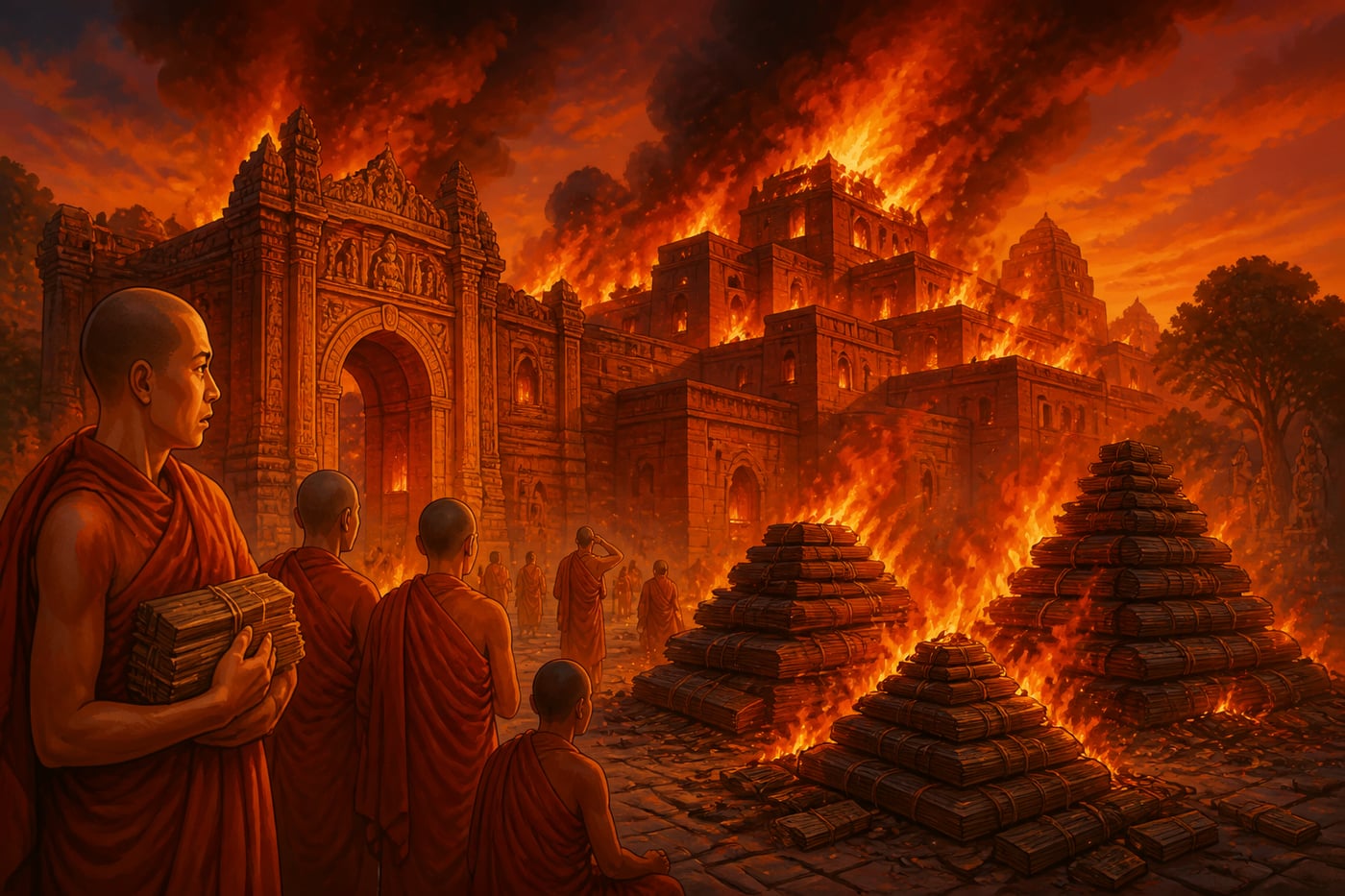
When Bakhtiyar Khilji's forces burned Nalanda's libraries in 1193 CE, monks reportedly said the fires burned for three months, so vast were the manuscript collections. The destruction was catastrophic not because one university was lost, but because it represented the targeted destruction of the knowledge architecture's institutional infrastructure. Similar destructions at Vikramashila and Odantapuri followed.
Yet the knowledge architecture partially survived because it was distributed. Manuscripts had been copied across the network. The commentary tradition existed in the memories of thousands of scholars. The oral knowledge system (Vedic chanting, memorized texts) preserved what written records could not. The architecture was wounded but not killed because it was a network, not a single point of failure.
This pattern reveals both the architecture's extraordinary resilience and its key vulnerability. A distributed knowledge network can survive the destruction of individual nodes. But if enough nodes are destroyed simultaneously, or if the connective tissue (Sanskrit, debate culture, commentary tradition) is degraded, the network falls below the threshold of self-repair.
Dharmic Wisdom: Pramana and the Pursuit of Valid Knowledge
The Nyaya Sutra opens with a remarkable claim: that liberation itself depends on correct knowledge. The first sutra lists sixteen categories of philosophical investigation, beginning with Pramana (valid means of knowledge).
The Nyaya school recognized four Pramanas: Pratyaksha (direct perception), Anumana (inference), Upamana (comparison), and Shabda (reliable testimony). Each was rigorously defined. Each had conditions for validity and known failure modes. This was not mysticism. It was systematic epistemology: the science of how we know what we claim to know.
What made this framework civilizationally powerful was its pluralism. The Charvaka school accepted only Pratyaksha. The Vaisheshika school accepted two Pramanas. Buddhism accepted three. Vedanta accepted six. Rather than one school declaring its epistemology correct and all others heretical, the civilization sustained multiple competing epistemologies, each refining itself through debate with the others.
Bhartrihari's Vakyapadiya added another dimension: the philosophy of language itself. Bhartrihari argued that Shabda (word/sound) is not merely a tool for communicating pre-existing thoughts but is itself the fabric of cognition. Knowledge and language are inseparable. This is why Sanskrit, as a formally precise language, was not just convenient for scholarship but essential to it. The precision of the language enabled the precision of the thought.
This insight carries a civilizational defense implication. When a civilization's language of intellectual discourse is degraded or replaced, it does not merely lose a communication tool. It loses the cognitive precision that language enabled. The replacement of Sanskrit with English as India's language of intellectual discourse is not a neutral linguistic shift. It is an epistemological one.
The Defense: Rebuilding the Architecture, Node by Node
India's knowledge architecture was not built in a generation. It was built over millennia through countless individual decisions to learn, teach, debate, write, and preserve. It cannot be rebuilt overnight. But it can be rebuilt, if the rebuilding follows the architecture's own logic: distributed, pluralistic, rigorous, and interconnected.
Individual level: Become a node in the network. Learn one element of the traditional knowledge architecture. Study Sanskrit, even at a basic level. Read one Darshana's primary text. Understand the Pramana framework. You do not need to become a pandit. You need to become an informed participant in the civilizational conversation that has been running for three thousand years.
Community level: Create or support Shastrartha spaces. The debate tradition died not because people stopped having opinions but because the institutional spaces for rigorous intellectual contest disappeared. Study circles, reading groups, and structured debate forums that engage with traditional texts using traditional methods can revive the culture of intellectual rigor. Online platforms now make this possible across geographic boundaries.
Institutional level: Support the IKS movement and beyond. The Indian Knowledge Systems initiative within NEP 2020 is a beginning. IITs and central universities are now offering courses on Nyaya logic, Paninian grammar, and traditional mathematics. Support these with enrollment, funding, and intellectual engagement. But also build independent institutions. The commentary tradition needs new commentators. The Darshanas need scholars who can engage with modern philosophy as equals, not as museum curators. Digital Sanskrit projects need contributors.
The knowledge architecture survived Bakhtiyar Khilji's fires because it was a network. Every person who learns, debates, writes, and teaches within this tradition adds a node to that network. The architecture rebuilds itself one node at a time.
Case studies
The Nalanda-Vikramashila Knowledge Network
Between the 5th and 12th centuries CE, India operated a distributed network of major universities including Nalanda (Bihar), Vikramashila (Bengal), Taxila (northwest), Valabhi (Gujarat), Odantapuri (Bihar), and Pushpagiri (Odisha). These institutions embodied all five pillars of the knowledge architecture: Sanskrit as the medium of instruction, philosophical pluralism in the curriculum, daily Shastrartha debates, multi-disciplinary knowledge from medicine to mathematics, and active commentary traditions. Nalanda alone housed approximately 10,000 students and 2,000 teachers, with students arriving from China, Korea, Tibet, and Southeast Asia.
The university network functioned exactly as the knowledge architecture predicts: distributed, pluralistic, and resilient. Xuanzang's accounts from the 7th century describe entrance exams so rigorous that 80% of applicants failed, daily debates where hundreds participated, and nine-story library buildings containing millions of manuscripts. Each university specialized (Vikramashila in logic, Valabhi in Buddhist studies, Taxila in medicine) while sharing the common framework of Sanskrit scholarship and philosophical debate. This distribution meant no single point of failure could destroy the system.
When Bakhtiyar Khilji's forces destroyed Nalanda in 1193 CE, followed by Vikramashila and Odantapuri, the institutional layer of the knowledge architecture was devastated. Yet the system partially survived through its distributed nature: manuscripts had been copied across institutions, scholars carried knowledge in memory, oral traditions preserved what written records could not, and southern and western centers continued functioning. The architecture was severely wounded but not killed.
A distributed knowledge network can survive the destruction of individual nodes, but not the simultaneous destruction of multiple nodes combined with degradation of the connective tissue (Sanskrit, debate culture, commentary tradition). The Nalanda network's partial survival proves the architecture's resilience. Its permanent damage proves that resilience has limits. Rebuilding requires restoring both nodes (institutions) and connections (shared intellectual frameworks).
The NEP 2020 Indian Knowledge Systems initiative, IIT courses on Nyaya logic and Paninian grammar, and digital Sanskrit projects represent the first systematic attempt to rebuild institutional nodes in the knowledge architecture since the medieval destructions. The challenge is the same as it was for Nalanda's builders: creating institutions that embody all five pillars, not just one.
Xuanzang recorded that Nalanda's library complex, called Dharmaganja (Treasury of Truth), consisted of three multi-story buildings: Ratnasagara, Ratnodadhi, and Ratnaranjaka. The collection was so vast that when it burned in 1193, contemporary accounts say the fires lasted three months. The loss is estimated at millions of manuscripts covering over a millennium of accumulated scholarship.
Indian Knowledge Systems in the 21st Century University
In 2020, India's National Education Policy (NEP) formally introduced Indian Knowledge Systems (IKS) as a domain of study in higher education. By 2023, IIT Kharagpur had launched a Centre of Excellence for IKS, IIT Bombay offered courses on Paninian grammar and computational Sanskrit, and over 50 institutions incorporated Nyaya logic, Ayurveda principles, or traditional mathematics into their curricula. The IKS Division under the Ministry of Education began funding research projects connecting traditional knowledge frameworks with modern disciplines.
The IKS movement represents an institutional attempt to reconnect with the knowledge architecture. Teaching Nyaya logic at IITs mirrors how Nalanda taught logic alongside astronomy and medicine. The key question is whether these initiatives will treat traditional knowledge as a living intellectual framework (engaging with it through the Bhashya tradition of active commentary) or as a museum exhibit (studying it as historical curiosity without intellectual engagement). The knowledge architecture demands the former.
The initiative is still in early stages. Early results show strong student interest, with IKS courses regularly oversubscribed. Research papers connecting Paninian grammar to computational linguistics, Nyaya epistemology to AI reasoning, and traditional mathematics to modern number theory are emerging. The Digital Sanskrit corpus has grown to millions of indexed text units. Challenges remain: shortage of faculty trained in both traditional and modern frameworks, institutional resistance from departments anchored in Western academic paradigms, and the risk of reducing IKS to nationalistic symbolism rather than serious scholarship.
Rebuilding the knowledge architecture requires institutional commitment, not just individual enthusiasm. The IKS initiative succeeds to the extent that it creates genuine intellectual engagement with traditional frameworks, teaching students to produce new Bhashyas (commentaries) rather than merely reading old ones. The test is whether IKS graduates can contribute to the living tradition, not just appreciate its historical achievements.
The IKS movement directly responds to the knowledge architecture gap that opened with colonial education reforms. Every IIT student who learns Nyaya logic or Paninian grammar becomes a new node in the civilization's knowledge network. The question is whether enough nodes can be created to reach the threshold of self-sustaining growth.
By 2024, IIT Kharagpur's IKS Centre had published over 100 research papers connecting traditional Indian knowledge with modern STEM disciplines. Dr. Rishi Rajpopat's 2022 Cambridge discovery that solved a 2,500-year-old Paninian grammar problem was itself a product of this intellectual reconnection: a modern scholar engaging seriously with the Ashtadhyayi as a living system rather than a historical artifact.
Reflection
- Consider your own education. How many of the five pillars of India's knowledge architecture were present in your schooling? Did you learn any Indian philosophical framework (Darshana)? Were you ever taught to formally debate using logical rules? Were you exposed to Sanskrit as an intellectual language rather than just a 'classical' subject?
- Bhartrihari argued that language and thought are inseparable: the precision of your language determines the precision of your thinking. If this is true, what are the consequences of India's intellectual discourse shifting from the formally precise Sanskrit to English, a language in which most Indians think as second-language speakers?
- India's knowledge architecture sustained radical philosophical disagreement for millennia without producing religious wars or inquisitions. Materialists (Charvaka), atheists (Samkhya), theists (Vedanta), and agnostics (Buddhism) coexisted within one civilizational framework. What structural feature of the architecture made this possible? And what would it take to rebuild that capacity for intellectual pluralism today?