The Civilizational Operating System
Dharma as Ethical Framework, Social Duty, and Governance
Indian civilization maintained coherence across extraordinary diversity not through political centralization but through a shared operating system called Dharma. This lesson reveals how Dharma functions across four integrated dimensions: Rta (cosmic order), Svadharma (contextual duty), Rajadharma (governance as sacred obligation), and Samanya Dharma (shared ethics). From the Kumbh Mela's 400 million self-organizing pilgrims to the Ramayana's voluntary spread across 20 countries, the evidence shows a civilizational architecture unlike any other in human history.
See It Today: 400 Million at the Confluence
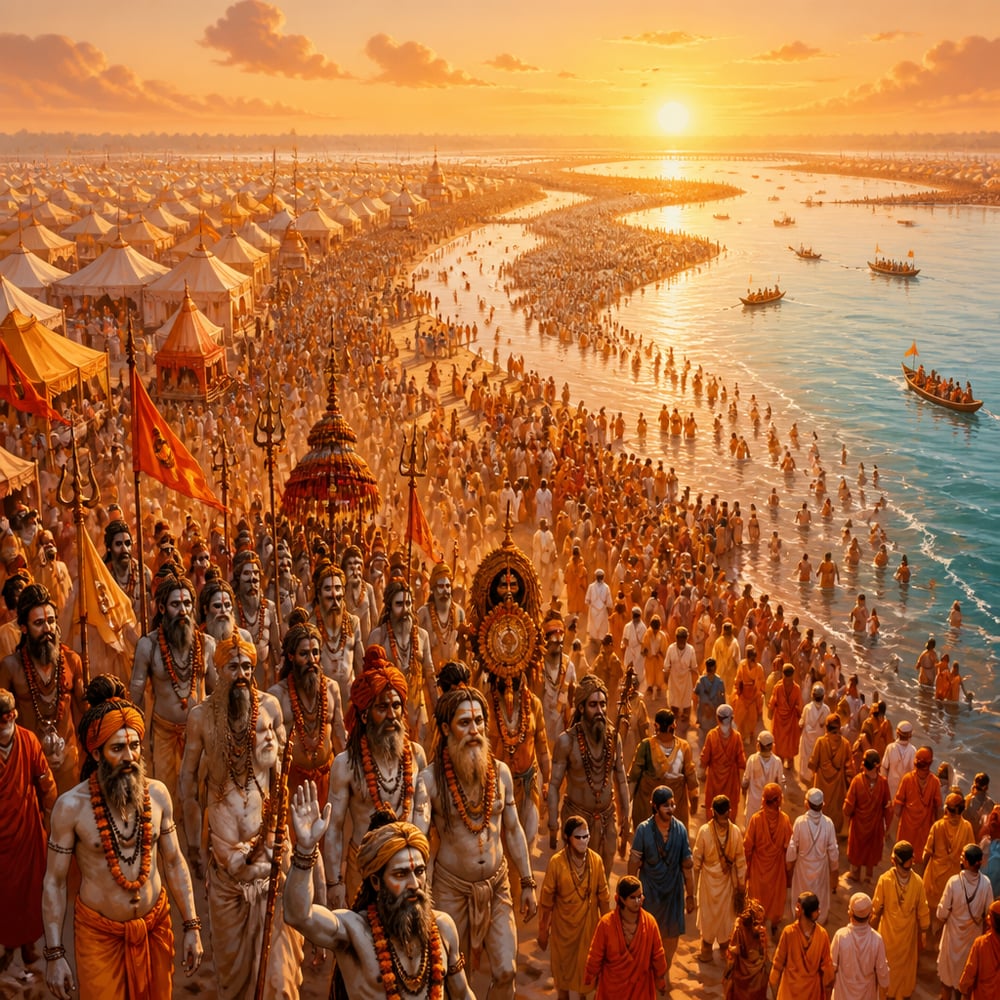
In January 2025, the Maha Kumbh Mela began at Prayagraj. Over the weeks that followed, more than 400 million people arrived at the confluence of the Ganga, Yamuna, and the invisible Sarasvati. To put that number in perspective, it exceeds the entire population of the United States, the European Union, or any single nation on Earth except India and China.
Nobody organized them. No advertising campaign summoned them. No government mandate compelled them.
Naga Sadhus from akharas tracing their lineage to Adi Shankaracharya walked into the same waters as IT engineers from Bengaluru. A farmer from Bihar performed the same ritual alongside a business owner from Gujarat. A Tamil grandmother stood knee-deep in the river next to a Kashmiri student. They shared no language, no cuisine, no political party.
What they shared is a civilizational operating system.
The metaphor is precise, not poetic. An operating system is the foundational software that allows different programs to run on the same hardware. Without it, the hardware is inert. The programs are incompatible. Nothing communicates with anything else. Dharma functions identically for Indian civilization. It is the foundational layer that allows radically different cultures, languages, traditions, and practices to operate on the same civilizational hardware.
Without it, India's diversity would be merely difference. Thousands of languages, thousands of communities, thousands of local traditions, all pulling in different directions. With it, diversity becomes civilization. The differences remain. They are not erased or homogenized. But they become interoperable, able to communicate, cooperate, and cohere across vast distances and deep time.
Kumbh Mela is the most visible proof that this operating system is still running. Four hundred million people coordinating around shared civilizational principles without centralized command. No other civilization on Earth can demonstrate anything comparable.
Understanding how this operating system works is the first step in understanding why its enemies attack it.
The Mechanism: Four Dimensions of the Civilizational Operating System
Dharma is the most consequential word in Indian civilization, and the most misunderstood. It is routinely translated as "religion," which is roughly as accurate as translating "algorithm" as "recipe." The word captures something far more complex: an integrated system of cosmic order, individual duty, governance principles, and shared ethics that together constitute the operating system on which Indian civilization runs.
This system operates across four dimensions. Each is distinct. Together, they form a unified architecture.
Dimension 1: Rta, the Cosmic Order
Dharma rests on the Vedic concept of Rta: the cosmic order governing the universe. The sun rises and sets according to Rta. Seasons follow their cycle according to Rta. Rivers flow, seeds germinate, and celestial bodies maintain their orbits according to Rta.
This is not a commandment issued by a deity. It is an observation. The universe operates according to patterns, and these patterns are discoverable through reason, contemplation, and experience. Dharma is the human expression of Rta. It is what happens when conscious beings align their conduct with the order that already governs everything else.
This foundation is radically different from the Abrahamic model, where moral law descends from a deity's explicit command. In that framework, something is right because God said so. In the Dharmic framework, something is right because it aligns with the order inherent in reality itself. The deity does not stand above Rta. Even the gods operate within it.
The consequence is enormous. Dharma becomes philosophical rather than dogmatic, adaptive rather than rigid. If moral law is a fixed commandment, it cannot evolve without theological crisis. If moral law is alignment with observable cosmic order, it can be refined as understanding deepens. This is why Dharmic civilization produced continuous philosophical debate across millennia without collapsing into the kind of doctrinal wars that devastated Europe.
Dimension 2: Svadharma, Individual and Contextual Duty
If Rta is the universal order, Svadharma is its local expression. Every individual, community, and institution has a specific function based on nature, context, and capability.
The Bhagavad Gita states this with characteristic directness: it is better to perform one's own duty imperfectly than to perform another's duty perfectly. This is not a prescription for rigid social hierarchy, though it has been misread that way by both colonial scholars and modern critics. It is a recognition that systems work when components perform their intended functions.
Svadharma is contextual, not static. The same person holds multiple dharmic obligations simultaneously. As a parent, your Svadharma involves nurturing and guidance. As a professional, it involves competence and integrity. As a citizen, it involves participation in collective welfare. These duties shift with life stage, circumstance, and capability. The ashrama system (Brahmacharya, Grihastha, Vanaprastha, Sannyasa) formalized this understanding: what is appropriate at twenty is not appropriate at sixty, and the operating system accounts for that.
Consider the difference between an operating system and a rulebook. A rulebook prescribes the same action for everyone regardless of context. An operating system allocates different functions to different components based on what they are and what the situation demands. Svadharma is why Indian civilization could accommodate such extraordinary diversity of occupation, practice, and lifestyle without requiring everyone to conform to a single behavioral template.
Dimension 3: Rajadharma, Governance as Sacred Duty
Perhaps the most sophisticated dimension of the Dharmic operating system is its treatment of political power. Rajadharma frames governance not as privilege but as sacred obligation. The ruler does not own the kingdom. The ruler serves it.
The Mahabharata's Shanti Parva contains one of the most extensive treatises on governance in any civilization's literature. Bhishma, lying on his bed of arrows, instructs Yudhishthira on every aspect of statecraft. The instruction is detailed and practical, but it rests on a single principle: the ruler exists for the people, not the other way around.
The metaphors are precise. Taxation should be proportionate, like a bee collecting honey from a flower without harming it. The king should protect all subjects regardless of their station, like the rain that falls equally on all. Justice should be administered without regard to personal relationship or political convenience.
Kautilya's Arthashastra operationalized these principles into institutional design. It specified checks on royal power, systems of accountability, intelligence networks to detect administrative corruption, and welfare mechanisms for the vulnerable. The text's central concept of Yogakshema, the welfare and security of the people, defined the state's fundamental purpose.
What makes this remarkable is scale. This framework of Rajadharma operated across hundreds of kingdoms that shared no political authority, no central government, no imperial bureaucracy. A Chola king in Tamil Nadu and a Pala king in Bengal administered their domains independently, yet both understood their role through the same civilizational principles of Rajadharma. The operating system provided coherence without requiring centralization.
Dimension 4: Samanya Dharma, the Shared Ethical Framework
Beneath the contextual duties of Svadharma and Rajadharma lies a bedrock of universal ethical principles that apply to every human being regardless of station, region, or era. These are the protocols of Samanya Dharma: Satya (truth), Ahimsa (non-harm), Daya (compassion), Dana (generosity), Shaucha (purity of conduct).
These principles appear across every Dharmic text, from the Vedas to the Tirukkural, from the Mahabharata to the Jain Agamas, from the Buddhist Dhammapada to the Sikh Guru Granth Sahib. A Tamil Shaivite and a Bengali Vaishnava may worship different forms of the divine, follow different rituals, speak different languages, and eat different food. But they share the same foundational ethical framework. When one says "this is adharmic," the other understands exactly what is meant.
This is what makes India a civilization rather than a geography. France is a nation-state held together by political authority and a single language. India is a civilizational state held together by shared ethical protocols that operate beneath and across its staggering diversity. Samanya Dharma is the communication protocol that allows different cultural "programs" to exchange information, cooperate, and maintain coherence.
The Unified System
These four dimensions do not operate in isolation. They function as an integrated architecture. Rta provides the foundation. Svadharma translates cosmic order into individual responsibility. Rajadharma extends it to governance. Samanya Dharma ensures a shared ethical baseline across all domains.
The Mahabharata and Ramayana function as civilizational user manuals for this system. The Ramayana demonstrates Dharma in ideal practice: what it looks like when individuals, rulers, and communities align with the operating system as designed. The Mahabharata demonstrates Dharma under extreme stress: what happens when the system is pushed to its limits by ambiguity, corruption, and impossible choices. Together, they gave every Indian, literate or not, a shared vocabulary for discussing ethical dilemmas.
When a Malayali grandmother says "that is not dharmic," a Rajasthani farmer understands exactly what she means. They have never met. They share no language. But they share an operating system, and that is sufficient.
The Pattern: One Story, A Thousand Voices
If Dharma is an operating system, the Ramayana is the clearest proof of its portability. No single cultural artifact better demonstrates how the civilizational OS propagated without coercion, without missionaries, and without armies.
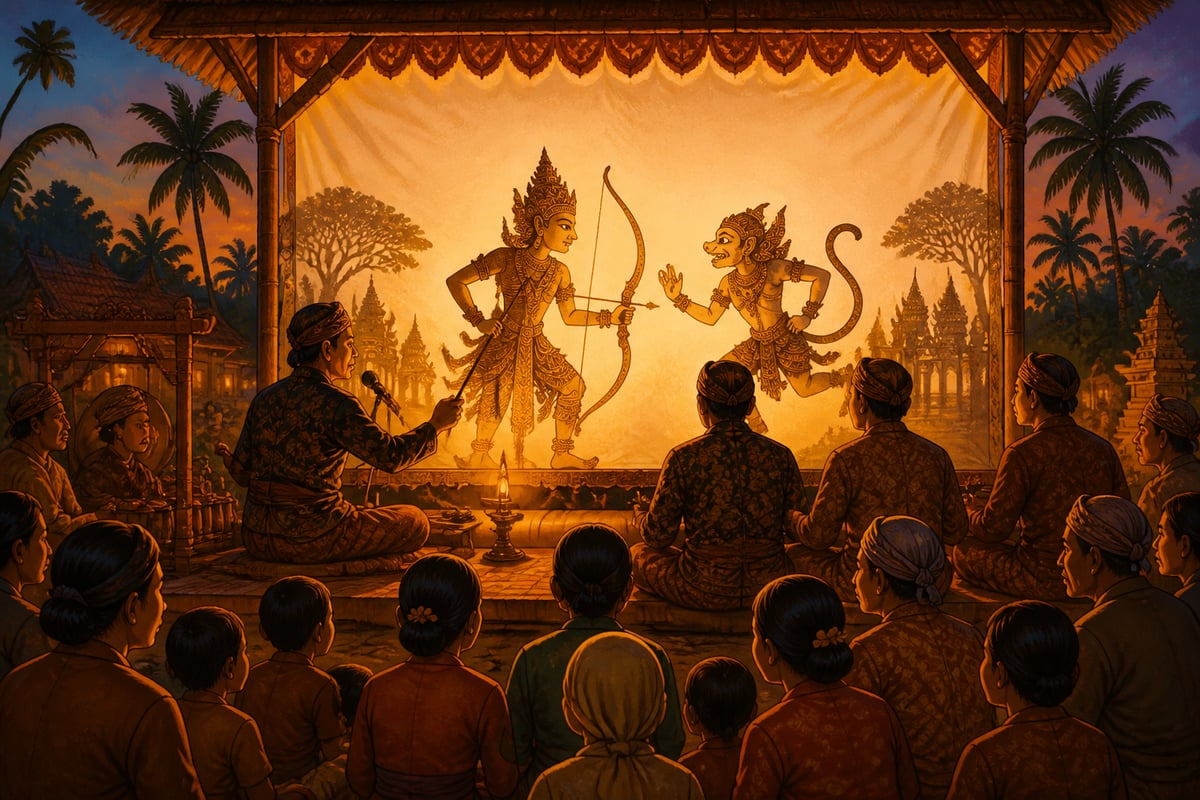
In the 9th century, Javanese poets composed the Kakawin Ramayana. They did not translate Valmiki. They reimagined the story within their own cultural context, preserving its Dharmic ethical core while adapting characters, settings, and emphasis to Javanese sensibilities. In the 12th century, the Tamil poet Kamban composed the Kamba Ramayanam, a work so powerful that it stands as an independent literary masterpiece, not a derivative of Valmiki but a parallel expression of the same civilizational principles.
Thailand's Ramakien is the national epic, performed in royal courts and village festivals alike. Cambodia's Reamker adorns the walls of Angkor Wat. Laos preserves the Phra Lak Phra Ram. Myanmar, Tibet, and the Philippines each have their own versions. In the 16th century, Tulsidas composed the Ramcharitmanas in Awadhi, making the story accessible to millions who did not read Sanskrit. His version became so central to North Indian cultural life that many people know its verses by heart five centuries later.
No army carried the Ramayana to Java. No missionary distributed it in Thailand. No colonial administration imposed it on Cambodia. The story spread because its Dharmic ethical framework resonated with human moral intuition across cultures, languages, and centuries. Each civilization that received it adapted it freely, because the operating system supports adaptation. A doctrine demands exact replication. An operating system supports local customization while maintaining core functionality.
This is the mechanism by which Indian civilization maintained coherence without political centralization. Where Rome required legions to hold its empire together, and where Christendom required papal authority and ecclesiastical hierarchy, Indian civilization maintained its coherence through shared narrative and a shared ethical operating system. Political boundaries shifted constantly. Dynasties rose and fell. But the stories endured, and with them, the civilizational principles they encoded.
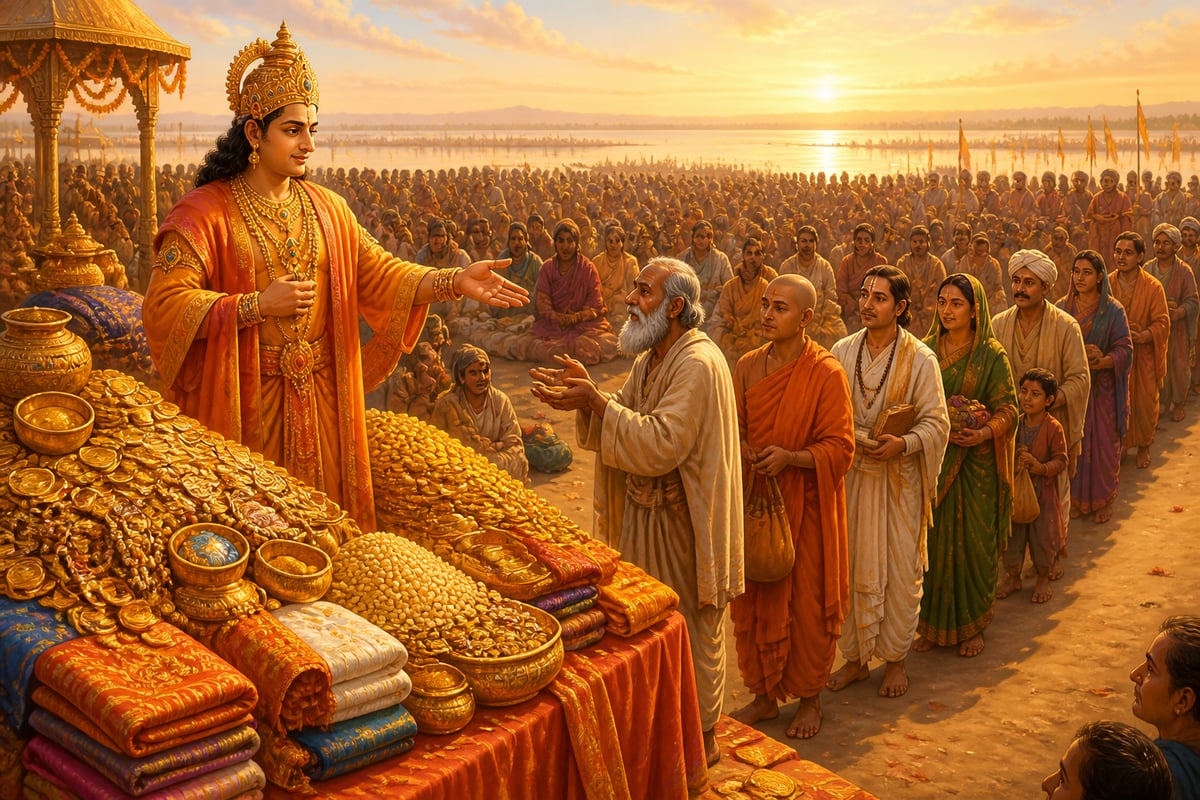
Emperor Harsha understood this intuitively. The 7th century Chinese pilgrim Xuanzang recorded that Harsha convened massive religious assemblies at Prayag every five years, bringing together scholars, monks, and common people from across the subcontinent. Harsha was not merely being pious. He was performing civilizational maintenance. Rulers who understood the operating system knew it required periodic reinforcement through shared gathering, debate, and celebration.
You can destroy a kingdom. You cannot easily destroy a story that millions of people retell in their own words every generation. This is the deepest resilience of the Dharmic civilizational operating system, and it is precisely why those who seek to break India focus their attacks not on political structures but on the stories themselves.
Dharmic Wisdom: The Eternal Law That Sustains
The Dharmic tradition itself understood its own function in remarkably clear terms. The Mahabharata states: "Dharma exists for the welfare of all beings. That by which the welfare of all living beings is sustained, that is Dharma." This is not a mystical pronouncement. It is a functional definition. Dharma is that which sustains. Remove it, and what it sustained collapses.
Vidura, counselor to the blind king Dhritarashtra, provided the sharpest diagnostic framework for civilizational health. His Vidura Niti is essentially a systems manual for detecting when Rajadharma is failing. When honest counsel is silenced and sycophants are elevated. When short-term gain is pursued at the cost of long-term stability. When those in power tolerate visible adharma because confronting it is inconvenient. When these symptoms appear, Vidura warned, the civilizational order begins to unravel. His diagnostics were articulated thousands of years ago. They apply with uncomfortable precision to any civilization in any era, including this one.
In the Bhagavad Gita, Krishna's instruction to Arjuna is direct: alignment with Dharma is a fundamental obligation regardless of personal cost. Arjuna does not want to fight. The personal cost is unbearable. Krishna does not minimize that cost. He reframes the question. The issue is not what Arjuna wants. The issue is what Dharma requires. This is not fatalism or submission. It is the recognition that civilizational systems depend on individuals willing to bear personal cost for systemic integrity.
The key insight across all these texts is consistent: Dharma is not maintained by kings alone or priests alone. It is maintained by every participant performing their contextual duty. The farmer who works honestly sustains Dharma. The teacher who transmits knowledge faithfully sustains Dharma. The ruler who governs justly sustains Dharma.
When individuals abandon Svadharma, when rulers abandon Rajadharma, when communities abandon Samanya Dharma, the operating system degrades. Not suddenly, but progressively, like software accumulating bugs. Each small failure is tolerable. The accumulation is catastrophic.
The Defense: Rebooting the Operating System
The civilizational crisis described in Breaking India is fundamentally a systems failure. The attacks Rajiv Malhotra documents do not target India's military or economy directly. They target the operating system itself. Redefining Dharma as "Brahmanical oppression." Dismissing the epics as "mythology" rather than civilizational literature. Replacing Dharmic ethical frameworks with imported categories that fragment rather than integrate. Convincing Indians that their own operating system is the source of their problems rather than the foundation of their coherence.
The defense, therefore, is not merely political. It is civilizational.
At the individual level, the task is to relearn the operating system. Read the Bhagavad Gita not as a religious scripture but as an ethical decision-making manual. Study the Arthashastra not as an ancient curiosity but as strategic wisdom. Engage with the Ramayana and Mahabharata not as entertainment but as civilizational narratives encoding principles that kept a billion people coherent for millennia. Every Indian who understands the operating system becomes a node that sustains it.
At the community level, the task is to revive shared practices. Temples, festivals, and traditions are not cultural nostalgia. They are civilizational infrastructure. Every festival celebrated with genuine understanding is a system process keeping the OS running. Every temple maintained as a living institution rather than a tourist site is a server that keeps the network alive. Support these not out of sentimentality but out of strategic clarity about what holds a civilization together.
At the intellectual level, the task is to refuse reductionism. Challenge it when someone reduces Dharma to "religion" or dismisses the epics as primitive stories. Insist on precision. Dharma is an ethical, philosophical, and governance framework with no exact equivalent in Western categories. The epics are civilizational literature that shaped the moral reasoning of a billion people across thousands of years. Accuracy matters, because the operating system cannot defend itself. Its users must.
Four hundred million people at Prayagraj demonstrate that the system still runs. The question this course will continue to explore is whether enough people understand it well enough to protect it.
Case studies
Kumbh Mela: The World's Largest Self-Organizing Civilizational Gathering
In January and February 2025, the Maha Kumbh at Prayagraj drew over 400 million pilgrims across 45 days, making it the largest peaceful human gathering in recorded history. No central command issued attendance orders. No advertising campaign ran at sufficient scale to explain the turnout. No government mandate compelled participation. Naga Sadhus from akharas tracing unbroken institutional lineage to Adi Shankaracharya walked into the same sacred waters as software engineers from Bengaluru, farmers from Bihar, and grandmothers from Tamil Nadu. Every caste, every language region, every economic class arrived at the same confluence on the same tithis, coordinated by something no government ministry controls.
Dharma here functions as Rta: the cosmic timing encoded in planetary alignments (the Jupiter-Sun-Moon configuration that defines Kumbh tithis) provides the scheduling layer that no bureaucracy could replicate. Each Akhara fulfills its Svadharma by maintaining its distinct identity, lineage, and ritual role within the Shahi Snan procession order, a sequence formalized by Shankaracharya over 1,200 years ago and still honored without litigation or central enforcement. Samanya Dharma, the shared reverence for sacred geography at the Triveni Sangam, provides the unifying layer that makes 400 million individual decisions converge into a single civilizational act. This is Dharma as operating system: it provides the protocols, the timing, the role assignments, and the shared values that allow a massively distributed civilization to self-coordinate.
The 2025 Maha Kumbh completed without civilizational fracture despite the extraordinary scale. Indian Railways ran over 13,000 special trains. The UP government deployed infrastructure across 4,000 hectares. Yet the infrastructure served an event whose engine was entirely Dharmic. The Shahi Snan procession order among akharas, a sequence encoding centuries of negotiated precedence, held without a single formal legal mechanism compelling compliance. What outside observers described as logistical chaos resolved itself through a distributed Dharmic architecture that no modern event-management firm could have designed.
An operating system does not need to be visible to function. Dharma coordinates 400 million people across geography, language, caste, and class not through commands but through shared protocols, shared timing, and shared reverence for sacred geography.
The Kumbh is the clearest living proof that Dharma functions as civilizational infrastructure rather than personal religion. When critics argue that India's diversity makes unified civilizational identity impossible, Kumbh 2025 is the empirical counterevidence. The question for modern India is whether this self-organizing capacity can be preserved as urbanization, digital fragmentation, and epistemological attacks on civilizational identity accelerate.
The 2025 Maha Kumbh drew an estimated 400 to 450 million visitors over 45 days, surpassing the entire population of the United States. At peak attendance on Mauni Amavasya (January 29), approximately 60 million people bathed at the Sangam in a single day, a self-coordinated convergence with no equivalent in human history.
One Story, A Thousand Civilizations: The Ramayana's Voluntary Spread
Between the 9th and 16th centuries, the Ramayana spread across Southeast Asia without a single army, missionary, or colonial administration carrying it. The 9th-century Javanese Kakawin Ramayana adapted the story into Old Javanese poetic form for a Hindu-Buddhist Javanese court. The 12th-century Tamil Kamba Ramayanam reimagined Rama through the devotional Bhakti lens of Tamil literary culture. Thailand's Ramakien, Cambodia's Reamker, and Laos's Phra Lak Phra Ram each built national literary and theatrical traditions on the same civilizational foundation. By the 16th century, Tulsidas's Awadhi Ramcharitmanas had made the story the devotional heartbeat of North India. Each version transformed characters, settings, and cultural details. None abandoned the core Dharmic ethical architecture.
The Ramayana's core question, what does it mean to act with Dharma when duty conflicts with desire, is not culturally specific. It is universally human. This is what makes Dharma an operating system rather than a doctrine: a doctrine demands exact replication of content, but an operating system provides protocols that support unlimited surface-level adaptation while preserving structural integrity. Each civilization that received the Ramayana was not receiving a foreign religion. It was receiving a framework for asking and answering its own civilizational questions through a shared ethical vocabulary. The Ramayana functioned as Dharmic software: self-replicating across cultures because it solved real problems of human moral life that every civilization faces.
Today, the Ramayana remains a living tradition across Indonesia, Thailand, Cambodia, Laos, Myanmar, Malaysia, and the Philippines, in countries where Hinduism as a formal religion has largely been replaced by Islam or Buddhism. The story outlasted the institutional religion that originally carried it because it was embedded in the civilizational operating system rather than in any single institution. Wayang kulit shadow puppetry in Java still performs Ramayana stories for Muslim-majority audiences. The Ramakien remains the official epic of the Thai royal house.
Dharma spreads not through compulsion but through resonance. A civilizational operating system that solves genuine human problems replicates itself voluntarily across cultures, adapting its surface expression while preserving its ethical core.
The Ramayana's pan-Asian spread offers a precise model for understanding what India exports when it exports civilization rather than ideology. No soft-power campaign, no government cultural program, and no diplomatic initiative achieved what the Ramayana achieved organically across twelve centuries and twenty countries. For modern India, this history raises a direct question: if Dharma was once self-replicating civilizational software, what conditions allowed it to spread, and are those conditions recoverable?
Scholars have documented over 300 distinct versions of the Ramayana across South and Southeast Asia, spanning at least 10 languages and 15 countries. The earliest Southeast Asian version, the 9th-century Kakawin Ramayana from Java, predates the Tulsidas Ramcharitmanas by over 700 years, demonstrating that the story's pan-Asian spread began centuries before North India's most popular retelling was composed.
Reflection
- Think of a festival, family ritual, or community gathering you have participated in. Without anyone issuing commands or consulting a rulebook, people somehow knew their roles, the sequence of events, and how to treat one another. Where did that knowledge come from, and what was quietly coordinating everyone?
- When a shared ethical framework erodes in a civilization, what fills the vacuum? Look at societies today that are highly diverse but lack a common moral vocabulary. What mechanisms are they using to hold together, and how durable do those mechanisms seem?
- Commandment-based moral systems offer clarity: the rule is the rule regardless of who you are or what the situation demands. Dharma, by contrast, shifts with role, context, and stage of life through the principle of Svadharma. Is that contextual flexibility a sign of wisdom or a dangerous loophole that allows anyone to justify anything?