The Civilizational Network Insight
Why India Is a Network, Not a State
India survived not through powerful kings but as a distributed network of six interlocking systems. This lesson reveals why networks outlast hierarchies and how to keep each node strong.
See It Today: The World's Largest Self-Organizing Event
In January 2025, the Maha Kumbh Mela began at the Triveni Sangam in Prayagraj. Over the course of 45 days, more than 100 million people arrived, bathed, prayed, attended discourses, and departed. No single organization issued invitations. No corporation managed logistics. No government decree compelled attendance. Yet it happened, as it has happened for centuries, with a precision that baffles urban planners worldwide.
Consider what this event actually requires. Millions of people from every state, speaking dozens of languages, following hundreds of distinct sampradayas, coordinated their arrivals around specific astronomical dates. Naga sadhus from Juna Akhara marched alongside families from Tamil Nadu. Shankaracharyas shared space with Sikh nihang warriors and Jain monks. Street vendors from Rajasthan set up alongside tech workers from Bengaluru who had taken leave to attend.
There was no CEO of Kumbh Mela. No central app dispatching pilgrims to bathing slots. The coordination emerged from something deeper: shared sacred geography (the Sangam as a civilizational node), shared calendrical knowledge (Makar Sankranti, amavasya tithis), shared ritual grammar (snana, daan, satsang), and a millennia-old institutional memory carried by akharas, mathas, and guru lineages.
The Indian government provided infrastructure. Police managed crowds. Municipal workers handled sanitation. But the event itself, the reason 100 million people showed up at the same place at roughly the same time, was not organized by the state. It was organized by civilization.
This is not an anomaly. This is India's operating principle. And understanding it changes everything about how you see this civilization, its extraordinary resilience, and its specific vulnerabilities.
The Mechanism: Networks vs. Hierarchies
Every civilization must solve a fundamental problem: how do you maintain coherence across vast geographies, diverse populations, and long stretches of time? History shows two broad solutions.
The Centralized Model. Rome built roads, imposed Latin, stationed legions, and administered provinces from a single capital. China unified script, standardized weights, built the Great Wall, and governed through an imperial bureaucracy and examination system. These are hierarchical civilizations. Coherence flows from the top. When the center holds, the periphery holds. When the center falls, the periphery fragments. Rome collapsed, and within two centuries, Western Europe had splintered into dozens of kingdoms speaking mutually unintelligible languages. The centralized model is efficient but brittle.
The Network Model. India took a fundamentally different path. No single emperor ever ruled all of India for any sustained period. No single language was ever imposed on the entire subcontinent. No single religious authority ever claimed the power to excommunicate or declare orthodoxy for all Hindus. Yet this civilization maintained coherence across 5,000 years, 28 states, 22 official languages, and hundreds of jatis. How?
The answer is the civilizational network. India built coherence not through a central command but through six interlocking systems, each distributed across the subcontinent, each reinforcing the others.
System 1: Dharma (the ethical operating system). As we explored in Lesson 02_01, Dharma provides a shared moral grammar. A Brahmin in Kashmir and a fisherman in Kerala may live utterly different lives, but both operate within a framework of Rta (cosmic order), Karma (moral causation), and Dharma (right conduct in context). This shared grammar does not require a pope or a caliph to enforce it. It is embedded in stories, rituals, family structures, and daily practice.
System 2: Sacred Geography. India's unity is literally mapped onto the land. The Char Dham circuit (Badrinath, Dwarka, Puri, Rameswaram) spans the four cardinal directions. The twelve Jyotirlingas dot the entire subcontinent. Pilgrimage routes cross every linguistic and political boundary. A Tamil pilgrim at Varanasi and a Gujarati pilgrim at Rameswaram are participating in the same civilizational network, reinforcing the same sacred geography, without any central authority directing them.
System 3: Knowledge Systems. Sanskrit served not as an imposed imperial language but as a shared intellectual protocol. Panini's grammar in the northwest was studied in Nalanda in the east and Kanchi in the south. The Nyaya logicians of Mithila debated the Vedantins of Kerala. This created what Lesson 02_02 described as a pan-Indian intellectual commons, a shared knowledge architecture that crossed every political boundary.
System 4: Temple Institutions. As we saw in Lesson 02_04, temples were not merely "places of worship." They were civilizational nodes: economic engines, educational centers, artistic conservatories, and social welfare systems. A network of tens of thousands of temples, each locally governed but following shared architectural, ritual, and philosophical templates, created a distributed institutional infrastructure that no invader could dismantle by capturing a single capital.
System 5: Festival Networks. Diwali, Navaratri, Makar Sankranti, Holi. These festivals are celebrated with regional variations across the entire subcontinent. They synchronize civilizational time. When 800 million people celebrate Diwali on the same night, they are not following orders from a central committee. They are participating in a shared temporal rhythm that has maintained civilizational coherence for millennia.
System 6: Philosophical Pluralism. Unlike civilizations that maintained coherence through doctrinal uniformity (one creed, one book, one authority), India maintained coherence through structured diversity. The six darshanas (Samkhya, Yoga, Nyaya, Vaisheshika, Mimamsa, Vedanta) disagreed on fundamental metaphysical questions but shared a common intellectual grammar: respect for Shruti, commitment to logical debate (Shastrartha), and acceptance of multiple valid paths (Anekantavada). Disagreement was the system, not a bug in it.
Why Networks Are Resilient. A centralized system has a single point of failure. Capture the capital, kill the emperor, burn the library, and the system collapses. A network has no single point of failure. You can destroy Nalanda, but Vikramashila still functions. You can capture Delhi, but Vijayanagara still thrives. You can ban Sanskrit in universities, but Vedic chanting continues in thousands of villages. The network routes around damage.
Why Networks Are Vulnerable. Networks fail not when one node is destroyed but when enough nodes weaken simultaneously. If temples decline, knowledge systems decay, festivals lose their meaning, sacred geography is forgotten, philosophical traditions stagnate, and Dharma becomes mere ritual without understanding, the network does not collapse suddenly. It degrades gradually. And that gradual degradation is far harder to detect and resist than a dramatic invasion.
This is the central insight of this entire course. India's attackers, from colonial administrators to modern-day breaking forces, have understood something that many Indians have not: you do not break India by conquering its capital. You break India by weakening its nodes.
The Pattern: Three Survival Tests
History has tested India's civilizational network three times. Each test reveals both the network's resilience and the specific conditions under which it heals.
Test 1: The Sultanate and Mughal Period (1200-1700 CE). The destruction was staggering. Nalanda was burned. Thousands of temples were demolished. Delhi, the political center of North India, fell to Turkic invaders. By conventional civilizational logic, India should have fragmented like the Roman Empire.
It did not. When the northern nodes weakened, the network activated southern and eastern nodes. The Vijayanagara Empire (1336-1646) rose as a conscious civilizational response, patronizing Sanskrit scholarship, rebuilding temple networks, reviving classical arts. The Bhakti movement, emerging simultaneously across multiple regions, rewired the civilizational network at the grassroots level. Tukaram in Maharashtra, Kabir in the Gangetic plains, Mirabai in Rajasthan, Annamacharya in Andhra. No central coordination. The network self-organized a cultural renaissance precisely when political power was lost.
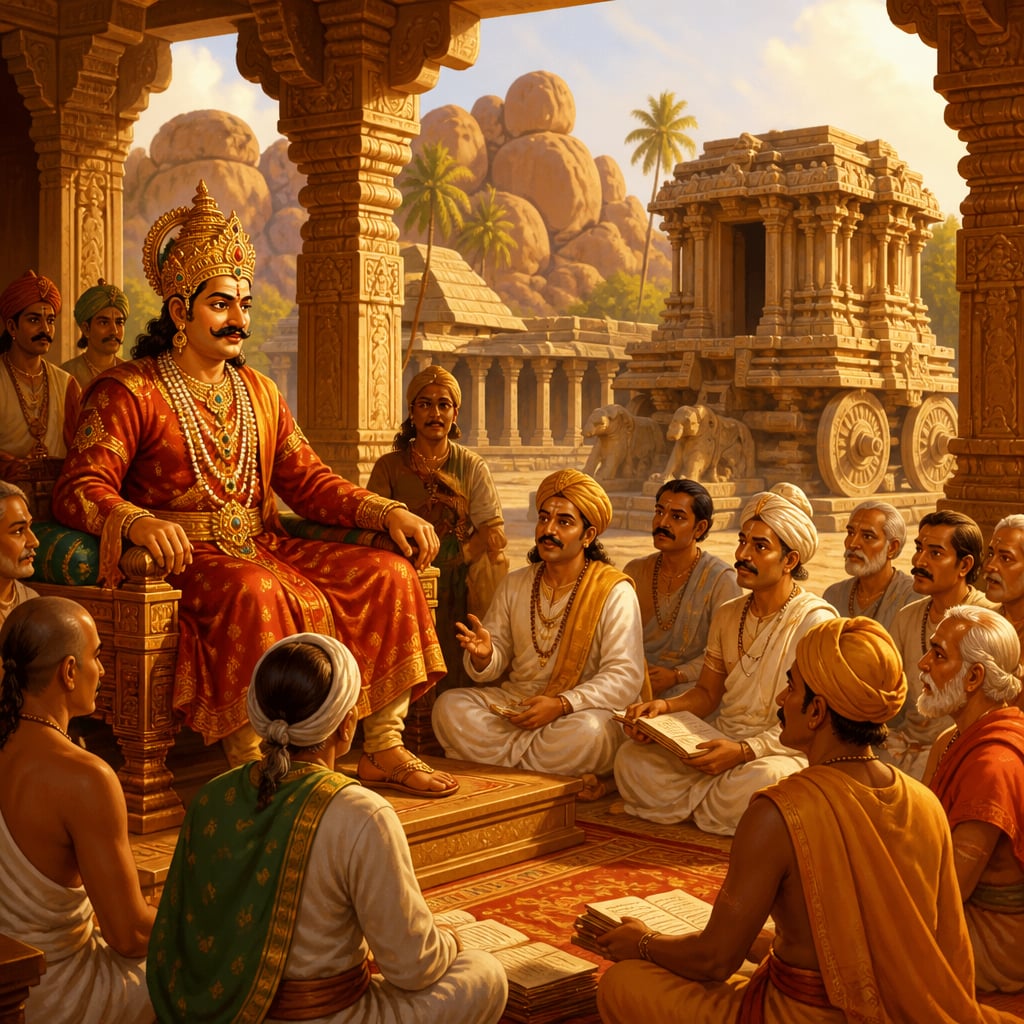
Test 2: British Colonialism (1757-1947). The British understood networks better than the Mughals did. They attacked not just political power but the nodes themselves. Macaulay's education policy targeted the knowledge system. Land revenue reforms destroyed the temple economy. The criminal tribes act disrupted artisan guilds. Census operations rigidified fluid social categories. This was systematic node-by-node degradation.
Yet the network survived. The Guru-Shishya Parampara continued in thousands of households even as gurukuls were dismantled. The Arya Samaj and Ramakrishna Mission created new institutional nodes. The Kumbh Mela continued without interruption. Village panchayats maintained local dharmic governance even under colonial administration. The freedom movement itself drew its energy from civilizational network activation: Gandhi's Dandi March worked because it activated sacred geography (the sea), economic networks (salt production), and dharmic vocabulary (satya, ahimsa) simultaneously.
Test 3: Post-Independence Institutional Capture (1947-present). After independence, India's formal institutions, universities, courts, media, and cultural bodies, were largely captured by frameworks hostile to civilizational consciousness. Marxist historiography dominated textbooks. Temple control was seized by state governments. Sanskrit was marginalized in education. Yet again, the network survived at the grassroots level: through family traditions, temple communities, festival observance, regional language literature, and the unbroken chains of guru-shishya transmission.
The pattern is consistent. When centralized institutions fail, the distributed network carries the civilization through. But each test leaves scars. Each cycle of destruction and regeneration leaves the network slightly weaker, the recovery slightly more difficult, the cultural memory slightly thinner.
Dharmic Wisdom: Indra's Net
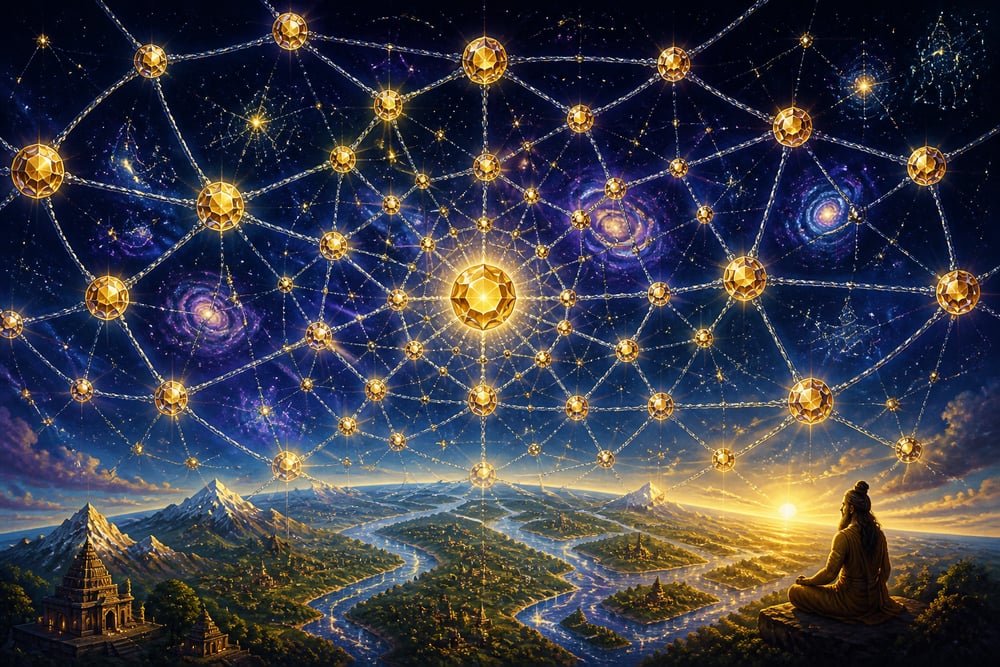
The Atharva Veda describes Indra's Net, Indrajala, as a vast cosmic web in which every node contains a jewel that reflects every other jewel. Pull one thread, and the entire net trembles. Strengthen one jewel, and every reflection brightens.
This is not mere poetry. It is a precise description of how India's civilizational network functions. Dharma, sacred geography, knowledge systems, temples, festivals, and philosophical pluralism are not independent pillars standing side by side. They are interconnected nodes in a single web. When temples are strong, they support knowledge systems through education, festivals through patronage, and sacred geography through pilgrimage infrastructure. When knowledge systems flourish, they produce the scholars who maintain philosophical pluralism, the priests who sustain temple rituals, and the poets who give festivals their meaning.
Kautilya's Arthashastra, composed in the 4th century BCE, understood this at the governance level. Kautilya did not envision an empire where all power flowed from the king's throne. He designed a system of distributed governance: village assemblies (grama sabhas), guild councils (shreni), regional administrators with defined autonomy, and an intelligence network that monitored the health of the entire system. The king was the most powerful node but not the only node. Remove the king, and the system could reconstitute itself.
The Mahabharata reinforces this principle through its depiction of Bharatavarsha itself. The epic does not describe a single kingdom but a network of kingdoms, each with its own character, bound together by shared Dharma, shared sacred sites (Kurukshetra, Prayaga, Kashi), and shared kinship networks. When Dharma weakened across enough of these kingdoms simultaneously, the great war became inevitable. The network's failure was not the fall of one king but the moral degradation of many nodes at once.
This is the warning and the instruction. Civilizations built as networks do not fall to a single blow. They fall when too many nodes weaken at the same time, when the web of mutual reinforcement frays beyond its capacity for self-repair.
The Defense: Strengthening the Six Systems
The insight is clear. India survived as a network. It can be broken only as a network, by weakening enough nodes simultaneously. Therefore, civilizational defense means strengthening each of the six systems. Not abstractly, but through specific, individual actions.
Dharma: Study the actual philosophical foundations, not just rituals. Read one primary text (Gita, Yoga Sutras, Arthashastra) this year. Understand Dharma as an ethical operating system, not a set of superstitions to defend or abandon.
Sacred Geography: Visit a pilgrimage site you have never visited. Understand why it is sacred, not just that it is sacred. Learn the Puranic geography of your own region. When you know why Kashi matters, you understand why India is a civilization and not just a country.
Knowledge Systems: Learn one concept from a traditional knowledge system: a sutra from Panini, a principle from Ayurveda, a theorem from Aryabhata. The goal is not nostalgia but reconnection with a living intellectual tradition.
Temple Institutions: Support a temple that functions as a community institution, not just a ritual space. Advocate for temple liberation from government control. If your local temple runs a school or feeds the poor, support those functions specifically.
Festivals: Celebrate with understanding. Before the next Navaratri, learn the stories. Before the next Makar Sankranti, understand the astronomy. Festivals without meaning are entertainment. Festivals with meaning are civilizational infrastructure.
Philosophical Pluralism: Engage with a darshana different from your own. If you are drawn to Vedanta, study Nyaya logic. If you follow Bhakti, explore Samkhya's analytical rigor. The strength of the network lies in its diversity, and diversity requires active engagement, not passive tolerance.
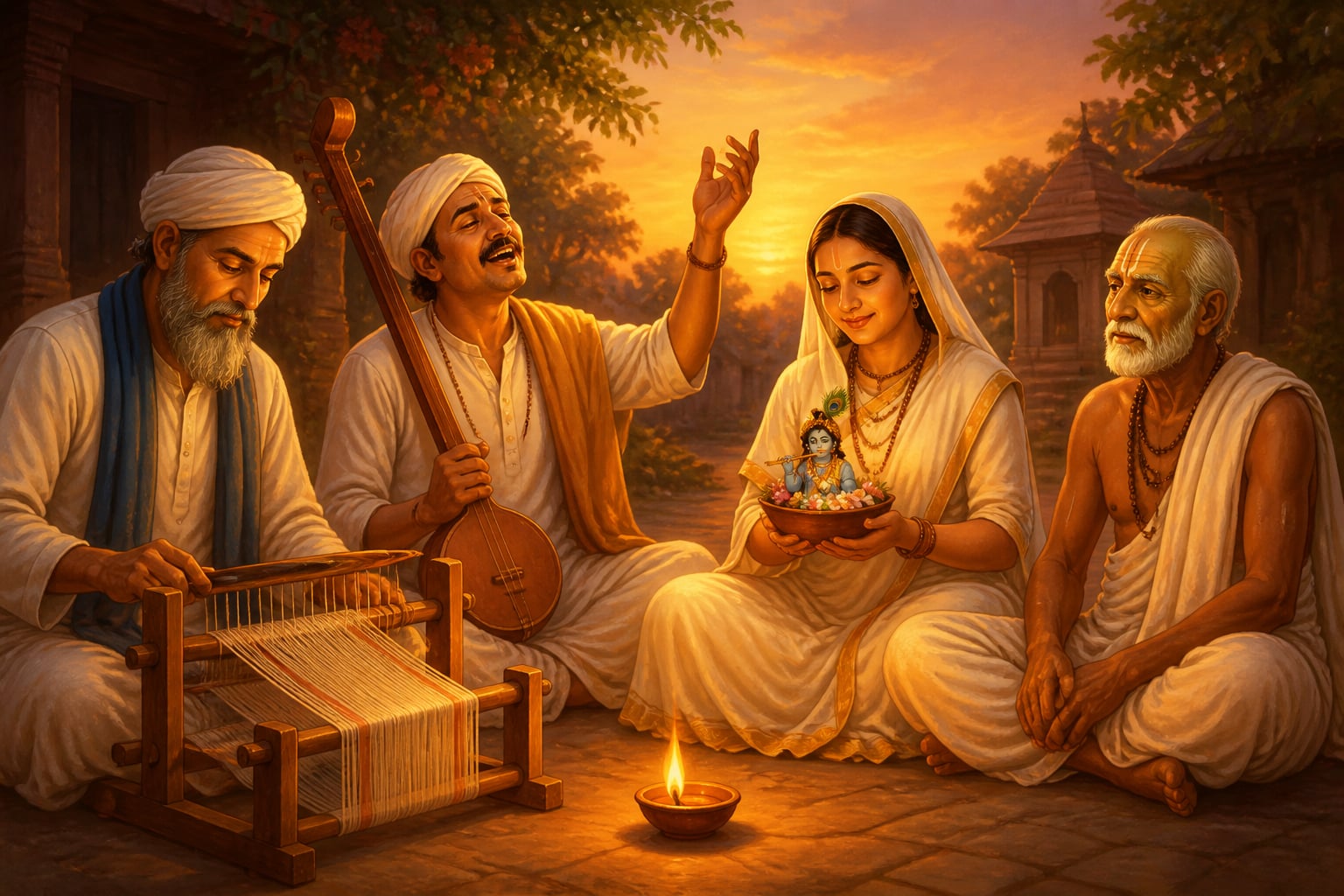
The chapters ahead will show you exactly how each of these six systems has been targeted, which forces are weakening which nodes, and how the breaking forces operate. But the counter-strategy begins here, with this recognition: India is a network. Every node you strengthen makes the entire civilization more resilient.
Case studies
The Rise of Vijayanagara: Network Self-Healing in Action
By the early 14th century, the Delhi Sultanate had devastated northern India's civilizational infrastructure. Nalanda and Vikramashila were destroyed. Thousands of temples were demolished. Sanskrit scholarship in the Gangetic plains was severely disrupted. By conventional logic, Indian civilization should have entered terminal decline, much as Roman civilization did after the fall of the Western Empire. Instead, in 1336, Harihara and Bukka Raya founded the Vijayanagara Empire in the Deccan. Over the next three centuries, this empire became the most powerful state in southern India, consciously rebuilding the civilizational infrastructure that had been damaged in the north. Krishnadevaraya (r. 1509-1529) patronized Sanskrit and Telugu scholarship, rebuilt temple networks, revived classical arts, and maintained trade connections that sustained economic vitality across the peninsula.
Vijayanagara illustrates the Indrajala principle: when one set of jewels in the net is shattered, other jewels intensify their brilliance to compensate. The empire did not merely survive as a political entity. It functioned as a civilizational backup system, preserving and regenerating knowledge systems, temple institutions, artistic traditions, and philosophical scholarship that had been disrupted elsewhere. Kautilya's concept of janapada (the productive community rooted in its land) explains why this was possible: the southern janapadas retained their civilizational code intact, and when given political support, they could regenerate the entire network.
Vijayanagara preserved and transmitted temple architecture traditions, Carnatic music, Bharatanatyam, Sanskrit scholarship, and dharmic governance through three centuries of northern disruption. Even after Vijayanagara's own fall at Talikota (1565), the traditions it preserved continued through the Nayaka kingdoms and Maratha successor states. The network had already distributed the civilizational code to new nodes.
Civilizational networks self-heal by activating dormant or secondary nodes when primary nodes are damaged. The key is that enough nodes must remain strong enough to carry the civilizational code until conditions allow regeneration.
Today, as institutional capture weakens India's formal civilizational nodes (universities, media, cultural bodies), the network is again self-healing through grassroots movements, digital platforms, and diaspora communities. The pattern is identical: when official nodes fail, distributed nodes activate.
At its peak under Krishnadevaraya, Vijayanagara's capital city had a population estimated at 500,000, making it one of the largest cities in the world at that time.
Kumbh Mela 2025: 100 Million People, No CEO
In January 2025, the Maha Kumbh Mela commenced at the Triveni Sangam in Prayagraj. Over 45 days, more than 100 million pilgrims arrived from every Indian state and dozens of countries. They organized themselves around specific bathing dates (Makar Sankranti, Mauni Amavasya, Basant Panchami) determined by astronomical calculations preserved for millennia. Thirteen akharas coordinated their traditional processions (shahi snaan) in a sequence established centuries ago. Thousands of mathas, ashrams, and guru lineages set up camps, offered discourses, and fed pilgrims. The Indian government provided infrastructure (roads, sanitation, security, medical facilities), but the event itself, the reason 100 million people converged on one point at specific times, was coordinated by civilizational memory, not administrative command.
Kumbh Mela is the civilizational network made visible. All six systems activate simultaneously: Dharma (shared ritual grammar of snana and daan), sacred geography (the Sangam as a civilizational node), knowledge systems (discourses by scholars and saints), temple and monastic institutions (akhara processions), festivals (the Kumbh as civilizational time-keeper), and philosophical pluralism (Shaiva, Vaishnava, Shakta, and Sikh traditions all participating in the same event). No central authority coordinates this. The coordination emerges from the network itself.
The 2025 Maha Kumbh became the largest peaceful human gathering in recorded history, demonstrating that India's civilizational network remains functional at extraordinary scale. Urban planners and sociologists from around the world studied the event, struggling to explain how a gathering of this magnitude could self-organize without centralized command infrastructure.
India's civilizational network is not a historical artifact. It is a living, functioning system capable of coordinating human activity at a scale no corporation or government could replicate. The network works because the nodes (shared calendar, sacred geography, institutional memory, dharmic grammar) remain active.
The Kumbh Mela proves that India's civilizational operating system is still functional. The question is whether the other nodes (knowledge systems, philosophical traditions, temple institutions) can be maintained at the same level of vitality, or whether they will continue to weaken under institutional neglect and cultural erosion.
The 2025 Maha Kumbh Mela's estimated attendance of over 100 million people exceeds the entire population of most nations on Earth.
Rome vs. India: Why Hierarchies Shatter and Networks Endure
Rome and India faced structurally similar threats: prolonged invasion by militarily superior forces, destruction of institutions, economic disruption, and loss of political sovereignty over core territories. Rome fell to Germanic invasions in 476 CE. Within three centuries, Latin had splintered into mutually unintelligible Romance languages (French, Spanish, Italian, Portuguese). Roman legal and administrative systems fragmented into feudal localism. The Roman Senate, which had functioned for over a millennium, ceased to exist. No civilizational recovery occurred. Western Europe did not regain Roman levels of urbanization, literacy, or infrastructure until the Renaissance, nearly a thousand years later. India lost Delhi to Turkic invaders in 1192 CE. The destruction was comparable or worse: universities burned, temples demolished, administrative systems dismantled. Yet Indian civilization continued without interruption. Sanskrit scholarship migrated south and east. Temple traditions continued in thousands of locations. Philosophical debate persisted. Festivals were celebrated. The civilization endured.
The difference is architectural, not moral or genetic. Rome was a hierarchy: one capital, one senate, one language of administration, one legal code. Destroy the center, and the periphery cannot self-organize. India was a network: many centers, many languages, many legal traditions, many philosophical schools, all interconnected through shared Dharma, sacred geography, and knowledge systems. Destroying Delhi was like cutting one node in a mesh network. The network routed around the damage. Destroying Rome was like cutting the trunk of a tree. The branches could not survive independently.
Rome's civilizational continuity was permanently broken. Modern Italians, Spaniards, and French do not share a common language, legal system, or civilizational identity derived from Rome. India's civilizational continuity was preserved. A Tamil Hindu, a Bengali Hindu, and a Kashmiri Hindu today share recognizable dharmic vocabulary, sacred geography, festival calendars, and philosophical frameworks despite centuries of political fragmentation.
Centralized civilizations are efficient but fragile. Distributed civilizations are messier but resilient. India's 'inefficiency,' its lack of a single capital, a single language, a single authority, turned out to be its greatest survival advantage.
Modern India faces pressure to centralize (one language, one exam system, one cultural authority). The Rome comparison warns: centralization may feel efficient, but it replaces a resilient network with a brittle hierarchy. The challenge is to modernize without losing the distributed architecture that has kept this civilization alive.
Latin fractured into distinct Romance languages within roughly 300 years of Rome's fall. Sanskrit, despite never being imposed by a central authority, remained a shared intellectual language across the subcontinent for over 3,000 years.
Reflection
- Of the six civilizational systems (Dharma, Sacred geography, Knowledge systems, Temple institutions, Festivals, Philosophical pluralism), which are you personally connected to, and which have you lost connection with? What does your personal 'network health map' look like?
- What does it mean that no single person, institution, or authority 'owns' or 'controls' Indian civilization? Is this a strength, a vulnerability, or both?
- How do you defend a civilizational network without centralizing it? If centralization would make defense easier but would destroy the very distributed architecture that has kept the civilization alive for millennia, what is the right approach?