Pattanam: Archaeological Evidence of Global Trade

When Science Proved the Legends True

For centuries, Muziris was legend, mentioned in ancient texts but never found. Then archaeologists began digging at Pattanam. What emerged from the Kerala soil rewrote history: Roman coins, Mediterranean pottery, and evidence of the ancient world's greatest trade hub.

The Hunt for a Lost City

For two thousand years, scholars knew Muziris existed. The Periplus mentioned it. Pliny described it. Sangam poetry celebrated it. Roman coins bearing the names of emperors appeared in Kerala fields.

But where exactly was it?

The problem was that Muziris had vanished. According to local tradition, a catastrophic flood in the 14th century, or perhaps earlier, destroyed the port, rerouted rivers, and buried the greatest trading city of the ancient world under meters of silt.

Historians proposed various locations: Kodungallur, Cranganore, North Paravur. But without excavation, Muziris remained what Troy was before Schliemann, a place more legend than history.

Then came Pattanam.

The Dig That Changed Everything
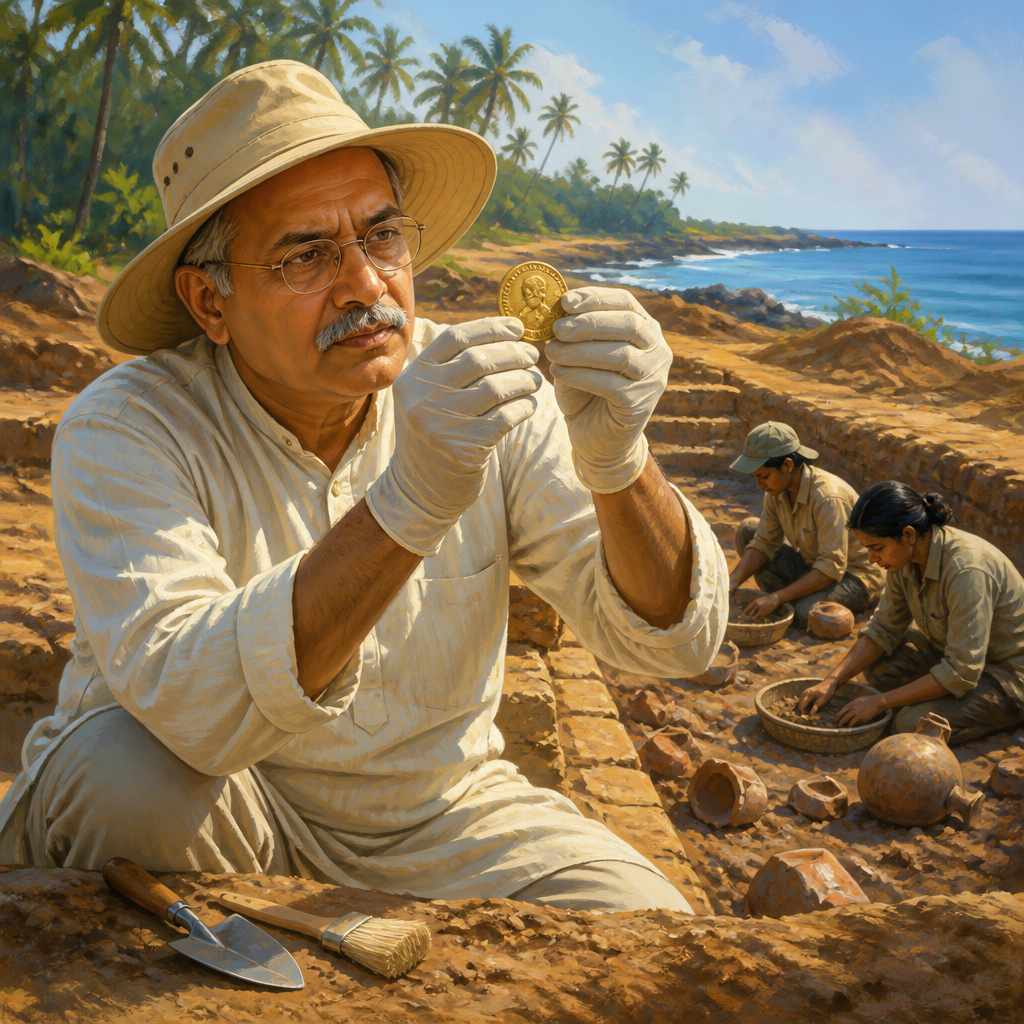
Dr P J Cherian examining a Roman coin at the Pattanam excavation

In 2004, Dr. P.J. Cherian, an archaeologist with the Kerala Council for Historical Research, began systematic excavations at Pattanam, a small village 20 kilometers from Kodungallur.

The locals had always known something was there. Farmers plowing fields turned up ancient beads. Children found strange coins in the river. But no one understood what lay beneath.

What Dr. Cherian's team found over the next two decades transformed our understanding of ancient India:

Roman artifacts: Not occasional finds, but thousands of pieces. Amphorae fragments for wine and olive oil. Terra sigillata pottery from Italy. Glass beads from Alexandria. Bronze vessels with Roman maker's marks.

Coins by the thousands: Roman aurei and denarii spanning from the 1st century BCE to the 5th century CE. The coins weren't just scattered, they appeared in stratigraphic layers, allowing precise dating of the site's trading phases.

Mediterranean pottery: Distinctive red-slip ware that could only have come from the Roman world. Chemical analysis traced some sherds to specific kilns in Italy.

International diversity: Not just Roman, Persian, Arabian, Southeast Asian, and Chinese artifacts. Pattanam was a crossroads where every trading civilization left its mark.

Industrial infrastructure: Wharves, warehouses, what appears to be a boat-repair facility. Evidence of a purpose-built trading hub, not an accidental fishing village.

What the Artifacts Tell Us

Archaeology reveals what texts cannot, the physical reality of daily life.

An archaeological trench at Pattanam with Roman amphora fragments

Consider the amphorae fragments. These large ceramic jars transported wine, olive oil, and garum (fermented fish sauce) from the Mediterranean. Finding them at Pattanam proves Romans didn't just trade at a distance, they lived here, eating Mediterranean food, drinking Italian wine, maintaining their lifestyle far from home.

The coin distribution tells another story. Roman coins appear in dense concentrations in trading areas but spread thinly into the hinterland. This matches the Periplus account: Romans paid in coin, but local merchants converted coins to goods for the interior trade. The coins were money at the port but became bullion inland.

The pottery diversity reveals something unexpected: Pattanam wasn't just Indo-Roman. Artifacts from Persia, Arabia, Southeast Asia, and possibly China appeared in the same layers. This was a truly global entrepôt, a node where multiple trading networks intersected.

Most striking: the industrial scale. This wasn't occasional exchange between curious travelers. Pattanam shows systematic infrastructure, planned warehouses, standardized measures, organized workspaces. The archaeology confirms what the Muziris Papyrus described: professional trade conducted at industrial volume.

The Science of Evidence

Modern archaeology is scientific archaeology. At Pattanam, multiple techniques confirmed and extended what excavation revealed:

Radiocarbon dating of organic material established the site's chronology: significant activity from the 4th century BCE, peak occupation in the 1st-3rd centuries CE, decline after the 5th century.

Neutron activation analysis traced pottery origins by analyzing chemical signatures. Sherds that looked Mediterranean were confirmed as Mediterranean, some traced to specific Italian production centers.

Pollen analysis revealed ancient agricultural patterns. Pepper cultivation intensified precisely when Roman trade peaked, direct evidence that commerce drove cultivation.

Satellite imagery identified ancient river courses and harbor structures now buried under sediment. The geography that made Muziris possible is still visible from space.

This is the power of modern archaeology: turning intuitions into evidence, legends into data.

Global Perspectives on Archaeological Proof

Heinrich Schliemann (1822-1890) faced the same challenge a century earlier. For millennia, scholars debated whether Homer's Troy was real or mythological. Many assumed the Trojan War was pure fiction.

Heinrich Schliemann at the Hisarlik excavation in 1871

In 1871, Schliemann, a wealthy merchant turned amateur archaeologist, began digging at Hisarlik in Turkey. What he found silenced skeptics: layer upon layer of ancient cities, including one destroyed by fire around the traditional date of the Trojan War.

Schliemann proved that ancient texts, however embellished, often preserved genuine historical memory. The Iliad was poetry, but Troy was real.

Dr. Cherian's work at Pattanam follows the same pattern. The Periplus was a trading manual, but Muziris was real. Sangam poetry was literature, but the Yavana ships were real. Roman complaints about gold draining to India were politics, but the coins were real.

Ian Morris, Stanford historian, has used archaeology to measure ancient economies. His "social development index" quantifies urbanization, energy capture, and information technology across civilizations. Morris's work shows that India's western coast in the 1st-3rd centuries CE was among the most economically developed regions in the ancient world, a claim now supported by Pattanam's evidence.

Romila Thapar, India's preeminent ancient historian, has long argued that Indian Ocean trade was central to understanding ancient India, more important than the land-based contacts emphasized by earlier scholars. Pattanam proves her thesis: the sea connected India to the world in ways that transformed society, economy, and culture.

Scholar Key Insight Pattanam Connection
Schliemann Ancient texts preserve real history Pattanam proves Periplus accurate
Morris Archaeology can measure ancient economies Evidence quantifies Indo-Roman trade scale
Thapar Maritime trade shaped Indian history Physical proof of oceanic connections

Modern Resonance: Archaeology Rewriting Indian History

Pattanam is not alone. Across India, archaeological discoveries are rewriting timelines and challenging assumptions.

Dholavira and Rakhigarhi: Excavations at these Indus Valley Civilization sites have pushed back dates of urban development and revealed a civilization far larger and more sophisticated than previously understood. Rakhigarhi's DNA studies sparked new debates about ancient Indian origins and migrations.

Keeladi: In Tamil Nadu, excavations at Keeladi revealed an urban civilization dating to at least the 6th century BCE, contemporary with Muziris's early phases. The site shows Tamil urbanization developed independently, not as a result of northern influence. Iron smelting, writing, and craft production flourished here when Rome was still a village.

These discoveries share a pattern: archaeology is proving that ancient India was more urban, more connected, and more sophisticated than colonial-era scholarship assumed. The evidence in the ground contradicts narratives that depicted India as isolated, unchanging, or derivative.

Your Turn: Reading Evidence

Archaeology teaches critical thinking about evidence:

Physical artifacts don't lie. Roman coins at Pattanam prove Roman presence, no interpretation needed. The challenge is understanding what presence means.

Context matters more than objects. A Roman coin in a museum is a curiosity; a Roman coin in stratigraphic context at a documented trade site is historical proof. Where something is found matters as much as what is found.

Absence of evidence isn't evidence of absence. Before Pattanam's excavation, lack of archaeological proof led some to doubt Muziris's scale. The lesson: unknown isn't the same as unreal.

Next, we'll leap from ancient evidence to modern reality, exploring how India remains the world's spice capital, and how the patterns established in Muziris's time continue to shape global trade today.

Evidence-based decision making. In both archaeology and business, systematic collection and analysis of evidence leads to better conclusions than intuition or assumption.

The scientific method, evidence-based management, and data-driven decision making all reflect this principle. The contrast with assumption-based thinking is the contrast between pre-modern and modern approaches to knowledge.

India's pramāṇa tradition, systematic epistemology distinguishing valid from invalid knowledge sources, anticipated modern evidence-based thinking. The Nyaya school's analysis of perception, inference, and testimony as knowledge sources prefigured scientific methodology.

Pattanam excavations recovered over 10,000 artifacts and documented them using scientific protocols. This evidence base transformed speculation about Muziris into knowledge about Muziris.

Knowledge sovereignty and institutional capacity. Who controls the interpretation of evidence matters as much as the evidence itself. Building domestic research capacity is an investment in intellectual self-determination.

Every nation invests in historical research as a form of cultural capital. The British Museum, the Smithsonian, and European archaeological institutes represent centuries of such investment. India's catch-up requires sustained institutional development.

Key terms

Purātattva
Archaeology, literally 'ancient elements' or 'ancient principles.' The systematic study of material remains to understand past societies.
Stara-vijñāna
Stratigraphy, the study of geological and archaeological layers. The principle that older deposits lie beneath newer ones, allowing chronological sequencing.
Pramāṇa
Evidence, proof, or valid means of knowledge. In Indian philosophy, the accepted sources of knowledge that lead to true conclusions.
Utkhanana
Excavation, the systematic digging and recording of archaeological sites. The primary method by which buried evidence is recovered.

Verses

தெரிந்த இனத்தொடு தேர்ந்தெண்ணிச் செய்வார்க்கு

terinta iṉattoṭu tērnt-eṇṇic ceyvārkku

Weigh evidence with care, count costs with precision, then act with confidence.

Modern archaeology's scientific methodology, stratigraphic analysis, chemical testing, radiocarbon dating, reflects this principle. Evidence-based conclusions are more durable than assumptions. The same discipline that makes scientific claims credible makes business analysis valuable.

Thirukkural, Kural 503 (G.U. Pope)

To Muziris come ships from distant lands, for pepper fills their holds and gold their hands.

Primary sources from practitioners, traders, sailors, merchants, often contain more reliable data than secondary scholarly speculation. The Periplus was a practical handbook, not literature. Its commercial accuracy reflects its commercial purpose.

Periplus Maris Erythraei, Chapter 54 (Lionel Casson)

Key figures

Dr. P.J. Cherian

Director of the Pattanam excavations since 2004, the archaeologist who proved Muziris was real

Heinrich Schliemann

German archaeologist who proved Homer's Troy was real, establishing that ancient texts preserve genuine historical memory

The Periplus Author

Anonymous Greek-Egyptian merchant whose trading handbook proved astonishingly accurate when tested by archaeology

Case studies

Dholavira and Rakhigarhi: Rewriting Indus Valley History

For decades, the Indus Valley Civilization was understood primarily through sites in Pakistan, Mohenjo-daro and Harappa. Indian sites existed but were less studied. The picture was of a civilization centered on the Indus River with peripheral extensions eastward. Then came systematic excavations at Dholavira (Gujarat) and Rakhigarhi (Haryana). What emerged challenged the established narrative.

These excavations exemplify archaeology as truth-seeking. Rather than confirming assumptions, the evidence forced revision: **Dholavira** revealed a massive water management system, sophisticated reservoirs, channels, and dams that enabled urban life in a semi-arid zone. The site showed that Indus engineering wasn't limited to the Indus River itself. **Rakhigarhi** proved to be larger than Mohenjo-daro, the biggest Indus Valley site discovered. Its location far from the Indus River suggested the civilization was more extensive and diverse than previously understood. **DNA studies** at Rakhigarhi sparked controversy but also advanced the science: ancient DNA analysis allowed direct study of population history rather than reliance on linguistic or textual inference.

These excavations transformed understanding of ancient India: 1. **Geographic scope**: The Indus Valley Civilization extended far beyond the Indus, covering Gujarat, Rajasthan, Haryana, and beyond. Some scholars now prefer 'Harappan Civilization' to acknowledge this breadth. 2. **Urban sophistication**: Engineering achievements at Dholavira rival anything in the ancient world. Indian sites aren't 'peripheral', they're central to understanding the civilization. 3. **Ongoing revision**: Each excavation season produces new evidence, forcing continuous revision of understanding. The history isn't settled, it's actively being discovered. Like Pattanam proving Muziris, these excavations prove that India's ancient past was more sophisticated and extensive than previous scholarship recognized.

Archaeological evidence can overturn established narratives. What was 'known' about the Indus Valley Civilization proved incomplete when new sites were properly excavated. The lesson: assumptions should yield to evidence, and evidence requires investment to generate.

Rakhigarhi's DNA studies and site dating have prompted a broader global conversation about how archaeological evidence should reshape historical narratives. Similar reexaminations are underway for Gobekli Tepe in Turkey and Gunung Padang in Indonesia, challenging Eurocentric timelines of civilizational development.

Rakhigarhi covers 350+ hectares, larger than Mohenjo-daro (250 hectares). Its discovery forced reconsideration of which sites were central to the Indus Valley Civilization.

Keeladi: Evidence of Ancient Tamil Urbanization

In 2015, the Tamil Nadu Archaeology Department began excavating at Keeladi, near Madurai. The site had been identified years earlier but never systematically explored. What emerged challenged assumptions about the timeline of Tamil civilization. Conventional dating placed Tamil urbanization after the Mauryan period, perhaps the 3rd century BCE, influenced by northern contact. Keeladi's evidence pushed that date back dramatically.

Keeladi's excavations demonstrate several dharmic principles: **Systematic methodology**: Unlike treasure-hunting, modern archaeology documents context meticulously. Every potsherd is recorded; every layer is mapped. This discipline makes evidence credible. **Indigenous scholarship**: Keeladi was excavated by Tamil archaeologists, for Tamil historical understanding. The research questions emerged from local concerns, not foreign agendas. **Evidence transforming narrative**: The finds forced revision of assumptions about when and how Tamil urbanization developed, proof that evidence should lead interpretation, not follow it.

Keeladi's findings reshaped understanding of Tamil history: 1. **Timeline revision**: Radiocarbon dating placed the site at the 6th century BCE, centuries earlier than conventional dating for Tamil urbanization. 2. **Indigenous development**: Evidence of iron smelting, graffiti marks (proto-writing?), and brick architecture suggested Tamil urbanization developed independently, not as northern influence. 3. **Contemporary with Muziris**: Keeladi and Pattanam are roughly contemporary. The Tamil country had multiple sophisticated urban centers during the period of Indo-Roman trade. 4. **Literacy**: Tamil Brahmi inscriptions at Keeladi demonstrate that writing was widespread earlier than previously documented. The excavations continue, with each season producing new evidence that extends and revises understanding.

History isn't fixed, it's continuously revised as new evidence emerges. What was 'known' about Tamil history proved incomplete when systematic excavation tested assumptions. Investment in archaeology is investment in self-knowledge.

Keeladi's findings have energized citizen-funded archaeology across India, with crowdfunding campaigns raising crores for excavation. This model, where communities directly invest in uncovering their own history, is emerging globally as a complement to state-funded research.

Keeladi has produced over 18,000 artifacts across multiple excavation seasons. Radiocarbon dating of organic samples establishes the site's antiquity with scientific precision.

Historical context

2004-present (excavation period) / 4th century BCE - 5th century CE (site occupation)

Pattanam excavations occurred during a period of renewed interest in Indian archaeology. The discovery coincided with increased funding for heritage research and growing public interest in reclaiming Indian history through indigenous scholarship.

Pattanam's excavations parallel other major archaeological projects proving ancient trade connections: Berenike in Egypt (Roman Red Sea port), Myos Hormos (departure point for India), and various Arabian Gulf sites that together reveal the scale of ancient Indian Ocean commerce.

Over 20 excavation seasons have produced more than 10,000 artifacts. Approximately 12,000 square meters have been excavated, still a fraction of the estimated site area.

Pattanam proves that ancient texts describing Indian trade were accurate. This validation has implications beyond history: it suggests that other ancient accounts, of technology, governance, philosophy, may also preserve genuine knowledge waiting to be recovered.

Living traditions

The Pattanam excavations have sparked renewed interest in Kerala's maritime heritage. State and central government investment in the Muziris Heritage Project represents archaeology translated into cultural tourism and public education.

Reflection

More in The Spice Trade: India's Golden Monopoly

All lessons in The Spice Trade: India's Golden Monopoly · Trade Routes of Ancient Bharat course