Maricha: Black Pepper That Funded Exploration
How a Climbing Vine Changed World History
Trace the remarkable journey of black pepper from Malabar vine to Roman table, and discover how this single spice became so valuable that it funded Columbus, bankrolled da Gama, and launched the Age of Exploration that reshaped the modern world.
The Roman Senator's Complaint
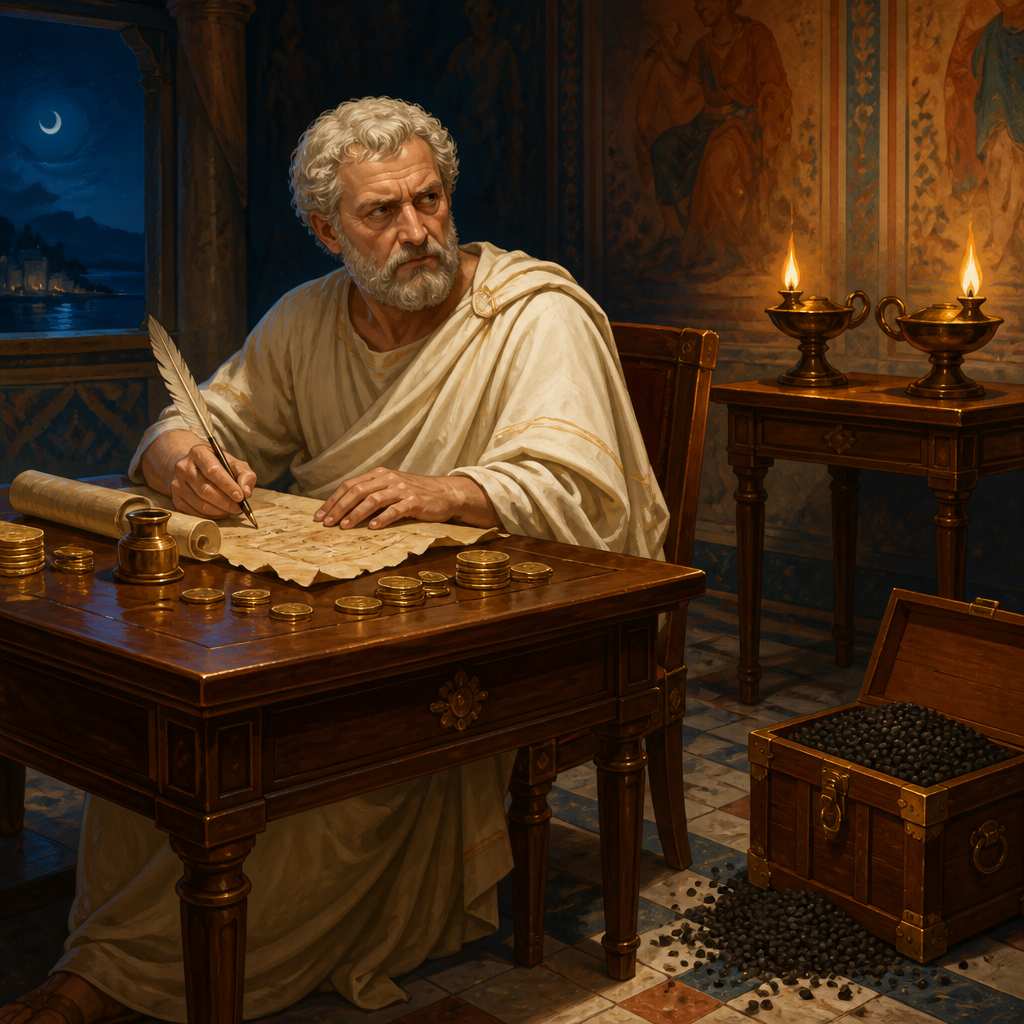
In 77 CE, Pliny the Elder, Rome's greatest naturalist, sat down to calculate something that infuriated him. Every year, Rome sent 50 million sesterces to India for pepper, pearls, and silk. That was roughly 5% of the empire's entire annual budget, more than the cost of feeding Rome's legions, flowing east for spices that Romans couldn't grow.
"There is no year in which India does not drain Rome of fifty million sesterces," Pliny wrote bitterly, "sending back merchandise that is sold among us at a hundred times its original cost."
He wasn't exaggerating. A Roman merchant buying pepper in Kerala paid perhaps 4 denarii per pound. By the time that pepper reached Rome, crossing the Indian Ocean, traversing Egyptian deserts, sailing the Mediterranean, it sold for 15 denarii. And at Roman dinner tables, it fetched prices that could buy land.
Pliny called pepper "black gold." He wasn't speaking metaphorically.
The Economics of Addiction
Why did Romans pay such absurd prices for a spice that "has nothing to recommend it in either fruit or berry," as Pliny complained? "We prize it only for a certain pungency!"
The answer reveals everything about how commodity markets work, then and now.
Scarcity: Black pepper (Piper nigrum) grew only in Kerala. Romans couldn't transplant it, synthesize it, or find substitutes. Complete geographic monopoly.
Inelasticity: Once Romans tasted peppered food, they wouldn't go back. Pepper wasn't just flavor, it was status. A patrician household without pepper was marking itself as poor. Demand was fixed; price could rise indefinitely.
Store of Value: Unlike grain that rotted or wine that soured, dried peppercorns lasted for years. They could be stored, transported, divided, and traded. Pepper functioned as money.
Network Effects: The more Romans used pepper, the more they expected it. Recipes assumed pepper. Social occasions required it. Pepper became embedded in Roman culture, withdrawal was unthinkable.
This is what economists call a "captured market." India held the supply; Rome had no alternative. The trade would last as long as Rome had gold to send east.
The Journey of a Peppercorn
Follow a single peppercorn from vine to table:
Harvest (Kerala, January-February): A farmer climbs a pepper vine winding around a jackfruit tree, picking clusters of green berries. He spreads them on mats to dry in the sun, turning them daily as they darken and shrivel.
Collection (Kerala, March): A broker from Muziris arrives at the village, weighs the dried peppercorns, and pays in Roman gold coins, aurei and denarii that have become Kerala's second currency.
Port (Muziris, March-April): The peppercorns are weighed, taxed (Kerala's śulka of 5-10%), and loaded onto warehouses near the harbor. Ships from Alexandria wait for the monsoon to reverse.
Ocean Voyage (Indian Ocean, September-October): When the northeast monsoon begins, ships laden with pepper, cinnamon, and nard set sail for the Red Sea. The 40-day journey crosses open ocean, dangerous, but faster than coastal hopping.

Desert Transit (Egypt, October-November): At the port of Berenice, pepper is unloaded onto camels for the 12-day trek to the Nile. Each camel carries about 400 pounds.
River Journey (Nile, November-December): From Coptos on the Nile, pepper floats north to Alexandria, the empire's commercial hub.
Mediterranean Crossing (December-January): Final voyage to Puteoli or Ostia, Rome's great ports. Customs duties add another layer of cost.
Market (Rome, February): Nearly a year after harvest, the peppercorn reaches the Forum Cuppedinis, Rome's spice market. It sells for 10-15 times the Kerala price.
Each stage added cost: transport, storage, taxes, risk premiums, profit margins. The final price reflected not just the pepper but the entire infrastructure of global trade.
Global Perspectives on Commodity Chains
Fernand Braudel (1902-1985), in The Wheels of Commerce, analyzed the pepper trade as the prototype of modern commodity capitalism. He identified three layers:
Material life: The actual production, farmers climbing vines, traders weighing pepper, sailors crossing oceans. Real people doing physical work.
Market economy: The price mechanisms, supply and demand, the visible trade that Pliny could observe and complain about.
Capitalism: The invisible layer of finance, speculation, and concentrated profit. The Venetian and Genoese bankers who financed voyages, collected interest, and accumulated wealth without ever touching pepper.
Braudel argued that the top layer, finance capitalism, extracted most of the value while the bottom layer, actual producers, received least. Kerala's farmers grew the pepper; Italian bankers captured the profit.
Immanuel Wallerstein (1930-2019) built on Braudel's work to describe "world-systems." In his framework, Kerala was the "periphery", producing raw commodities that flowed to "core" regions (first Rome, later Europe) where value was extracted. This pattern, established in the pepper trade, would define colonial economics for centuries.
Douglas North (1920-2015), Nobel laureate in economics, emphasized the role of institutions in reducing transaction costs. The Indo-Roman pepper trade worked because both sides trusted the systems: standard weights, predictable taxes, enforceable contracts. Good institutions made long-distance trade possible.
| Economist | Key Insight | Pepper Trade Application |
|---|---|---|
| Braudel | Three-layer capitalism | Producers earned least; financiers earned most |
| Wallerstein | Core-periphery dynamics | Kerala supplied; Rome extracted value |
| North | Institutional economics | Trust systems enabled 5,000-mile trade |
The Pepper That Launched Ships
Rome fell. The pepper trade continued.
Arab merchants captured the western routes, adding another layer of middlemen. By the 15th century, pepper reaching Venice had passed through so many hands that prices had become extraordinary.
This created the economic pressure that launched the Age of Exploration.
When Christopher Columbus sailed west in 1492, he wasn't looking for America. He was looking for a direct route to India's pepper. His letters to Ferdinand and Isabella emphasized the wealth of "the Indies" and the spices that awaited.

When Vasco da Gama reached Calicut in 1498, his first words to the locals were reportedly: "We come in search of Christians and spices." He was more interested in the spices.
The entire Portuguese empire in Asia, Goa, Cochin, Malacca, was built on controlling pepper. The Dutch and English followed, establishing trading companies whose primary purpose was bypassing Arab middlemen to get pepper directly from the source.
A climbing vine in Kerala shaped 500 years of world history.
Modern Resonance: Vietnam's Pepper Revolution
In 1990, Vietnam produced virtually no black pepper. India was the world's dominant exporter, as it had been for two millennia.
By 2020, Vietnam had become the world's largest pepper producer, exporting 250,000 tonnes annually, more than double India's production. How did a country with no pepper tradition overtake the historic leader?
The answer illustrates both the power and limits of geographic advantage.
Vietnam's advantages: Lower labor costs, government support for agricultural exports, newer plantations using high-yield varieties, and farmers hungry to escape poverty.
India's response: Rather than compete on volume, Indian producers pivoted to quality and provenance. GI-tagged Malabar pepper commands 50-100% premiums over Vietnamese pepper. The Spices Board India positioned Indian pepper as the "original" with unique flavor profiles developed over millennia.
This is the dharmic approach to competition: when you can't win on price, compete on authenticity. Vietnam produces more pepper; India produces Malabar pepper.
Your Turn: The Commodity Lesson
Black pepper teaches three timeless economic lessons:
Scarcity creates leverage, but only while it lasts. Kerala's monopoly ended when Vietnam entered the market. Every advantage has a shelf life.
Middlemen capture value, Braudel's insight remains true. In any commodity chain, those who control distribution often earn more than those who produce. Positioning matters.
Authenticity is the last moat, when commodity competition arrives, the only defense is being genuinely different. India's pepper heritage cannot be replicated; it can only be protected.
Next, we'll explore the greatest pepper port of the ancient world, Muziris, where Rome met India, and discover how this city became the gateway for the largest peacetime wealth transfer in ancient history.
Value chain analysis and rent distribution. In any supply chain, value is created at each stage but captured unevenly. The pepper trade shows this starkly: Kerala farmers earned denarii while Roman merchants earned fortunes.
Michael Porter's 'value chain' analysis and Gary Gereffi's 'global value chain' framework formalize what Braudel observed historically: power and profits accrue to those who control distribution, branding, and finance, not production.
India's modern spice export strategy addresses this directly. Through GI tagging, direct-to-consumer brands, and farmer cooperatives, Indian producers are capturing more of the value chain rather than remaining commodity suppliers to foreign brands.
Farmer-owned spice cooperatives in Kerala that sell directly to international buyers report margins 3-5x higher than those selling through traditional commodity channels.
Monopoly decay and competitive dynamics. Every monopoly faces eventual erosion through substitution, innovation, or new entry. The question is whether you prepare during prosperity or scramble during decline.
Joseph Schumpeter's 'creative destruction' describes how innovation undermines established positions. Clayton Christensen's 'Innovator's Dilemma' shows how market leaders often fail to adapt when new competitors emerge from unexpected directions.
Key terms
- Marīca
- Black pepper (Piper nigrum). The Sanskrit name that became 'peperi' in Greek and 'piper' in Latin. India's most valuable historical export.
- Mūlya-vṛddhi
- Value addition or price increase. The economic concept that goods gain value through processing, transport, or reaching markets where they're scarce.
- Vāṇijya-patha
- Trade route or commercial pathway. The established channels through which commodities moved between production and consumption centers.
- Bhoga-vastu
- Consumption good or luxury item, something valued for enjoyment rather than necessity. Pepper was the archetypal bhoga-vastu of the ancient world.
Verses
पण्यानां मूल्यवृद्धिः परदेशे भवति
paṇyānāṃ mūlya-vṛddhiḥ paradeśe bhavati
What is common at home becomes treasure abroad; distance transforms value.
This sutra captures the essence of trade profits. The pepper that fetched 4 denarii in Kerala sold for 60+ denarii in Rome, not because it changed, but because it moved. Understanding geographic price differentials is the foundation of commerce.
Arthashastra, Book 2, Chapter 11 (R.P. Kangle)
Minimique mirum est placuisse piperi
How strange that we prize mere pungency, yet there is no table in Rome without it.
Pliny inadvertently described what economists call 'Veblen goods', products valued precisely because they are expensive. Pepper's price wasn't a barrier to consumption; it was the attraction. Status goods follow inverse demand curves.
Pliny the Elder - Natural History, Book XII, Chapter 14 (John Bostock)
Key figures
Pliny the Elder
Roman naturalist, author of 'Natural History,' and the primary ancient source on Rome's pepper trade with India
Fernand Braudel
French historian who analyzed the pepper trade as the prototype of modern capitalism in his 'Civilization and Capitalism' trilogy
Vasco da Gama
Portuguese explorer who reached India in 1498, opening direct European access to the pepper trade and ending Arab intermediary dominance
Case studies
Vietnam's Pepper Revolution: How a Newcomer Disrupted a 2,000-Year Monopoly
In 1990, Vietnam was recovering from decades of war and economic isolation. Pepper production was negligible. India, as it had been for two millennia, dominated global pepper exports. By 2000, Vietnamese pepper exports had exploded to 30,000 tonnes. By 2015, Vietnam produced more pepper than India and Brazil combined. By 2020, Vietnam controlled 40% of global pepper trade. The disruption was complete. How did a country with no pepper tradition overtake the historic leader in just two decades?
Vietnam's rise illustrates both the power and the limits of geographic advantage. Kerala's monopoly was never about superior farming skill, it was about unique climate and ecology. Vietnam, with similar tropical conditions but different elevation profiles, could grow pepper. What it couldn't replicate was Kerala's 4,000 years of varietal development, flavor complexity, and heritage. The dharmic question isn't whether competition is fair, it is inevitable. The question is whether incumbents respond with panic (racing to match competitor prices) or with wisdom (doubling down on authentic differentiation).
India's response was textbook dharmic economics. Rather than compete on Vietnamese terms (volume and price), Indian producers pivoted to premium positioning: 1. **GI Protection**: Malabar, Tellicherry, and Wayanad pepper received Geographical Indication status, legally distinguishing them from generic 'black pepper.' 2. **Quality Standards**: The Spices Board India established stricter quality grades, with top-tier Indian pepper commanding 2-3x Vietnamese prices. 3. **Heritage Marketing**: Indian spice exporters emphasized the 'original' status of Kerala pepper, the same vines that supplied Rome. 4. **Direct Relationships**: Farmer cooperatives bypassed commodity markets to sell directly to premium buyers. Result: While Indian volume share declined, value share remained strong. India earns similar export revenue from 50,000 tonnes as Vietnam earns from 250,000 tonnes.
When commodity competition arrives, the wrong response is matching competitor prices. The right response is differentiating on dimensions competitors cannot replicate. Vietnam can grow pepper; it cannot grow Malabar pepper. Authenticity is the last monopoly.
Vietnam's pepper disruption follows the classic pattern of commodity market entry: a new producer gains share through volume and price, forcing incumbents to either compete on cost or differentiate on quality. India chose differentiation, the same strategic response that Swiss watchmakers used when Japanese quartz watches disrupted their market.
India's pepper export realization (price per kg) is approximately $5.50 vs. Vietnam's $2.20, a 150% premium that reflects successful differentiation strategy.
Historical context
1st century BCE - 16th century CE
For over 1,500 years, Kerala's pepper trade operated through a network of local rulers, merchant guilds, and port authorities. The system was remarkably stable, foreign powers changed (Rome, Byzantium, Arabs, Europeans), but Kerala's role as producer remained constant. This stability came from geographic monopoly, not military power.
The pepper trade created the template for colonial exploitation. Portuguese, Dutch, and English traders initially came to buy; eventually they came to control. The transition from trade to conquest followed the pepper routes.
Roman-era shipwrecks in the Mediterranean have been found carrying Indian peppercorns, archaeological proof that the trade Pliny described was physically real.
Understanding pepper's role in launching European colonialism reveals that India's colonization wasn't incidental, it was the primary objective. The wealth that attracted Columbus, da Gama, and their successors was Kerala's spice production. The 'discovery' of America was a side effect of the search for pepper.
Living traditions
The commodity trading systems developed for pepper, standardized grades, futures contracts, international price benchmarks, now govern global agricultural trade. Today's commodity markets are direct descendants of the pepper exchanges of medieval Venice and Amsterdam.
- Hand-Picking of Pepper at Optimal Ripeness: Pepper clusters hand-picked at optimal ripeness ensure maximum piperine content, a labor-intensive practice that produces the quality that made Kerala pepper worth its weight in gold.
- White Pepper Water-Aging: White pepper produced by aging peppercorns in water to remove outer skin, using a technique unchanged for centuries that creates the distinctive mild flavor prized in European cuisine.
- Jew Town Spice Markets, Fort Kochi: Historic spice trading district where pepper has been bought and sold for over 400 years
- Pepper Plantations, Wayanad: Working spice plantations where visitors can see traditional pepper cultivation
- Maritime History Museum, Kochi: Museum documenting the history of Kerala's maritime trade, including the pepper routes
- Paradesi Synagogue: Built in 1568, this synagogue served the Jewish trading community that was central to Kerala's pepper commerce. The Jewish presence in Kerala for over 2,000 years demonstrates the cosmopolitan nature of the pepper trade.
- Santa Cruz Cathedral Basilica: One of India's heritage churches, originally built by the Portuguese who came seeking pepper. The church represents the religious dimension of European involvement in the spice trade.
Reflection
- Braudel observed that in the pepper trade, producers earned the least while financiers earned the most, those furthest from the actual work captured the greatest value. Is this pattern just, or is it simply how markets work? What would a dharmic distribution of value along a commodity chain look like?
- Kerala's pepper monopoly lasted 2,000 years but ultimately fell to Vietnamese competition. What 'monopolies' in your own life or career seem permanent but might actually be vulnerable? How might you prepare for the 'Vietnam' that could disrupt your position?