Malabar: The World's Spice Capital
Kerala's Golden Coast and the Geography of Monopoly
Explore how Kerala's unique geography, wedged between the Western Ghats and Arabian Sea, created the perfect conditions for spice cultivation that no other region on earth could replicate, establishing a natural monopoly that lasted two millennia.
The Mountain Wall and the Monsoon
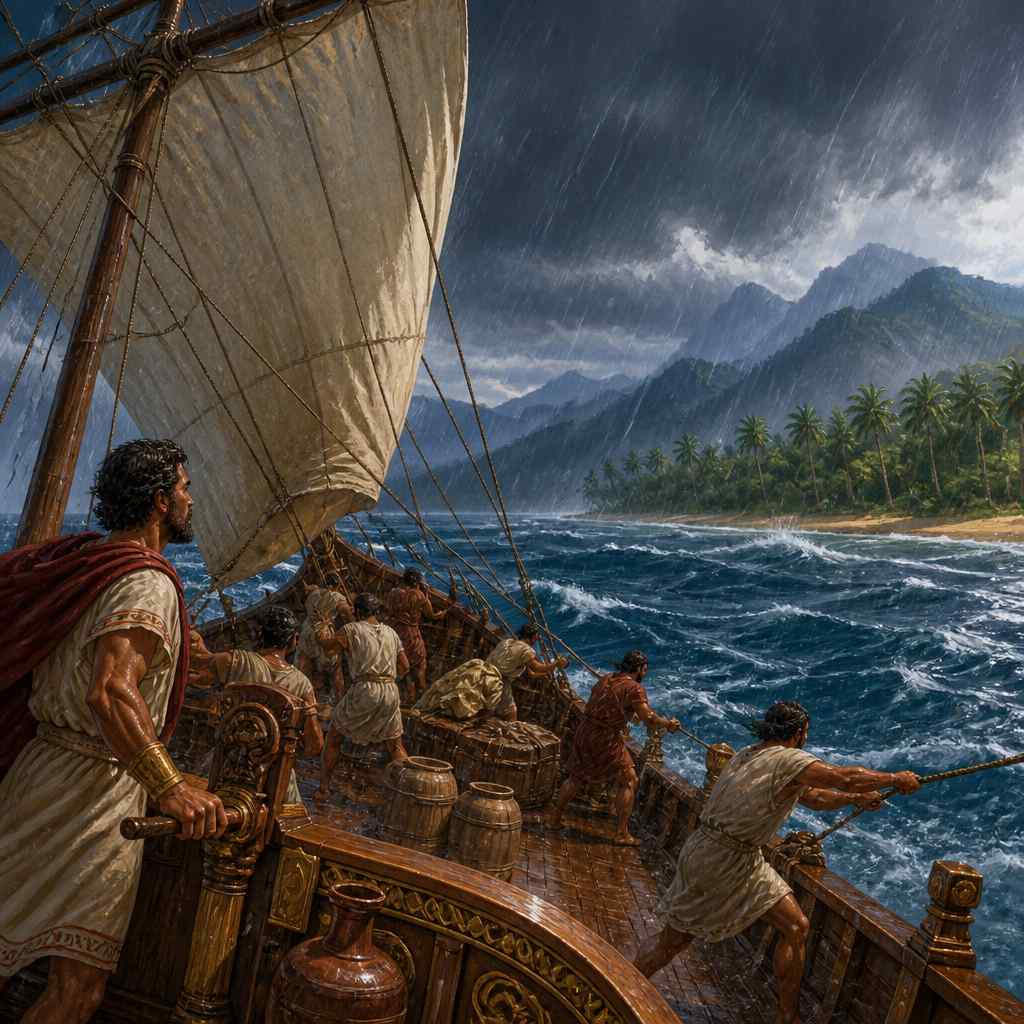
Stand on the deck of a Roman merchant ship approaching Kerala in July, and you would witness one of nature's most spectacular displays. The Western Ghats rise like a 1,500-kilometer wall along India's southwest coast, their peaks shrouded in monsoon clouds. As the moisture-laden winds from the Arabian Sea slam into these mountains, they release torrential rains, 3,000 millimeters annually, more than London sees in three years.
This wasn't just weather. It was the manufacturing plant of the world's most valuable commodities.
Cosmas Indicopleustes, the Byzantine merchant who sailed these waters in the 6th century, recorded his wonder: "The land of pepper receives such rains that the pepper grows wild in the mountains, and the inhabitants need only to collect it." He was describing not luck, but a geographic machine that created wealth.
The Perfect Storm of Agriculture
The Chera kings of the Sangam era (3rd century BCE to 3rd century CE) ruled a kingdom defined entirely by geography. Their territory ran barely 100 kilometers from coast to mountain, but this narrow strip contained three distinct ecological zones:
The Coastal Plain (0-75m elevation): Coconut palms, rice paddies, and the great ports, Muziris, Tyndis, Nelcynda, where ships from Rome waited for monsoon winds.
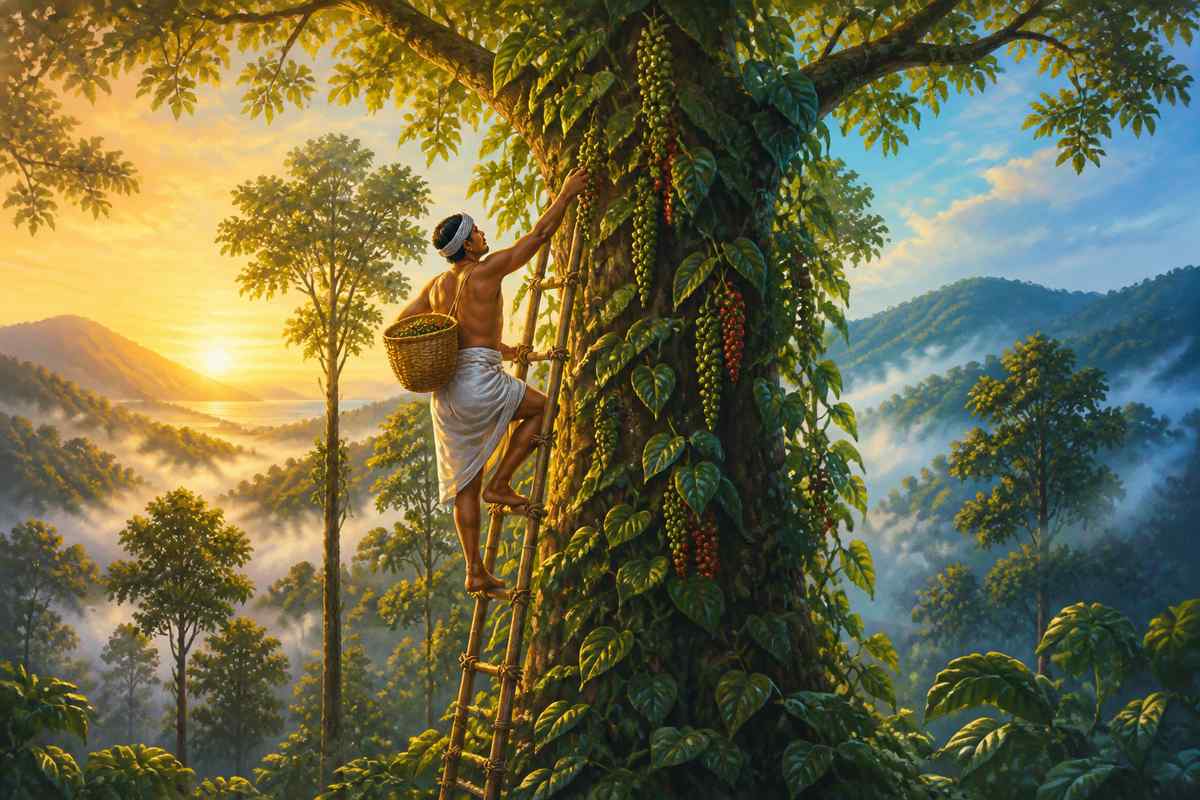
The Midlands (75-750m): Rubber and spice gardens today, but in ancient times, dense forests that protected pepper vines climbing wild trees. Here, the humidity never dropped below 80%, and morning mists bathed every leaf.
The Cardamom Hills (750-2,000m): The high ranges of Idukki and Wayanad, where cardamom and cinnamon flourished in cool, moist forests at elevations impossible to replicate elsewhere.
"The mountains here are clothed in forests," wrote the Periplus author, "and the pepper country lies beyond."
This wasn't random distribution. Each spice had evolved for a specific microclimate. Black pepper (Piper nigrum) needed the humid midlands where it could climb trees. Cardamom (Elettaria cardamomum) required the cool shade of high-altitude forests. Cinnamon (Cinnamomum verum) flourished only in the transition zones. Move any of these plants a hundred kilometers north, south, or inland, and they would die.
Why No One Could Compete
The Romans tried. Pliny the Elder complained bitterly about gold flowing to India, and Roman agricultural experts attempted to transplant pepper to Egypt, Syria, and Arabia. Every attempt failed.
The Arabs tried. They controlled the western trade routes for centuries and desperately wanted to grow their own pepper. They couldn't.
The secret wasn't just rainfall or elevation, it was the combination:
| Factor | Kerala | Elsewhere |
|---|---|---|
| Annual rainfall | 3,000+ mm | Most regions: <1,000 mm |
| Monsoon pattern | Predictable June-September | Unpredictable or absent |
| Elevation range | 0-2,695m in 100km | Gradual over 1,000+ km |
| Laterite soil | Iron-rich, acidic | Variable |
| Humidity | 80%+ year-round | Seasonal |
This combination created what economists call a natural monopoly, geographic conditions so specific that competition was impossible. The Chera kings didn't need trade policies to protect their spice markets. Nature had already built an impenetrable wall.
Global Perspectives on Geographic Advantage
Jared Diamond, in his Pulitzer Prize-winning Guns, Germs, and Steel (1997), argued that geography determines the fate of civilizations. Some regions won the "biological lottery", they received plants and animals that could be domesticated, climates that supported agriculture, and positions that enabled trade.
Kerala won the spice lottery. It received pepper vines that evolved in its specific conditions, cardamom that grew nowhere else naturally, and monsoon patterns that nurtured them. Diamond's framework helps explain why Kerala's advantage was so durable: it wasn't cultural or political; it was geological.
David Ricardo (1772-1823), the British economist, formalized the theory of comparative advantage: nations should specialize in what they produce most efficiently. Kerala had absolute advantage, it didn't just produce spices more efficiently; it was the only place that could produce them at all.
Alfred Marshall (1842-1924) extended this thinking to industrial clusters. He noticed that industries concentrated in specific locations, Sheffield for steel, Lancashire for cotton. Kerala was the original cluster economy: an entire region specialized in spice production, with generations of accumulated expertise, infrastructure, and trade networks.
| Economist | Key Concept | Kerala Application |
|---|---|---|
| Diamond | Geographic determinism | Unique ecology created spice monopoly |
| Ricardo | Comparative advantage | Kerala had absolute, not relative, advantage |
| Marshall | Industrial clusters | 2,000 years of accumulated expertise |
Modern Resonance: Protecting the Advantage
Today, Kerala faces a paradox. The geographic advantage remains, the same mountains, the same monsoons, the same microclimates. But competition has emerged. Vietnam now produces more pepper than India. Guatemala grows cardamom. The monopoly has cracked.
Or has it?
The Wayanad Pepper Consortium and the Indian Institute of Spices Research in Kozhikode are proving that geography plus knowledge creates durable advantage. They've documented what makes Malabar pepper chemically distinct: higher piperine content (the compound that creates heat), more complex aromatic oils, and a flavor profile shaped by 4,000 years of natural selection in Kerala's specific conditions.
Vietnamese pepper grows faster and costs less. But it isn't Malabar pepper, and increasingly, global consumers are willing to pay the difference.

Similarly, the Cardamom Research Station in Idukki has preserved and improved traditional varieties like Malabar and Mysore cardamom. These heritage varieties, adapted over centuries to Kerala's highlands, produce essential oils that synthetic cultivation cannot match.
Your Turn: The Geography Within
Kerala's lesson isn't just about spices, it's about understanding what makes you irreplaceable.
Geographic advantages compound: The Cheras didn't just have good land; they had 2,000 years of accumulated knowledge about how to cultivate it. Today's farmers inherit not just soil but wisdom.
Specificity creates value: Pepper that grows anywhere is worth less than pepper that can only come from Malabar. What do you offer that cannot be sourced elsewhere?
Protection requires action: Kerala's geographic monopoly lasted millennia, but only because farmers continued cultivating with care. Advantages neglected are advantages lost.
Next, we'll follow a single peppercorn on its journey from Malabar vine to Roman table, and discover how maricha became the most valuable agricultural product in human history.
Natural monopoly and sustainable resource management. When geography creates exclusive access to valuable resources, stewardship determines whether the advantage is temporary or permanent.
Modern economics distinguishes between 'rent-seeking' (extracting value from natural advantages) and 'value creation' (building sustainable enterprises). Jared Diamond's geographic determinism shows how some civilizations squandered natural gifts while others sustained them.
The Chera approach to spice cultivation exemplifies dharmic resource management: forests were protected because they supported pepper vines; soil quality was maintained through traditional practices; and harvesting followed sustainable cycles rather than maximum extraction.
Kerala maintained its pepper export dominance for approximately 2,000 years (300 BCE to 1700 CE), one of the longest-sustained trade advantages in human history.
Product differentiation through terroir and provenance. In markets where products appear interchangeable, geographic origin can create perceived and real value differences.
The French concept of 'terroir' captures this, the idea that wine from specific vineyards has qualities that cannot be replicated elsewhere. Champagne is just sparkling wine unless it comes from Champagne. This is Kerala's insight applied to agriculture.
Key terms
- Malayagiri
- The Western Ghats mountain range, also called the Sahyadri. The term 'Malaya' specifically refers to the southern section in Kerala, the heart of spice country.
- Mosim (from Arabic 'Mausim')
- The monsoon, seasonal wind patterns that determined navigation and agriculture in the Indian Ocean world. The term entered Greek as 'hippalos' (named after a legendary navigator) and eventually became 'monsoon' in English.
- Elā
- Cardamom (Elettaria cardamomum), called the 'Queen of Spices.' The Sanskrit name that became 'elattari' in Tamil and eventually the botanical name 'Elettaria.'
- Deśa-kāla
- Place-and-time, the concept that geographic location (deśa) and seasonal timing (kāla) together determine appropriate action and opportunity.
Verses
மலைநாட்டின் செல்வம் மழையால் வரும்
malai-nāṭṭin celvam maḻaiyāl varum
The mountains' treasure flows from heaven's gift, where clouds embrace peaks, prosperity is born.
The Cheras understood environmental economics 2,000 years before the term existed. They recognized that their competitive advantage was climatological and acted as stewards of the geographic gift, protecting forests and managing water flows to sustain spice production.
Sangam Literature - Purananuru, Poem 343 (George L. Hart)
देशकालशक्तिसंपन्नो राजा कोशं वर्धयेत्
deśa-kāla-śakti-sampanno rājā kośaṃ vardhayet
The wise king multiplies what nature provides, geography becomes wealth through skilled governance.
This sutra describes the dharmic approach to natural monopoly: geographic advantages are to be cultivated and sustained, not extracted and depleted. The Chera kings followed this wisdom, maintaining forest cover and sustainable harvesting that kept their spice trade viable for two millennia.
Arthashastra, Book 2, Chapter 24 (L.N. Rangarajan)
Key figures
The Sangam Era Chera Kings
Dynasty that ruled Kerala during the height of Indo-Roman spice trade, managing the geography that created global wealth
Cosmas Indicopleustes
Byzantine merchant and later monk who documented the spice trade in his 'Christian Topography'
Jared Diamond
American evolutionary biologist and geographer who authored 'Guns, Germs, and Steel' on geographic determinism
Case studies
Wayanad Pepper Consortium: Preserving Geographic Advantage in the 21st Century
By 2010, Wayanad's pepper farmers faced a crisis. Vietnam had overtaken India as the world's largest pepper producer, using intensive cultivation methods that produced higher yields at lower costs. Many Wayanad farmers abandoned traditional pepper cultivation for rubber or coffee, which offered more predictable returns. But a group of farmers, researchers, and entrepreneurs saw an opportunity. They recognized that Wayanad's high-altitude pepper, grown at 700-1,000m elevation using traditional methods, had qualities that Vietnamese pepper couldn't match: higher piperine content, complex aromatic profiles, and the 'terroir' of 4,000 years of Kerala cultivation.
The Wayanad response exemplified dharmic economics: rather than competing on price (a race to the bottom), they competed on authenticity. They documented what made Wayanad pepper distinct, obtained GI protection, developed direct relationships with premium buyers, and created certification systems that verified traditional cultivation methods. This approach reflected the Arthashastra's teaching about deśa-kāla-śakti, maximizing the advantages of place, time, and capacity rather than abandoning them for short-term gains.
The Wayanad Pepper Consortium now includes over 3,000 farmers cultivating traditional varieties on more than 5,000 hectares. GI-tagged Wayanad pepper commands premiums of 40-60% over generic Indian pepper. More importantly, the model has attracted young farmers back to traditional cultivation, reversing the abandonment trend. The consortium also partnered with the Indian Institute of Spices Research to document and improve traditional varieties, ensuring that the genetic heritage developed over millennia continues to evolve.
When facing commodity competition, don't compete on price, compete on provenance. Kerala's pepper advantage isn't volume; it's 4,000 years of natural selection and human cultivation that created unique varieties. Protect the authenticity; the market will pay the premium.
Wayanad's consortium model is being studied by coffee cooperatives in Ethiopia, vanilla growers in Madagascar, and saffron producers in Iran. The pattern is universal: smallholder farmers competing against industrial plantations survive by organizing collectively and marketing provenance.
While India's overall pepper production has declined from global #1 to #3, premium Indian varieties like Wayanad and Malabar pepper have seen export value increase by 15-20% annually as they capture the specialty market.
Cardamom Research Station, Idukki: Where Science Meets Sacred Hills
The Indian Cardamom Research Institute (ICRI) in Idukki operates in one of the world's most unique agricultural environments: the Cardamom Hills, where wild cardamom evolved over millions of years. When Guatemala began intensive cardamom cultivation in the 1970s, eventually overtaking India in volume, the question became: how could Kerala compete? The answer lay not in imitating Guatemalan methods but in understanding what made Kerala cardamom irreplaceable.
ICRI's approach embodies the dharmic principle of deśa-kāla awareness. Rather than fighting nature's distribution of advantages (Guatemala's larger land area and lower labor costs), Kerala scientists focused on what geography had given them: endemic varieties evolved over millennia, traditional knowledge encoded in farming communities, and unique aromatic compounds produced by Idukki's specific conditions. This is svadharma in agricultural policy: play to your unique strengths rather than imitate others' advantages.
ICRI has documented and preserved over 250 varieties of cardamom, including the prized 'Malabar' and 'Mysore' types that produce essential oils no Guatemalan variety can match. They've developed disease-resistant strains that maintain heritage flavor profiles while improving yields. Most importantly, ICRI has established that 'Alleppey Green Cardamom' (now GI-tagged) is biochemically distinct from cardamom grown elsewhere, higher in cineole and lower in terpinene, creating the flavor that global spice buyers pay premium prices to obtain.
Science can quantify what tradition always knew: some advantages are embedded in geography and cannot be transferred. Kerala's cardamom advantage isn't 'better farming', it's evolution, ecology, and accumulated wisdom. Research protects this advantage by making it visible and verifiable.
ICRI's research into terroir-specific cardamom varieties mirrors the scientific approach that transformed French and Californian winemaking. Quantifying why location matters through soil analysis, microbial studies, and chemical profiling converts subjective quality claims into defensible market differentiation.
While Guatemala produces 35,000+ tonnes of cardamom annually vs. India's 25,000 tonnes, Indian cardamom (especially Alleppey Green) commands 50-100% price premiums in specialty markets due to documented quality differences.
Historical context
3rd century BCE - 6th century CE
The Sangam Era represents Tamil civilization's classical period, with remarkable literature documenting trade, war, and society. The three Tamil kingdoms, Chera, Chola, and Pandya, competed for resources, but the Cheras' control of the spice coast gave them disproportionate wealth from maritime trade.
While Rome was an empire of conquest, extracting tribute from conquered territories, the Chera kingdom was an empire of geography, extracting wealth from trade that came naturally to their shores. This made their prosperity more sustainable but also more vulnerable to disruption of trade routes.
Sangam literature describes ships from Rome ('Yavana vessels') bringing gold and leaving with pepper. Archaeological finds at Pattanam include over 5,000 Roman coins, confirming the scale of this trade.
Understanding that Kerala's wealth was geographic rather than military helps explain both its ancient prosperity and its colonial vulnerability. When Europeans arrived with naval power, they could seize what geography had given, a cautionary tale about depending on natural monopolies without defensive capacity.
Living traditions
Kerala's spice geography now supports a $1+ billion tourism industry alongside agricultural exports. The 'spice trail' tourism route brings visitors to experience the same mountains, forests, and plantations that attracted Roman merchants two millennia ago.
- Staged Pepper Harvesting: Pepper harvested in stages as clusters ripen, ensuring maximum piperine content - a practice unchanged for 2,000 years that produces superior quality.
- Traditional Cardamom Drying (Bhatti System): Cardamom dried over wood fires in traditional 'bhatties' (kilns) that preserve aromatic oils better than modern alternatives.
- Spice Gardens of Thekkady: Working spice plantations that demonstrate traditional cultivation methods for pepper, cardamom, and cinnamon
- Indian Institute of Spices Research: Research facility documenting and preserving traditional spice varieties and cultivation knowledge
- Cardamom Hills Heritage Walk: Trek through the transition zones where cardamom, pepper, and cinnamon grow in their natural microclimates
- Sabarimala Temple: Located in the Western Ghats, this temple sits within the spice-growing geography that made Kerala famous. Pilgrims passing through spice country connected devotion to Kerala's agricultural prosperity.
- Periyar Tiger Reserve Temples: Small temples within the spice-growing regions served agricultural communities who cultivated pepper, cardamom, and cinnamon. These temples connected farming to dharmic practice.
Reflection
- Kerala's geographic advantages were gifts, monsoons, mountains, and microclimates that human effort did not create. How do we distinguish between success from effort and success from circumstance? What obligations come with 'geographic' luck, whether literal geography or metaphorical advantages like family, education, or nationality?
- Jared Diamond argues that some advantages are genuinely geographic, they cannot be created by effort, only leveraged or squandered. In your career, community, or business, what are the 'geographic' factors you cannot change? And what are the factors you can influence? How are you currently allocating effort between the two?