India's Spice Export Dominance Today

From Ancient Monopoly to Modern Leadership

Two thousand years after Muziris, India remains the world's spice capital, producing, consuming, and exporting more spices than any other nation. Discover how India defends its ancient advantage against commodity competition, quality challenges, and global market forces.

The Empire That Never Fell

The Roman Empire is gone. The British Raj is history. Arab trade dominance ended centuries ago. But Kerala's spice supremacy continues.

India in 2024:

No ancient trade advantage has lasted longer. While Kerala no longer monopolizes supply, Vietnam grows more pepper, Guatemala more cardamom, India remains the undisputed center of the spice world.

How did a 2,000-year-old industry survive and thrive in the modern economy?

The Modern Spice Ecosystem

India's spice industry isn't a relic, it's a sophisticated modern ecosystem:
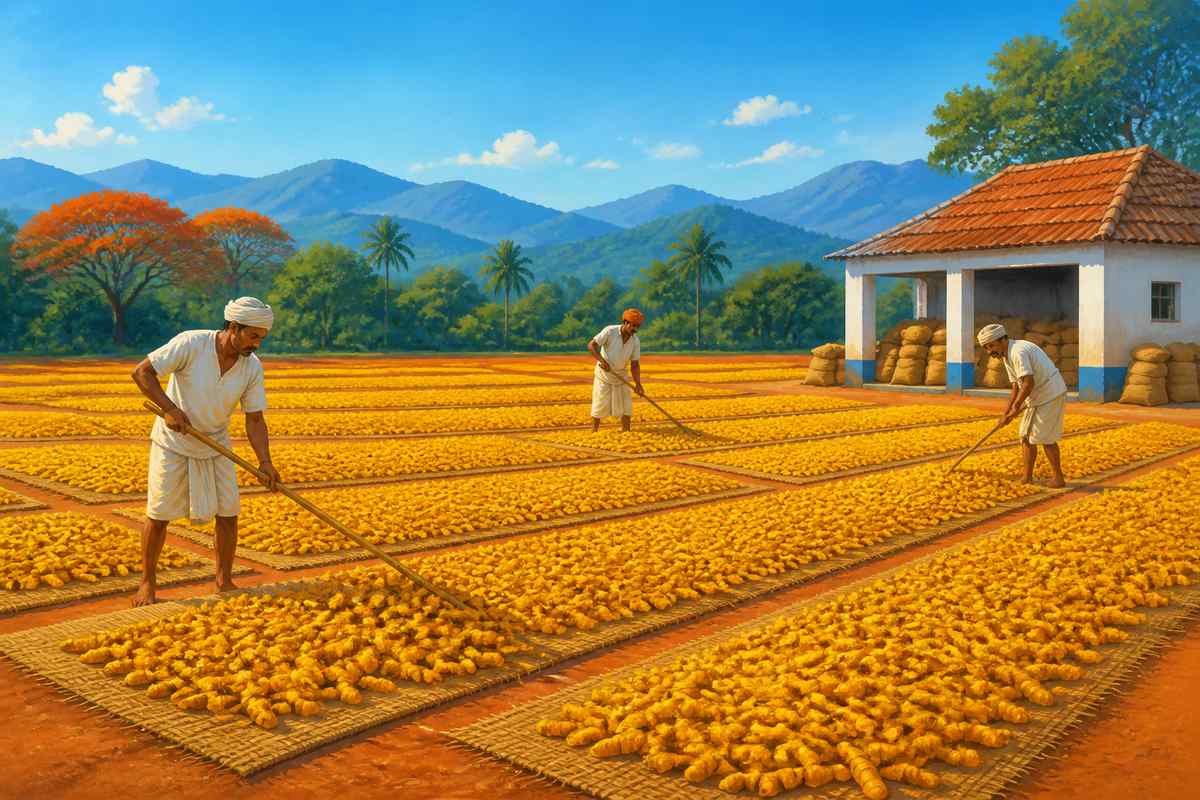
A Karnataka turmeric drying yard at midmorning

Production: 4.5 million hectares under spice cultivation across 30+ states. Kerala, Karnataka, Andhra Pradesh, Tamil Nadu, and Rajasthan lead different spice categories.

Processing: From traditional sun-drying to modern extraction facilities. India processes spices at every level, raw, ground, oil, oleoresin.

Research: The Indian Institute of Spices Research (Kozhikode), the Cardamom Research Station (Idukki), and state agricultural universities continuously improve varieties and practices.

Regulation: The Spices Board India sets quality standards, promotes exports, and manages GI protections for 50+ spice varieties.

Finance: From village moneylenders to NABARD agricultural loans, sophisticated financing enables cultivation, processing, and export.

This ecosystem evolved from the same networks that served Muziris, but adapted to modern markets with scientific grading, quality certification, and global distribution.

The Value Chain Revolution

The ancient spice trade had a problem: Kerala farmers grew the pepper; Italian bankers captured the profits. Braudel called this the fundamental structure of capitalism, production at the bottom, finance at the top, with producers earning least.

Modern Indian entrepreneurs are rewriting this script.

From raw to processed: Selling raw peppercorns means competing with Vietnam on price. Selling pepper oleoresin, concentrated essence used in food manufacturing, means competing on technology and quality. India has moved up the value chain.

From commodity to brand: Unbranded spices sell for commodity prices. GI-tagged Malabar pepper, organic-certified cardamom, and branded spice blends command premiums. India is branding its heritage.

From export to manufacture: Instead of shipping spices to foreign processors, Indian companies now extract oils, create blends, and manufacture finished products. Value addition happens at home.

The Spices Board data tells the story: while raw spice exports grew modestly, value-added exports (oils, oleoresins, curry powders) grew at 15%+ annually. India is capturing more of the value chain its ancestors created.

Global Perspectives on Value Chains

Gary Gereffi, Duke University economist, developed the framework of Global Value Chains (GVC), analyzing how goods move from production to consumption and who captures value at each stage.

Gereffi distinguishes between:

Producer-driven chains: Where manufacturers control design, production, and branding. Think automobiles or electronics.

Buyer-driven chains: Where retailers and marketers control access to consumers. Think garments or agriculture.

Historically, spices were buyer-driven: Indian farmers produced; Western companies marketed and profited. But Indian entrepreneurs are increasingly controlling their own chains, producing, processing, and marketing under Indian brands.

Michael Porter's competitive advantage framework explains why. India has:

This cluster effect, mutually reinforcing advantages, explains why India's spice leadership persists despite cheaper competitors.

Daron Acemoglu and James Robinson emphasize institutions: countries prosper when institutions support entrepreneurship, protect property, and enforce contracts. India's Spices Board, GI registry, and agricultural finance systems provide this institutional support, modern equivalents of the port superintendent's office that Kautilya prescribed.

Economist Key Framework India Application
Gereffi Global Value Chains Moving from producer to processor to marketer
Porter Competitive clusters Factor + demand + industry + strategy advantages
Acemoglu Institutional economics Spices Board, GI protection, agricultural finance

The Entrepreneur's Answer: Synthite Industries

C V Jacob examining peppercorns at his Kolenchery spice unit in 1972

In 1972, a young entrepreneur named C.V. Jacob started a small spice processing unit in Kolenchery, Kerala. He had an insight that would transform the industry:

Indian farmers were selling raw spices at commodity prices. Food manufacturers in America and Europe were buying those spices, extracting the valuable oils and oleoresins, and selling concentrated flavoring at premium prices. The value addition happened abroad.

Jacob decided to do the processing in India.

Today, Synthite Industries is the world's largest producer of spice oleoresins. From that small Kerala unit, it grew into a $300+ million global operation with facilities across India and subsidiaries worldwide. The company processes 25,000+ tonnes of spices annually, extracting the concentrated essences that flavor products from Coca-Cola to McCormick.

The transformation is complete: where Braudel's European financiers once captured India's spice value, Indian companies now capture it themselves. Kerala processes its own pepper, extracts its own oleoresins, and sells directly to global food manufacturers.

The Quality Challenge

Success brought new challenges. As India's spice exports grew, so did scrutiny.

In the 2010s, European Union regulators raised concerns about pesticide residues in Indian spices. Some shipments were rejected. For a moment, it seemed quality standards might threaten the ancient advantage.

India's response exemplified dharmic economics: rather than resisting standards, embrace them and exceed them.

A modern Indian spice quality testing laboratory

The Spices Board implemented:

The result? After initial disruption, Indian spice exports to the EU recovered and grew. Quality compliance became competitive advantage, buyers knew Indian-certified spices met the strictest standards.

This is the lesson of the GI tagging strategy applied broadly: when you can't win on price, win on trust. India's quality infrastructure is the modern equivalent of Muziris's reputation for fair dealing.

Your Turn: Value Chain Thinking

India's spice industry teaches three principles for modern competition:

Move up the chain: Raw commodities earn commodity prices. Processing, branding, and marketing capture higher margins. Where are you positioned in the value chains you participate in?

Convert heritage to advantage: India's 4,000-year spice history isn't just nostalgia, it's GI protection, cultivar diversity, and embedded knowledge that competitors can't replicate. What heritage advantages do you have?

Let quality be your moat: When commodity competition arrives, the response isn't to cut prices, it's to raise standards. India's quality infrastructure turns regulatory requirements into competitive barriers.

In our final lesson, we'll synthesize the spice trade's wisdom for 2026 and beyond, exploring how the principles that built Muziris's prosperity apply to your career, your business, and India's future in the global economy.

Value chain positioning and upgrading. Where you sit in a value chain determines your margins. Upgrading means moving from low-value activities (basic production) to high-value ones (processing, branding, marketing).

Stan Shih's 'smiling curve' shows that value concentrates at both ends of chains, R&D/design and marketing/branding, while manufacturing in the middle earns least. Successful companies position at the curves' high points.

India's spice industry has upgraded dramatically. The same Kerala that once exported raw pepper to Roman processors now exports oleoresins to Nestle and Coca-Cola. Value addition happens at source.

Value-added spice products (oleoresins, oils, curry powders) grew from 15% of India's spice exports in 2000 to over 35% in 2024, a doubling of value chain position.

Quality differentiation and standards as barriers to entry. In commodity markets, price competition erodes margins. Quality standards create barriers that protect incumbents while signaling reliability to buyers.

W. Edwards Deming's quality revolution showed Japanese manufacturers that quality isn't a cost, it's a competitive advantage. The same principle applies to agricultural trade: quality systems enable market access and premium pricing.

Key terms

Oleoresin
Concentrated spice extract containing both essential oils and resin components. Used in food manufacturing for consistent flavoring without the bulk of raw spices.
Mūlya-śṛṅkhalā
Value chain, the full sequence of activities that create value, from raw material to final consumer. Each link adds value and captures some of the final price.
Guṇavattā-āśvāsana
Quality assurance, systematic processes to ensure products meet specified standards. Includes testing, certification, and traceability.
Niryāta-saṃvardhana
Export promotion, government and industry efforts to increase export volumes, values, and competitiveness.

Verses

செல்வம் சிறந்த பொருளதனை செய்து அடைக

celvam ciṟanta poruḷataṉai ceytu aṭaika

True wealth is made, not taken, create value that others will prize.

The distinction between value creation and value extraction is fundamental to sustainable economics. India's shift from exporting raw spices (extraction) to exporting oleoresins and branded products (creation) reflects this dharmic principle applied to international trade.

Thirukkural, Kural 759 (V.V.S. Aiyar)

गुणवद्द्रव्यं कृत्वा व्यापारे नियोजयेत्

guṇavad-dravyaṃ kṛtvā vyāpāre niyojayet

Quality first, then commerce, let excellence be your entry to markets.

Quality control is a trade enabler, not a burden. India's pre-export testing and certification systems, though initially seen as compliance costs, have become competitive advantages. Buyers trust Indian certification, reducing their own verification costs.

Arthashastra, Book 2, Chapter 16 (L.N. Rangarajan)

Key figures

C.V. Jacob

Founder of Synthite Industries, who built the world's largest spice oleoresin company from a small Kerala unit

Gary Gereffi

Duke University economist who developed Global Value Chain theory, explaining how countries capture value in international trade

The Spices Board India

Government body responsible for development and promotion of Indian spice exports

Case studies

Synthite Industries: From Kerala Kitchen to Global Food Industry

In 1972, C.V. Jacob observed a fundamental imbalance: Kerala farmers grew the world's best pepper and cardamom, but the valuable processing, extracting essential oils and oleoresins used in food manufacturing, happened in Europe and America. International food companies wanted consistent flavoring. Raw spices varied by season and batch. Oleoresins provided precise, standardized flavor profiles. But India exported raw material while importing finished extracts. Jacob saw the opportunity: bring the processing to the source.

Synthite's journey exemplifies several dharmic principles: **Value creation over extraction**: Rather than accepting India's role as commodity supplier, Jacob created value at source. This reflects Thiruvalluvar's teaching that wealth comes from creation. **Patient building**: From a small unit in 1972 to global leadership took decades of sustained investment. This long-term orientation contrasts with extractive approaches that maximize short-term returns. **Ecosystem development**: Synthite didn't just build a company, it helped create an industry. The firm trained engineers, developed suppliers, and demonstrated that Indian processing could meet global standards. This rising-tide-lifts-all-boats approach reflects dharmic thinking about collective prosperity. **Quality commitment**: Synthite invested heavily in quality systems, R&D, and certifications. This enabled access to demanding customers like Coca-Cola and McCormick who wouldn't trust uncertified suppliers.

Today Synthite Industries: - **Global leader**: World's largest producer of spice oleoresins - **$300+ million revenue**: From that small 1972 unit - **25,000+ tonnes capacity**: Processing more spices annually than entire countries export - **Global customers**: Supplying every major food manufacturer - **Industry creator**: Inspiring dozens of other Indian processors The transformation is complete: where European companies once extracted value from Indian spices, Indian companies now extract value themselves and sell globally. Kerala captures the margin that once flowed to Amsterdam and London.

Value chain position determines profitability. By moving from raw spice supply to high-value processing, Synthite captured margins that previously accrued to foreign processors. The same principle applies to any industry: identify where value is captured and position there.

Synthite's value chain upgrade from raw spice exporter to oleoresin processor mirrors the industrialization strategy that transformed Malaysia from rubber plantation economy to electronics hub. Moving up the processing chain captures margins that raw material exporters permanently forfeit.

India now supplies 60%+ of the world's spice oleoresins, a market that barely existed in India in 1970. This represents massive value chain upgrading in a single generation.

Historical context

1947-present

Post-independence, India's spice industry evolved from colonial extraction to domestic development. The green revolution improved agricultural productivity; industrialization enabled processing; trade liberalization opened global markets. Each phase built on the ancient foundation.

While other commodity producers (coffee in Latin America, cocoa in West Africa) remain trapped in low-value supply, India's spice industry has successfully upgraded. This makes India a model for agricultural value chain development.

India's spice export value grew from $200 million in 1990 to $4.25 billion in 2024, a 20x increase in 34 years, far exceeding GDP growth rates.

India's spice industry demonstrates that ancient advantages can be preserved and extended in the modern economy. The same geographic and knowledge advantages that served Muziris continue to serve India, adapted but fundamentally continuous.

Living traditions

The Spices Board India and the spice processing industry represent the institutional legacy of ancient trade systems, modern organizations performing the functions that Kautilya's port superintendents performed: standardization, quality control, market development, and trade facilitation.

Reflection

More in The Spice Trade: India's Golden Monopoly

All lessons in The Spice Trade: India's Golden Monopoly · Trade Routes of Ancient Bharat course