Muziris: Rome's Gateway to Indian Spices

The Port That Connected Two Empires

Step inside ancient Muziris, where 120 Roman ships docked annually, where Greek was the language of commerce, and where the infrastructure of global trade was invented. Discover how this Kerala port became the most cosmopolitan city in the ancient world.

A Day in the World's Busiest Port
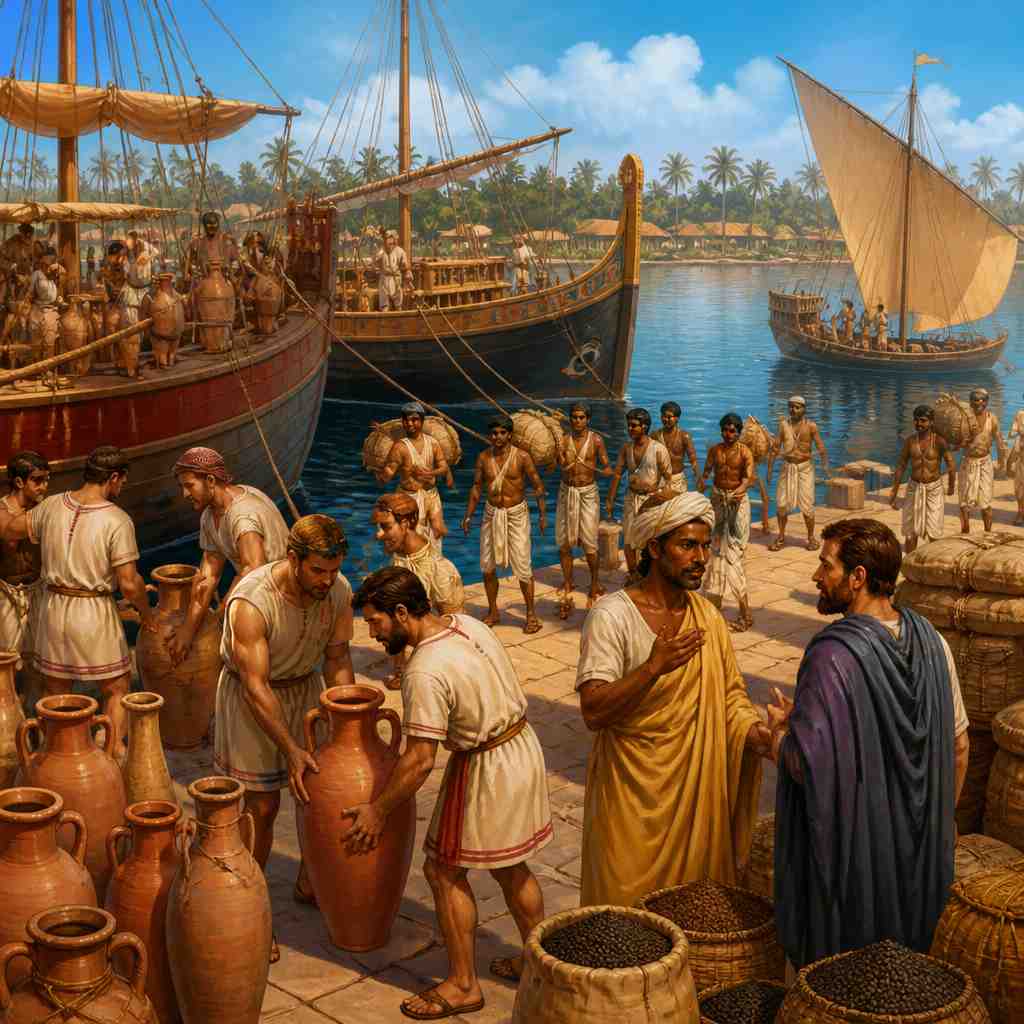
The bustling Muziris port with Roman and Tamil ships at the quayside

Imagine standing on the quays of Muziris in 50 CE. The monsoon has just ended, and the harbor is chaos, organized, profitable chaos.

A Roman merchant ship unloads amphorae of wine and olive oil. Next to it, a smaller vessel from Arabia offloads frankincense and myrrh. On the docks, porters carry bales of Chinese silk brought overland, ready for re-export to the West. And everywhere, in warehouses, on carts, being weighed and taxed, pepper. Mountains of pepper.

You hear Greek, Tamil, Arabic, and languages you don't recognize. You see Romans in togas, Arabs in flowing robes, and local merchants in cotton dhotis. You smell spices, incense, tar from ships, and the salt of the Arabian Sea.

This was Muziris. Not just a port, but the world's first truly global trading hub, a place where East met West, where cultures mixed, where fortunes were made.

The Geography of Destiny

Why here? Why did Muziris, and not a hundred other coastal towns, become the spice capital of the ancient world?

The Greek geographer Strabo, writing in the early 1st century CE, recorded that "about 120 ships sail from Myos Hormos to India every year." Most were bound for Muziris.

The location was perfect:

Monsoon access: Muziris sat precisely where ships riding the southwest monsoon would arrive after the 40-day crossing from the Red Sea. The prevailing winds delivered traders directly to its harbor.

River network: The Periyar River connected the port to the pepper-growing highlands of the Western Ghats. Spices could be transported by boat from plantation to warehouse with minimal overland hauling.

Protected harbor: A complex system of backwaters and lagoons provided shelter from storms while allowing deep-draft Roman ships to anchor close to shore.

Neutral ground: Muziris operated as a free port, welcoming traders from every nation without imposing the political conditions that constrained commerce elsewhere.

Sangam literature celebrates this cosmopolitanism:

"The ships of the Yavanas brought gold and took pepper, Their wine flowed in streets where our silks were traded, And in Muziris, every tongue was welcome."

The Business of Empire

How did the port actually operate? The remarkable Muziris Papyrus, discovered in 1985, gives us the answer.

This 2nd-century contract, written in Greek, documents a single pepper shipment from Muziris to Alexandria. The level of detail is stunning, and reveals a trading system as sophisticated as anything in the modern world.

The contract specifies:

This was trade finance, the same mechanisms that would later power the Dutch East India Company and modern commodity markets. Letters of credit, marine insurance, currency exchange, and international contract law all existed in Muziris 2,000 years ago.

Tamil nagarattar merchants grading pepper in a Muziris warehouse

The local Tamil merchants, the nagarattar and vaṇijyar, operated as intermediaries, guaranteeing quality, managing warehouses, and providing the on-ground infrastructure that foreign traders needed. Their role was crucial: Romans could navigate the ocean, but only locals could navigate the spice supply chain.

Global Perspectives on Port Economics

Strabo (64 BCE - 24 CE), the Greek geographer, provided the first systematic analysis of the Indo-Roman trade. His Geographica described not just the routes but the economics: why certain ports thrived, how monsoon winds enabled commerce, and why 120 ships annually made the journey worthwhile. He understood that trade concentrated at nodes where geography, infrastructure, and governance aligned.

Douglass North (1920-2015), Nobel laureate in economics, developed the theory of institutional economics, the idea that economic performance depends on rules, norms, and enforcement mechanisms. Muziris exemplified this: its success came not from geographic advantage alone, but from the institutions that reduced transaction costs. Standard weights, predictable taxation, contract enforcement, and protection of foreign merchants created a trading environment that attracted commerce.

Saskia Sassen (1947-present), sociologist of global cities, describes how certain locations become "global cities", nodes where international flows of capital, goods, and people concentrate. Muziris was the original global city: a cosmopolitan hub where diverse populations converged, where multiple legal systems coexisted, and where local and global were seamlessly integrated.

Thinker Key Concept Muziris Application
Strabo Geographic determinism Monsoon winds + river access created optimal location
North Institutional economics Standard weights, fair taxes, contract enforcement
Sassen Global cities Cosmopolitan hub integrating diverse flows

The Arab Intermediary

Rome wasn't the only player. Arab merchants had traded with India for centuries before Rome entered the scene, and they continued long after Rome fell.

The Arabs controlled a crucial advantage: knowledge of the monsoons. For centuries, they guarded the secret of the seasonal winds that made the open-ocean crossing possible. Greek and Roman merchants who attempted the journey without understanding the monsoon patterns died at sea.

Eventually, the secret leaked. According to legend, a Greek navigator named Hippalus "discovered" the monsoon winds around 45 CE, though he more likely learned about them from Arab sailors. The winds are still called the "Hippalus winds" in some texts.

With direct access, Roman trade exploded. But Arabs didn't disappear, they pivoted. Instead of controlling the route, they became specialists in specific commodities: frankincense from Arabia, myrrh from Africa, pearls from the Persian Gulf. They remained essential middlemen in a more complex trading ecosystem.

This pattern, disruption of route control, adaptation to new niches, would repeat in the spice trade for the next 2,000 years.

Modern Resonance: Singapore as the New Muziris

The modern Singapore container port at dusk

In 1819, Singapore was a fishing village with a few hundred inhabitants. By 2025, it handles 130,000 vessel calls annually and processes 37 million shipping containers, the world's second-busiest port.

How did a tiny island with no natural resources become the Muziris of the modern age?

The parallels are striking:

Strategic location: Singapore sits at the choke point of the Malacca Strait, where 40% of global maritime trade passes. Like Muziris on the monsoon route, geography made it inevitable, if properly developed.

Institutional excellence: Singapore invested relentlessly in efficient customs, low corruption, fair contract enforcement, and predictable regulation. The World Bank ranks it #2 globally for ease of doing business. Like ancient Muziris, traders come because the system works.

Openness to all: Singapore welcomes traders, investors, and workers from everywhere. Its population is 25% non-citizen. Multiple languages, religions, and cultures coexist. Like Muziris, it is neutral ground.

Value-added services: Singapore doesn't just transship goods, it provides financing, insurance, legal services, and logistics. The same transformation from mere port to comprehensive trade hub that Muziris pioneered.

The lesson: port success isn't about geography alone. It's about building institutions that reduce friction and attract commerce. Muziris understood this in 50 CE. Singapore understood this in 1965.

Your Turn: Building Trade Hubs

Muziris teaches three principles of economic concentration:

Location matters, but institutions matter more. Dozens of ports had similar geography. Muziris thrived because it offered reliability, fairness, and efficiency that traders trusted.

Neutrality attracts commerce. Ports that favor one party, through discriminatory taxes, political conditions, or arbitrary rules, drive trade elsewhere. Openness compounds.

Intermediaries create value. The Tamil merchants of Muziris didn't just facilitate trade, they guaranteed quality, provided financing, and navigated complexity. Their expertise was as valuable as the goods they handled.

Next, we'll explore what Muziris left behind, the archaeological treasures at Pattanam that prove this global hub wasn't legend but reality, preserved in Roman coins, Mediterranean pottery, and the physical evidence of history's greatest trade.

Institutional economics and transaction costs. Trade happens when the costs of exchanging are lower than the benefits. Institutions that reduce these costs, through standardization, predictability, and enforcement, enable commerce that would otherwise be impossible.

Douglass North's Nobel-winning work showed that institutional quality explains more economic variation than natural resources. Oliver Williamson extended this to explain why firms exist, to reduce transaction costs within organizations.

India's traditional trading systems, the śreṇī guilds, the hundi financial instruments, the reputation-based networks of Marwari and Chettiar merchants, were institutional innovations that enabled complex trade without modern contracts or courts.

The World Bank's Ease of Doing Business index correlates strongly with trade volumes. Countries that reduce bureaucratic friction attract more commerce, the same dynamic that made Muziris successful.

Trade hub economics and network effects. When a port welcomes diverse traders, each new participant increases value for all others, more buyers, more sellers, more connections. Exclusion breaks these networks.

Modern examples include Switzerland (neutral in wars, hub for diplomacy and finance), Singapore (multicultural trade hub), and Hong Kong (historically neutral interface between China and the world).

Key terms

Pattana
Port, harbor, or trading town. The term specifically denotes a settlement organized around maritime commerce, distinguished from inland cities.
Nāvika
Sailor, mariner, or one who operates ships. The term encompasses both ordinary sailors and ship captains.
Yavana
Originally Greeks (from 'Ionia'), but expanded to include all western foreigners, Greeks, Romans, Arabs, and later Europeans. A general term for Western traders.
Śreṇī
Guild, trade association, or merchant corporation. The organizational structure through which traders collectively managed quality, disputes, and representation.

Verses

யவனர் தந்த வினைமாண் நன்கலம்

yavanar tanta viṉaimāṇ naṉkalam

From distant lands the Yavanas came, bearing treasures wrought with foreign skill.

The verse reveals that Indo-Roman trade wasn't purely extractive. Romans brought wine, glassware, metals, and coins that had real value in Indian markets. The trade balance favored India, but it was genuine exchange, not one-way extraction.

Sangam Literature - Akananuru, Poem 149 (George L. Hart)

पत्तनाध्यक्षो नौकातटाकतरीसेतुबन्धनानि कारयेत्

pattanādhyakṣo naukā-taṭāka-tarī-setubandhanāni kārayet

Let the port master build what trade requires, vessels, waters, crossings, and harbors that welcome ships.

This sutra describes infrastructure investment as a government function. The Arthashastra understood that ports succeed through public investment in facilities that individual traders cannot provide. This is the logic of public goods, enabling private commerce through collective infrastructure.

Arthashastra, Book 2, Chapter 28 (R. Shamasastry)

Key figures

Strabo

Greek geographer who documented the scale and economics of Indo-Roman trade in his 'Geographica'

The Sangam Tamil Merchants

Local merchant communities who managed Muziris's trade infrastructure and served as intermediaries for foreign traders

Douglass North

Nobel Prize-winning economist who developed the theory of institutions as determinants of economic performance

Case studies

Singapore: Building the Modern Muziris

When Singapore gained independence in 1965, it was a tiny island with no natural resources, no hinterland, and hostile neighbors. Its only advantage was location, at the crossroads of Asian shipping lanes. Lee Kuan Yew and his government faced a choice: accept economic insignificance or build something remarkable. They chose to become the world's most efficient trading hub. The strategy was deliberate: if Singapore couldn't compete on resources, it would compete on institutions. The government invested in port infrastructure, streamlined customs, eliminated corruption, enforced contracts fairly, and welcomed traders and investors from everywhere.

Singapore's rise echoes Muziris in remarkable ways. Both succeeded through: **Institutional excellence**: Like Kautilya's port superintendent, Singapore invested in the systems that enable trade, not just physical infrastructure but governance quality. **Radical openness**: Singapore welcomes everyone. Its population is 25% non-citizen. Multiple languages are official. Religious diversity is protected. Like Muziris, it is neutral ground. **Value-added services**: Singapore doesn't just move containers, it provides financing, legal services, logistics, and expertise. The same evolution from simple port to comprehensive trade hub. The dharmic principle: geography creates possibility; institutions convert possibility into prosperity.

By 2024, Singapore handles 37 million shipping containers annually, the world's second-busiest port. It ranks #2 globally for ease of doing business. Its per capita GDP exceeds $65,000, higher than the United States. More importantly, Singapore created value beyond transshipment. Its port and airport are hubs for Asian trade. Its legal system is the preferred venue for Asian commercial disputes. Its financial center rivals Hong Kong and Tokyo. From fishing village to global hub in 60 years, the Muziris model applied to the modern age.

Port success isn't about geography, it's about governance. Many cities have strategic locations; few have built the institutions that convert location into prosperity. Singapore and ancient Muziris both understood: fairness, efficiency, and openness attract commerce that creates wealth.

Singapore's transformation from colonial port to global hub validates the principle that institutional quality matters more than natural resources. Rwanda, Estonia, and Georgia have all pursued similar strategies: small countries building outsized economic influence through governance excellence.

Singapore's port handles more cargo than India's entire coastline combined, despite India having 7,500 km of coast and Singapore being 50 km across. Institutional quality trumps geographic advantage.

Historical context

1st century BCE - 5th century CE

During Muziris's peak, the Chera kingdom controlled the Malabar coast while simultaneously maintaining relationships with the Pandya and Chola kingdoms to the east. This period saw remarkable cultural flowering, the Sangam literary age, fueled partly by the wealth of the pepper trade.

While Rome was the ancient world's greatest empire, its trade balance with India was consistently negative. Roman gold flowed east; Indian goods flowed west. This pattern, Western consumers, Asian producers, would characterize global trade for the next two millennia.

The Muziris Papyrus documents a single cargo worth 1,154 talents, approximately $7 million in today's money. If 120 ships made the journey annually with similar cargoes, total annual trade value approached $1 billion in modern terms.

Muziris proves that sophisticated global trade existed long before European colonialism. The institutions, financing mechanisms, and commercial practices of the Indo-Roman trade were as advanced as anything that followed. Colonialism didn't create global trade, it disrupted an existing system.

Living traditions

Kerala's tradition of religious pluralism, Hindu, Christian, Muslim, and Jewish communities coexisting for millennia, originated in the trade relationships of Muziris. The openness that attracted Roman merchants created a cultural pattern that persists today.

Reflection

More in The Spice Trade: India's Golden Monopoly

All lessons in The Spice Trade: India's Golden Monopoly · Trade Routes of Ancient Bharat course