Shilp-Vidhvansa: Deindustrialization of India

From Manufacturer to Raw Material Supplier

Beyond textiles, Britain systematically dismantled India's steel, shipbuilding, and metallurgical industries, transforming the world's workshop into a plantation economy that exported raw materials and imported finished goods.

The Steel That Conquered Europe
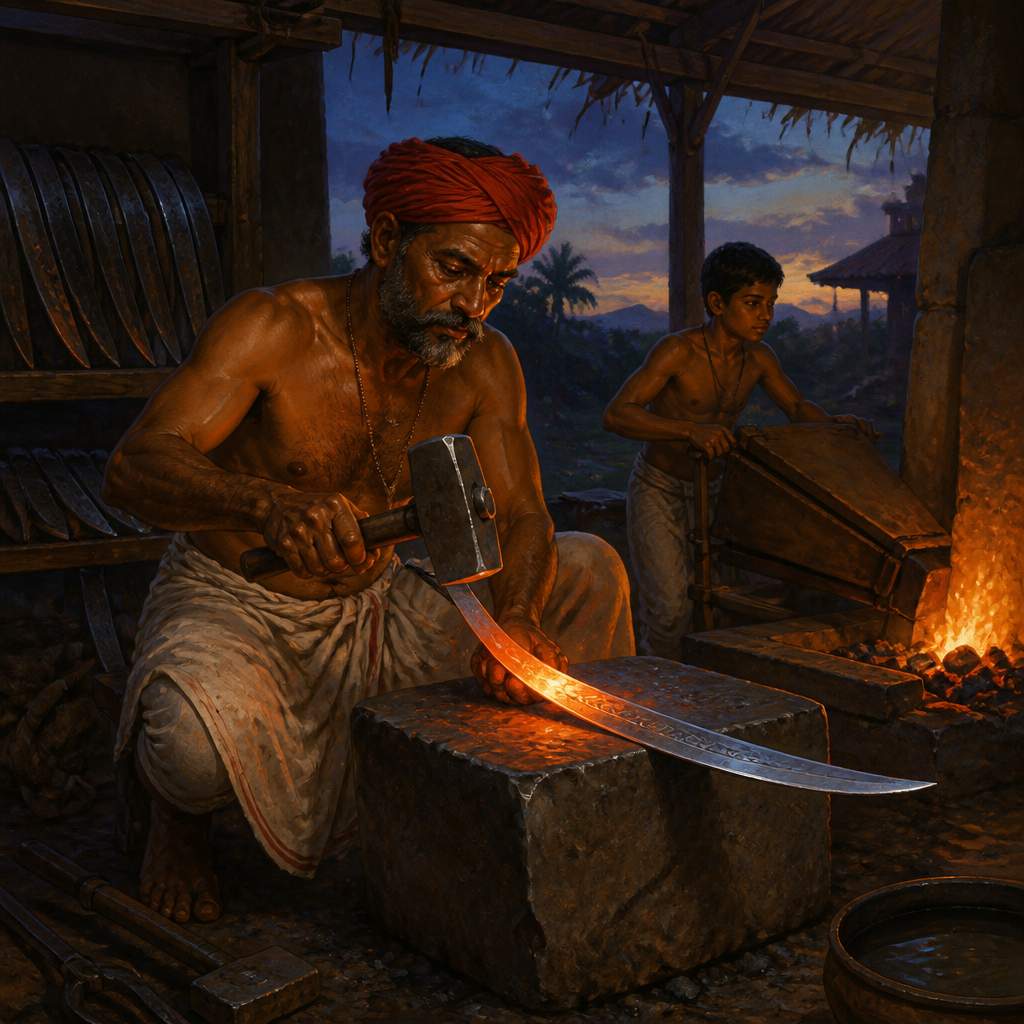
Master wootz steel smith forging in 1790s Mysore

In 1790, a British metallurgist named Michael Faraday examined a strange sword captured from Tipu Sultan's forces. The blade had a distinctive watered pattern, waves of light and dark steel rippling like water. More remarkably, it could cut through European swords like paper through butter.

Faraday spent years trying to replicate this wootz steel. He failed. So did every European metallurgist for the next century. The secret lay in crucible furnaces of Karnataka, where master craftsmen produced steel with 1.5% carbon content, a feat Europe wouldn't match until the Bessemer process of 1856.

By 1830, those furnaces were cold. The craftsmen were dead or scattered. And Britain was exporting 'Sheffield steel' to India, at prices Indian smiths couldn't match, backed by tariffs Indian rulers couldn't impose.

The Workshop Dismantled

Textiles were the visible tragedy. But India's deindustrialization ran far deeper, into every forge, shipyard, and workshop across the subcontinent.

Steel and Metallurgy

India produced the world's finest steel for over two millennia. Wootz steel, called ukku in Kannada, was exported to Damascus, where it became the legendary 'Damascus steel.' Roman historian Pliny complained about Rome's trade deficit with India, listing iron among key imports.

The destruction was methodical:

Bibek Debroy estimates that India's iron production fell 80% between 1800 and 1900, while Britain's rose 3,000%.

Shipbuilding: The Fleet That Vanished
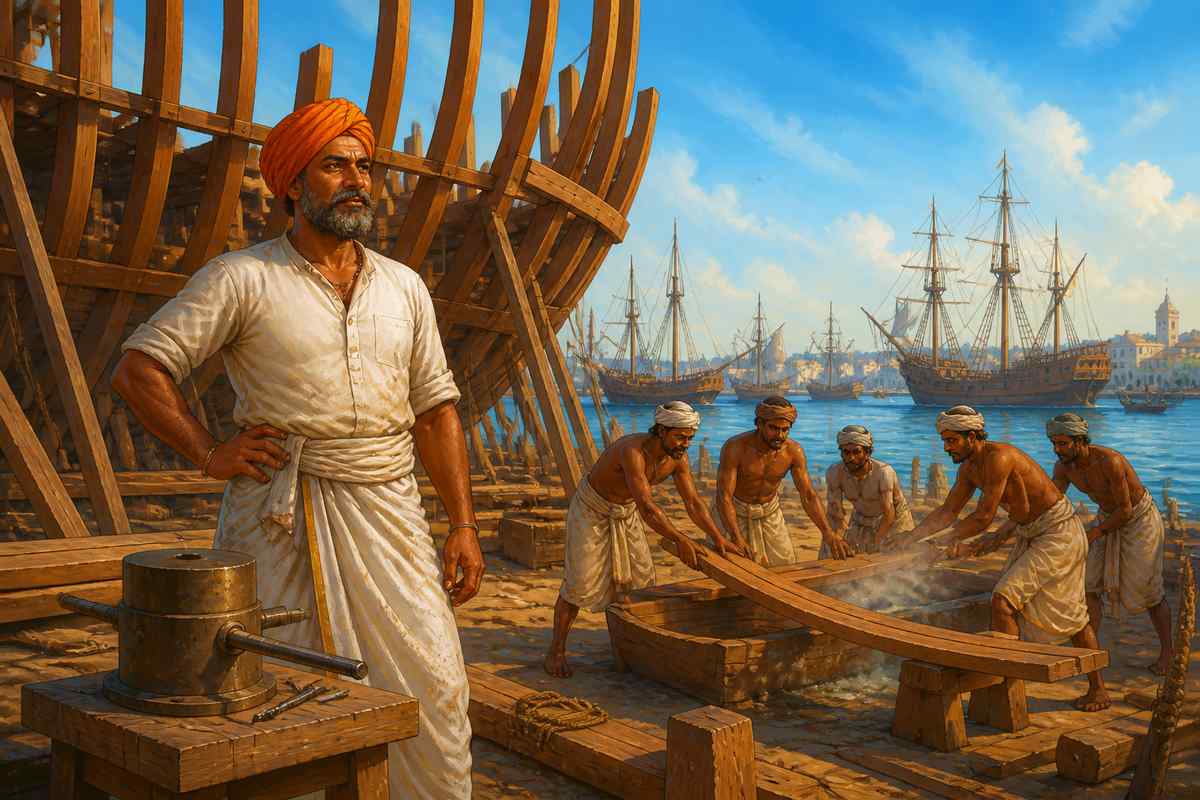
Master Indian shipwright at a 1700 Surat shipyard

In 1700, Surat alone had 100+ shipyards. Indian ships were so superior that the British Navy actively purchased them, HMS Minden, built in Mumbai in 1810, served in the British fleet for 50 years. The East India Company's own reports admitted: 'Indian ships last twice as long as British-built vessels.'

The destruction came through regulation:

By 1850, Surat's shipyards employed fewer than 500 workers, down from 30,000 a century earlier. Masulipatnam, once building 200 ships annually, had ceased production entirely.

The Policy of Lord Cornwallis

Charles Cornwallis, the same general who surrendered to George Washington at Yorktown, arrived in India in 1786 with a mission: restructure India's economy for British benefit.

His Permanent Settlement (1793) wasn't just about land revenue. It created a legal framework where:

Cornwallis wrote to the Directors: 'The object is to make India a consumer of British manufactures and a producer of raw materials.' This wasn't hidden, it was stated policy.

Global Perspectives on Industrial Destruction

The deliberate destruction of colonial industries wasn't unique to India, but its scale was unprecedented.

Paul Bairoch (1930-1999), the Belgian economic historian, calculated that India and China together accounted for 53% of world manufacturing output in 1750. By 1900, their combined share was 7.5%. In Economics and World History (1993), Bairoch demonstrated this wasn't natural decline: 'The Third World was de-industrialized by the First World's industrial revolution.'

Utsa Patnaik (born 1944), the economist, quantified the extraction: between 1765 and 1938, Britain drained approximately $45 trillion (in 2020 dollars) from India. Her research shows this wasn't just wealth transfer, it was systematic destruction of productive capacity to eliminate competition.

Alexander Gerschenkron (1904-1978), the Harvard economic historian, developed the 'advantages of backwardness' theory, arguing late industrializers could leapfrog by adopting latest technology. But his model assumed agency. Colonies like India weren't 'backward' nations catching up, they were advanced economies being pushed backward.

Thinker Key Insight Indian Evidence
Bairoch De-industrialization was policy, not accident Manufacturing share fell from 24.5% to 1.7%
Patnaik $45 trillion drain over 200 years Funded Britain's industrial revolution
Gerschenkron 'Backwardness' assumes agency India was actively de-developed

Modern Resonance: The Revival Begins

In 2025, India is systematically reversing colonial deindustrialization, sector by sector.

Ratan Tata signing the Tata Steel Corus acquisition

Steel: Tata Steel's 2007 acquisition of Corus (formerly British Steel) for $12 billion was more than a business deal. A company founded by Jamsetji Tata in 1907, explicitly to end dependence on British steel, now owned the colonizer's flagship steel company. Today, India is the world's second-largest steel producer at 140 million tonnes annually.

Shipbuilding: Cochin Shipyard built India's first indigenous aircraft carrier, INS Vikrant, launched in 2022. Mazagon Dock exports warships to friendly nations. The industry that Britain destroyed to protect its naval supremacy now builds vessels Britain cannot.

Semiconductors: The $10 billion India Semiconductor Mission, launched in 2021, explicitly frames chip manufacturing as strategic sovereignty. Commerce Minister Piyush Goyal stated: 'We learned from history, dependence on others for critical technology is vulnerability.' Tata's semiconductor fab in Gujarat and Micron's assembly plant in Gujarat represent the first steps.

Your Turn

The next time you see 'Made in India' on a steel product, a ship, or eventually a semiconductor, you're witnessing history being rewritten.

The craftsmen of Karnataka who forged wootz steel didn't document their techniques, knowledge passed through apprenticeship was extinguished when the chain broke. Some technologies are lost forever. But the principle remains: industrial capacity, once destroyed, must be consciously rebuilt. It doesn't return automatically.

Ask yourself: in your field, what dependencies exist that could become vulnerabilities? What would self-reliance look like? The questions Cornwallis forced upon India in 1793 remain relevant for every economy in 2025.

In the next lesson, we'll quantify exactly how much Britain extracted, through the eyes of Dadabhai Naoroji, who first calculated the 'drain of wealth.'

Gary Becker's human capital theory emphasizes skill development, but focuses on individual investment. The Shukraniti approach emphasizes collective/institutional preservation, recognizing that some knowledge exists only in communities, not individuals.

Indian economic thought understood knowledge as embodied in lineages (parampara), not just individuals. This explains why colonial destruction was so effective, breaking the apprenticeship chain destroyed knowledge permanently.

Wootz steel production techniques, lost by 1850, weren't fully replicated by modern metallurgy until the 2000s, a 150-year gap of lost knowledge

Alexander Hamilton's 'Report on Manufactures' (1791) made the same argument for American industrial policy. The US protected its industries from British competition, exactly what India was prevented from doing.

Kautilya's framework is more comprehensive, integrating industrial policy with overall state strategy. Modern India's PLI schemes, semiconductor mission, and defense manufacturing initiatives reflect this integrated approach.

India's $10 billion semiconductor mission aims to capture 10% of global chip manufacturing by 2030, strategic capacity building that Cornwallis-era policies specifically prevented

Key terms

Shilp-Vidhvansa
The destruction of crafts and industries, systematic dismantling of manufacturing capacity
Ukku / Wootz
High-carbon crucible steel produced in India, renowned globally as the world's finest steel for over two millennia
Sthayi Bandobast
Permanent Settlement, Cornwallis's 1793 land revenue system that created zamindars as intermediaries and restructured rural economy
Shreni
Guild, self-governing associations of craftspeople and merchants that regulated quality, training, and trade in pre-colonial India

Key figures

Lord Cornwallis (1738-1805)

Governor-General who restructured India's economy for colonial extraction

Bibek Debroy (born 1955)

Economist, Sanskrit Scholar, and Policy Advisor

Shipbuilders of Surat and Masulipatnam

Master craftsmen whose industry was systematically destroyed

Case studies

From Colonial Victim to Global Acquirer: Tata Steel's Corus Conquest

In 2007, Tata Steel acquired Corus, the company formed from British Steel, for $12.1 billion. The symbolism was impossible to miss. Jamsetji Tata founded Tata Steel in 1907 explicitly to end India's dependence on British steel imports. He traveled to Pittsburgh to study American methods, hired American engineers, and built Asia's first integrated steel plant at Jamshedpur. The colonial government offered no support, if anything, they preferred continued British imports. A century later, his successors bought the colonizer's steel industry. Corus, which traced its lineage to companies that profited from Indian deindustrialization, became a subsidiary of an Indian firm. Ratan Tata noted: 'This is a special moment for India.'

The Tata acquisition embodies a dharmic approach to commerce: patient, multi-generational, focused on capability building rather than quick profits. Jamsetji Tata didn't start steel production to make money, he started it to build national capacity. His descendants honored that vision. The dharmic principle here is *kartavya* (duty), wealth creation as service to the nation, not extraction from it. This is the opposite of colonial economics.

Tata Steel is now the world's 10th-largest steel producer. More importantly, the Corus acquisition gave India access to European technology and markets, accelerating capability development. India produces 140 million tonnes of steel annually, second only to China.

Economic damage can be reversed through persistent, mission-driven enterprise. What took colonialism a century to destroy, dedicated Indian entrepreneurs have rebuilt, and surpassed. But it required a 100-year vision, not quarterly thinking.

Tata Steel's acquisition of Corus belongs to a broader pattern of 'reverse colonialism' in global business. Indian companies now own Jaguar Land Rover, Tetley Tea, and British Steel's successor. Chinese and Brazilian firms have made similar acquisitions of former colonial-era industrial assets.

British Steel, which once dominated global markets using Indian-extracted capital, no longer exists as an independent entity. India's steel production exceeds Britain's by 12x.

Three Reversals: Steel, Ships, and Semiconductors

India is systematically reversing colonial deindustrialization across three strategic sectors: **Shipbuilding**: In 2022, India launched INS *Vikrant*, its first indigenous aircraft carrier. Cochin Shipyard, the builder, was established in 1972; fifty years later, it delivered a vessel that only six nations can construct. India now exports warships to countries including Vietnam and Philippines. The nation that Britain rendered incapable of building ships now builds vessels Britain cannot. **Steel**: India's 140 million tonnes annual production makes it the world's second-largest producer. The sector employs 2.5 million directly and 10 million indirectly. Companies like JSW, SAIL, and Tata Steel compete globally. **Semiconductors**: The $10 billion India Semiconductor Mission (2021) targets domestic chip manufacturing. Tata's fab in Gujarat, Micron's assembly plant, and multiple OSAT (outsourced semiconductor assembly and test) facilities are under construction. By 2030, India aims for 10% of global semiconductor production.

These three sectors represent strategic sovereignty, the ability to function independently in critical domains. The dharmic principle is *swadeshi* evolved for the 21st century: not autarky (isolation), but capability (the ability to produce what you need). Each sector also demonstrates *shraddha* (faith/commitment), multi-decade efforts that required sustained investment without immediate returns. Cochin Shipyard took 50 years from establishment to aircraft carrier. This patience contrasts with colonial extraction, which sought immediate profit regardless of long-term damage.

India has moved from importer to exporter in ships and steel. Semiconductors remain in early stages, but the trajectory is clear. The pattern: identify colonial damage, invest patiently, build capability, then compete globally.

Strategic sectors require strategic patience. The payoff for India's shipbuilding investment took 50 years. Semiconductor returns may take 20. Colonial deindustrialization worked because it was systematic and sustained, reversal requires the same discipline.

India's simultaneous push into shipbuilding, steel, and semiconductors mirrors China's 2015 'Made in China 2025' strategy of targeting strategic industrial sectors. Both countries recognized that modern economic sovereignty requires domestic capability in defense-critical manufacturing.

India's defense exports grew from $1 billion (2017) to $2.8 billion (2024), ships, missiles, and electronics that colonial policy specifically prevented India from developing

Historical context

1793-1900 (Crown Rule Emergence)

Pre-colonial India had sophisticated industrial capacity, not just textiles but steel, shipbuilding, metalwork, paper, glass, and dozens of other industries. Village economies supported artisan communities through integrated systems of exchange. Urban centers like Surat, Dhaka, and Masulipatnam were industrial hubs rivaling any in Europe.

While India was being deindustrialized, the United States (using Hamilton's industrial policy) and Germany (using List's infant industry protection) were deliberately building manufacturing capacity, with tariffs protecting domestic industry from British competition. India was denied the same tools.

India's share of world manufacturing output fell from 24.5% (1750) to 1.7% (1900), a 93% relative decline in 150 years.

Understanding deindustrialization as policy (not 'natural' decline) reframes India's development challenge. The task isn't 'catching up' from backwardness, it's rebuilding what was deliberately destroyed.

Living traditions

India's metal crafts sector employs 5 million people and exports $10 billion annually. The GI (Geographical Indication) tagging system now protects traditional crafts, Moradabad Brassware received GI in 2019. Modern designers increasingly collaborate with traditional artisans, creating fusion products that preserve heritage skills.

Reflection

More in Colonial Disruption & Economic Decline

All lessons in Colonial Disruption & Economic Decline · Trade Routes of Ancient Bharat course