Aupanaveshik Vinash: Systematic Destruction of Trade
How Britain Killed Indian Manufacturing
The systematic dismantling of India's textile supremacy through tariffs, coercion, and policy manipulation, a blueprint for colonial economic warfare that reduced the world's largest manufacturer to a supplier of raw materials.
The Loom Falls Silent
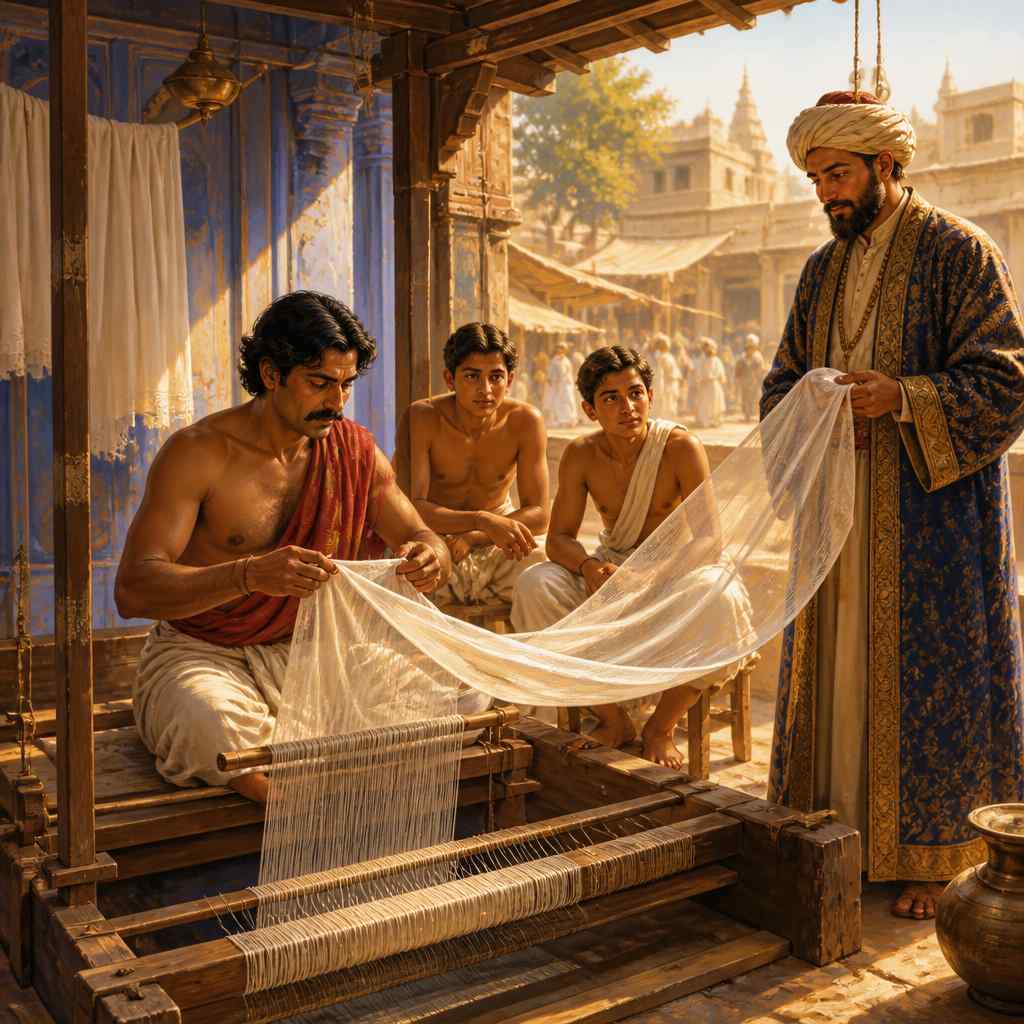
In 1750, a weaver named Gangaram sat at his pit-loom in Dhaka, threading cotton so fine it was called malmal shahi, 'king's muslin.' European traders paid twice its weight in gold for this fabric. A single sari could pass through a finger ring. The British East India Company's own records marveled: 'The weavers of Bengal produce cloth which cannot be imiated by any manufacture in Europe.'
Forty years later, Gangaram's grandson couldn't afford rice. The looms were silent. The fingers that once wove moonlight into cloth now tilled British indigo fields. What happened in those four decades wasn't market competition, it was calculated destruction.
The Architecture of Annihilation
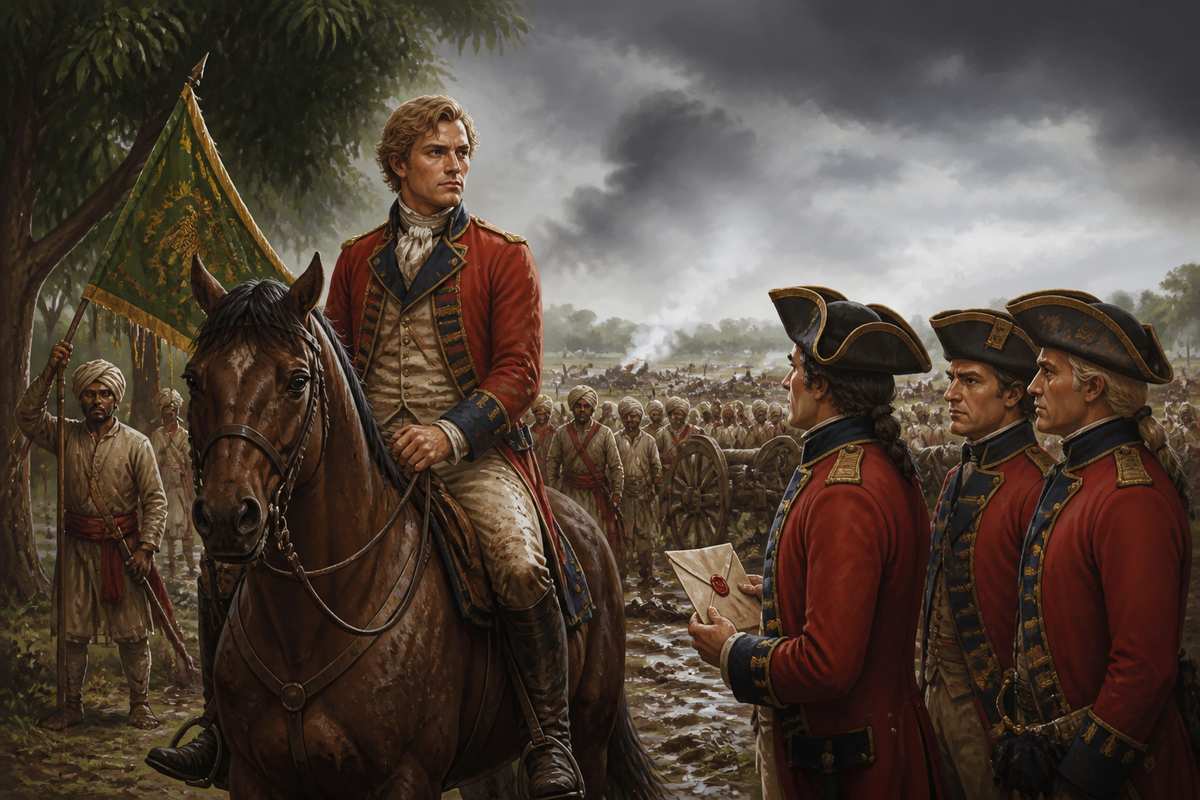
When Robert Clive won the Battle of Plassey in 1757, India produced 24.5% of world manufacturing output, more than all of Western Europe combined. Britain produced just 1.9%. By 1900, those numbers had reversed: Britain at 18.5%, India at 1.7%.
How do you destroy the world's largest manufacturing economy? The Company developed a three-stage strategy:
Stage 1: Control the Supply Chain (1757-1793)
The Company forced weavers to sell exclusively to British agents, called gomastas, at prices 20-40% below market. Weavers who sold to other buyers were fined, imprisoned, or beaten. The 1773 'Famine Report' documented: 'The weavers are treated with the utmost harshness...they are tied up and beaten in a most cruel manner.'
Mir Kasim, Nawab of Bengal, tried to resist. He abolished internal duties to help Indian merchants compete. The Company declared war. After his defeat at Buxar in 1764, no Indian ruler would challenge British commercial domination for a century.
Stage 2: Tariff Warfare (1793-1830)
Britain imposed tariffs of 70-80% on Indian textiles entering British markets, while British cloth entered India duty-free. As historian Will Durant calculated, 'This was not free trade, it was systematic exclusion backed by military power.'
The numbers tell the story:
- 1814: Indian textile exports to Britain = £1.3 million
- 1835: Indian textile exports to Britain = £100,000
A 92% collapse in twenty years, not through competition, but legislation.
Stage 3: Force Raw Material Export (1830-1857)
India was restructured from manufacturer to supplier. Railways built after 1853 weren't designed for Indians, they connected cotton fields to ports, ensuring raw cotton flowed to Manchester. As Dadabhai Naoroji documented, 'India is bled of her resources systematically.'
Global Perspectives on Colonial Economics
The British approach wasn't unique, but its scale was unprecedented.
Friedrich List (1789-1846), the German economist, observed British hypocrisy directly. In The National System of Political Economy (1841), he noted: 'England has used tariffs, bounties, and navigation laws to build her industry, then preaches free trade to those she wishes to dominate.' List argued that what Britain did to India, she had earlier done to Ireland, and would do to any rival.
Karl Marx (1818-1883), writing in the New York Tribune in 1853, documented the textile destruction: 'The British intruder...broke up the Indian handloom and destroyed the spinning wheel. England began with driving the Indian cottons from the European market; it then introduced twist into Hindustan and in the end inundated the very mother country of cotton with cottons.'
Ha-Joon Chang (born 1963), the Cambridge economist, draws the definitive parallel in Kicking Away the Ladder (2002). He demonstrates that Britain built its textile industry through protectionism (banning Indian calico imports in 1700 and 1720), then forced 'free trade' on colonies. The Indian destruction wasn't capitalism, it was mercantile imperialism disguised as markets.
| Thinker | Key Insight | Indian Parallel |
|---|---|---|
| List | Protectionism built British industry | India denied same protection |
| Marx | Deliberate destruction of handlooms | Documented weaver impoverishment |
| Chang | 'Kicking away the ladder' | Britain banned what made it rich |
Modern Resonance: The Pattern Repeats
In 2025, the ghosts of colonial economics haunt new corridors.
The US-China trade war mirrors British tactics. When Chinese manufacturing threatened American dominance, tariffs of 25-100% appeared, not on national security grounds, but on manufactured goods. The rhetoric of 'unfair trade practices' echoes 1800s British arguments against Indian textiles.
But India is writing a different story. The Production-Linked Incentive (PLI) scheme, launched in 2021, has attracted ₹4 lakh crore in investment across 14 sectors. Apple now manufactures over $14 billion worth of iPhones in India annually, in the same land where British policy once banned manufacturing.

Prime Minister Modi's 'Vocal for Local' campaign consciously echoes swadeshi, the movement that arose to resist colonial deindustrialization. In 2024, India became the world's fifth-largest economy, crossing the GDP that Britain held when it began colonizing India.
Your Turn
The next time someone speaks of 'free markets' creating wealth, ask: whose markets, and free for whom?
The weavers of Dhaka didn't lose to Manchester because British cloth was better. They lost because British policy made Indian excellence illegal. Understanding this distinction, between market competition and market destruction, is essential for evaluating every trade deal, every tariff debate, every 'liberalization' proposal you'll encounter.
Sanjeev Sanyal writes: 'The deindustrialization of India was not a byproduct of colonial rule, it was its primary purpose.' In the next lesson, we'll examine exactly how deep that deindustrialization went.
Lenin argued imperialism was capitalism's highest stage, seeking markets and raw materials. Ha-Joon Chang shows how industrial powers systematically 'kick away the ladder' they climbed.
Indian economic thought (Kautilya) recognized the treasury-power connection millennia earlier, but applied it to building, not destroying. The British innovation was weaponizing economics for subjugation.
India's textile exports fell 92% in 20 years (1814-1835), demonstrating how quickly targeted policies can destroy industrial capacity
Strategic trade theory and infant industry protection
Friedrich List advocated 'infant industry protection', tariffs to build national capacity. Britain practiced this at home while preaching 'free trade' to colonies.
India's current approach (PLI, phased manufacturing programs) applies List's principles: protect strategic industries until they can compete globally, then open markets gradually.
Key terms
- Aupanaveshik Vinash
- Colonial destruction, the systematic dismantling of indigenous economic systems under colonial rule
- Gomasta
- Native agents employed by the East India Company to enforce exclusive purchase contracts with Indian weavers
- Swadeshi
- Of one's own country, the movement to revive indigenous industry and reject foreign goods
- Dhana-Nirgama
- Drain of wealth, the continuous outflow of resources from colony to colonizer without equivalent return
Key figures
Robert Clive (1725-1774)
Architect of British Colonial Economy in India
Sanjeev Sanyal (born 1971)
Economic Historian & Government Economic Advisor
Bengal Weavers (Tantis of Dhaka)
Victims of Colonial Deindustrialization
Case studies
From Manchester's Victim to Global Competitor: India's Textile PLI Story
In 2021, the Indian government launched a ₹10,683 crore Production-Linked Incentive scheme for textiles, specifically targeting man-made fibers and technical textiles where India lagged. The irony was deliberate: textiles, the very industry Britain destroyed to build Manchester, would be India's vehicle for manufacturing renaissance. Within two years, the scheme attracted ₹1,536 crore in investments. Reliance Industries, Welspun, and Shahi Exports committed to expanding capacity. More significantly, global brands began sourcing from India: H&M increased Indian procurement by 30%, and Zara opened dedicated sourcing offices in Tirupur. By 2024, India's textile exports reached $44.4 billion, still behind China's $300 billion, but growing at 12% annually while China's growth slowed to 3%.
The PLI approach embodies swadeshi principles updated for global realities. Rather than autarky (complete self-reliance), it targets strategic self-sufficiency: ensuring India can manufacture what it needs while competing globally. The dharmic critique of colonial economics wasn't against trade, India traded for millennia. It was against asymmetric extraction disguised as trade. The PLI scheme addresses this by building indigenous capacity that enables equal partnership rather than dependency.
India's textile sector is projected to reach $350 billion by 2030, potentially surpassing the UK's entire manufacturing output. The student of history will note: Manchester's textile industry, built on Indian destruction, employs fewer than 20,000 people today. Tirupur alone employs 600,000.
Economic damage, however systematic, can be reversed through equally systematic rebuilding. The same policy tools used for destruction, targeted incentives, infrastructure investment, trade frameworks, can rebuild. What took Britain 70 years to destroy, India is rebuilding in 30.
India's textile PLI scheme parallels Vietnam's and Bangladesh's strategies of using targeted industrial policy to capture global textile supply chains. The broader lesson: countries that combine policy incentives with existing workforce skills can rebuild devastated industries within a single generation.
India's man-made fiber production grew 58% between 2021-2024 under PLI, creating 75,000 new jobs, more than the entire British textile workforce
US-China Tariff Wars: Colonial Economics Returns
In 2018, the United States imposed tariffs of 25% on $250 billion of Chinese goods, escalating to effective rates over 100% on some products by 2024. The stated reason: 'unfair trade practices,' intellectual property theft, and national security. The parallels to colonial-era British arguments against Indian textiles are striking. In 1780, Britain argued Indian cloth was 'unfairly' cheap due to low wages. In 2020, America argued Chinese goods were 'unfairly' cheap due to state subsidies. Both framed protection of domestic industry as defense against 'cheating.' China's response also echoed history: retaliatory tariffs, investment in indigenous technology (semiconductor self-sufficiency programs), and cultivation of alternative markets (Belt and Road Initiative).
The dharmic economic perspective offers a different framing: trade should benefit both parties (mutual flourishing), not extract from one to enrich another. By this standard, both American tariffs AND exploitative Chinese practices (forced technology transfer, IP theft) violate dharmic principles. The Indian position, building indigenous capacity while maintaining trade relationships, represents a middle path: neither dependent integration nor hostile decoupling.
The US-China trade war created a 'China+1' strategy among global manufacturers, and India became the primary beneficiary. Apple's $14 billion Indian manufacturing operation, Samsung's smartphone factories, and electronics PLI investments all accelerated as companies diversified away from China dependency.
Trade wars create opportunities for third parties who position themselves as reliable alternatives. India's colonial experience, being destroyed by others' trade conflicts, now informs a strategy of benefiting from them.
The US-China tariff war created a 'China plus one' strategy now pursued by nearly every multinational manufacturer. India, Vietnam, and Mexico are the primary beneficiaries. For India specifically, this represents a historical irony: trade conflicts between other powers are creating exactly the kind of manufacturing inflows that colonialism once blocked.
India attracted $83 billion in FDI in 2023-24, with 40% in manufacturing, the highest manufacturing share since independence
Historical context
1757-1857 (Company Rule)
India in 1750 was the world's largest economy, producing 24.5% of global manufacturing. Textiles were the crown jewel, Indian muslins, calicoes, and chintzes were luxury goods across Europe. Bengal alone had over 1 million weavers. The economy was complex, monetized, and globally integrated.
Britain in 1750 was a second-tier power. British textile output was a fraction of India's. The Industrial Revolution was just beginning, James Watt's steam engine came in 1769. Britain's rise and India's fall were directly connected: Indian wealth financed British industrialization, and British policy destroyed Indian competition.
Between 1765-1815, Britain extracted an estimated £18 million annually from India, roughly £2.7 billion in today's terms, or more than Britain's entire government revenue.
Understanding this context reframes 'development' narratives. India didn't 'fail to develop', it was actively de-developed. This distinction matters for understanding both historical injustice and modern development strategy.
Living traditions
The Khadi and Village Industries Commission (KVIC) supports 4.4 million artisans. India's textile exports ($44 billion, 2024) increasingly include handloom and heritage textiles marketed as sustainable luxury, reversing the colonial dynamic where Indian cloth was deemed inferior.
- Handloom weaving using traditional pit looms
- Natural dyeing with plant-based materials
- Pattern transmission through family apprenticeship
- Community quality control systems
- Varanasi (Banaras): The Banarasi silk weaving tradition survived because silk was less targeted than cotton (Britain lacked silk-weaving capacity). Today, over 100,000 weavers produce Banarasi saris using techniques unchanged for centuries. Visit Manikarnika Ghat area's weaver colonies.
- Kanchipuram: The Kanchipuram silk tradition dates to Pallava times (3rd century CE). Temple patronage protected it from colonial disruption, silk for deity decoration remained exempt from Company control. The town still has 20,000 weaver families.
- Chanderi: Chanderi's tissue fabrics (a cotton-silk blend) survived by adapting, switching from export to domestic elite markets. The Geographical Indication tag (2005) now protects this heritage. UNESCO has documented its traditional techniques.
- Meenakshi Temple: Major South Indian trade hub where temple silk requirements sustained weaver communities during colonial destruction. Temple orders for ritual textiles provided protected markets for traditional craftsmanship.
- Kashi Vishwanath Temple: Ancient temple complex where Banarasi silk weaving survived colonial destruction. Temple demand for fine silk ensured continuation of traditional techniques in weaver families.
Reflection
- The British framed their policies as 'free trade' while systematically destroying Indian industry. What modern economic policies might be using similar rhetoric to disguise extraction or asymmetric benefit?
- Identify one product you regularly purchase that could be replaced with an Indian-made alternative. What would it take for you to make that switch? What barriers exist?