Dhana-Nirgama: Dadabhai Naoroji's Drain Theory

Quantifying Colonial Extraction

Dadabhai Naoroji pioneered the use of economic data to prove colonial extraction, calculating that Britain drained billions from India with no return. Modern economists have updated his work, estimating total extraction at $45 trillion.

The Mathematician Who Counted the Loot
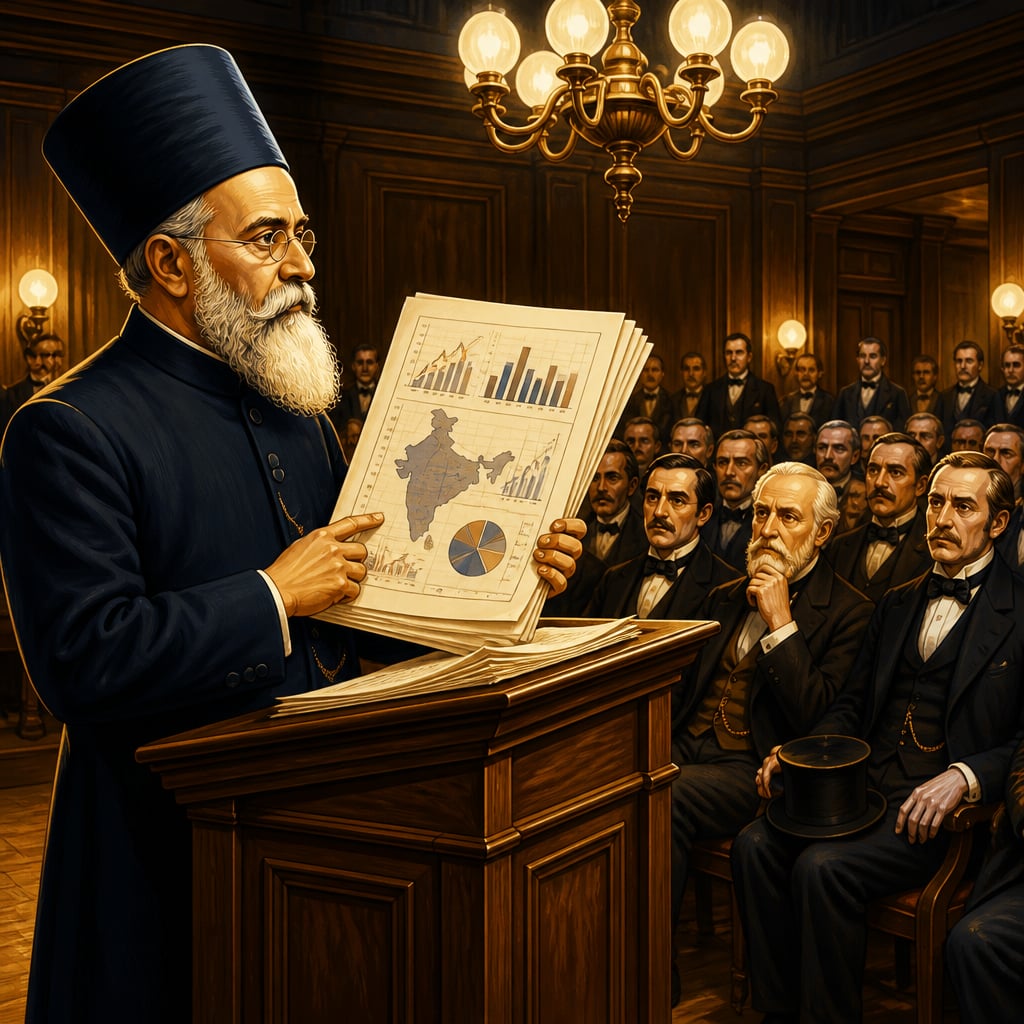
Dadabhai Naoroji presenting the drain theory in 1867 London

In 1867, a Parsi mathematics professor named Dadabhai Naoroji stood before the East India Association in London and did something revolutionary: he used numbers. Not rhetoric, not emotion, not appeals to morality, but cold, verifiable data from British government reports.

'I am going to show you,' Naoroji declared, 'that England is draining India of its wealth at the rate of twelve million pounds annually, wealth that leaves India and never returns.'

The audience was stunned. Naoroji had weaponized the colonizer's own records. For the next four decades, until his death in 1917, he refined these calculations, eventually documenting what he called the 'drain of wealth', systematic extraction that impoverished India while enriching Britain.

Thirty years later, this mathematics professor would become the first Asian elected to British Parliament, still armed with the same devastating data.

The Drain Theory Explained

Indian merchant watching a laden British ship depart Calcutta

Naoroji's genius was distinguishing between legitimate trade and colonial extraction. Trade benefits both parties, goods and services flow both ways. The 'drain' was different: wealth that left India with no equivalent return.

He identified the key channels of extraction:

1. Home Charges

India was forced to pay for its own conquest. The 'Home Charges' included:

By 1900, Home Charges consumed 25% of India's central government revenue, money that flowed to Britain, never to return.

2. Unrequited Exports

India consistently ran trade 'surpluses', exporting more than it imported. But these surpluses weren't India's wealth; they were Britain's. The mechanism was ingenious:

As Naoroji explained: 'India exports goods and receives in return, nothing.'

3. Debt Servicing

By 1900, India's public debt was £200 million, money borrowed to fund railways, wars, and 'improvements' that primarily benefited British interests. Indians paid both principal and interest. Yet the investments themselves were often owned by British shareholders who extracted dividends.

Quantifying the Drain: Multiple Estimates

Naoroji's calculations evolved over his lifetime. Here's how different scholars have estimated the extraction:

Scholar Period Method Estimate
Dadabhai Naoroji (1867) Annual 1860s Home Charges + unrequited exports £12 million/year
Dadabhai Naoroji (1901) Cumulative 1757-1900 Refined methodology £200-300 million/year at peak
R.C. Dutt (1902) 1757-1900 Trade balance analysis Similar to Naoroji
Utsa Patnaik (2018) 1765-1938 Trade surplus compounded at 5% $45 trillion (2018 dollars)

Patnaik's $45 trillion figure is controversial but methodologically defensible. She calculated actual trade surpluses, then compounded them at the same 5% rate Britain guaranteed its own investors. Critics argue this overstates modern value; defenders note it applies Britain's own standards.

The exact number matters less than the principle: extraction was systematic, documented, and massive. Even conservative estimates suggest India transferred wealth equivalent to Britain's entire GDP many times over.

Global Perspectives on Colonial Economics

Naoroji wasn't alone in analyzing colonial extraction, but he pioneered the empirical approach.

John Stuart Mill (1806-1873) initially defended colonialism as 'development,' but his own logic undermined him. Mill acknowledged that India's 'surplus' trade wasn't free exchange, it was tribute disguised as commerce. Late in life, he conceded that colonial economics violated his own principles of reciprocal benefit.

John Maynard Keynes (1883-1946) began his career at the India Office, analyzing the very mechanisms Naoroji criticized. In Indian Currency and Finance (1913), Keynes described how India's trade surplus financed British balance of payments, essentially proving Naoroji's point while working for the colonizers. Later, Keynes's own theories about demand and capital flows owed much to observing colonial extraction.

André Gunder Frank (1929-2005) built on Naoroji's work to develop 'dependency theory', the argument that underdevelopment isn't failure to develop but active underdevelopment by colonial powers. Frank's phrase 'the development of underdevelopment' directly echoes Naoroji's drain theory.

Thinker Insight Naoroji Connection
Mill Colonial 'trade' was disguised tribute Naoroji proved this with data
Keynes India financed British payments balance Worked in the system Naoroji exposed
Frank 'Development of underdevelopment' Globalized Naoroji's India analysis

Modern Resonance: Protecting Against the New Drain

In 2025, India applies Naoroji's lessons across multiple domains.

Forex Reserves as Defense

India maintains $600+ billion in foreign exchange reserves, the world's fourth largest. This isn't hoarding; it's protection against what former RBI Governor Raghuram Rajan called 'sudden stops', capital flight that can devastate economies. India learned from 1991, when depleted reserves forced humiliating IMF conditions. Never again.

IMEC: Reversing Trade Dynamics

The India-Middle East-Europe Corridor (IMEC), announced in 2023, represents a fundamental shift. Colonial-era trade routes enriched middlemen in London; IMEC positions India as infrastructure owner, not colonial subject. When trade flows through Indian-built corridors, the economics reverse.

The Reparations Question

Shashi Tharoor at the 2015 Oxford Union reparations debate

Shashi Tharoor's 2015 Oxford Union speech, arguing for British reparations, went viral with 10 million views. He wasn't asking for $45 trillion, he suggested £1 as symbolic acknowledgment. Britain refused even this. The debate isn't about money; it's about historical truth. Naoroji's data underpins every reparations argument today.

Your Turn

Naoroji spent fifty years proving what everyone felt but couldn't document: that colonialism was theft dressed as governance.

His method, using the colonizer's own data against them, remains powerful. Today, when evaluating any economic relationship, ask Naoroji's question: Is this exchange mutual, or is wealth flowing one way with no return?

This applies to trade deals, corporate partnerships, even personal relationships. The drain theory isn't just historical analysis, it's a framework for identifying extraction wherever it occurs.

As Arvind Subramanian, former Chief Economic Advisor, notes: 'India's economic policy today is deeply informed by colonial memory. The drive for self-reliance, the skepticism of foreign capital, the obsession with reserves, all trace to understanding what the drain cost us.'

In the next lesson, we'll see how Sanjeev Sanyal documents another dimension of colonial destruction: the collapse of India's maritime trade networks.

David Ricardo and other classical economists made theoretical arguments about trade benefits. Naoroji countered with actual data, anticipating modern empirical economics by decades.

Naoroji's innovation was using the colonizer's own records. This made his critique unanswerable, Britain couldn't deny data from its own Parliamentary Papers and India Office reports.

Naoroji compiled over 50 years of trade data, budget figures, and demographic statistics, creating what may be the first comprehensive economic dataset for a colonial economy

Foreign exchange reserves and financial sovereignty

Keynes advocated for reserves as buffer against external shocks. But Western advice to developing nations often emphasized 'efficient' low reserves, until crises struck.

India's $600B+ reserves represent colonial memory institutionalized. The 1991 crisis, when India had just two weeks of import cover, taught what Naoroji knew: without reserves, sovereignty is hollow.

Key terms

Dhana-Nirgama
Drain of wealth, the continuous, unrequited outflow of resources from India to Britain during colonial rule
Griha-Vyaya (Home Charges)
Payments India was forced to make to Britain, including interest on loans, pensions for British officials, and military expenses, all remitted to London
Anavritti-Niryat
Unrequited exports, goods exported without equivalent value returning, essentially one-way tribute disguised as trade
Rina-Pasha
Debt trap, borrowing under conditions that ensure permanent indebtedness and dependency

Key figures

Dadabhai Naoroji (1825-1917)

Father of Indian Economic Nationalism, First Asian MP in British Parliament

Mahadev Govind Ranade (1842-1901)

Pioneer of Indian Economic Thought, Judge and Reformer

Arvind Subramanian (born 1959)

Former Chief Economic Advisor, International Economist

Case studies

Three Responses to the Drain: Reparations, Reserves, and Routes

In 2025, India responds to colonial extraction through three distinct but connected strategies: **The Reparations Debate** Shashi Tharoor's 2015 Oxford Union speech arguing for British reparations garnered 10 million views and reignited global discussion. Citing Naoroji's data and Patnaik's $45 trillion estimate, Tharoor asked for £1, not money, but acknowledgment. Britain refused even this symbolic gesture. The debate matters less for extracting payment than for establishing historical truth: colonialism was theft, not development. **Fortress Reserves** India's $600+ billion foreign exchange reserves represent the institutional response to drain memory. RBI maintains import cover exceeding 12 months, compared to just 2 weeks in 1991. This isn't hoarding; it's sovereignty insurance. When COVID struck and capital fled emerging markets, India's reserves provided stability that smaller economies lacked. **IMEC: Owning the Routes** The India-Middle East-Europe Corridor (IMEC), announced at the G20 Delhi Summit (2023), positions India as infrastructure owner rather than transit point. Colonial-era trade enriched London merchants; IMEC's economics benefit India directly. The $20 billion project connects India to Europe via UAE, Saudi Arabia, Jordan, and Israel, creating trade routes that India controls.

These three responses represent dharmic principles in action: **Reparations = Satya** (truth-telling as precondition for justice) **Reserves = Sthairya** (stability as foundation for sovereignty) **IMEC = Swadeshi** (self-reliance in strategic infrastructure) Notably, India doesn't demand revenge or victimhood. The approach is practical: document the truth (reparations debate), prevent recurrence (reserves), and reverse the dynamics (IMEC). This is Kautilyan pragmatism, acknowledging injury while focusing on strategic response.

The reparations debate has shifted global discourse on colonialism, 'development' narratives are increasingly challenged. India's reserves provided resilience during 2020-2022 global turbulence while other emerging markets faced crises. IMEC, if completed, will reshape Eurasian trade, positioning India as the connector between Eastern manufacturing and Western consumption.

Responding to historical extraction requires truth-telling AND practical action. Naoroji documented the drain; modern India builds systems to prevent its recurrence. The best response to exploitation isn't complaint, it's capability.

The reparations debate has evolved from emotional argument to data-driven economic analysis. Utsa Patnaik's $45 trillion estimate and similar studies from Caribbean nations have made colonial extraction a legitimate topic in international economics, influencing discussions at the UN and World Trade Organization.

India's forex reserves grew 60,000% since 1991 (from $1B to $600B+), while IMEC's $20B infrastructure investment aims to capture 40% of EU-Asia trade by 2040

Historical context

1867-1947 (Nationalist Economics Period)

The late 19th century saw emergence of Indian economic nationalism. Naoroji, Ranade, R.C. Dutt, and others created a school of thought that challenged colonial justifications with evidence. This intellectual movement provided the economic foundation for political nationalism, proving that independence wasn't just desirable but economically essential.

While India's economists documented extraction, similar analyses emerged in Ireland (drain to Britain), the Caribbean (plantation economics), and later across Africa. Naoroji's methods influenced anti-colonial economics globally, his empirical approach became the template for documenting colonial exploitation.

Naoroji calculated the drain at £200-300 million annually by 1900, equivalent to 8% of India's national income flowing to Britain with no return, year after year.

The drain theory transformed understanding of colonialism from 'failed development' to 'successful extraction.' This reframing is essential: India didn't fail to develop, it was actively de-developed for British benefit. Policy responses differ fundamentally depending on which narrative is accepted.

Living traditions

India's economic policy establishment explicitly references colonial history. Budget speeches, trade negotiations, and development strategies regularly invoke the drain as context for current choices. The Annual Economic Survey, published since independence, extends Naoroji's tradition of evidence-based economic analysis.

Reflection

More in Colonial Disruption & Economic Decline

All lessons in Colonial Disruption & Economic Decline · Trade Routes of Ancient Bharat course