Samudra-Patan: Maritime Collapse

Sanyal's Ocean of Churn Analysis

For millennia, Indian merchants dominated the Indian Ocean. Sanjeev Sanyal's 'Ocean of Churn' documents how colonial policy systematically destroyed this maritime supremacy, and how modern India is rebuilding it through Sagarmala, IMEC, and naval power.

The Port That Fed the World
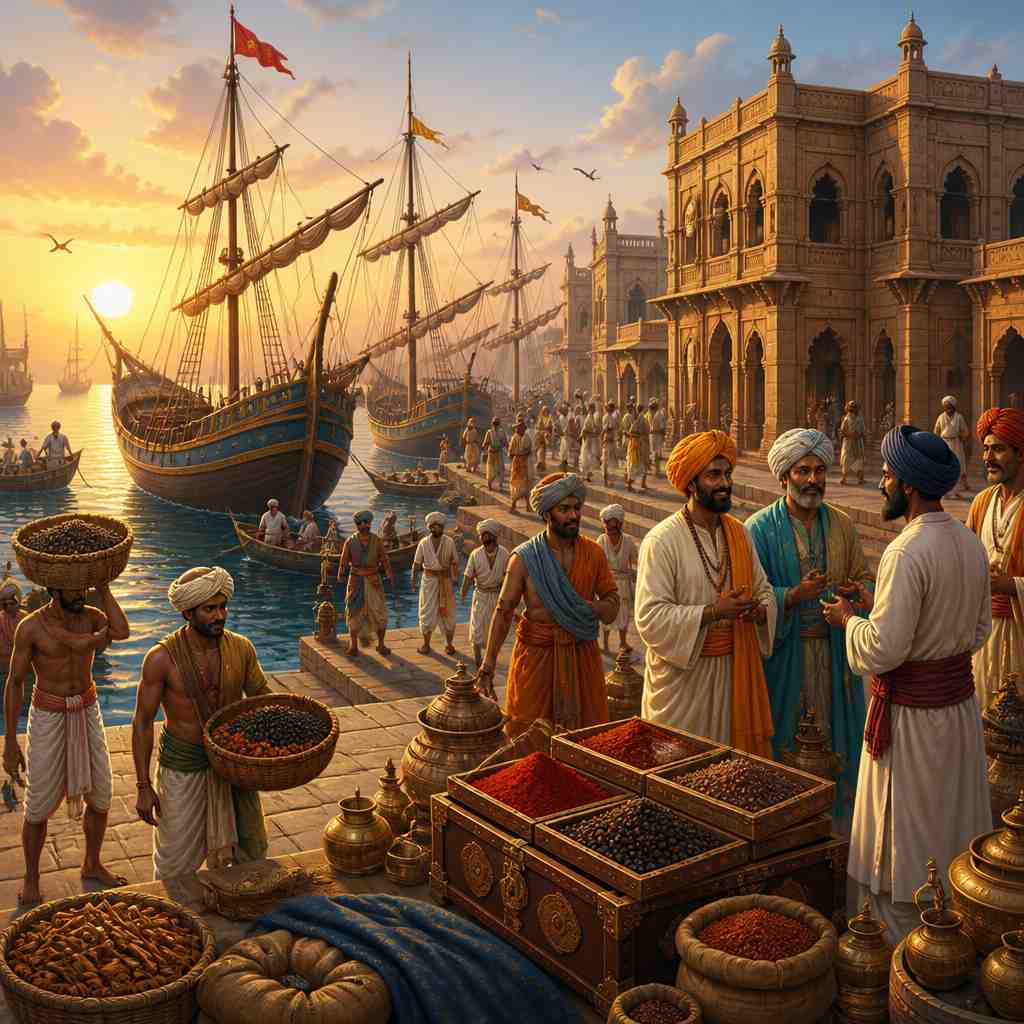
Surat harbour at the height of its 1600 commercial glory

In 1600, Surat was one of the largest cities in the world. Its harbor held 100+ ocean-going vessels at any time. Arab, Persian, Ethiopian, Malay, and Chinese traders filled its markets. The annual Hajj fleet departed from here, 30,000 pilgrims on Indian-built ships, financed by Indian bankers, provisioned by Indian merchants.

Sanjeev Sanyal, in The Ocean of Churn, reconstructs this lost world: 'For two thousand years, the Indian Ocean was essentially an Indian lake. Not through conquest, but through commerce. Indian ships, Indian goods, Indian traders, they connected Africa to Indonesia.'

By 1800, Surat's harbor was nearly empty. Its shipyards were silent. Its merchant families had scattered. The same story repeated from Mandvi to Masulipatnam, a maritime civilization systematically dismantled.

The Gujarat-Arab Trading World

The western Indian Ocean trade network predated Rome. Archaeological evidence shows Gujarat-Mesopotamia trade routes active by 2500 BCE. By the medieval period, this had evolved into the most sophisticated commercial system on earth.

The Network Structure

Gujarati merchants, particularly Banias, Bohras, and Memons, operated across the entire western Indian Ocean:

They didn't just trade, they settled. Indian merchant communities in East Africa date to the 1st century CE. Their banking networks (hundi) enabled credit across 10,000 km. Their ships connected three continents.

Cambay and Mandvi

Cambay (Khambhat) was Gujarat's ancient port, mentioned in Periplus of the Erythraean Sea (1st century CE). By the 16th century, Mandvi in Kutch had become equally important. When Ibn Battuta visited in 1341, he found a cosmopolitan city rivaling any in the Mediterranean.

These weren't just ports, they were manufacturing centers. Cambay produced agate beads found in Egyptian tombs. Mandvi built ships that reached Zanzibar. The integration of manufacturing, shipping, and trade created an economic ecosystem that colonial policy would deliberately destroy.

The Mechanisms of Maritime Destruction

Sanyal documents three phases of destruction:

Phase 1: Portuguese Violence (1500-1700)

Vasco da Gama arrived in 1498 seeking 'Christians and spices.' Finding neither Christians nor welcome, the Portuguese turned to violence. They introduced the cartaz system, every Indian ship needed Portuguese permission to sail. Ships without cartaz were sunk, crews enslaved.

Kunjali Marakkar admiral resisting the Portuguese off Kerala

The Kunjali Marakkars of Kerala resisted for 100 years. But when the Portuguese allied with Cochin against Calicut, divide-and-rule began working.

Phase 2: British Commercial Warfare (1700-1850)

The East India Company didn't use Portuguese-style violence. It used regulation:

By 1800, Indian ships carried less than 10% of India's own maritime trade. The rest sailed on British vessels, Indian goods, British profits.

Phase 3: Infrastructure Inversion (1850-1947)

Railways accelerated the destruction. Colonial railways were designed to move goods from interior to ports, but only for export. They didn't connect ports to each other or enable coastal trade.

Sanyal notes: 'Pre-colonial India was a maritime civilization. Goods moved by sea from Gujarat to Bengal. Colonial policy made India a land-locked economy, dependent on railways that all led to British-controlled ports.'

Global Perspectives on Maritime Empires

India's maritime decline was part of a larger pattern, the European displacement of Asian maritime commerce.

K.N. Chaudhuri (1934-2016), the Cambridge historian, documented Asian maritime trade in Trade and Civilisation in the Indian Ocean (1985). He showed that Asian commerce before 1500 was larger, more sophisticated, and more peaceful than anything Europeans brought. Violence was the European innovation.

Janet Abu-Lughod (1928-2013) argued in Before European Hegemony (1989) that the 13th-century world economy was centered on Asia, with India as a crucial node. European 'rise' wasn't development; it was displacement of an existing system through superior violence.

Sanjay Subrahmanyam (born 1961), the historian, demonstrates in The Career and Legend of Vasco da Gama (1997) that Portuguese 'discovery' was actually piracy, seizing control of trade routes Indians had operated for millennia. The Portuguese didn't open the Indian Ocean; they closed it to Indians.

Thinker Key Insight Maritime Evidence
Chaudhuri Asian commerce was sophisticated Hundi networks, shipbuilding technology
Abu-Lughod Europe displaced, didn't create India was node in 13th-century world economy
Subrahmanyam Portuguese 'discovery' was piracy Cartaz system, violence against traders

Modern Resonance: India Returns to Sea

In 2025, India is systematically rebuilding maritime power across three dimensions.

Sagarmala: Port Modernization

The Sagarmala programme, launched in 2015, represents a $120 billion investment in port infrastructure. Under former Ports Minister Sarbananda Sonowal, the programme has:

IMEC and Chabahar: Controlling Routes

The India-Middle East-Europe Corridor (IMEC) and the Chabahar port in Iran represent India controlling trade routes, not just using them. Colonial-era trade enriched intermediaries; IMEC positions India as infrastructure owner.

Chabahar bypasses Pakistan entirely, connecting India to Afghanistan and Central Asia. IMEC competes with China's Belt and Road. Both echo the historical trade networks Gujarat merchants operated for millennia.

INS Vikrant: Naval Power

INS Vikrant sailing as India's first indigenous carrier

In 2022, India commissioned INS Vikrant, its first indigenous aircraft carrier. Only six nations can build carriers. India now projects power across the Indian Ocean that Rajendra Chola I once dominated.

The symbolism matters: India returns to the ocean not as colonial subject but as sovereign power. The Blue Economy initiative targets $10 billion in marine resources, fishing, offshore energy, seabed mining. The ocean that colonial policy made foreign is becoming Indian again.

Your Turn

Sanyal's 'Ocean of Churn' title refers to the constant churning of peoples, goods, and ideas across the Indian Ocean, a churning India drove for two millennia.

Colonial policy interrupted this churning. India became land-oriented, looking inward, cut off from the seas that connected it to the world. Understanding this helps explain everything from India's post-independence naval neglect to the transformative ambition of Sagarmala.

Ask yourself: What connections did your own family lose during colonial disruption? India's maritime collapse wasn't abstract history, it was millions of families separated from livelihoods, from trade networks, from the world.

In the next lesson, we'll see the most devastating consequence of colonial economics: famine. Shashi Tharoor's analysis of Churchill's role in the Bengal Famine of 1943 shows what happens when extraction meets crisis.

Alfred Thayer Mahan's 'The Influence of Sea Power Upon History' (1890) argued that maritime nations dominate. But India's experience shows geography isn't destiny, policy can negate natural advantages.

India has 7,500 km of coastline and sits astride the world's busiest shipping lanes. Colonial policy made this irrelevant. Sagarmala reactivates geographic advantage through deliberate policy choice.

India's coastline/landmass ratio is more favorable than Britain's, yet post-independence India neglected maritime infrastructure until Sagarmala's $120 billion investment

Modern 'chokepoint capitalism' theory (Rebecca Giblin and Cory Doctorow) shows how controlling bottlenecks, platforms, standards, routes, extracts value from creators. The cartaz system was 16th-century chokepoint capitalism.

IMEC and Chabahar represent India learning this lesson. Instead of just using routes others control, India is building infrastructure it owns, reversing 500 years of being at others' mercy.

IMEC will reduce goods transport time from India to Europe from 45 days (Suez route) to 25 days, with India controlling critical nodes

Key terms

Samudra-Patan
Maritime collapse, the destruction of India's oceanic trade networks and naval capacity under colonial rule
Kartaz (Cartaz)
Portuguese-era pass required by all Asian ships to sail in the Indian Ocean, essentially a protection racket enforced by violence
Sagarmala
Garland of the Sea, India's comprehensive port modernization and coastal development program launched in 2015
Neel Arthavyavastha (Blue Economy)
Ocean-based economic development, fishing, shipping, offshore energy, seabed mining, marine tourism

Key figures

Rajendra Chola I and the Chola Naval Commanders

Builders of India's Greatest Maritime Empire

Sanjeev Sanyal (born 1971)

Economic Historian and Principal Economic Advisor

Sarbananda Sonowal (born 1962)

Union Minister for Ports, Shipping and Waterways

Case studies

India's Maritime Trinity: Sagarmala, IMEC, and INS Vikrant

In 2025, India pursues maritime revival through three interconnected initiatives: **Sagarmala: Port Modernization** Launched in 2015, Sagarmala is a $120 billion program transforming India's 12 major and 200+ minor ports. Key achievements: - Port capacity increased from 1,500 to 2,500 million tonnes (2015-2024) - Cargo dwell time reduced from 5 days to 2 days - Vadhavan port (Maharashtra) under construction, will be world's 10th largest - Coastal shipping revived, reducing the colonial-era dependence on railways **IMEC and Chabahar: Route Control** The India-Middle East-Europe Corridor (IMEC), announced at G20 Delhi (2023), connects India to Europe via UAE, Saudi Arabia, Jordan, and Israel, rail and ship links India controls. Simultaneously, Chabahar port (Iran) connects India to Central Asia, bypassing Pakistan entirely. Both recreate historical trade networks with India as infrastructure owner. **INS Vikrant: Naval Power** India's first indigenous aircraft carrier, commissioned in 2022, represents naval manufacturing capability. Only six nations can build carriers. Combined with the Tejas fighter program and indigenous submarine development, India projects power across the Indian Ocean, the military dimension of maritime revival.

These three initiatives embody dharmic principles applied to maritime strategy: **Sagarmala = Artha** (economic development through infrastructure) **IMEC/Chabahar = Svadeshi** (self-reliant trade routes, not dependence on others) **INS Vikrant = Kshatra** (protective power to secure commerce) The integration matters. Ports without protection are vulnerable. Routes without ports are unusable. Naval power without commercial purpose is expensive. The Cholas understood this integration; colonial policy destroyed it; modern India rebuilds it comprehensively.

India's maritime cargo has grown from 1 billion tonnes (2014) to 1.6 billion tonnes (2024). Port efficiency now rivals Singapore. India exports warships for the first time in history. The Indian Ocean, which colonial policy made hostile territory, is becoming Indian again, not through conquest but through commerce, infrastructure, and legitimate naval presence.

Maritime power is a system, not a component. Ports, routes, and naval capacity must develop together. India's integrated approach, Sagarmala, IMEC, and INS Vikrant as connected initiatives, reflects understanding that colonial destruction was also systematic, requiring systematic rebuilding.

India's three-pronged maritime strategy (ports, corridors, naval capability) is being studied by ASEAN defense planners and African Union strategists as a template for integrated maritime development. The insight that commercial ports, trade routes, and naval protection must develop as a system applies to any maritime nation.

India's maritime trade accounts for 95% of trade by volume and 70% by value, yet until Sagarmala, port infrastructure was a colonial-era inheritance. The $120 billion investment represents India finally treating maritime capacity as strategic priority.

Historical context

1498-1947 (European Maritime Domination)

Pre-colonial India was a maritime civilization. The Periplus (1st century CE) documents Indian ships sailing to Egypt. Chola inscriptions record naval expeditions to Southeast Asia. Gujarat's merchants maintained permanent settlements across the Indian Ocean. This wasn't primitive trade, it was sophisticated commerce with credit instruments, insurance, and multinational firms.

While India's maritime trade was being destroyed, Britain was becoming a maritime empire. The Royal Navy's dominance was built partly with Indian resources, including teak from Malabar forests and ships built in Indian yards. Britain used India's maritime assets to build British power, while destroying India's ability to use them independently.

In 1800, Indian-owned ships carried less than 10% of India's maritime trade, down from over 80% a century earlier. The remaining 90% sailed under British flags, enriching British owners.

Understanding maritime destruction explains India's post-independence naval neglect. Seventy years of colonial policy made Indians think of themselves as a land power. Sagarmala and INS Vikrant represent psychological as well as physical recovery, remembering that India is a maritime nation.

Living traditions

India's maritime revival explicitly honors this heritage. The Cochin Shipyard, builder of INS Vikrant, employs workers from families who built boats for generations. Sagarmala's coastal community development includes support for traditional fishing and boat-building. The past isn't just remembered, it's integrated into the revival.

Reflection

More in Colonial Disruption & Economic Decline

All lessons in Colonial Disruption & Economic Decline · Trade Routes of Ancient Bharat course