Prithu: The Ideal King

The first anointed sovereign

From Vena's arms emerges Prithu, an empowered incarnation of Vishnu. He becomes the first king to be formally coronated, establishing the principles of righteous governance. His rule becomes the gold standard for all future kings, and Earth herself is named Prithvi after him.

The Divine Emergence

After the dark figure of Nishadha emerged from Vena's sinful body, the great sages continued their sacred churning. This time, they worked upon the arms of the dead king, the limbs that should have protected dharma but had instead crushed it. The sages' mantras intensified, their collective spiritual power focused on extracting whatever righteousness might still reside in Vena's lineage.
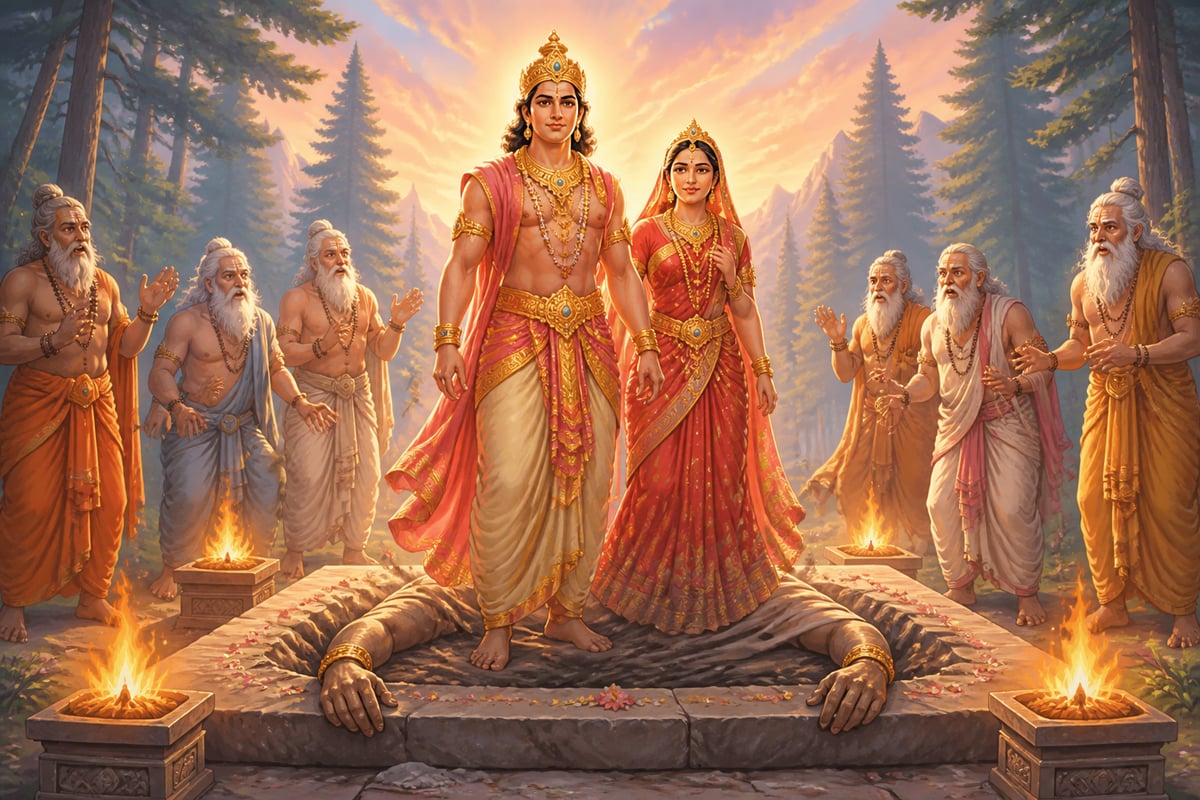
Prithu and Arci emerge from Vena's churned arms

From the right arm emerged a magnificent figure that made all present gasp in wonder. This was no ordinary man. His form radiated divine splendor (tejas) that illuminated the entire assembly. His complexion was golden like molten sunlight. In his hands appeared divine weapons, a celestial bow named Ajagava and a set of imperishable arrows. A divine armor materialized upon his chest, and his body bore the sacred marks of Vishnu himself.

Simultaneously, from the same churning emerged a beautiful woman with lotus-like features. She was Arci, destined to be the devoted queen of this divine king. Her emergence alongside Prithu symbolized that righteous rule requires the balance of masculine and feminine energies, strength tempered by grace, justice complemented by compassion.

The Avatara of Vishnu's Power

The celestial beings, devas, gandharvas, siddhas, and sages, immediately recognized the divine presence. This was not a mere human born of royal lineage. Prithu was an 'avesha-avatara', a jivatma empowered with the divine potency of Lord Vishnu himself. While he was not Vishnu directly incarnated as in the case of Rama or Krishna, he carried such a concentrated measure of divine energy that he could accomplish what ordinary humans could not.

The Bhagavatam explains that Prithu appeared with specific powers: the strength of Vishnu for protection (raksha-shakti), the wisdom of Brahma for governance (prabhu-shakti), and the austerity of Shiva for justice (danda-shakti). This threefold potency made him uniquely qualified to restore a world that had descended into chaos under Vena's tyranny.

The First Formal Coronation

What happened next established a precedent for all human civilization. The great sages, recognizing Prithu's divine mandate, decided to perform humanity's first formal coronation ceremony, the 'abhisheka' and 'rajyabhisheka'. This was revolutionary. Before Prithu, rulers either inherited power through lineage or seized it through conquest. But Prithu's coronation established that true kingship required divine sanction, sage approval, and public consent.

Lord Brahma himself descended to oversee the ceremony. Indra brought sacred water from all the holy rivers. The great sages chanted Vedic mantras that would later become the foundation of all coronation rituals. The celestial musicians played, and flowers rained from the heavens. Every deity contributed something to mark this momentous occasion.

Maharaja Prithu is crowned on a stone dais as Brahma and Indra preside with Vedic chants.

From this ceremony emerged the very concept of 'raja-dharma', the sacred duty of kings. Prithu was not merely given a throne; he was bound by solemn oaths to protect dharma, nourish his subjects, punish the wicked, and reward the righteous. The crown became not just a symbol of power but of responsibility.

The Divine Gifts

Each deity presented Prithu with objects that would symbolize different aspects of kingship for all time:

These gifts established the regalia of kingship that would be replicated in coronation ceremonies for millennia. The throne, crown, umbrella, sword, and treasury became universal symbols of royal authority across all cultures that descended from Vedic civilization.

The Proclamation of Dharma

Prithu proclaims raja-dharma to his subjects

After his coronation, Prithu addressed his subjects with words that became the template for righteous governance. He declared that a king exists not for his own pleasure but as a servant of the people. He proclaimed the concept of 'praja-palana', nurturing subjects as a parent nurtures children.

His famous declarations included:

'I shall be the father of my subjects, caring for them without discrimination. The weak shall receive my protection, and the wicked shall face my justice. My treasury exists not for royal luxury but for public welfare. In times of famine, I shall open my granaries. In times of invasion, I shall be the first to march.'

These words established the philosophical foundation of Indian political thought. The king was not a despot but a trustee. Power was not absolute but conditional upon dharmic conduct. These principles would later be elaborated in texts like Kautilya's Arthashastra and the Shanti Parva of the Mahabharata.

Earth Named Prithvi

Perhaps the most enduring legacy of Prithu was his relationship with Mother Earth herself. The planet we walk upon took his name, 'Prithvi' means 'that which was expanded by Prithu.' This naming was not mere honor but reflected a profound transformation.

When Prithu assumed the throne, the Earth was barren and unproductive. Vena's atheistic rule had disrupted the cosmic order, and the Earth had withdrawn her bounty in protest. Plants refused to grow, rivers ran dry, and famine stalked the land. Prithu would need to perform a mighty deed to restore prosperity, a story so significant that it fills the entire next lesson.

For now, understand that the naming of Earth as 'Prithvi' commemorates the establishment of the proper relationship between ruler and ruled, between human civilization and the natural world. Prithu did not conquer the Earth; he convinced her to cooperate through righteous governance.

The Model for All Kings

Prithu's coronation became the archetype for all future consecrations of kings. The rituals established in his abhisheka were preserved and transmitted through the Brahmana texts and later through the Dharmasutras. When a king was crowned anywhere in India, whether in Magadha or Kalinga, Chola or Chera, he underwent rituals that traced back to Prithu.

More importantly, Prithu established the metrics by which all kings would be judged:

  1. Praja-ranjana: Does the king please his subjects through good governance?
  2. Dharma-sthapana: Does the king establish and protect dharma?
  3. Dushta-nigraha: Does the king punish the wicked without fear or favor?
  4. Shishta-paripalana: Does the king protect the righteous and learned?
  5. Kosa-vriddhi: Does the king increase the treasury through fair means?
  6. Bala-vriddhi: Does the king maintain strong defenses?

Every king who followed was measured against these standards. When the Mahabharata says 'Raja dharmasya karanam' (the king is the source of dharma), it is invoking principles first established by Prithu.

The Significance of Divine Empowerment

Prithu's status as an avesha-avatara carries profound meaning. It demonstrates that divine grace can transform any situation. From the same body that produced the embodiment of sin (Nishadha from Vena's legs), divine churning extracted the embodiment of righteousness (Prithu from Vena's arms).

This offers hope: no lineage is permanently cursed, no situation irredeemable. The same family that produced Vena the tyrant also produced Prithu the ideal. The crucial factor was not genetics but divine grace combined with the sincere intervention of sages.

Preparing for the Great Challenge

Despite his divine weapons, cosmic coronation, and sage blessings, Prithu faced an immediate crisis. The Earth, traumatized by Vena's misrule, remained uncooperative. Crops failed, animals starved, and people died. The new king's first test would be to restore the broken relationship between humanity and nature.

This challenge would bring out Prithu's greatest qualities, not his martial prowess but his diplomatic wisdom, not his divine weapons but his capacity for both firmness and compassion. His confrontation with Earth becomes one of the Bhagavatam's most instructive episodes for understanding how power should be wielded: with determination but without tyranny, with strength but without cruelty.

Living traditions

Reflection

More in Skanda 4: Fourth Order Creation

All lessons in Skanda 4: Fourth Order Creation ยท Srimad Bhagavatham course