Dhruva: The Five-Year-Old's Resolve

A child's unshakeable vow

Five-year-old Dhruva, rejected by his stepmother and unsupported by his father King Uttanapada, sets out to find God. With guidance from sage Narada, the determined child enters the forest to perform austerities that will shake the three worlds and earn him an eternal position.

The Palace of Two Queens

In the kingdom of King Uttanapada, there lived two queens with two very different fates. Suruchi, the younger and more beautiful queen, held the king's heart captive. Whatever she desired, she received. Her son Uttama grew up in luxury, believing himself destined for the throne.

Suniti, the elder queen, lived in the shadow of neglect. Though she was the first wife and of noble character, the king's obsession with Suruchi had pushed her to the margins of palace life. Her son Dhruva - just five years old - grew up knowing his father's love was rationed, if it came at all.

This was the setting for one of the Bhagavatam's most beloved stories - a tale of a child's wounded heart that would reach the throne of God Himself.

The Day Everything Changed

One afternoon, young Dhruva wandered through the palace and found his father seated on the throne. His half-brother Uttama was sitting happily on the king's lap, basking in paternal affection. Dhruva's heart leaped - perhaps today his father would hold him too.

The five-year-old ran forward, arms outstretched, longing for the simple embrace that every child craves from their father.
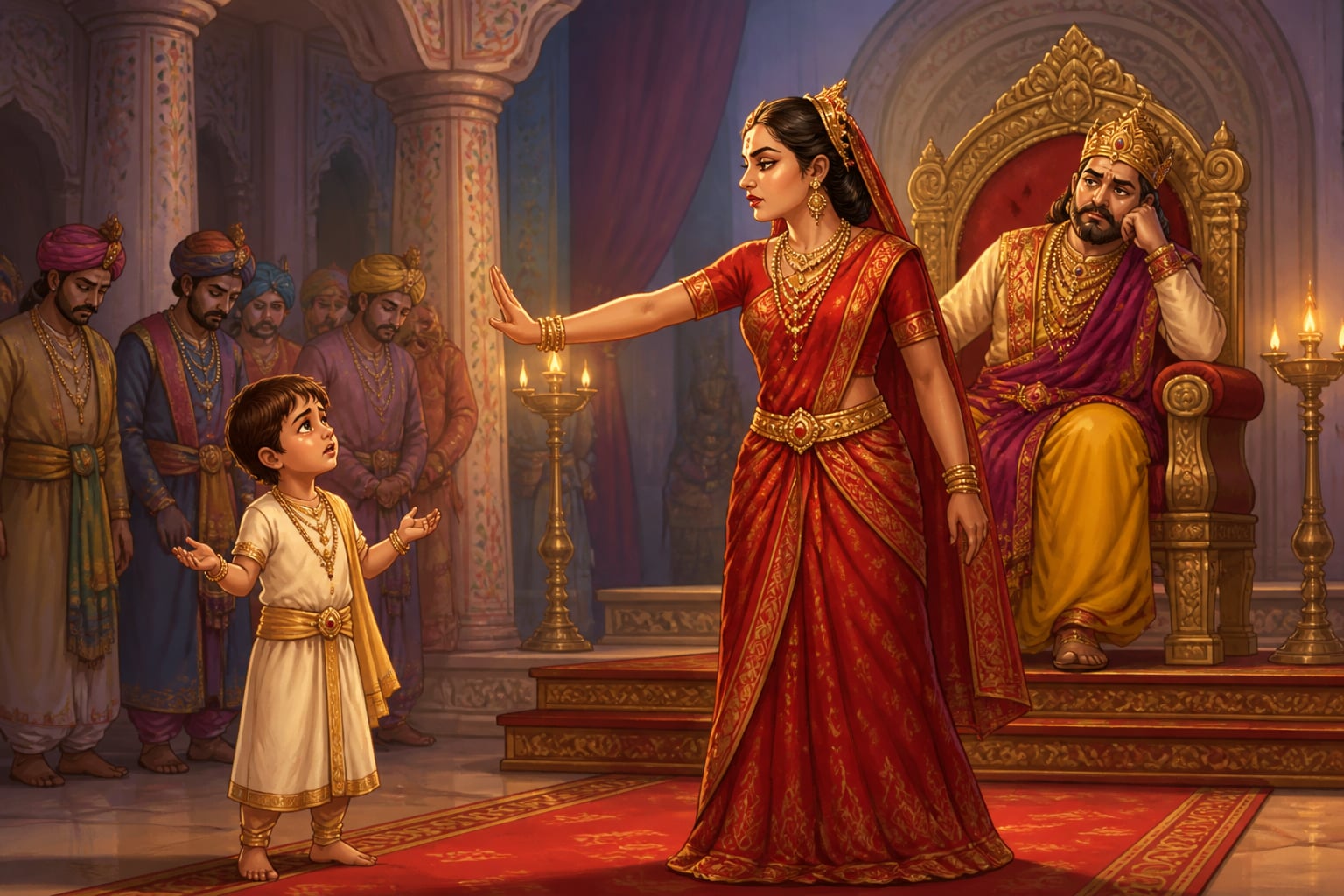
Suruchi steps between Dhruva and the throne

But Queen Suruchi stepped between them.

"Stop there, little one," she said, her voice dripping with contempt. "You wish to sit on the throne? You wish for your father's lap? But you were not born from my womb. If you wanted such privileges, you should have prayed to be born as my son."

She continued, each word a knife:

"Go worship Lord Vishnu. Perhaps through many lifetimes of devotion, you will be fortunate enough to be born as my child. Then - and only then - will you have the right to sit on this throne."

King Uttanapada sat in silence. He did not defend his son. He did not contradict his favorite queen. He simply looked away, his weakness laid bare.

Dhruva stood frozen, absorbing the rejection. He was five years old, and he had just learned that his father's love was conditional, that his very birth was considered inferior, that he was unwanted in his own home.

A Mother's Wisdom

Suniti consoles the rejected Dhruva

Dhruva ran to his mother Suniti, tears streaming down his face. He collapsed in her arms, his small body shaking with sobs. Between gasps, he told her everything - Suruchi's cruel words, his father's silent betrayal.

Suniti held her son, her own heart breaking. But what could she say? Suruchi's words, however cruel, reflected reality. In that palace, under that king, she and Dhruva had no power, no protection, no position.

Yet Suniti was a woman of faith. Instead of teaching her son bitterness, she taught him something remarkable:

"My child, your stepmother spoke harshly, but in one thing she was right - you should worship Lord Vishnu. Not to become her son, but to become the son of the Supreme Lord Himself. He is the only one who can protect the unprotected and elevate the lowly."

She continued, planting a seed that would grow beyond anything she imagined:

"Your grandfather Svayambhuva Manu achieved his position through devotion to the Lord. Your great-great-grandfather Brahma exists only by the Lord's grace. If even Brahma depends on Vishnu, surely He can help a five-year-old boy. Go, my son. Seek the Lord. He will not reject you as your father has."

The Resolve Forms

Something extraordinary happened in Dhruva's heart. The rejection that would have crushed most children instead ignited a fire. He had been told he was unworthy of his father's lap - very well, he would seek a higher throne. He had been told to worship Vishnu to gain privilege - very well, he would find Vishnu Himself.

Dhruva wiped his tears. His jaw set with determination that seemed impossible in one so young. He hugged his mother and walked out of the palace, heading toward the forest.

A five-year-old boy. Alone. Walking into the wilderness to find God.

Narada's Intervention

Word of this astonishing child reached Narada Muni, the celestial sage who wanders all worlds. Narada descended to earth and intercepted Dhruva on his path.

"Child," Narada said gently, "where are you going?"

Dhruva looked up at the sage, recognizing a divine presence.

"I am going to find Lord Vishnu. My stepmother said I should worship Him if I want anything. So I will worship Him until He gives me a position higher than anyone in my family has ever held."

Narada was moved - and concerned. This child's determination was genuine, but his motivation was mixed. He wanted God, yes, but he wanted God as a means to outshine those who had rejected him. This was devotion tainted by ego.

The sage tried to dissuade him:

"Little one, you are only five years old. The path of austerity is harsh. Sages spend lifetimes in meditation without success. The forest is full of dangers - wild animals, harsh weather, hunger, loneliness. Go home, play with other children, wait until you are older."

Dhruva's response revealed the steel within:

"Great sage, I cannot play. I cannot rest. My heart is pierced by the arrows of my stepmother's words. Only the Lord can remove them. Please tell me how to find Him, or I will find Him on my own."

Narada realized he was witnessing something rare - a soul whose determination could move even the cosmos.

Sage Narada meets young Dhruva on a wooded forest path outside the palace grounds.

The Gift of the Mantra

Narada saw that this child would not be deterred. Rather than leave him to wander blindly, the sage decided to guide him properly. He gave Dhruva three precious gifts:

First, the destination: Madhuvana, a sacred forest on the banks of the Yamuna, where the Lord had appeared in previous ages.

Second, the method: Dhruva should purify himself, control his breath, and fix his mind single-pointedly on the Supreme Lord in his heart.

Third, and most precious - the mantra:

ॐ नमो भगवते वासुदेवाय

Om Namo Bhagavate Vāsudevāya

"I bow to Lord Vasudeva, the Supreme Personality of Godhead."

This twelve-syllable mantra, known as the Dvadashakshari Mantra, would become Dhruva's lifeline to the infinite. Each syllable carried the power of divine connection. Each repetition would draw him closer to the One he sought.

Narada taught Dhruva to meditate on the Lord's beautiful form - adorned with divine ornaments, holding the conch, disc, lotus, and mace, with eyes like blooming lotuses and a smile that could remove all suffering.

"Fix your mind on this form," Narada instructed. "The Lord will respond. He always responds to sincere devotion."

Madhuvana

Dhruva traveled to Madhuvana as Narada had directed. The sacred forest welcomed the child with its ancient trees and sacred atmosphere. Here, Dhruva began practices that would astonish the universe.

In the first month, he ate only fruits and berries every three days, maintaining his young body while beginning to quiet his mind.

In the second month, he ate only dry grass and leaves every six days, his body thinning but his resolve strengthening.

In the third month, he drank only water every nine days, his consciousness becoming clearer, more focused.

In the fourth month, he breathed only every twelve days, entering states of meditation that adult sages rarely achieve.

In the fifth month, he stood on one leg, perfectly still, his mind completely absorbed in the form of Lord Vishnu.

By the sixth month, Dhruva had stopped even breathing in the normal sense. He held his breath completely, sustaining his body through pure yogic power, his entire being merged with the divine mantra.

The Three Worlds Tremble

When Dhruva achieved complete breath control, standing on one leg, his mind utterly fixed on the Lord, something unprecedented happened. His concentration was so intense that it began to affect the cosmic order.

The earth trembled under his single foot. The celestial beings found themselves unable to breathe - Dhruva's yogic control over prana was affecting the cosmic breath itself. The demigods rushed to Lord Vishnu in alarm.

"Lord!" they cried. "A child in Madhuvana is performing austerities so severe that we are being suffocated! Please intervene before the universe is disrupted!"

Vishnu smiled. He knew exactly what was happening. A five-year-old boy had just shaken the three worlds through the power of devotion alone.

What We Learn So Far

Before we witness the Lord's appearance to Dhruva in the next lesson, we must pause to absorb what this story teaches:

Rejection can become a doorway. Dhruva's pain could have made him bitter, defeated, withdrawn. Instead, it propelled him toward the highest goal. Every rejection contains within it the seed of redirection.

A mother's wisdom plants eternal seeds. Suniti did not have power, wealth, or influence. But she had faith, and she transmitted that faith to her son. Her words set Dhruva on the path to immortality.

Determination matters more than age. Narada listed all the reasons why Dhruva should fail - his youth, the hardships, the long odds. But determination is not measured in years. A resolved heart can accomplish what lifetimes of half-hearted effort cannot.

Even mixed motivations can lead to pure devotion. Dhruva started with wounded pride and a desire to outshine his enemies. But the path of devotion would purify even these motivations, as we will see.

The child stands on one leg in the forest of Madhuvana. The Lord of the universe prepares to descend. What happens when infinite grace meets a five-year-old's unshakeable faith?

Living traditions

Dhruva's story remains one of the most popular teaching tales for Hindu children, demonstrating that determination and faith can overcome any obstacle. The Pole Star's Sanskrit name preserves his memory in the night sky, and the Dvadashakshari Mantra he received continues to be chanted by millions seeking divine connection.

Reflection

More in Skanda 4: Fourth Order Creation

All lessons in Skanda 4: Fourth Order Creation · Srimad Bhagavatham course