Dhruva: The Eternal Position
Beyond the stars themselves
Dhruva returns to rule as a righteous king, but his heart remains fixed on the Lord. After a long reign, he ascends to the spiritual realm, receiving a position that even the stars revolve around. His mother Suniti, who encouraged his quest, accompanies him to eternal bliss.
The Crown Prince Returns
When Dhruva returned from Madhuvana, he was no longer the wounded five-year-old who had fled into the forest. He was still young in body, but ancient in wisdom. He had seen the Lord of the universe face to face. He had received promises that transcended anything the material world could offer.
King Uttanapada officially crowned Dhruva as the heir apparent. The kingdom rejoiced. The father who had failed to protect his son now publicly honored him. Suniti, the mother whose faith had launched Dhruva's journey, watched with quiet joy. Her simple words - "Go worship Lord Vishnu" - had yielded fruit beyond imagination.
Even Suruchi, the stepmother whose cruelty had started everything, treated Dhruva with respect now. Perhaps she felt remorse. Perhaps she simply recognized that this child had been touched by something far beyond palace politics. Whatever her reasons, she no longer opposed him.
Thirty-Six Thousand Years
When King Uttanapada decided to retire to the forest for spiritual practice - as was customary for kings in their later years - Dhruva ascended the throne. He ruled for thirty-six thousand years.
This number may seem impossible to modern readers, but in the cosmic timescale of the Bhagavatam, lifespans were vastly longer in earlier ages. What matters is not the literal duration but what Dhruva did with his reign:
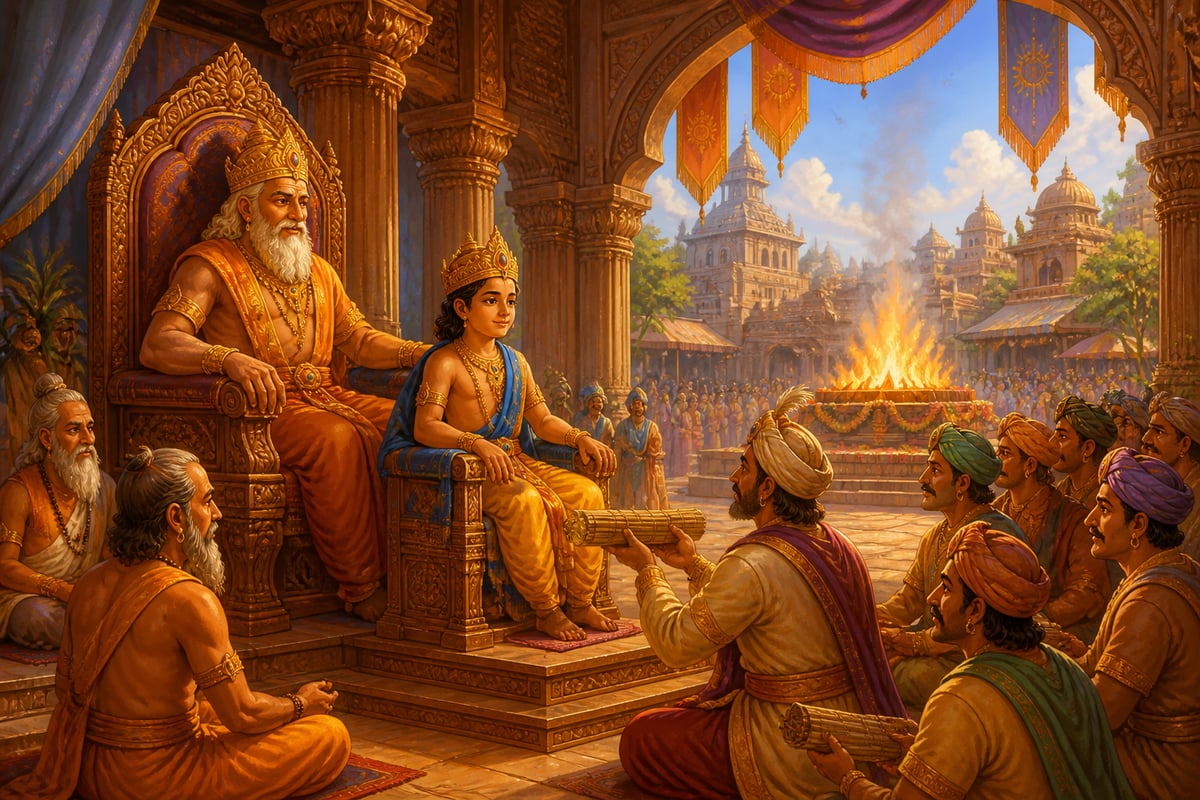
He ruled righteously. His policies protected the weak, honored the sages, and maintained dharma throughout the kingdom. The citizens prospered under his care.
He performed great sacrifices. Dhruva conducted elaborate yajnas, offering portions of his wealth and power back to the cosmic order that had blessed him.
He remained a devotee. Despite his royal duties, Dhruva never forgot the Lord he had seen in Madhuvana. His inner life continued even as his outer responsibilities expanded.
He married and had children. From his wife Bhrami, he had two sons. Life proceeded normally on the surface.
The Tragedy and the Test
But Dhruva's reign was not without sorrow. His half-brother Uttama - the one who had sat on their father's lap while Dhruva was rejected - was killed during a hunting expedition by a Yaksha (a type of nature spirit).
When Dhruva heard this news, a storm arose within him. The brother who had unwittingly caused his childhood pain was dead. But instead of feeling vindicated, Dhruva felt protective rage. Whatever childhood rivalry existed, Uttama was still his brother.
Dhruva gathered his armies and marched against the Yakshas. The battle was devastating. Dhruva's warrior skills, honed over thousands of years, proved formidable. He slaughtered Yakshas by the thousands.
But this vengeance was noticed in higher realms.
Grandfather's Intervention

Svayambhuva Manu, Dhruva's grandfather and the first lawgiver of humanity, descended to stop the carnage.
"Dhruva, what are you doing?" Manu asked. "You have killed thousands of Yakshas, but not all of them were responsible for your brother's death. Many innocent beings have perished because of your anger."
Manu continued:
"A single Yaksha killed Uttama. But you have responded with indiscriminate slaughter. This is not worthy of one who has seen the Supreme Lord. The same Lord who blessed you is present in every being - including these Yakshas you have killed."
Dhruva realized his error. Despite his spiritual advancement, he had allowed grief and anger to override wisdom. He had treated an entire race as responsible for one individual's crime. This was the same logic of collective punishment that causes so much suffering in the world.
Dhruva withdrew his armies and made peace with the Yakshas. Kubera, the king of the Yakshas and lord of wealth, was so impressed by Dhruva's change of heart that he offered him any boon.
Dhruva asked only for unbroken remembrance of the Lord. Material wealth he had in abundance; spiritual memory was what he valued.
The Final Journey
As Dhruva's earthly time drew to a close, a remarkable event occurred. A divine vimana - a celestial aircraft - descended from the heavens. Two divine beings emerged, glowing with transcendental radiance.
They introduced themselves as Nanda and Sunanda, eternal associates of Lord Vishnu.
"Dhruva," they announced, "the Lord has sent us to escort you to your eternal position. Your time of earthly service is complete. Now you will ascend to Dhruva-loka, where you will remain forever, beyond the dissolution of the material universe itself."
Dhruva prepared to depart. He touched his forehead to the vimana in reverence. He bowed to the sages and brahmanas who had guided him. He embraced his family.
Then he noticed something that moved him to tears.
A Mother's Reward
The celestial messengers had instructions that Dhruva would not travel alone. Suniti, the mother who had planted the seed of faith in her five-year-old son's heart, had earned passage to the eternal realm as well.
She who had been neglected by her husband, overshadowed by a co-wife, marginalized in her own palace - she would now accompany her son to a position that kings and sages dream of but rarely attain.
Suniti had not performed the austerities. She had not stood on one leg for months. She had not received the Lord's darshan directly. But her faith, transmitted to her son at the crucial moment, had made everything possible. And divine justice ensured she would share in the reward.
This is one of the Bhagavatam's most beautiful teachings: those who enable devotion share in its fruits. Suniti's quiet faith achieved what Suruchi's scheming never could.
The Ascent
As Dhruva and Suniti boarded the vimana, the entire cosmos took notice. The celestial aircraft rose through the atmospheric layers, past the orbits of the planets, past the realm of the stars.

The Saptarshis - the Seven Sages whose constellation we know as the Big Dipper - watched in wonder as Dhruva's vimana passed them. These great sages, who had performed austerities for countless ages, now witnessed a child (grown to kingship, but still a child compared to their antiquity) ascending to a position above their own.
Dhruva's eternal position is so elevated that the entire stellar constellation, including the Saptarshis themselves, circumambulates Dhruva-loka in perpetual reverence. The child who was denied a seat on his father's lap would have all the stars of heaven revolving around him.
What Dhruva's Complete Story Teaches
The full arc of Dhruva's life - from rejected child to cosmic sovereign - carries teachings that have guided seekers for millennia:
Pain can be portal. Dhruva's rejection became the doorway to his destiny. What seemed like the worst moment of his young life was actually the catalyst for his eternal glory.
Spiritual achievement doesn't make us perfect. Even after seeing the Lord, Dhruva made mistakes - his excessive vengeance against the Yakshas showed that spiritual vision doesn't automatically eliminate all flaws. Growth continues throughout life.
Those who enable devotion share its fruits. Suniti didn't perform the tapas, but she inspired it. The Bhagavatam recognizes that behind every great devotee are others who made their devotion possible.
Material and spiritual success can coexist. Dhruva ruled righteously for tens of thousands of years while maintaining his inner devotion. The Bhagavatam doesn't advocate abandoning worldly duties but sanctifying them through devotional consciousness.
The cosmos recognizes genuine achievement. Dhruva didn't campaign for his position or politick for cosmic influence. He simply pursued God with total determination, and the universe itself reorganized to honor that pursuit.
The Pole Star's Witness
To this day, the Pole Star - called Dhruva Nakshatra in Sanskrit - serves as a witness to this ancient story. While other stars wheel across the night sky, the Pole Star remains fixed, just as Dhruva's devotion remained fixed on the Lord.
For thousands of years, travelers and navigators have looked to this star for direction. They may not know the story of the five-year-old boy who sought God with unshakeable determination, but they benefit from the constancy that his name implies.
Every time someone looks up at the night sky and finds the Pole Star, they are, in a sense, looking at the cosmic marker of what determination, devotion, and divine grace can accomplish.
The rejected child sits enthroned among the stars, and his mother sits beside him, forever.
Living traditions
Dhruva's story is the first spiritual narrative most Hindu children learn. His image - a small child in meditation while a magnificent Lord appears before him - adorns countless homes, temples, and children's books. NASA and ISRO scientists with traditional backgrounds sometimes reference Dhruva when discussing pole stars, blending ancient narrative with modern astronomy.
- Dhruva Meditation: Contemplating Dhruva's story while gazing at the Pole Star, connecting visual astronomy with spiritual narrative
- Dhruva Narayan Temple: Temples dedicated to Dhruva often feature murals depicting his complete story - from rejection to ascension - serving as visual scripture for devotees
- Madhuban Temple: Associated with the Madhuvana forest where Dhruva performed his tapas; pilgrims visit to honor his memory
Reflection
- Suniti was taken to the eternal realm not for her own austerities but for enabling her son's devotion. Who has enabled your spiritual growth, and how can you honor their contribution?
- Even after seeing God, Dhruva made the mistake of disproportionate vengeance. What mistakes have you made even after significant spiritual experiences, and what did they teach you?
- When Kubera offered Dhruva any material wealth, Dhruva asked only for remembrance of the Lord. If you could have any material blessing, what would you ask for? What does your answer reveal about your current spiritual state?