Dhruva: The Pole Star Devotee
The Lord appears to Dhruva
After six months of severe penance, Lord Vishnu appears before Dhruva. The child, overwhelmed with divine vision, offers the famous Dhruva Stuti. Though he came seeking a kingdom, seeing the Lord, he no longer desires material gain. Yet the Lord grants him the eternal Pole Star position.
The Divine Response
For six months, the child Dhruva had stood on one leg in the forest of Madhuvana, his breath suspended, his mind utterly absorbed in the form of Lord Vishnu. His concentration had become so intense that the three worlds trembled. The demigods themselves could not breathe properly.
Lord Vishnu knew exactly what was happening. He had watched this five-year-old reject despair, reject defeat, reject every reasonable excuse to give up. He had witnessed a child's determination exceed that of sages who had meditated for lifetimes.
Now it was time to respond.
The Lord decided to test Dhruva one final time. He withdrew the divine form from the boy's meditation. The image that Dhruva had been contemplating in his heart - the beautiful four-armed Lord holding conch, disc, lotus, and mace - suddenly vanished.
Dhruva's eyes flew open in distress. Where had the Lord gone? Had his concentration failed? Had his unworthiness finally caught up with him?
The Descent of the Divine
But when Dhruva opened his eyes, he saw something that made his heart stop.
The Lord he had been seeking internally was now standing before him externally.
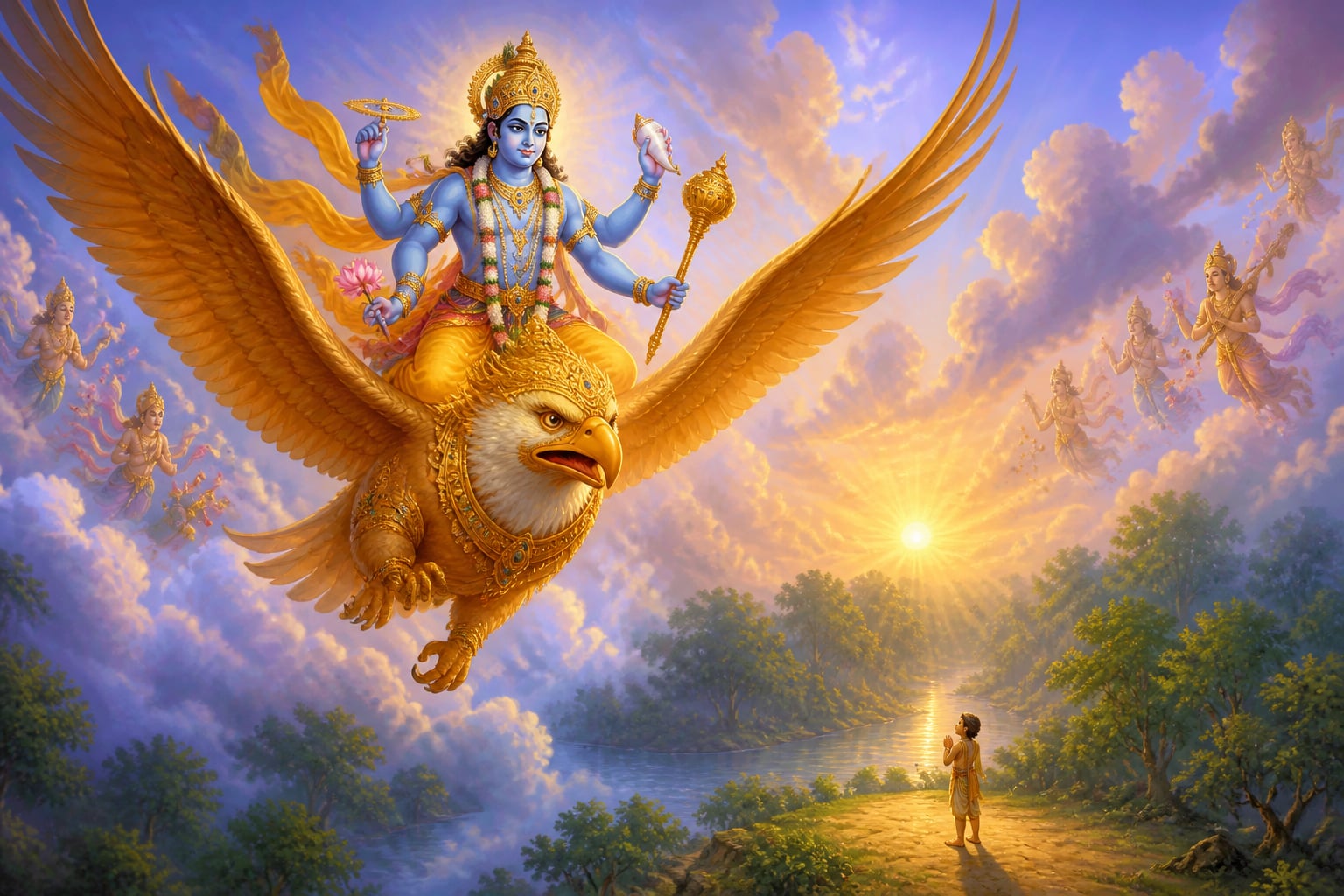
Vishnu had descended on His divine carrier Garuda, accompanied by celestial attendants. His form was exactly as Narada had described - transcendentally beautiful, with lotus-like eyes, wearing yellow garments that shimmered like liquid gold, adorned with the Kaustubha jewel, holding the divine weapons that protect the cosmos.
Dhruva tried to speak, but no words came. His throat constricted. His eyes brimmed with tears. After all this striving, after all this determination, after pushing his young body beyond all limits - here was the goal of his journey, standing right before him.
But he realized with shame that he could not properly glorify the Lord. He had the determination to find God, but not the knowledge to praise Him adequately.
The Lord's Touch
Vishnu saw the child's struggle. With infinite tenderness, He reached out and touched Dhruva's cheek with His divine conch shell, the Panchajanya.

In that moment, everything changed.
The touch of the conch awakened knowledge within Dhruva that had been dormant through countless lifetimes. Suddenly, words flowed - not memorized phrases, but spontaneous hymns of praise that poured from a heart overflowing with divine love.
This is the famous Dhruva Stuti - considered one of the most beautiful hymns in the Bhagavatam.
The Dhruva Stuti
Dhruva began to speak, his child's voice carrying words of profound wisdom:
"O Lord, You have entered my heart and awakened my speech, my senses, my life force, and my intelligence. I offer my obeisances unto You, the Supreme Personality of Godhead."
He continued:
"This form of Yours that I now behold is the same form that great yogis see in their deepest meditation. This form is the source of all other forms of the Lord. You are the original personality, and yet You have appeared before me - a mere child - out of Your causeless mercy."
The hymn reached deeper:
"Those who seek material pleasures worship the demigods and achieve temporary gains. But I have approached You directly. Even though I came with material desires, You have given me something far greater - the vision of Your divine form, which removes the desire for anything else."
Then came the verse that captures the transformation of his heart:
"My Lord, I came to You seeking a kingdom greater than my father's, greater than my grandfather's. But now that I have seen You, I realize I was like a beggar who approaches the emperor for a few grains of rice. I was seeking broken glass when diamonds were available."
The Lord's Response
Vishnu listened to the child's prayers with joy. Here was proof that devotion purifies even mixed motivations. Dhruva had come seeking revenge and material glory, but the very process of seeking God had transformed him.
The Lord spoke:
"Dear Dhruva, I know the determination with which you undertook these austerities. I know the pain in your heart when you were rejected. I know every step of your journey, every hunger pang you ignored, every moment of doubt you overcame."
He continued:
"You came seeking a position higher than anyone in your family. This I will grant - but not in the way you imagined. I will give you the Dhruva-loka, the Pole Star realm. This position is so exalted that all other stars, planets, and celestial bodies will revolve around you. Not even the great sages, the Saptarshis (Seven Sages), have such a position. Their constellation will circumambulate you for all eternity."
Dhruva's eyes widened. This was beyond anything he had imagined. He had wanted to outshine his stepmother and half-brother - instead, he would outshine the entire cosmos.
But the Lord was not finished:
"First, return to your kingdom. Rule righteously for thirty-six thousand years. Your father, filled with remorse for his neglect, awaits you. Your stepmother and half-brother will no longer trouble you. After ruling wisely and well, you will ascend to the Pole Star, where you will remain eternally, beyond the dissolution of the universe itself."
The Bitter Aftertaste
Despite receiving everything he had asked for and infinitely more, Dhruva felt a strange dissatisfaction. He spoke to the Lord with complete honesty:
"My Lord, I approached You with material desires. Even though I have been purified by Your vision, a thorn remains in my heart. I came to You, the ocean of transcendental bliss, asking for that which perishes. It is as if a man thirsting for nectar is offered water from a ditch."
This confession reveals Dhruva's spiritual advancement. He had grown enough to feel ashamed of his initial motivations. He had approached the infinite seeking the finite, and though he had received both, he now understood the disproportion of his original request.
The Lord smiled. This very dissatisfaction was a sign of spiritual maturity. Dhruva would no longer be satisfied by material achievements alone. His heart had tasted something higher, and nothing less would fully satisfy him.
"Do not grieve," the Lord said. "Your initial motivation brought you to Me, and now you have been transformed. Rule well, fulfill your duties, and remember Me always. When your work is complete, I will come for you Myself."
The Return
With these assurances, Lord Vishnu departed on Garuda. Dhruva stood alone in the forest, transformed from the wounded five-year-old who had entered it six months before. He had sought his father's lap and found the Lord's embrace. He had sought a throne and received a star.
As Dhruva walked back toward his kingdom, he reflected on his journey. The stepmother's cruelty that had seemed so devastating was now revealed as divine providence. If Suruchi had been kind, he might have grown up an ordinary prince, satisfied with ordinary pleasures. Her rejection had propelled him toward the extraordinary.
His mother Suniti had planted the seed of faith. Sage Narada had provided the method. His own determination had carried him forward. And the Lord's grace had completed what his effort alone could never have achieved.
The Homecoming

As Dhruva approached the capital, word spread of his return. King Uttanapada, who had spent six months in agony over his failure as a father, rushed out to meet his son. The king who had sat silent while his child was insulted now publicly embraced him, tears streaming down his face.
Suniti, whose words had sent Dhruva toward God, received her son back as a divine gift. She had released him to the forest with faith; he returned bearing the blessings of the Supreme Lord Himself.
Even Suruchi, the stepmother whose cruelty had started everything, came forward to greet Dhruva with genuine affection. The boy's achievement had transcended their petty conflict. She had told him to worship Vishnu as a mockery; he had actually done it and earned the Lord's personal audience.
The kingdom celebrated, but Dhruva remained changed. He smiled at the festivities, accepted the honors, performed his duties as crown prince - but his heart was elsewhere, fixed on the vision of the Lord that now lived permanently within him.
What Dhruva Teaches Us
This portion of Dhruva's story carries essential teachings:
The process purifies the motivation. Dhruva began with wounded pride and desire for revenge. But the very practice of devotion transformed these base metals into spiritual gold. You do not need pure motivation to begin the spiritual journey; the journey itself creates purity.
What we seek and what we receive may differ. Dhruva sought a temporary kingdom; he received an eternal position. He sought to outshine his stepmother; he outshone the stars. Divine grace often gives us what we truly need rather than what we think we want.
The taste of the infinite creates divine dissatisfaction. After seeing the Lord, Dhruva could no longer be fully satisfied by material gains. This 'dissatisfaction' is actually a blessing - it prevents us from settling for less than our highest potential.
Grace completes what effort begins. Dhruva's determination was essential, but it was the Lord's touch with the conch shell that awakened his ability to truly praise God. Human effort and divine grace work together; neither alone is sufficient.
Living traditions
Dhruva's story remains the most popular teaching tale for Hindu children, demonstrating that age is no barrier to spiritual achievement. His determination has inspired countless generations. The Pole Star's Sanskrit name ensures his memory is written in the night sky forever, and the Dhruva Stuti continues to be recited by devotees seeking transformation of their own motivations.
- Dhruva Stuti Recitation: Devotees recite the Dhruva Stuti as part of their daily worship or during special occasions. The hymn is believed to invoke the same purification that Dhruva experienced.
- Dhruva Sthan, Haridwar: An alternate traditional site associated with Dhruva's penance, located in the Himalayan foothills near the sacred city of Haridwar
- ISKCON Vrindavan: The Krishna-Balaram temple in Vrindavan includes Dhruva's story in its educational programs, emphasizing how even children can achieve the highest spiritual success
Reflection
- Dhruva realized he had approached the 'emperor seeking grains of rice' - seeking small material things from the source of infinite bliss. What small things do you seek that may be blocking your vision of greater possibilities?
- Vishnu's touch with the Panchajanya awakened knowledge that Dhruva's own effort could not produce. Have you experienced moments when grace suddenly accomplished what struggle could not?
- Dhruva's stepmother's cruelty became the catalyst for his meeting with God. Can you identify painful experiences in your life that, looking back, served purposes you couldn't see at the time?