Daksha: Pride and Sati's Sacrifice
An insult that shakes creation
Daksha Prajapati, filled with pride, performs a great sacrifice but deliberately insults his son-in-law Lord Shiva. His devoted daughter Sati, unable to bear her father's offense against her husband, gives up her body in the sacrificial fire. Her sacrifice triggers cosmic consequences.
The Prajapati's Pride
In the cosmic hierarchy of creation, few positions carried more prestige than that of Daksha Prajapati. As one of the mind-born sons of Lord Brahma and the progenitor of countless beings, Daksha commanded respect throughout the three worlds. He had fathered sixty daughters, many of whom had married great sages and demigods, weaving his bloodline into the very fabric of creation.
Yet with great position came great pride. Daksha's accomplishments had swelled within him until humility became a distant memory. He saw himself as essential to the cosmic order - and he was not entirely wrong. But when a man begins to measure himself against the divine, disaster follows.
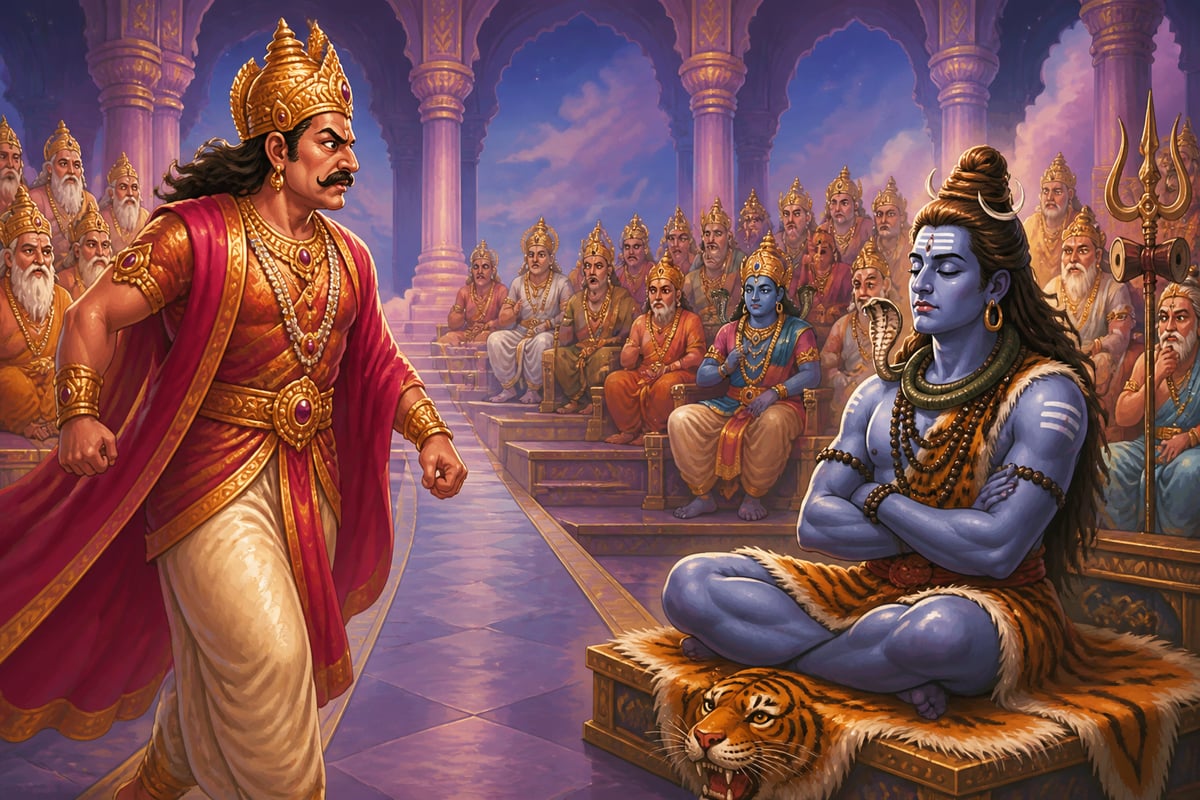
The trouble had begun at an earlier assembly of sages and celestials presided over by Lord Brahma himself. When Daksha had entered that gathering, every being had risen in respect - except one. Lord Shiva, absorbed in meditation on the Supreme, had remained seated. Some say he did not notice Daksha's entrance. Others say that Shiva, being the supreme yogi, transcended such social formalities. Regardless, Daksha took it as a deliberate insult.
"This Shiva lives in cremation grounds, smears ash on his body, and keeps company with ghosts and goblins," Daksha had thought bitterly. "And now he insults me before the entire assembly!"
From that moment, a poison had entered Daksha's heart - the poison of wounded pride seeking revenge.
The Great Yajna at Kankhal
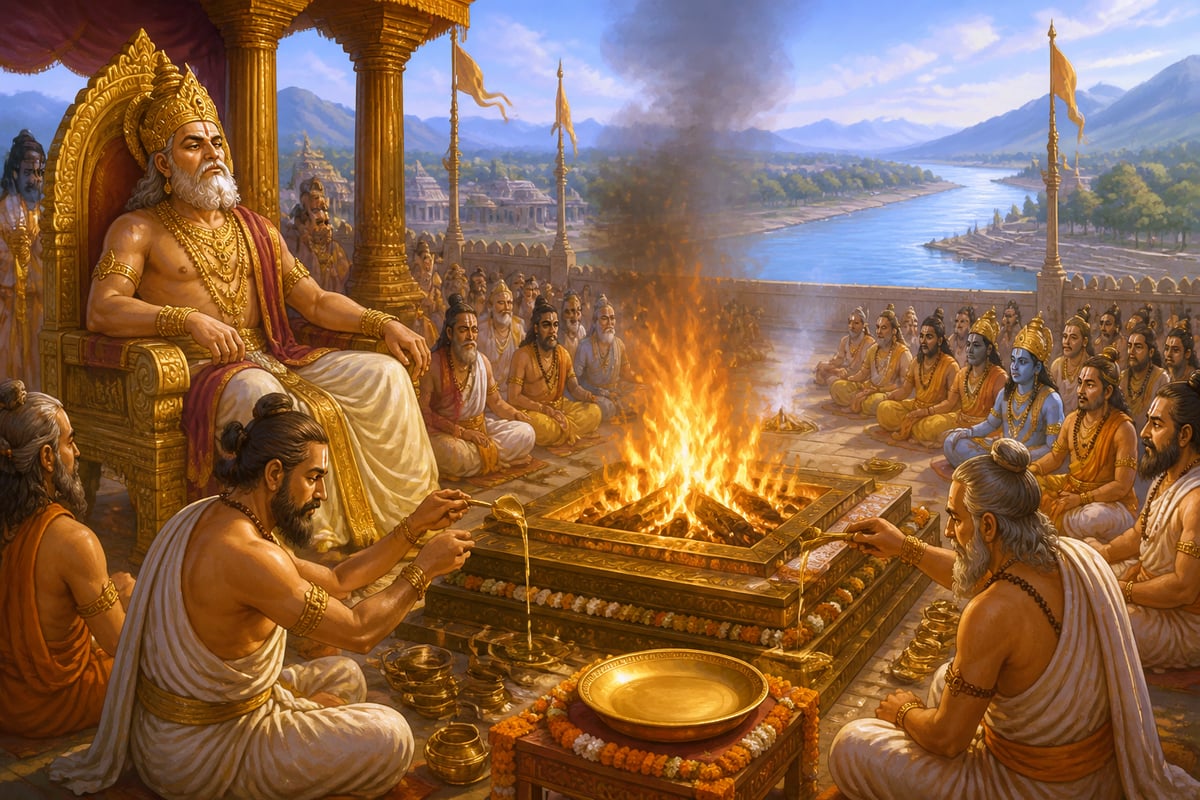
Years passed, but Daksha's resentment only fermented. When he decided to perform a great yajna (fire sacrifice) at Kankhal near the Ganges, he saw his opportunity. This would be no ordinary sacrifice. Daksha invited:
- All the demigods (devas)
- All the great sages (rishis)
- All the celestial beings (gandharvas, kinnaras)
- All the Prajapatis and their families
But deliberately, conspicuously, he did not invite Lord Shiva and Sati, his own daughter who was Shiva's devoted wife.
The omission was calculated cruelty. In the ancient world, exclusion from a major sacrifice was a public humiliation. It declared to all assembled that the uninvited person was unworthy of participation in the cosmic order. Daksha was using his religious ceremony as a weapon against his son-in-law.
Sati's Dilemma
From her home on Mount Kailash, Sati watched the celestial chariots streaming across the sky toward her father's sacrifice. The apsaras and gandharvas flew by in their divine vehicles, dressed in their finest ornaments. The excitement of a great gathering was palpable in the heavens.
Sati's heart stirred with longing. Despite the strained relations between her father and husband, she still loved Daksha. The pull of family, of childhood memories, of belonging - these tugged at her.
She approached Lord Shiva with her request:
"My lord, my father is performing a great yajna. All the gods and sages are going. Even though we were not invited, I wish to see my family. A daughter may go to her father's house uninvited - this is the custom."
Shiva, who understood the situation perfectly, tried to dissuade her. With compassionate wisdom, he explained:
"Beloved Sati, your father harbors deep resentment toward me. If you go uninvited, he will insult me before the assembly, and you will not be able to bear it. An insult to one's husband, heard in public, is like a sword through the heart."
But Sati was determined. Perhaps she hoped to reconcile her father and husband. Perhaps the pull of family was simply too strong. She insisted on going, and Shiva, respecting her will, sent her with an escort of his ganas.
The Public Humiliation
When Sati arrived at Kankhal, her sisters and mother received her with cold formality. The warmth she remembered from childhood was absent. Her father Daksha did not even acknowledge her presence.
Looking around the sacrificial arena, Sati noticed something that made her blood freeze. There were designated seats and offerings for every major deity - Brahma, Vishnu, Indra, and all the others. But there was no seat, no offering, no place whatsoever for Lord Shiva.
This was not a mere oversight. This was calculated exclusion of her husband from the cosmic order itself.
Then Daksha began his public tirade. Before all the assembled demigods and sages, he poured out his contempt:
"Yes, my foolish daughter has come, following that ash-smeared dweller of cremation grounds. Shiva is inauspicious (ashiva). He wanders naked among ghosts. He has no lineage, no qualification. I was tricked into giving my daughter to such a being. He is not fit to participate in any sacred ceremony!"
The words struck Sati like physical blows. Each insult to Shiva was a wound to her own heart. She looked around - at the sages who lowered their eyes, at the demigods who shifted uncomfortably, at her sisters who turned away. No one spoke in defense of her husband.
Sati's Response
Sati's response revealed the depth of her devotion and the fire of her spirit. She stood before the assembly and answered her father:
"Father, you may criticize Shiva's external appearance, but do you understand who he truly is? The greatest sages seek him. Lord Vishnu Himself considers Shiva His dearest devotee. The Vedas sing his glories. Brahma meditates on him.
You see ash and matted locks and call them inauspicious. But that ash is the remnant of burnt attachments. Those matted locks are the rivers of wisdom flowing from divine consciousness. What you call cremation grounds are the truth of mortality that all beings must face.
But you will not understand this, for your heart is poisoned by pride."
Then Sati made a devastating declaration:
"This body that came from you has become intolerable to me. I cannot bear to carry this connection to one who has blasphemed my lord. I will not keep this body that came from such a father."
The Sacred Fire
What happened next shook the three worlds. Sati sat down in yogic posture, right there in the sacrificial arena. She turned her gaze inward, focusing on the fire of yoga within her. As the horrified assembly watched, flames began to emanate from her body - not external fire, but the internal fire of her yogic power.
She meditated on Lord Shiva at her heart. She remembered their divine union, his infinite compassion, his cosmic dance. She offered this body - this body tainted by connection to her blasphemous father - as her final sacrifice to her lord.
The flames consumed her physical form completely. Where the beautiful goddess Sati had sat, only sacred ash remained.

The assembly erupted in chaos. Some wept, some screamed, some tried to flee. Shiva's ganas, who had accompanied Sati, drew their weapons, ready to destroy everyone present. Only the intervention of Sage Bhrigu, who created defensive warriors through his mantric power, prevented immediate carnage.
The Cosmic Implications
But the reckoning was only postponed. Sati had not merely ended her life - she had created a karmic debt that the universe itself would collect. Her sacrifice was not suicide born of despair; it was a profound statement about the relationship between devotion and honor.
In choosing to leave her body rather than accept it from one who had insulted her husband, Sati established an ideal that would echo through ages. This ideal, tragically misunderstood in later centuries, was not about family honor but about the primacy of spiritual devotion over biological connection.
The news traveled instantly to Kailash. What would Lord Shiva do? He who was so composed, so absorbed in meditation, so detached from worldly affairs - how would he respond to the death of his beloved?
The three worlds held their breath.
The Teaching Within the Tragedy
Before we witness Shiva's response in the next lesson, we must understand what this story teaches. It is not merely a tale of family conflict and tragic death. It operates on multiple levels:
On the personal level, it shows how pride destroys families. Daksha's inability to forgive a perceived slight led to the death of his own daughter and ultimately his own destruction.
On the devotional level, it demonstrates that the bond between devotee and divine transcends all other relationships. Sati chose her devotion to Shiva over her biological connection to Daksha.
On the cosmic level, it illustrates that dharma cannot be violated without consequence. Daksha used a sacred yajna for personal revenge - a profound corruption of the sacrificial tradition. The universe would restore balance.
This is not just ancient mythology. The patterns repeat in our lives. How often do we use righteous activities as weapons against those we resent? How often does wounded pride blind us to the destruction we cause? And how often must something precious be lost before we recognize our folly?
Living traditions
The story of Sati and Daksha continues to inspire devotion to the Divine Mother across India. The Shakti Peethas remain active pilgrimage centers. The narrative has also sparked important discussions about the later practice of 'sati' and its deviation from the original story's meaning.
- Shakti Peetha Pilgrimage: Devotees undertake pilgrimages to the 51 Shakti Peethas, sacred sites where Sati's body parts fell. Completing all 51 is considered highly auspicious.
- Daksha Mahadev Temple: The ancient temple marking the site of Daksha's yajna. The main deity is Shiva, commemorating his destruction and later restoration of the sacrifice. One of the most sacred sites in Haridwar.
- Kamakhya Temple: One of the most important Shakti Peethas, where Sati's yoni (womb) is said to have fallen. Famous for the annual Ambubachi Mela when the goddess is believed to menstruate.
Reflection
- Daksha couldn't forgive Shiva for not standing when he entered a room. What small slights are you holding onto that may be poisoning your relationships or spiritual practice?
- Sati chose her devotion to Shiva over her connection to her biological father. Have you ever faced a situation where spiritual truth conflicted with family expectations? How did you navigate it?
- Daksha performed elaborate religious rituals while harboring hatred in his heart. In what ways might your own spiritual practices be compromised by impure motivations like competition, pride, or seeking recognition?