Vrindavan: Childhood Among Cowherds

Playing with the gopas

Krishna and Balarama move to Vrindavan and enjoy childhood among the cowherd boys. They play in forests and pastures, tending calves and sharing lunch. These seemingly ordinary pastimes are filled with transcendental significance, attracting even the greatest yogis' meditation.
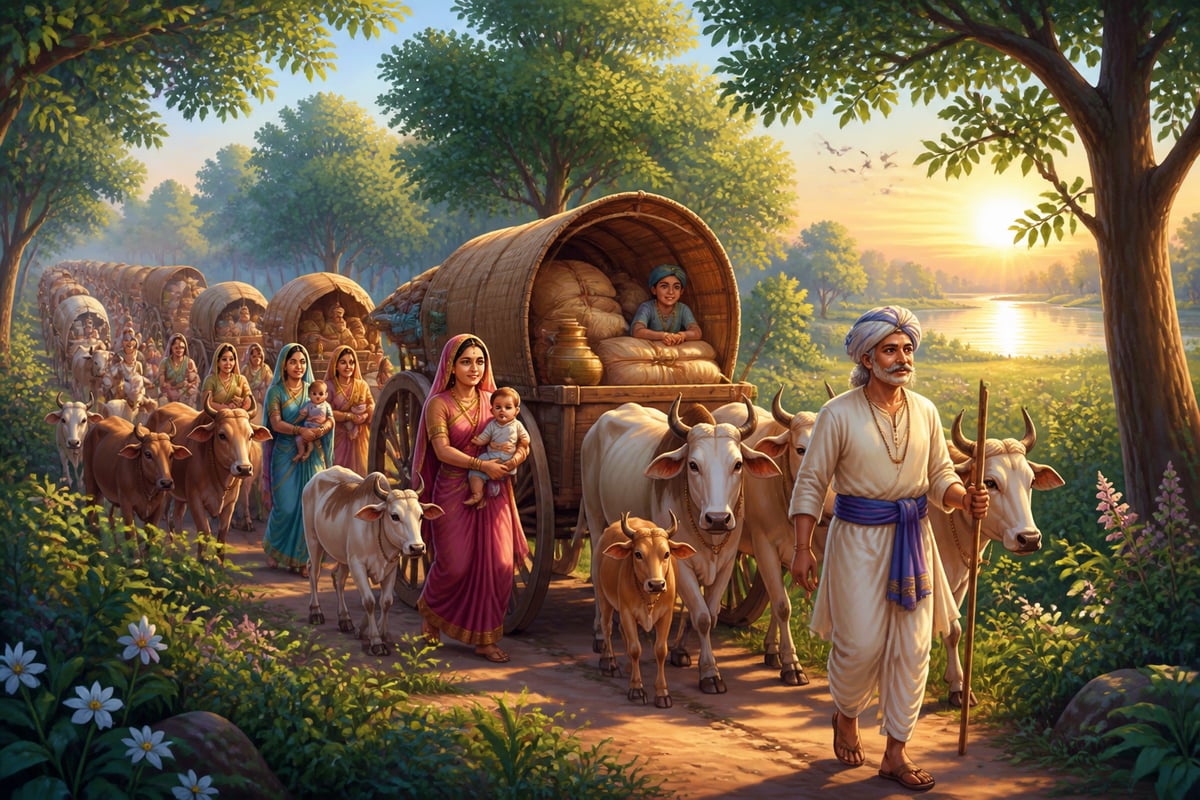
Cowherd carts roll into Vrindavan at dawn

The Move to Vrindavan

After the terrifying events in Gokul - the falling of the twin arjuna trees, the endless stream of demon attacks - the village elders gathered in council. Nanda Maharaja expressed what many felt: too many strange things were happening in this place. Perhaps a new location would bring peace.

An elder named Upananda spoke:

"This village has become inauspicious. First the witch Putana, then the whirlwind demon, now trees falling of their own accord. Our children are not safe here. I know of a place called Vrindavan - rich in pastures, blessed by forests of tulsi, protected by Govardhan Hill. Let us relocate our families and our herds."

The assembly agreed unanimously. And so the great migration began - carts loaded with household goods, women and children riding along, the men driving the vast herds of cattle. The dust they raised could be seen for miles.

They did not know they were walking into the landscape that would become the most sacred geography in all of Vaishnavism - Vraja, the holy land of Krishna's pastimes.

The Forest of Tulsi

Vrindavan derives its name from vrinda - tulsi, the sacred basil - and vana - forest. The entire region was covered with groves of this holy plant, whose fragrance filled the air. Rivers flowed pure and clear. Hills provided shelter and beauty. The grass grew thick and green for the cattle.

The cowherds established their new settlement. Each family built homes of wood and thatch. Cowsheds were arranged. Milk, yogurt, and butter flowed in abundance. The atmosphere was one of pastoral simplicity and contentment.

And through this idyllic setting, two brothers would now play their divine games - Krishna and Balarama, the dark and the fair, the embodiment of all divine energies in the form of cowherd boys.

The Life of a Cowherd

Krishna's daily routine emerged naturally:

Time Activity
Dawn Awakened by Yashoda, bathed, dressed with tilak and ornaments
Morning Breakfast of butter and rice, gathering with cowherd friends
Day Taking calves to pastures, playing games, eating lunch in forest clearings
Evening Returning with cows at sunset, greeted by anxious mothers
Night Dinner, stories, sleep in Yashoda's arms

This schedule - so ordinary for any village boy - became the template for spiritual meditation. Great yogis who had spent lifetimes in austere penance could not achieve what these simple cowherd boys enjoyed naturally: the constant association of the Supreme Lord.

The Cowherd Friends

Krishna's companions were the gopas - sons of other cowherd families. Chief among them were:

Together they would venture into the forests of Vrindavan:

"Their lunch bags swinging from their shoulders, their staffs and flutes in hand, the cowherd boys entered the forest with Krishna, their forms adding beauty to the already beautiful landscape."

Games in the Forest

The boys played countless games - some familiar, some unique to their transcendental situation:

Hide and Seek: Krishna would hide, and the boys would search through groves and caves. Sometimes He would become invisible, appearing only when their calls became desperate with love.

Imitating Animals: The boys would imitate peacocks dancing, frogs croaking, deer prancing. Krishna's imitations were so perfect that the actual animals would be confused and approach Him.

Wrestling: Balarama excelled at this, but Krishna was no less skilled. The boys would divide into teams, and the matches would go on until exhaustion.

Stealing Butter: Even in the forest, Krishna's butter-thieving ways continued. When the boys opened their lunch bags, they often found their butter mysteriously missing - and Krishna's mouth mysteriously full.

The Calf Tending

Younger boys were assigned to tend calves rather than full-grown cows. This was Krishna's first duty as a cowherd - and He performed it with supernatural skill.

Each calf had a name, and Krishna knew them all:

The calves would respond only to His call. They would follow Him anywhere, refusing to graze if He was out of sight. When He played His flute, they would stop eating and stand transfixed, milk dripping forgotten from their mothers' udders.

Lunch in the Forest

The midday meal was a highlight of each forest excursion. The boys would gather in a circular clearing, each opening his lunch bag prepared by his mother. Yashoda always packed Krishna's lunch with extra care - special rice, fresh butter, ripe fruits.

But Krishna had other plans. He would steal from everyone's lunch, claiming it tasted better. When caught, He would make such innocent excuses that the boys couldn't help laughing:

"My mother's butter is too sweet. Your mother's butter is just right. I'm doing you a favor by eating it!"

The Bhagavatam notes that Brahma and Shiva yearn for the remnants of Krishna's meal - yet these simple boys shared lunch with Him daily, feeding Him from their own hands.

Cowherd boys seated in a forest circle sharing their midday meal with small Krishna at the centre.

Krishna hurls Vatsasura the calf-demon into a kapittha tree

Demons Continue

Even in this pastoral paradise, Kamsa's demons continued their attacks. In the forests of Vrindavan, Krishna defeated:

Each demon's death brought momentary fear to the cowherd boys, then celebration, then amnesia - they would forget and return to their games, protected by yoga-maya from fully comprehending the miraculous nature of their friend.

The Nature Responds

All of Vrindavan responded to Krishna's presence:

Nature itself became a devotee. The dust of Vrindavan - touched by Krishna's lotus feet - became more sacred than all pilgrimage sites. The air He breathed carried liberation to all who inhaled it.

The Theological Significance

Why would the Supreme Lord, creator of infinite universes, choose to spend His childhood as a simple cowherd? The Bhagavatam offers multiple perspectives:

On Divine Play: The Lord's essential nature is ananda - bliss. His play is not purposeless but is the spontaneous expression of His joyful nature. He creates universes as sport; He plays with cowherd boys as sport. Both are equally divine.

On Accessibility: By becoming a cowherd, Krishna made Himself accessible. One cannot easily approach the cosmic Vishnu. But a friend who steals your butter, who plays hide-and-seek, who shares your lunch - such a friend is intimately approachable.

On the Nature of Devotion: The cowherd boys' devotion was unconscious. They didn't worship Krishna; they played with Him. They didn't offer formal prayers; they shared jokes. This natural, spontaneous relationship is considered higher than ritual devotion.

On Vrindavan as Spiritual Ideal: Vrindavan represents the soul's true home - not a geographical location but a state of consciousness where God is present as friend, child, beloved. All spiritual practice aims at this intimacy.

The Sacred Land

Every location in Vrindavan became sanctified:

Five thousand temples crowd into the small town of Vrindavan today. Millions visit annually. They come not for a historical site but to experience the eternal pastimes that, according to tradition, continue invisibly even now.

For in the spiritual Vrindavan - which the earthly town reflects - Krishna is still playing with His friends, still stealing butter, still calling the calves by name, still filling the forest with the sound of His flute.

And the soul that truly enters this consciousness joins those eternal pastimes, becoming a cowherd friend in the forest of tulsi, in the land of divine play.

Living traditions

Vrindavan has become a global pilgrimage destination, hosting visitors from over 100 countries annually. ISKCON's development has introduced Krishna consciousness worldwide, with Vrindavan as its spiritual heart. Contemporary artists, musicians, and filmmakers continue to draw inspiration from Krishna's childhood pastimes. The region faces environmental challenges from pilgrimage pressure, leading to conservation initiatives that blend ecological awareness with devotional motivation.

Reflection

More in Skanda 10 Part 1: Krishna in Vrindavan

All lessons in Skanda 10 Part 1: Krishna in Vrindavan ยท Srimad Bhagavatham course