Govardhan: Lifting the Mountain
Defeating Indra's wrath
Krishna convinces the Vrajavasis to worship Govardhan Hill instead of Indra. The enraged Indra sends devastating rains. Krishna lifts the entire mountain on His little finger, sheltering all of Vrindavan for seven days. Humbled, Indra descends to beg forgiveness and coronates Krishna as Govinda.
The Annual Indra-Yajna
As the monsoon season ended, the residents of Vrindavan began preparations for their annual Indra-yajna, the traditional worship of Indra, king of the celestials and lord of rain. This ceremony, performed across the agricultural communities of ancient India, expressed gratitude for the rains that made their cattle-based livelihood possible.
Nanda Maharaja supervised the elaborate preparations:
- Ingredients for the fire sacrifice gathered
- Offerings of ghee, grains, and sweets prepared
- The entire village mobilized for the celebration
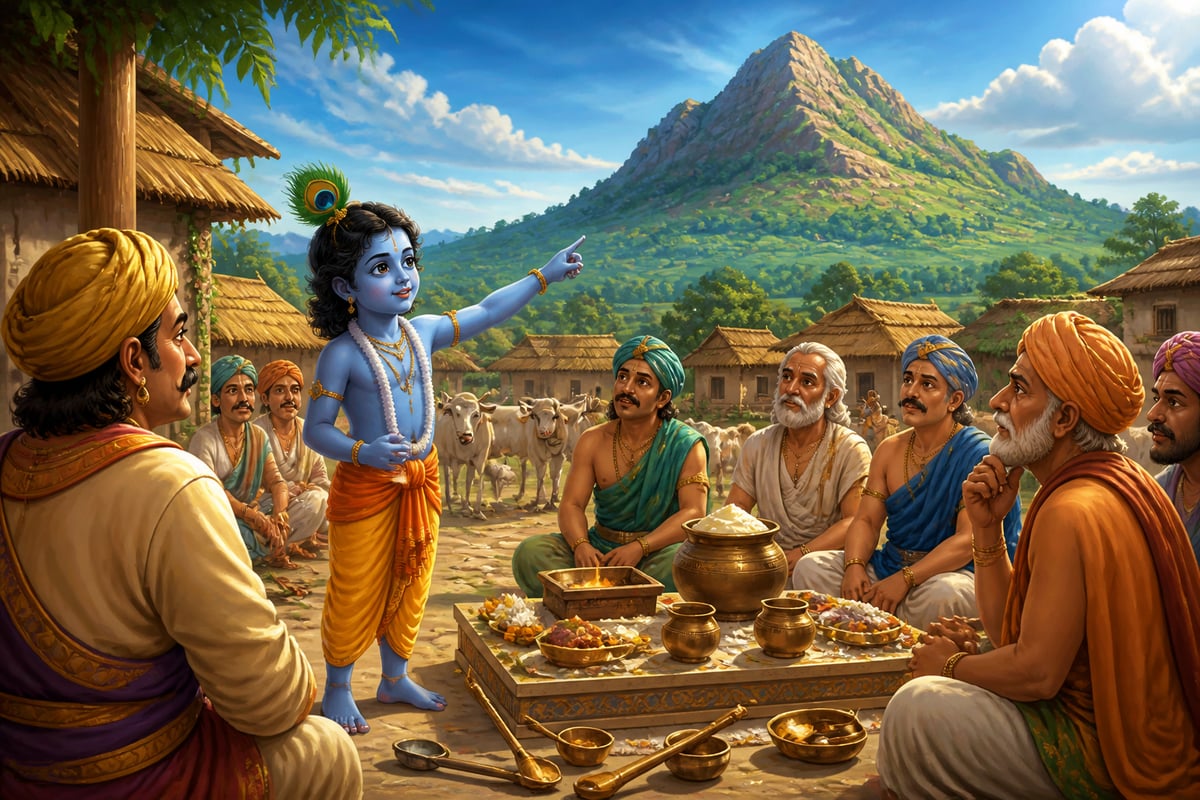
Watching these preparations, young Krishna, now around seven years old, approached His father with a question that would change everything.
Krishna's Challenge
"Father, who is this Indra? What has he done for us that we should worship him?"
Krishna's questions were pointed:
Does Indra personally send rain? Rain falls according to natural cycles driven by the sun's evaporation of water. Does Indra truly control this?
What has Indra done specifically for Vrindavan? The rains fall everywhere, on those who worship and those who don't.
What about our immediate benefactors? The cows give us milk, the hill gives us grass, the forests give us fruits. Should we not honor what directly sustains us?
Krishna proposed an alternative: instead of the distant Indra, worship Govardhan Hill, the geographical reality that made their pastoral life possible.
The Theological Logic
Krishna's argument was not atheistic; it was about proper placement of devotion:
| Traditional View | Krishna's Proposal |
|---|---|
| Worship Indra (distant deity) | Worship Govardhan (immediate sustainer) |
| Offerings sent to heaven | Offerings benefit local ecosystem |
| Relationship through fear | Relationship through gratitude |
| Abstract theology | Practical dharma |
The cowherd community, including Nanda Maharaja, found Krishna's logic compelling. They decided to redirect their yajna to Govardhan Hill.
The Govardhan Puja
The redirected worship was spectacular. The Vrajavasis prepared vast quantities of food, rice, vegetables, milk preparations, sweets of every variety. They circumambulated Govardhan Hill with their cattle, decorating the hill with flowers and incense.
Krishna, to demonstrate that Govardhan could indeed accept worship, expanded Himself and appeared as the spirit of the mountain, a massive form emerging from the hill itself, consuming the offerings and blessing the devotees.
"I am Govardhan," the form declared, accepting the worship while Krishna simultaneously stood among the villagers as one of them.
The Vrajavasis were delighted. Their faith in Krishna's wisdom was confirmed. They returned home satisfied, unaware that celestial observation had already set consequences in motion.
Indra's Wrath
In his celestial court, Indra received reports of the cancelled yajna. His reaction revealed the shadow side of celestial rulership:
- Pride wounded: How dare mortal cowherds redirect worship meant for him?
- Authority challenged: If this example spread, his worship everywhere might diminish
- Rage ignited: These simple villagers must be punished as a warning to others
Indra summoned the Samvartaka clouds, the devastating storm clouds reserved for universal dissolution. These were not ordinary rain clouds but weapons of cosmic destruction.
The Assault
The clouds gathered over Vrindavan:
- Rain fell not in drops but in solid columns
- Lightning struck continuously
- Winds reached hurricane force
- Temperature plummeted
- Rivers overflowed within hours
The villagers, their cattle, their homes, everything was threatened with obliteration. Women clutched their children. Men tried desperately to shelter their livestock. The elderly prepared to die.
"This is no natural storm," they realized. "This is divine punishment for our worship of Govardhan instead of Indra."
In their terror, they turned to Krishna.
The Lifting
Krishna's response was immediate and absolute.
With His left hand, some accounts say His little finger, Krishna lifted the entire Govardhan Hill. The mountain rose from its foundations, suspended above the ground like a cosmic umbrella.
The Technical Marvel
| Aspect | Description |
|---|---|
| Weight | Estimated billions of tons |
| Support | One child's hand |
| Duration | Seven days and nights |
| Coverage | All of Vrindavan's people and cattle |
"Come, all of you!" Krishna called. "Bring your families, your cattle, all that you hold dear. Take shelter beneath this hill."

Life Under the Mountain
For seven days, all of Vrindavan lived beneath Govardhan's protective canopy:
- The cows stood calm, as if at pasture
- The children played, their fear transformed to wonder
- The adults maintained their gaze on Krishna, their faith becoming their sustenance
- Krishna stood unchanged, no strain visible, no effort apparent
Above them, Indra's devastating rains struck the hill harmlessly. The lightning, the wind, the cold, all were neutralized by the mountain shield held by a child.
The celestial assault that should have annihilated Vrindavan became merely background noise to those sheltered beneath Krishna's protection.
Indra's Defeat and Surrender
After seven days, Indra understood. His mightiest weapons had accomplished nothing. The being he had dismissed as an upstart village boy was clearly something far greater.
Brahma, the creator, approached Indra and explained the truth: the child against whom he had waged war was none other than the Supreme Lord, the source from which Indra himself derived his limited powers.
The Descent
Humbled and terrified, Indra descended from heaven. He came not with his army but with:
- The celestial cow Surabhi
- The elephant Airavata
- A humble heart
Prostrating before the seven-year-old who stood casually holding a mountain, Indra offered prayers of surrender:
"My Lord, intoxicated by my position, I committed offense. I, who owe everything to You, attacked Your devotees. Please forgive this servant who has forgotten his true place."
The Coronation
Surabhi and Airavata bathed Krishna in celestial milk and Ganges water, formally coronating Him with the title Govinda, meaning "giver of pleasure to cows" or "one who won Indra through cows."

This title became one of Krishna's primary names, commemorating forever the moment when celestial pride bowed before pastoral simplicity.
Govardhan Returns
With Indra's submission, the storms ceased. Krishna gently replaced Govardhan Hill in its original position. The mountain that had served as shelter returned to its role as pastureland.
The Vrajavasis emerged to find their world transformed yet intact:
- Their homes required repair, but they lived
- Their cattle were healthy
- Their community was unified by shared miracle
- Their faith was no longer belief but certainty
Theological Significance
The Proper Object of Worship
This pastime addresses a perennial question: whom should one worship? Krishna's answer is nuanced:
- The Supreme is the ultimate object, Krishna, not Indra, is the true Lord
- Immediate benefactors deserve gratitude, The hill, the cows, the rivers merit recognition
- Mere tradition doesn't justify worship, Custom must be examined for validity
- The Supreme supports what supports you, Govardhan serves as Krishna's representative
Divine Protection
The lifting of Govardhan demonstrates a core Vaishnava teaching: the Lord protects those who take shelter of Him. Not symbolically, not metaphorically, but literally, even from cosmic forces of destruction.
The Correction of Celestials
Indra represents the danger of positional pride. His legitimate authority became distorted by ego into tyranny. The pastime corrects this:
- Power doesn't equal divinity, Having authority doesn't make one supreme
- Position is given, not owned, Indra's role is service, not sovereignty
- Pride invites correction, The universe has mechanisms to humble the arrogant
Govardhan Today
Govardhan Hill remains a living pilgrimage site, one of the most sacred locations in the entire Vaishnava world.
The Parikrama
Devotees circumambulate the hill, a 21-kilometer path called the Govardhan Parikrama. Many complete this circuit:
- Barefoot as a sign of reverence
- Offering prostrations at every step (this takes weeks)
- On sacred occasions like Govardhan Puja
Environmental Concerns
Modern Govardhan faces challenges: commercial development, stone quarrying, groundwater depletion. Devotees and environmentalists have united in protection efforts, seeing the hill as both sacred geography and ecological treasure.
Practical Wisdom
This episode offers enduring guidance:
- Question received tradition, Not all inherited practices serve their original purpose
- Honor immediate relationships, Those who directly support you deserve recognition
- True protection transcends threat, Divine shelter makes worldly danger irrelevant
- Power without humility corrupts, Position must be held with awareness of its source
- The simple can shelter from the cosmic, A village boy lifted what celestials couldn't move
The image of Krishna holding the mountain, effortless, smiling, protective, remains one of the most beloved in all Hindu iconography: the child-god proving that love, not lightning, holds ultimate power.
Living traditions
- Govardhan Parikrama: Circumambulating the sacred hill is considered one of the highest forms of devotion. Pilgrims walk the 21-kilometer path barefoot, often fasting, singing devotional songs. The most dedicated perform dandavat parikrama, prostrating their full body length at every step.
- Annakut (Mountain of Food) Offering: On Govardhan Puja day, temples create massive displays of food arranged as mountains, recreating the original offering to Govardhan. After the offering, this prasadam is distributed to devotees and the community.
Reflection
- Krishna questioned the tradition of Indra worship not to destroy religion but to redirect it to something more immediate and meaningful. Are there traditions in your life that might benefit from similar examination?
- Indra's devastating attack on innocent villagers arose from wounded pride over cancelled worship. How do you typically respond when you feel your authority or importance has been diminished?
- The Vrajavasis survived Indra's cosmic assault simply by standing under Krishna's protection. What does it mean to 'take shelter' in the Divine, and how might this translate to facing overwhelming challenges in your own life?