Damodara: Bound by Mother's Love

Krishna tied by Yashoda's cord

When Krishna steals butter, Yashoda tries to tie Him up. Her rope is always two inches too short - until Krishna allows Himself to be bound. The Supreme Lord, whom the universe cannot contain, submits to a mother's love. He then liberates the cursed Yamala-Arjuna trees.

The Butter Thief

Krishna had become notorious in Gokul. The toddler who could barely walk had developed a remarkable talent for stealing butter. No pot was too high, no storage room too secure. Where there was butter, Krishna would find it.

The gopis came to Yashoda with complaints:

"Your son breaks into our homes when we're away. He steals butter from pots we've hung from the ceiling. If the pots are too high, he piles up wooden mortars and grinding stones to climb. When even that fails, he makes holes in the pots to let the butter drip out. And if there's no butter? He pinches our children and runs away!"

Yashoda listened, half-apologetic, half-amused. How could her beautiful boy be such a thief? He seemed so innocent when she looked at Him, His dark face smeared with butter, His large eyes full of mischief.

But this particular morning, Krishna had gone too far.

The Churning Interrupted

Yashoda was churning butter herself, singing songs about Krishna's divine exploits - songs the villagers had composed after each miraculous escape from demons. Her arms moved rhythmically, the churning rod creating a gentle splashing.

Krishna woke up hungry. Finding His mother busy, He approached the churning pot and grabbed the churning rod, stopping her work. He wanted to be fed. His eyes were tearful, His lips pouting - the eternal Lord of the universe, demanding His mother's attention like any human child.

Yashoda's heart melted. She set aside her work and sat down to nurse Him. Mother and child, an image of perfect peace.

But then she smelled something burning. The milk she had placed on the fire was boiling over. Gently placing Krishna aside, she rushed to save the milk.
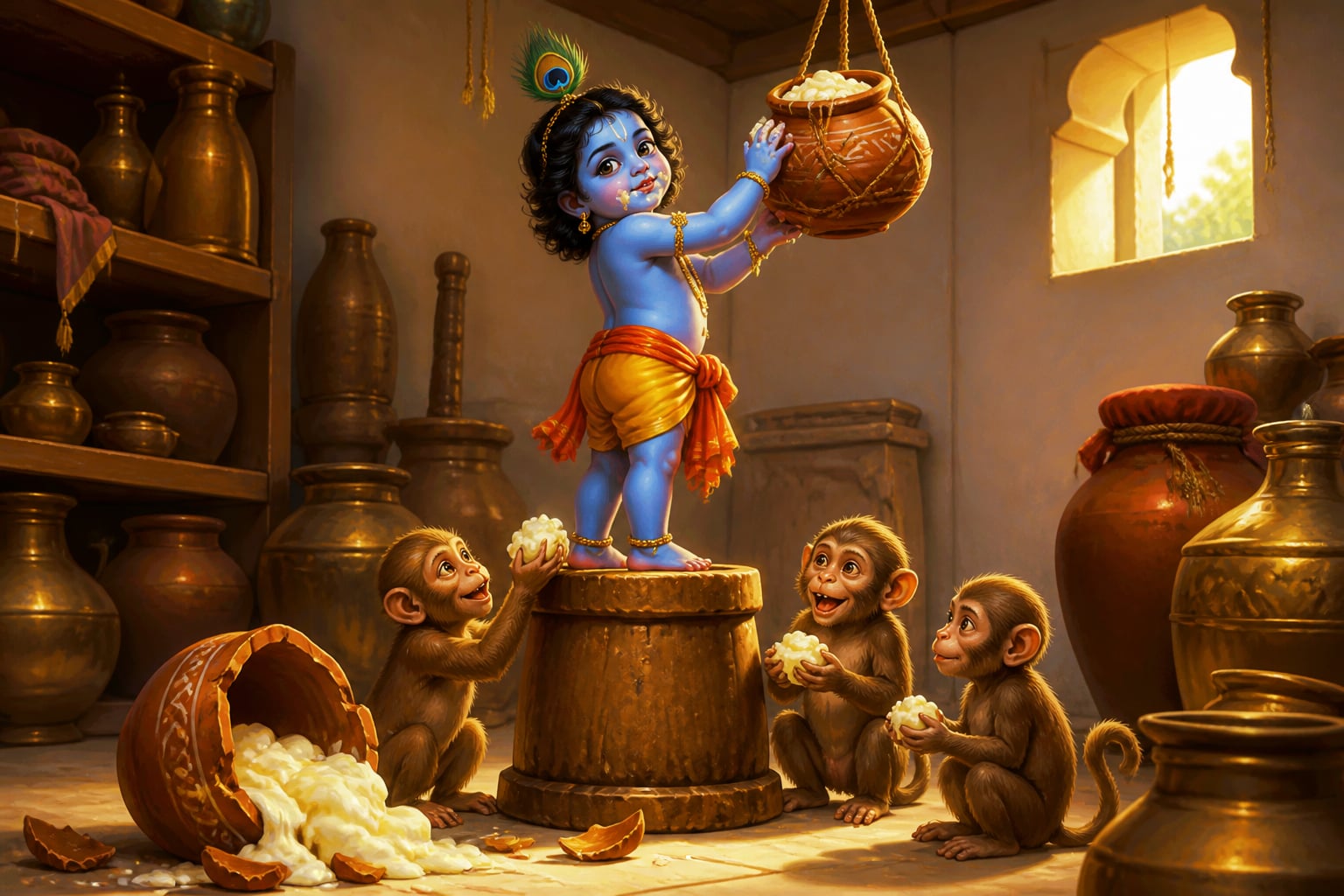
Krishna steals butter from a hanging pot with monkey friends

The Divine Tantrum

Krishna was furious. His mother had left Him mid-feed to save some milk? His eyes turned red with indignation. His lips quivered. In His small hand, He picked up a stone and struck the churning pot, breaking it. Butter and buttermilk spilled across the floor.

But He wasn't done. Krishna climbed up to where Yashoda kept the fresh butter in hanging pots. He broke open the pots and began feeding butter to the monkeys who gathered eagerly.

When Yashoda returned, she found her churning pot broken, butter stolen, and her son sitting happily among monkeys, distributing her morning's work.

She picked up a stick. Today, she would discipline this child.

The Chase

Krishna saw the stick and ran. The Supreme Lord, before whom the greatest demons trembled, fled from His mother's discipline. His ankle bells jingling, His peacock feather bouncing, He darted through the house with Yashoda in pursuit.

The Bhagavatam pauses here to marvel:

What Krishna Is What He Became
The Lord whom yogis seek through millennia of meditation A toddler running from His mother
The Supreme Being whom the Vedas cannot fully describe A child with tearful eyes, terrified of a stick
The infinite one whom all universes cannot contain Small enough to be chased around a courtyard

Yashoda's hair came loose as she ran. Flowers fell from her braid. Finally, she caught Him. And she saw something that moved her - His eyes were full of genuine fear. Tears streaked His butter-smeared face.

She threw away the stick. She would not beat Him. But she would tie Him up.

Two Fingers Too Short

Yashoda found a rope and tried to bind Krishna to a large wooden mortar - a ulukhala used for grinding. She wrapped the rope around His small waist... but it was too short. By two fingers' width, it couldn't reach.

She found another rope and joined it to the first. Still two fingers short.

The gopis gathered, watching with amusement as Yashoda collected every rope in the house. She tied rope after rope together - a length that could have bound an elephant. She wrapped it around her son's waist.

Still two fingers short.

The Mystery of Two Fingers

Why always two fingers?

The Bhagavatam reveals: One finger represents the devotee's effort; one finger represents the Lord's grace. Neither alone is sufficient. The devotee's sincere effort must meet the Lord's willing consent.

Yashoda could gather all the ropes in the universe, but without Krishna's agreement, she could never bind Him. He who is infinite cannot be contained by finite means. But love - devotee's love meeting God's grace - can accomplish what all the power in creation cannot.

Finally, seeing His mother exhausted, perspiring, her hair disheveled, her determination unbroken, Krishna allowed Himself to be bound.

The rope that moments ago was too short now wrapped perfectly around His waist. The Supreme Lord became Damodara - "bound by a rope around the belly."

Yashoda kneeling in her sunlit courtyard, winding a knotted cord around little Krishna's waist.

The Lord who cannot be bound by time, space, or causation became bound by His devotee's love. He whom the greatest mystics cannot reach through meditation was tied to a grinding mortar by His mother's cord. The infinite became finite, the unlimited became limited - not by force, but by His own choice.

Twin arjuna trees crash as Nalakuvara and Manigriva emerge

The Liberation of Nalakuvara and Manigriva

Yashoda left Krishna tied to the mortar while she resumed her household duties. The toddler, now playing the role of a bound captive, began crawling - dragging the heavy mortar behind Him.

In the courtyard stood two large arjuna trees, growing so close together that they formed a natural gateway. Krishna crawled between them, and the mortar lodged sideways, stuck between the tree trunks.

With one mighty pull, the baby uprooted both trees. They crashed to the ground with a sound that shook all of Gokul.

From the fallen trees emerged two radiant celestial beings - Nalakuvara and Manigriva, sons of Kubera, the treasurer of the gods.

The Story Behind the Trees

Long ago, these two demigods had been intoxicated by pride and liquor. They had disrobed and were sporting with celestial women in a sacred pond when Sage Narada passed by.

The women, ashamed, quickly covered themselves. But the two princes, drunk and arrogant, didn't even notice the great sage. Narada, moved by compassion rather than anger, pronounced a curse:

"Since you are so stupefied that you cannot recognize a sage standing before you, let you become trees - equally insensate. But through this curse, you will eventually receive the Lord's darshan and be liberated."

For ages, Nalakuvara and Manigriva had stood as twin arjuna trees, waiting. Now, through baby Krishna's playful pulling, their liberation had come.

The two celestials bowed before Krishna, recognizing Him as the Supreme Lord:

"You are Narayana, whom we failed to recognize in Narada. You are the goal of all sacrifice, all penance, all devotion. We were fools intoxicated by wealth and pleasure. Please accept our surrender."

Krishna blessed them, and they returned to their celestial abodes, finally free from their tree-forms.

The Villagers' Wonder

The cowherds came running at the sound of the crash. They found the massive trees uprooted, the baby Krishna sitting calmly between them, still tied to the mortar, unharmed.

Some children told them they had seen two celestial beings emerge from the trees. The elders dismissed this as imagination. But Nanda Maharaja grew thoughtful. Too many inexplicable things were happening around this child.

He untied Krishna and held Him close, marveling at the boy who seemed both utterly ordinary and mysteriously extraordinary.

The Depths of Damodara

This pastime of Damodara Lila is considered one of the most theologically profound in all of Bhagavatam. It reveals multiple truths simultaneously:

On Divine Accessibility: The Lord who cannot be reached through impersonal meditation or austere penance became accessible through a mother's frustrated love. Yashoda wasn't performing yoga or chanting mantras - she was trying to discipline a mischievous child. Yet she achieved what the greatest sages could not.

On The Nature of Bhakti: Love is more powerful than knowledge or renunciation. Yashoda didn't know she was binding the Supreme Lord - she was simply trying to control her naughty son. Her love was spontaneous, not calculated. And it was precisely this spontaneous, unconditional love that attracted the Lord's submission.

On Grace and Effort: The two-finger gap represents the eternal dance between human effort and divine grace. We cannot earn God's presence through effort alone - but He also does not appear without our sincere striving. The devotee tries with all their capacity; God responds by making Himself available.

On Divine Play: Krishna's tears were real, His fear was enacted, His binding was self-chosen. The Lord plays the role of the bound perfectly, giving His devotees the joy of caring for Him, protecting Him, disciplining Him. This is lila - divine play that fulfills the devotee's desire to love God intimately.

The Month of Damodara

The Kartik month (October-November) is known as Damodara month. Devotees sing the Damodarashtakam - eight verses describing this very pastime - every evening. They light small lamps and offer them to Krishna, remembering how He allowed Himself to be bound.

The image of baby Krishna tied to the mortar, tears on His cheeks, butter on His lips, has become one of the most beloved representations of the Divine in Vaishnavism - God made small, God made accessible, God made lovable.

He who contains all universes within His body was contained by a mother's rope. He who is feared by death itself feared His mother's stick. He who liberates all beings allowed two souls to be liberated by His playful fall.

This is Krishna - the Supreme Lord who delights in becoming the beloved child.

Living traditions

The Damodara lila has become the theological centerpiece for understanding bhakti's supremacy in Gaudiya Vaishnavism. ISKCON's Kartik programs introduce millions worldwide to this pastime annually. The image of baby Krishna tied to the mortar appears in countless paintings, sculptures, and devotional art. Contemporary spiritual teachers cite the 'two-finger' teaching to explain the relationship between grace and effort. The Damodarashtakam is one of the most-recorded devotional songs in the Krishna bhakti tradition, with versions in dozens of languages.

Reflection

More in Skanda 10 Part 1: Krishna in Vrindavan

All lessons in Skanda 10 Part 1: Krishna in Vrindavan ยท Srimad Bhagavatham course