Kaliya: Subduing the Serpent
Dancing on the serpent's heads
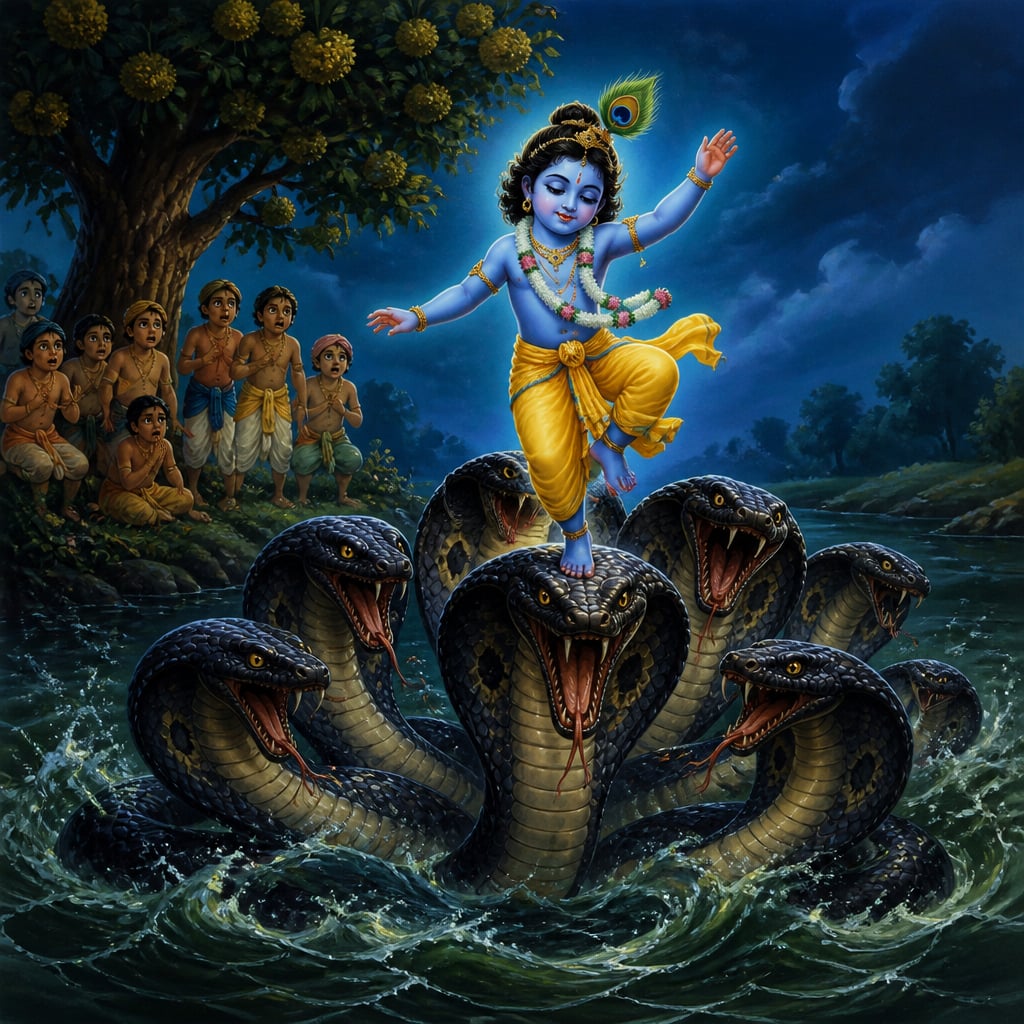
The poisonous serpent Kaliya pollutes the Yamuna. Krishna jumps into the river and, after an underwater battle, dances on Kaliya's many heads. The serpent's wives beg for mercy. Krishna spares Kaliya on condition he leave for the ocean, purifying the Yamuna forever.
The Poisoned Lake
Within the sacred Yamuna River lay a deep lake where the deadly serpent Kaliya had made his home. This was no ordinary snake, Kaliya was a massive naga with multiple hoods, and his venom was so potent that it polluted the entire lake.
"The water boiled with poison. Trees on the banks withered. Birds flying overhead dropped dead from the toxic fumes rising from the surface."
The once-pure waters of this stretch of Yamuna became a zone of death. No creature could drink from it, no fish could swim in it, no plant could grow near it. The residents of Vrindavan knew to avoid this cursed pool, warning their children about the dangers lurking beneath its bubbling surface.
Kaliya's History
Kaliya had not always lived in the Yamuna. Originally, he dwelt in the ocean at Ramanaka Island. However, he was driven from his home by Garuda, the divine eagle and eternal enemy of serpents.
| Detail | Information |
|---|---|
| Original Home | Ramanaka Island in the ocean |
| Why He Left | Fear of Garuda, the divine eagle |
| Why Yamuna? | Garuda had been cursed not to enter this lake |
| His Family | Multiple wives (naga-patnis) and offspring |
The lake in the Yamuna was the one place Garuda could not pursue him, a sage had once cursed Garuda that if he entered this particular water body, he would die. Kaliya, knowing this, took refuge there, turning the sanctuary into his fortress of poison.
The Catalyst
One summer day, Krishna and His cowherd friends wandered far while grazing their cattle. Overcome by thirst and heat, the boys and cows drank from the Yamuna, unknowingly from waters tainted by Kaliya's poison.
The effect was immediate and devastating. One by one, the cowherd boys and cows collapsed, life ebbing from their bodies. The toxic water worked swiftly.
Krishna, seeing His friends fallen, cast His merciful glance upon them, and they rose, revived, wondering what had happened. But Krishna knew that this threat to Vrindavan could not be tolerated. The serpent who dared poison His beloved river must be dealt with.
"What poisons the waters poisons the community. What threatens the sacred must be confronted, not avoided."
The Confrontation

The Dive
Krishna climbed a tall kadamba tree on the bank of the poisoned lake. As the horrified cowherd boys watched, He tightened His belt, slapped His arms in challenge, and dove headlong into the toxic waters.
The splash was tremendous. The impact sent waves of poisoned water crashing against the banks. From below, Kaliya felt the disturbance, someone had dared enter his domain.
The Battle Underwater
Kaliya, enraged at this intrusion, rose to confront the intruder. With his multiple hoods flared and fangs dripping venom, he coiled around Krishna's body, attempting to crush the life from this small boy who had invaded his home.
From the banks, the cowherd boys saw only the churning, poisoned water. Fearing the worst, they ran to Vrindavan, crying that Krishna had jumped into Kaliya's lake.
Vrindavan's Anguish
The news spread like wildfire. Nanda, Yashoda, Balarama, and all the residents rushed to the lake. Seeing no sign of Krishna, only the roiling poisoned waters, they were overcome with grief.
- Yashoda attempted to throw herself into the lake
- The gopis stood paralyzed with fear and love
- Nanda and the cowherd men prepared to enter the water themselves
- Balarama alone remained calm, knowing Krishna's true nature
Balarama restrained them with His glance, silently communicating that they should wait and witness rather than despair.
The Divine Dance
Seeing the distress of His devotees, especially His beloved mother, Krishna decided to end the underwater struggle. With a sudden expansion of His body, He broke free from Kaliya's coils.
Rising to the Surface
Krishna emerged from the water and leaped onto Kaliya's central hood. The serpent, with his massive body, rose from the lake trying to shake off this strange opponent. But Krishna began to dance.
"The Lord of all dance began His terrible yet beautiful performance on the serpent's heads, His lotus feet striking in rhythm with the cosmic pulse."
The Nata-Raja of the Yamuna
Krishna danced on each of Kaliya's multiple hoods. As the serpent raised one head, Krishna would leap to it. As Kaliya tried to strike with another, Krishna would stamp it down. The Lord's feet moved with the precision of a master dancer, each step crushing the serpent's pride and poison simultaneously.
| Aspect | Description |
|---|---|
| The Stage | Kaliya's multiple hoods spread on the water |
| The Dancer | Krishna, small in form but infinite in power |
| The Music | Celestial beings gathered to watch, providing divine accompaniment |
| The Audience | All of Vrindavan on the banks; gods from heaven above |
The celestial Gandharvas played instruments. The Siddhas and Charanas showered flowers. The devatas watched in wonder as a village boy subdued what an entire ocean could not contain.
Kaliya's Submission
Under the relentless pounding of Krishna's feet, Kaliya began to vomit blood and poison. His strength failed. His pride shattered. The multiple hoods that had terrorized the lake now drooped in defeat.
The great serpent, finally recognizing the Supreme Lord dancing upon him, began to surrender internally even as his body failed externally.

The Wives' Intercession
When Kaliya appeared near death, his wives, the naga-patnis, emerged from the waters. With folded hands and tearful eyes, they approached Krishna and offered prayers.
Their appeal was remarkable in its wisdom:
- They acknowledged Kaliya's fault rather than defending him
- They recognized Krishna's divinity despite His childlike form
- They accepted the punishment as deserved
- They asked only for mercy, not justice
"O Lord, this punishment is fitting. Our husband's sins deserve worse. But Your nature is compassion. A single touch of Your lotus feet is liberation, You have danced upon him repeatedly. Whatever karma he had is surely exhausted."
The naga-patnis' prayers are recorded in the Bhagavatam as models of how to approach the Divine, acknowledging wrong, recognizing divine authority, accepting consequences, and appealing to mercy rather than demanding rights.
The Resolution
Moved by the sincere prayers of the serpent's wives, Krishna ceased His dance and addressed Kaliya directly.
The Terms
Krishna commanded Kaliya to leave the Yamuna immediately and return to the ocean with his family. The serpent, having been marked by Krishna's footprints, would no longer be attacked by Garuda, the eagle would see those marks and recognize them as signs of divine grace.
The Purification
With Kaliya's departure, the Yamuna was instantly purified. The poison dissipated. The waters cleared. Life returned to the lake.
| Before | After |
|---|---|
| Boiling, toxic water | Cool, pure, life-giving water |
| Dead vegetation | Flourishing banks |
| Birds falling dead | Birds drinking freely |
| Zone of death | Place of pilgrimage |
Kaliya, humbled and transformed, departed for the ocean, his encounter with the Divine having changed him forever.
Theological Significance
Transformation Over Destruction
Notably, Krishna did not kill Kaliya. Despite the serpent's crimes, poisoning the sacred river, threatening Vrindavan, even attacking Krishna, the Lord chose reformation over elimination.
This demonstrates a key principle: the Divine seeks transformation of negativity, not merely its destruction. Kaliya left the Yamuna a changed being, bearing Krishna's footprints as a blessing.
The Feet of the Lord
In Vaishnava theology, the lotus feet of the Lord represent the ultimate refuge. That Krishna's feet danced on Kaliya's heads is loaded with meaning:
- What was punishment was simultaneously blessing
- The contact that crushed pride also granted liberation
- The serpent received through violence what sages seek through lifetimes of meditation
"Those feet that yogis contemplate through years of austerity danced freely on the serpent's hoods, such is the inconceivable mercy of the Lord."
Environmental Restoration
This pastime can be read as an early environmental narrative. The poisoning of waters by unrestrained malevolence, and their restoration through divine intervention, parallels modern concerns about water pollution and ecological restoration.
Kaliya Daha Today
The site of this pastime, known as Kaliya Daha (Kaliya's Lake) or Kaliya Ghat, remains a pilgrimage site in Vrindavan. The kadamba tree from which Krishna is said to have jumped is revered, with a new tree having grown in the traditional location.
Practical Wisdom
This narrative offers several timeless teachings:
- Courage to confront evil, Krishna did not avoid the poisoned lake; He entered it directly
- Action for community welfare, The threat to Vrindavan's water demanded response
- Mercy within justice, Punishment need not mean destruction; transformation is possible
- Sincere prayer reaches the Divine, The naga-patnis' humble appeal was heard
- Even enemies can be blessed, Kaliya received Krishna's footprints as grace
The image of the small boy dancing on the great serpent remains one of the most iconic in all of Hindu sacred art, representing the triumph of good over evil, the power of the Divine in humble form, and the possibility of transformation for even the most venomous among us.
Living traditions
- Kaliya-Daman Performances: Dramatic performances of Krishna dancing on Kaliya are central to Raslila traditions in Braj. Young performers enact the entire narrative, from the poisoned lake to the serpent's surrender, keeping this story alive in theatrical form.
- Serpent Worship on Nag Panchami: On the festival of Nag Panchami (serpent worship day), devotees remember that Krishna did not kill Kaliya but reformed him. This influences the tradition of offering milk to serpents and seeking their blessings rather than destroying them.
Reflection
- The residents of Vrindavan avoided Kaliya's lake rather than addressing the threat. Are there 'poisoned waters' in your own life, situations you navigate around rather than confronting directly?
- Kaliya's punishment, Krishna dancing on his heads, was simultaneously his liberation. The feet he received as crushing weight were the same feet that yogis seek in meditation. How do you understand suffering that is also grace?
- The naga-patnis' prayers are noted for their humility, they did not defend Kaliya or demand rights, but acknowledged fault and appealed to mercy. In what situations do you find it difficult to adopt this approach, and why?