Rasa Lila: The Divine Dance

The transcendental dance

On a full moon night, Krishna's flute calls the Gopis from their homes. They abandon everything to join Him. He multiplies Himself to dance with each Gopi simultaneously. When pride arises, He disappears. The purified Gopis sing the Gopi Gita, and the Rasa dance reaches its transcendental height.

The Sacred Heart of the Bhagavatam

The Rasa Lila, Krishna's divine dance with the gopis of Vrindavan, represents the theological summit of the Srimad Bhagavatam. These five chapters (29-33 of the 10th Canto) have inspired more devotional poetry, philosophical commentary, and sacred art than perhaps any other passage in Hindu literature.

"This is not a story for casual reading. It is the unveiled mystery of divine love, available only to those who approach with both intellect purified and heart prepared."

Traditional teachers emphasize that this pastime describes the relationship between the Supreme Soul and individual souls, portrayed through the language of the most intense human emotion, love. To read it merely as romance is to miss its depth entirely; to read it as mere allegory is to drain it of its transformative power.


The Autumn Night

On the full moon night of the Sharad season (autumn), when the jasmine flowers bloomed and the forest was bathed in silver light, Krishna stood at the edge of Vrindavan and began to play His flute.

The Flute's Call

This was no ordinary music. The sound of Krishna's venu (flute) carried a summons that bypassed the mind and spoke directly to the soul:

But most powerfully, the flute called the gopis, the young women of Vrindavan who had loved Krishna since childhood.
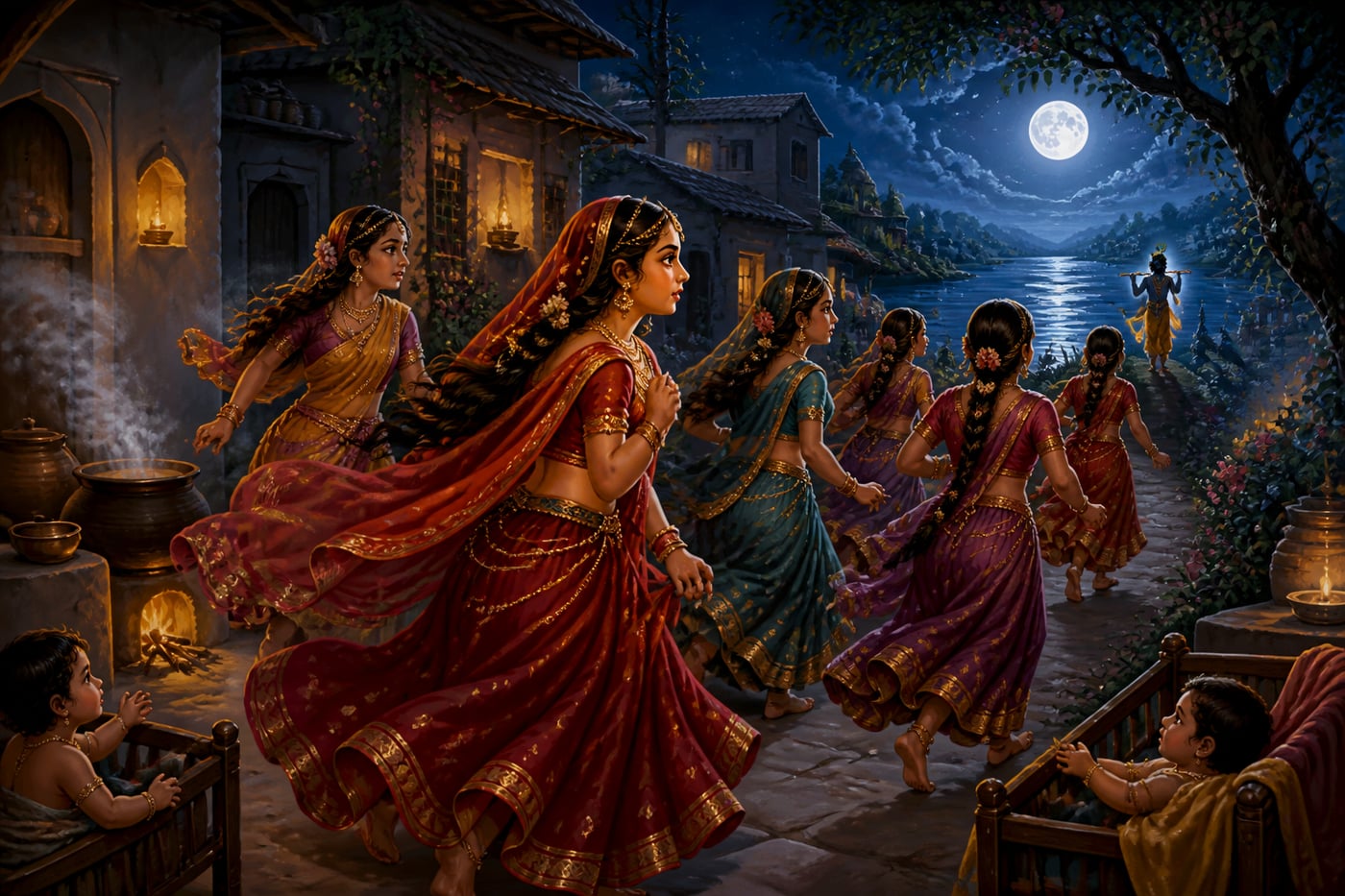

Gopis abandon their homes at moonrise drawn by Krishna's flute

The Gopis' Response

When the gopis heard that sound, something extraordinary happened. They abandoned everything, immediately, completely, without hesitation:

Situation Response
Cooking food Left pots on the fire
Feeding babies Set them down mid-feed
Serving husbands Walked away without explanation
Applying makeup Left half-finished
Sleeping Rose and departed without waking others

This was not ordinary behavior. Society, family, duty, all the structures that organize human life, were set aside in an instant. The Bhagavatam describes this as the arising of prema (divine love) in its purest form, overwhelming all other considerations.

The Obstacles

Some gopis were physically prevented from leaving:

For these gopis, the Bhagavatam states something remarkable: they closed their eyes, meditated on Krishna with such intensity that their material bodies fell away and they attained Him directly. Their physical constraint became spiritual liberation.

"Those who could not go gained more than those who went, for their love, blocked from outward expression, turned inward with such force that it broke all remaining barriers."


Krishna's Test

When the gopis arrived in the forest, Krishna did not immediately embrace them. Instead, He spoke words designed to turn them back:

The gopis were devastated. They had risked everything, social standing, family honor, their very place in society, and now Krishna Himself seemed to reject them.

But Krishna's words were a test, He was giving them one final opportunity to choose conventional life over divine love. Their response would reveal the depth of their devotion.

The Gopis' Reply

The gopis' answer, recorded in the Bhagavatam, is a masterpiece of devotional logic:

  1. "You speak of dharma, but the highest dharma is love of You."
  2. "You speak of danger, but separation from You is the only real danger."
  3. "You speak of family, but You are the soul of our souls; where else would we belong?"
  4. "You speak of returning, but our hearts left us long ago; only our bodies remained, and now even those have followed."

Convinced of their unwavering devotion, Krishna agreed to remain with them.


The Divine Dance Begins

What followed was the Rasa, a cosmic dance unlike anything possible in ordinary reality.

The Multiplication

Krishna, through His inconceivable power, expanded Himself so that He appeared simultaneously beside each gopi. Though hundreds of gopis had come, each experienced Krishna as exclusively hers. No gopi saw another gopi with Krishna, each saw only her beloved beside her.

Ordinary Reality Rasa Lila Reality
One Krishna As many Krishnas as gopis
Shared attention Complete individual focus
Awareness of others Each alone with the Beloved

This divine multiplication reveals a profound theological truth: the Supreme is simultaneously one and infinitely many. He can give complete attention to infinite souls without any diminishment.

The Dance Itself

The gopis and Krishna danced in a great circle, the Rasa-mandala. Arms linked, they moved in intricate patterns as celestial musicians provided accompaniment from the heavens:

The Bhagavatam describes the sound of their ankle bells, the flash of their ornaments, the mingling of their songs with Krishna's flute, a cosmic performance that combined the beauty of all arts into a single transcendent expression.

Gopis in jeweled saris forming the great Rasa-mandala circle dance on a moonlit Vrindavan glade.


The Test of Pride

As the dance reached its height, a subtle change occurred in the gopis' hearts. Surrounded by celestial watchers, dancing exclusively with the Lord of all creation, they began to feel special, superior to other beings.

"We alone have achieved what all yogis seek. We alone are blessed above all women. We alone truly know Him."

The moment this pride arose, Krishna disappeared.

The Vanishing

One moment He was there, the next, gone. The forest that had been filled with His presence became ordinary trees and shadows. The music stopped. The gopis stood alone, abandoned, bereft.

This disappearance was not punishment but purification. Divine love cannot coexist with pride. To possess the Supreme, one must be empty of self. The gopis' momentary inflation had to be deflated before the dance could reach its ultimate stage.


The Search and the Gopi Gita

Searching the Forest

The heartbroken gopis searched frantically through the forest, asking every tree and flower:

They found His footprints, but alongside another's. One gopi, they realized, had been singled out, taken away separately. (This was Radha, whose special position is implied but not named in this section of the Bhagavatam.)

Eventually, even that special gopi was found abandoned, she too had developed pride at being chosen exclusively, and she too had been left.

Gopis sing the Gopi Gita at the Yamuna's bank after Krishna vanishes

The Gopi Gita

United in their separation, the gopis gathered at the Yamuna's banks and sang. This song of longing, the Gopi Gita (Song of the Gopis), is considered one of the most beautiful devotional compositions in existence.

Themes of the Gopi Gita include:

  1. Remembrance of Krishna's qualities, His beauty, His words, His touch
  2. Acknowledgment of their own fault, They recognize their pride
  3. Complete surrender, No bargaining, only offering
  4. Request for return, Not demand, but desperate appeal

"Our hearts were stolen by Your smile. Our lives were taken by Your flute. We have nothing left but the hope of Your return."


The Return and Completion

Moved by the gopis' purified love, love that remained even when abandoned, love that blamed itself rather than Him, Krishna reappeared.

Now the dance resumed, but transformed. The pride that had interrupted was gone. The gopis danced not to receive but to give, not to possess but to surrender. And Krishna danced not to test but to fully reciprocate.

The Maha-Rasa, the great dance, continued through the night that Brahma's power extended to equal a night of the gods (millions of years by human calculation). Yet to the participants, it was a single perfect moment.


Theological Significance

The Soul's Relationship with the Divine

The Rasa Lila is understood as a portrait of the soul's deepest relationship with God:

Gopis Individual Souls
Their longing The soul's inherent attraction to the Divine
Their abandonment of duties The necessity of transcending material attachments
Their exclusive focus The devotion required for realization
Their pride and fall The ego's tendency to corrupt even spiritual progress
Their purified return The completion of spiritual journey

Beyond Morality?

Some readers question the gopis' abandonment of family duty. The tradition's response is nuanced:

  1. The gopis were already liberated souls, This was their eternal relationship with Krishna, temporarily veiled
  2. Their 'abandonment' was actually return, They were going to their real home, not leaving it
  3. Krishna is not a person among persons, He is the Self of all selves; "leaving" family for Him is not abandonment but recognition
  4. The highest dharma absorbs lower dharmas, Love of the Supreme includes and transcends all other duties

The Proof in Results

The Bhagavatam offers evidence of the Rasa Lila's spiritual nature: hearing it destroys lust in the heart. If it were material romance, it would increase desire; instead, it transforms it. This paradox, erotic imagery that liberates rather than binds, is central to understanding this pastime.


The Question of Radha

While the Bhagavatam does not explicitly name Radha in the Rasa Lila, later tradition identifies her as the special gopi taken separately. She represents the highest devotion, so elevated that even the general Rasa Lila could not contain her relationship with Krishna.

The Radha-Krishna tradition, developed extensively in later works like the Brahma Vaivarta Purana and Gita Govinda, sees Radha as:


Practical Wisdom

This profound narrative offers guidance for spiritual seekers:

  1. Divine love demands totality, The gopis' complete response shows that partial devotion yields partial results
  2. Pride interrupts progress, Even spiritual achievement can be corrupted by ego
  3. Separation serves union, Krishna's disappearance purified the gopis for deeper connection
  4. Surrender completes the circuit, Only when the gopis stopped demanding did Krishna fully return
  5. The highest love gives rather than takes, The completed Rasa was marked by the gopis' desire to please Krishna, not to be pleased

The image of Krishna dancing with infinite souls simultaneously, each experiencing complete divine attention, remains the ultimate portrait of what awaits those who surrender fully: not loss of individuality, but its perfect fulfillment in love.

Living traditions

Reflection

More in Skanda 10 Part 1: Krishna in Vrindavan

All lessons in Skanda 10 Part 1: Krishna in Vrindavan ยท Srimad Bhagavatham course