Uma-Maheshwara Samvada: The Dialogue That Never Ends
Parvati asks, Shiva answers
Most of what the Shiva Purana actually teaches is delivered as a conversation. Parvati asks. Shiva answers. The Uma-Maheshwara samvada is not just a literary device. It is the claim that knowledge only becomes alive when it is transmitted within a relationship between two who love each other.
A Question on the Mountain
On Mount Kailasa, after a long silence, Parvati turned to her husband and asked a single question.
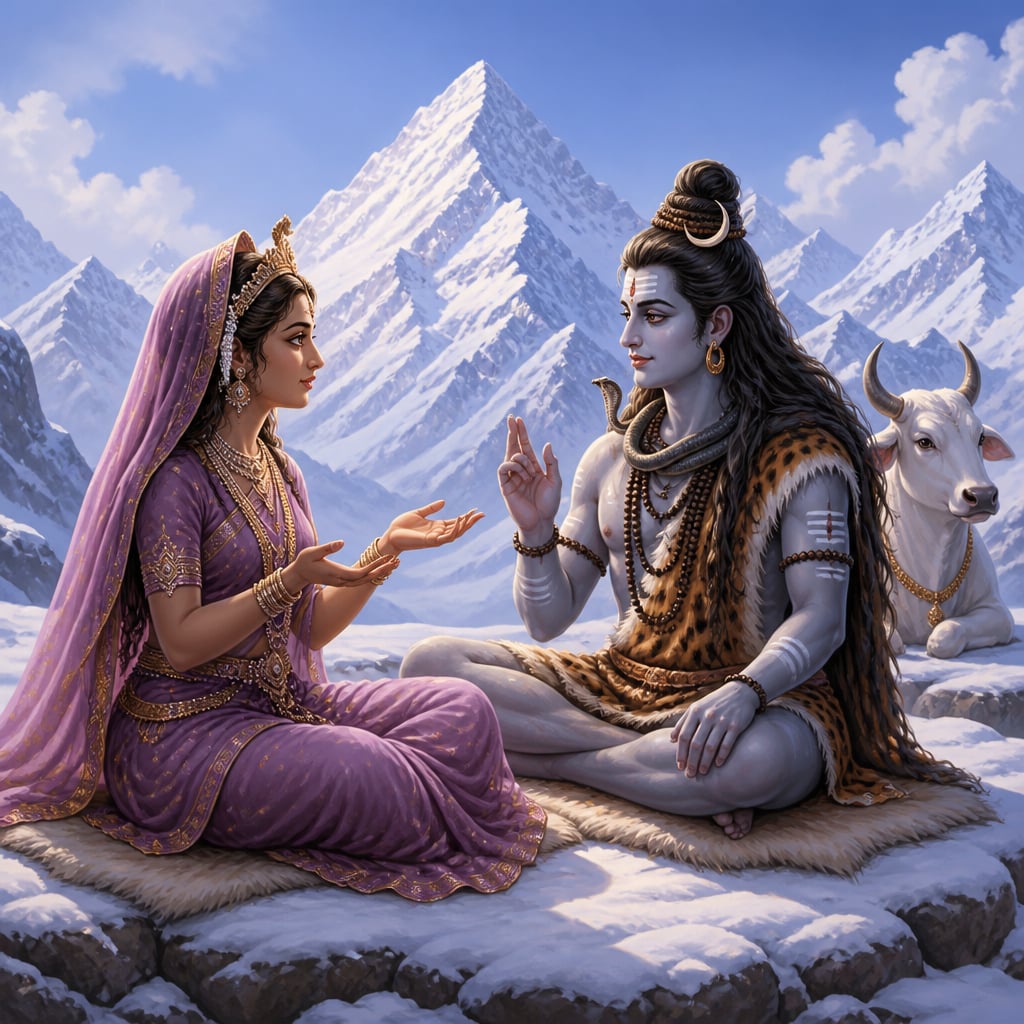
The peak was washed in white. Snowmelt ran in thin streams through the rock. The wind smelled of cold pine and the ash that always coated Shiva's body. Nandi, the great bull, lay at the doorway of the cave, eyes half-closed, listening. Inside, the floor was a slab of grey stone scattered with bilva leaves from the morning's worship. Parvati sat to Shiva's left, her hand resting lightly on his arm.
"Bhagavan," she said, "tell me the highest secret. Not for me. For the sake of the world."
Shiva looked at her. The question had stakes that the goddess herself fully understood. She is Shakti. She IS the source. She did not need the answer. She needed the asking. Without her question, there would be no teaching. Without the teaching, no Purana. Without the Purana, no path for the millions who would come centuries later, looking for the way home.
She had asked the question that opens the entire book.
The Pattern
The Shiva Purana is built on this conversation. Not just one dialogue, but dozens. The text is divided into seven major sections, called samhitas, and almost every one of them carries a stretch of Parvati asking and Shiva answering.
- Vidyeshvara Samhita: opens with the sages asking, but the deeper teachings come through Parvati.
- Rudra Samhita: tells the marriage story itself, much of it framed as Shiva explaining his nature to her.
- Kailasa Samhita: the most direct samvada, named for the very peak we just stood on.
- Vayaviya Samhita and Uma Samhita: long Parvati-Shiva exchanges on cosmology, vrata, and devotion.
The pattern is older than the Shiva Purana. The Tantras, the Agamas, the Devi Bhagavatam, the Linga Purana all use the same frame. Parvati asks. Shiva answers. The dialogue is the form of the teaching itself.
Why Does the Goddess Ask?
This is the question every careful reader hits. If Parvati IS Shakti, the consort and equal of Shiva, why does she need to ask anything? The tradition gives three answers. They are not in conflict. They are layers.
The pedagogical answer. A teacher needs a student. Even the deepest teaching can only become a teaching when someone is there to receive it. By asking, Parvati creates the role of the student. She is not asking for herself. She is asking for the world. Every reader who later opens the Purana steps into the seat she has prepared.
The theological answer. Shaiva metaphysics says that consciousness has to bend back on itself to become aware of itself. Shiva is the silent witness. Shakti is the power that lets that witness become active and known. When the goddess asks, what is happening is awareness curving back to look at itself. The samvada is the universe contemplating its own nature, in the form of a conversation.
The human answer. Knowledge given between two who love each other lands differently than knowledge given by a stranger. The Uma-Maheshwara dialogue is intimate. He sits with her hand on his arm. He calls her by her household name, Uma. Her hand is on his arm. The teaching is not a lecture. It is a marriage of minds. The relational frame is what makes the teaching warm rather than cold.
The Four Moods of Her Question
Parvati does not always ask in the same voice. Read the Shiva Purana carefully and you find at least four registers in her questions.
| Mood | What She Asks As | Example Question Type |
|---|---|---|
| Scholar | A learner of shastra | "What is the rule of this vrata?" |
| Devotee | A bhakta in love | "How may I worship you best?" |
| Foil | A teaching device for others | "Lord, the world doubts. Tell us why." |
| Mother | The cosmic mother | "What can you give the suffering?" |
This is part of why the dialogues never tire. The same two beings keep talking, but the texture keeps shifting. One stretch is technical. The next is tender. The next is a public question asked in front of all the gods. The next is the mother of the universe pleading on behalf of every creature that has ever lived.
A good question has a mood. A great teaching tradition has many.
What Gets Transmitted This Way
Much of the Shiva Purana's actual practical content arrives through the Uma-Maheshwara frame. To name a few areas:
- The vrata-mahatmyas: the meaning and rules of the major Shiva fasts (Pradosha, Shivaratri, Shravan Somvar). Parvati asks how to do them. Shiva explains.
- The Panchakshari teaching: the full unfolding of Om Namah Shivaya. Parvati asks for the simplest mantra a householder can hold. Shiva gives her five syllables.
- The rules of Shiva worship: which flowers, which leaves, which substances for abhisheka, which times of day. The whole liturgy of a Shiva temple traces back to her questions.
- The cosmology: the cycles of creation and dissolution, the structure of the worlds, the meaning of pralaya. She asks. He answers.
The teaching is the answer. The form of the asking is what makes the answer transmissible to humans.
The Older Pattern
The samvada form is much older than the Shiva Purana. The most famous early example is in the Brihadaranyaka Upanishad (around 700 BCE), where the sage Yajnavalkya sits with his wife Maitreyi and she asks him what makes a life truly worth living. He is about to leave home for the forest. She refuses to be paid off in cattle and gold and asks for the teaching instead. What follows is one of the great philosophical dialogues of world literature.

The Bhagavad Gita inherits the same form, but inverts the gender. A male student, Arjuna, asks a male teacher, Krishna, on the field at Kurukshetra. The structure is identical. One drops their armour, kneels, and asks. The other answers.
The Shiva Purana extends this old pattern across an entire library of cosmology and practice. The Maitreyi seat becomes the Parvati seat. The Yajnavalkya seat becomes the Shiva seat. Anyone who later sits down to read the Purana steps into the same shared room.
Modern Echoes

The educator Parker Palmer, in his 1983 book To Know As We Are Known, argued that real knowing is not a thing one possesses but a relationship two beings inhabit. He was making a case in late twentieth-century American epistemology. The Shaiva Agamas had said the same thing in plain Sanskrit a thousand years earlier, and the Brihadaranyaka Upanishad had said it twenty-six centuries before that. Knowledge is what happens between people who love each other enough to ask and to answer.
Eknath Easwaran, the Indian-born teacher who founded the Blue Mountain Center of Meditation in California in 1961, translated several of the Uma-Maheshwara dialogues for Western readers through the Nilgiri Press. His translations made it clear that the warmth of the form was not decorative. It was the teaching's content. Modern bhakti movements, from the Ramakrishna Mission to the work of contemporary acharyas, keep the dialogue form alive in their classroom style. A guru still answers questions. The questioner is still treated as the goddess making the teaching possible.
This is also why a chatbot, however clever, cannot quite be a guru. The chatbot has the answers. It does not have the goddess sitting on its left, hand on its arm, asking for the sake of the world.
Back to the Mountain
Back on Kailasa, the snow has not yet melted. Nandi has not moved. Parvati has not lowered her hand. Shiva is just beginning the answer that will, over the next many lessons, become the entire Shiva Purana.
The answer is long. It will take the next ten chapters of this course to unfold. But the question that opened it has already done its work.
Historical context
Puranic compilation period (roughly 400 to 1000 CE), with deeper roots in Vedic dialogue forms (~1500 to 800 BCE) and continuing into the medieval Bhakti era (~1100 to 1700 CE)
The dialogue form (samvada) is one of India's oldest pedagogical structures, traceable to the Brahmana literature and the Upanishads of the late Vedic period. By the Puranic compilation era (400 to 1000 CE), the Uma-Maheshwara samvada had become the dominant frame for transmitting Shaiva theology, ritual, and cosmology. The Shiva Purana's seven major samhitas each open with or contain extended Parvati-Shiva dialogues. The form was inherited by the Tantras and Agamas, and in the medieval period it shaped the bhakti literature of the Lingayats, Nayanmars, and the Saiva Siddhanta tradition. The pedagogical premise, that knowledge becomes alive only when it is transmitted within a relationship, runs through every dharmic teaching tradition that survives today.
Living traditions
The Uma-Maheshwara dialogue form has had a long modern afterlife. Eknath Easwaran, who founded the Blue Mountain Center of Meditation in California in 1961, translated several of the dialogues for Western contemplative readers through Nilgiri Press, and the Ramakrishna Mission keeps the dialogic guru-shishya register alive in its classroom and ashram pedagogy worldwide. The American educator Parker Palmer, in his 1983 book *To Know As We Are Known*, argued for a relational epistemology that closely parallels the Shaiva model. Halebidu's Uma-Maheshwara murtis remain among the most reproduced images in modern Hindu calendar art, and Hartalika Teej is observed by tens of millions of women each year across India and the diaspora.
- Kailasa Temple, Ellora Caves (Cave 16): The largest single rock-cut monolith in the world, carved out of a basalt cliff during the 8th century CE under the Rashtrakuta king Krishna I. The temple is an architectural representation of Mount Kailasa itself. Several panels show Uma-Maheshwara seated together in dialogue posture, including the famous relief of Ravana shaking the mountain, in which Parvati clings to Shiva's arm in fear and Shiva reassures her without rising. UNESCO World Heritage Site.
- Hoysaleshwara Temple, Halebidu: A 12th-century Hoysala temple complex begun under King Vishnuvardhana (c. 1121 CE), famed for the density and refinement of its sculpture. The temple walls carry some of the finest extant Uma-Maheshwara murtis in India, with Uma seated on Shiva's left thigh in classical conversational posture. The Hoysala sculptors included tiny narrative touches: a slightly parted mouth, a raised hand caught mid-gesture. UNESCO tentative list.
- Uma-Maheshvara Temple, Vishwanath Gali, Kashi: A small but historically significant shrine in the lanes near Kashi Vishwanath, dedicated specifically to the Uma-Maheshwara form (Shiva and Parvati seated in conversation). One of the oldest functioning shrines in Kashi to honour the dialogue pair, with daily abhisheka rituals that explicitly invoke both deities together. Worth visiting in combination with Vishwanath darshan.
Reflection
- Where in your life have you been told the answer too early, before you could ask the question? Where have you cut off the asking in others by giving them your answer first?
- Why does the goddess ask Shiva, when she is herself Shakti and the source of all power? What does her asking tell us about how knowledge becomes transmissible?
- The Uma-Maheshwara samvada says the dialogue form is itself the teaching. Does this change our model of knowing? Is knowledge a thing one possesses, or a relationship two beings inhabit?