Asantulana: When the Balance Breaks

Inner masculine and feminine today

Shiva-Shakti is not a story about gods on a mountain. It is the diagram of the inner life. When awareness and feeling stay together, a person is whole. When they split, awareness becomes coldness and feeling becomes flooding. This lesson walks through the modern shapes of that split, and the Shaiva method for finding the balance again.

The Therapist's Office in Bandra

It is a Tuesday evening in March 2024, the second-floor office of a clinical psychologist in Bandra West, Mumbai. The traffic on Linking Road is honking through the window. The air smells of jasmine from the agarbatti at the small altar in the corner. The altar holds one image. It is Ardhanarishvara, the half-and-half form of Shiva and Shakti that you met in the last lesson.
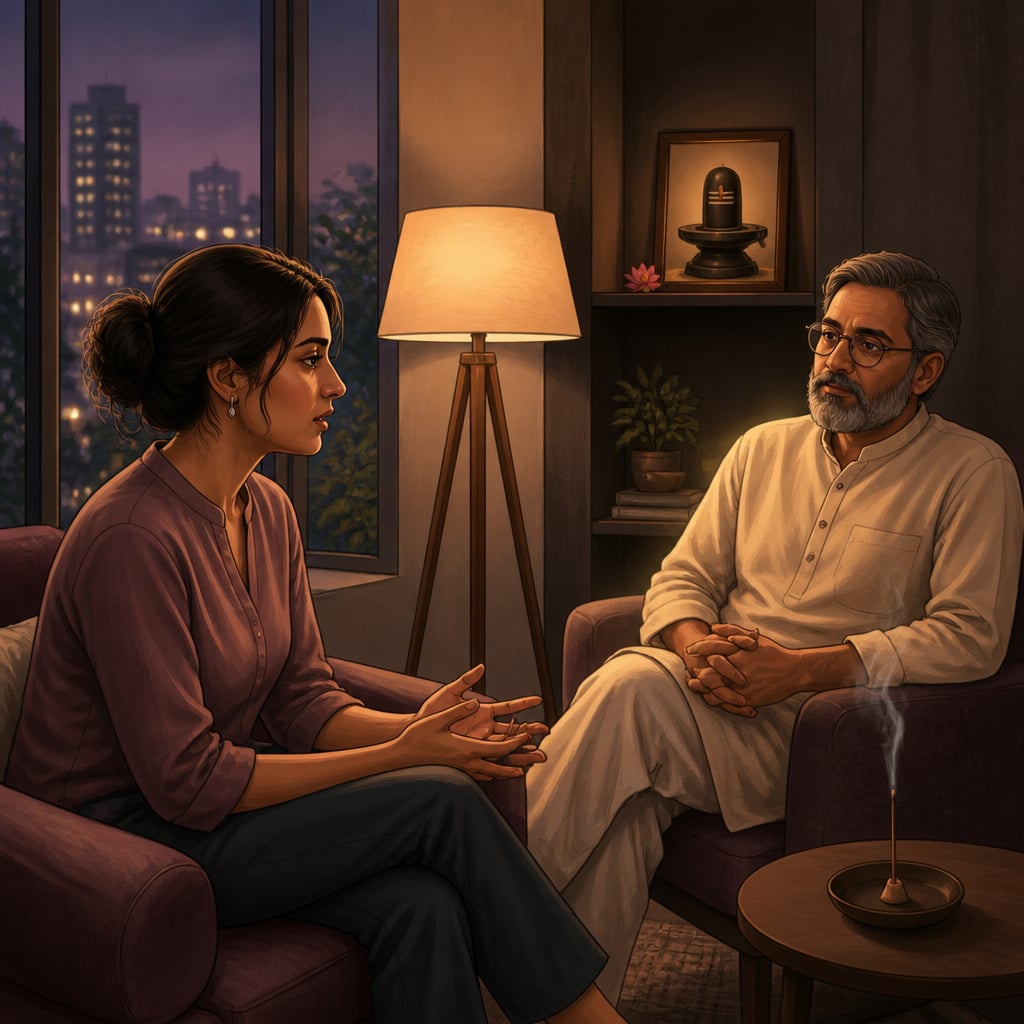
A woman sits across from her therapist in a quiet Bandra office at evening, an Ardhanarishvara image on the small altar behind.

A woman in her early thirties sits across from the therapist. She works at a tech company in Powai, leads a team of nine, has not cried in eleven years. She has come because last week, in a routine performance review, she said something cutting to a junior. The junior went home and did not come back the next day. The woman does not understand her own coldness. She wants to know where the warmth went.

The therapist, a Shaiva by upbringing and a clinician by training, listens. Then she points at the altar. Look at the figure there, she says. The trouble is not that you are cold. The trouble is that the two halves of that figure have stopped speaking to each other inside you.

The woman has never thought of herself as half a god. She leans forward.

The Diagram, Not The Decoration

For six lessons we have walked through the Shiva-Shakti story as an outer drama. Sati's choice. The marriage on Kailasa. Parvati's tapas. Kamadeva burned. Ardhanarishvara. The Uma-Maheshwara dialogue.

This final lesson of the chapter does one thing. It brings the whole story inside.

The Shaiva tradition is direct about this. Shiva is the still witness inside you. The awareness that watches your thoughts arrive, watches them leave, and is not changed by them. Shakti is the moving energy inside you. The feeling, the longing, the grief, the rising fear, the laugh that surprises you, the warmth toward another person.

The two are one being. That is the whole point of Ardhanarishvara. They are not two forces in tension. They are two faces of one life. Witnessing without feeling is a stone. Feeling without witnessing is a flood. A whole human is both.

The Sanskrit word for what happens when the two come apart is Asantulana. The word means imbalance, the loss of even weight. The Shaiva diagnosis of most modern suffering is one word long. Asantulana.

Pragyaparadha: The Original Mistake

Ayurveda has an older word for the same thing. It calls it Pragyaparadha (pra-gya-apa-radha), the error of awareness. Literally, the offence committed by intelligence against itself.

The error is this. The witness inside you forgets that it is also the feeler. The feeler inside you forgets that it is also the witness. Each half walks off claiming to be the whole. Pragyaparadha is the moment that walking off happens. Every other inner trouble, the texts say, follows from this one.

The story you read in this chapter pictures both halves. Shiva alone, before Sati, sat on the cremation ground for ages. Shakti alone, in the form of Kali on the battlefield, almost destroyed creation in her wrath until she stepped on Shiva's chest and remembered. The Puranic stories are not entertainment. They are case studies of imbalance and recovery, told at cosmic scale.

Two Modern Shapes Of The Split

Look at the two shapes of the split as they show up in 2026.

The Shiva-only life

Someone has trained themselves into pure witness. They are calm. They are productive. They have read the books on detachment. They run a team or a household efficiently. People respect them. People do not feel close to them.

In the Shaiva diagnosis, this person has not become spiritual. They have amputated their Shakti. The warmth that should have lit up their decisions has been quietly turned off, because warmth was once dangerous, or messy, or made them small in a meeting. Now the awareness runs the body, but no one is home in the room.

The inner cost arrives slowly. A subtle deadness. A wondering, late at night, why nothing tastes the way it did at twenty. The clinical name for the symptom is alexithymia, the inability to name one's own feelings. The Shaiva name is older. Shiva has forgotten he was ever married.

The Shakti-only life

Someone else has the opposite shape. They feel everything. They are warm. They are present. They cry at the right films. People love being around them. They cannot get out of bed on a Sunday because the feelings have flooded the room. Every news headline lands inside their ribs. Every harsh word from a colleague replays for three nights.

In the Shaiva diagnosis, this person has not become open. They have abandoned their Shiva. The witness that should have stood behind the feelings, holding them like a banked fire, has stepped away. Now there is only fire, and fire alone burns through whatever it touches first.

The inner cost is the opposite of the first. Burnout. Compassion fatigue. A sense of being used up by every encounter. The Shaiva name for this too is older than therapy. Shakti has forgotten her husband, the still mountain on which she could rest.

The Texture Of Imbalance

Shiva-Only Shakti-Only
Calm but cold Warm but flooded
Detached without warmth Connected without ground
Decisions wound others Reactions wound the self
Watches life from a glass wall Drowns in life with no shore
Forgets the body Forgets the witness

Most people are not at one extreme. Most people lean. Notice which side of this table makes you uncomfortable. That is usually the half you have abandoned.

Spanda: The Pulse That Heals

Vasugupta writing the Spanda Karikas in 9th century Kashmir

The ninth-century Kashmiri Shaiva master Vasugupta gave the integration a name. He called it Spanda, the throb. The single subtle pulse in which awareness and energy are not yet two.

In the Spanda Karikas, Vasugupta wrote that consciousness does not sit still. It pulses. Out into world as feeling, in toward source as witness, out, in, out, in, like a heart. To be whole is not to choose witness over feeling, or feeling over witness. It is to feel the throb itself, the breath of consciousness moving in both directions at once.

A blockquote of his teaching anchors the whole lesson:

स्पन्दः सर्वस्य भूतस्य प्राणानां स्पन्द एव हि।

spandaḥ sarvasya bhūtasya prāṇānāṃ spanda eva hi

The throb is in every living being. The very breath of life is throb itself.

Spanda Karika, attributed teaching of Vasugupta, Kashmir, 9th century CE

When the Shiva half and the Shakti half are remembered as one breath, the imbalance dissolves. There is nothing to fix. There is only the pulse to feel.

The Practice The Therapist Suggested

Back in the Bandra office, the therapist did not give the woman a new technique. She gave her one instruction. For seven days, when a feeling arrives, do not push it away and do not jump into it. Just sit with the witness who is noticing the feeling. Let both be there at once.

The instruction is the entire Shaiva method, translated into a working week. The witness, awake. The feeling, allowed. Neither forced. Neither erased. The two halves of Ardhanarishvara, brought back into the same room.

The same woman doing her dawn integration practice on the balcony

This is the stillness practice that Shiva represents. Not the stillness of a stone. The stillness of a mountain on which a river is flowing. The mountain does not stop the river. The river does not move the mountain. They are one place.

It is also a practice of surrender. Not surrender to circumstance. Surrender to the pulse itself. Letting the witness and the feeler stop competing for the throne and rest into one seat. I do not have to choose between awareness and warmth, the practice says. The Ardhanarishvara form is mine to inhabit.

Modern Echoes

The Swiss psychiatrist Carl Jung spent his last decades writing about what he called the anima (the inner feminine within a man) and the animus (the inner masculine within a woman). The integration of the two, he wrote in Aion (1951), is the central task of the second half of life. He acknowledged in his correspondence that he had encountered the framework first in Heinrich Zimmer's translations of Hindu Tantra. The anima and animus are Jung's name for the half he found in Ardhanarishvara.

The Oxford psychiatrist Iain McGilchrist, in The Master and His Emissary (2009), argued that the human brain divides labour between two hemispheres. The right hemisphere holds the present, the felt, the relational. The left hemisphere holds the abstract, the categorical, the analytical. McGilchrist's case, made in 600 pages of neuroscience, is that modern Western culture has let the left hemisphere claim the throne and forgotten the right. The Shaiva tradition would call that an Asantulana of civilizational scale. Recovery, McGilchrist writes, requires bringing the two back into conversation.

More recently, the psychologist Dacher Keltner at Berkeley has shown in laboratory studies that experiences of awe, where awareness and feeling are present together at full strength, reduce inflammation and increase generosity. The throb Vasugupta named in 9th-century Kashmir is now showing up in fMRI scans in 21st-century California.

The vocabulary changes. The diagnosis does not. When the witness and the feeler walk off in opposite directions, a person, or a culture, gets sick. When they remember they are one breath, the sickness lifts.

Back in the Bandra office, on the second-floor window of a building on Linking Road, the agarbatti has burned down to its stub. The woman has not yet cried. She will, on the fifth day of the practice, in a Powai meeting room, in front of the same junior. She will apologise. The two halves, for one moment, will be in the same room again.

The Bridge To The Next Chapter

We close the Shiva-Shakti chapter here, with the inner diagram complete. But the story has not yet shown what happens when the imbalance plays out at the cosmic scale, when a father refuses to honour his daughter's choice, when a yajna becomes the stage for a public insult, when Shakti walks into the fire to make her point and the universe trembles.

That is the next chapter. The Daksha Yajna. The most painful and the most clarifying turn in the whole Purana.

Historical context

Vedic Period through Medieval Kashmir Shaivism (c. 1500 BCE to 1100 CE)

The integration teaching this lesson develops emerged across more than two millennia and three textual layers. The Vedic root is the Rudra-Devi pairing visible in the Rig Veda and the Shri Sukta. The Puranic narrative form took shape between 300 and 800 CE in the Shiva Purana (especially the Vidyeshvara, Rudra, and Uma Samhitas), the Linga Purana, and the Devi Bhagavata Purana. The non-dual philosophical synthesis was achieved between 800 and 1100 CE in two parallel streams: Adi Shankaracharya's Soundarya Lahari and his Brahma Sutra commentary in the south, and the Spanda-Pratyabhijna school of Kashmir Shaivism (Vasugupta, Somananda, Utpaladeva, Abhinavagupta) in the north. The geography of integration is unusually balanced. The southern Tamil tradition gave the world the Ardhanarishvara icon, the Nataraja form, and the Tirumantiram of Tirumular. The northern Kashmiri tradition gave it the Spanda doctrine and the Pratyabhijna philosophy. Both arrived at the same teaching by independent routes during the same centuries.

Living traditions

The Ardhanarishvara form has become the most widely cited image in modern Hindu thought on gender, psychological integration, and non-dual identity. Carl Jung's framework of anima and animus, which he attributed in part to Heinrich Zimmer's Hindu Tantra translations, drew directly on this iconography. Iain McGilchrist's 2009 book The Master and His Emissary, an extended argument for hemispheric integration in modern culture, has been read by many Indian commentators as a neuroscientific restatement of the Shaiva diagnosis of Asantulana. Tiruchengode and Madurai remain among the most-visited temples in Tamil Nadu, with annual footfall in the millions, and their ritual calendars continue to enact the Shiva-Shakti integration daily, exactly as the Pallava and Pandya dynasties received them.

Reflection

More in Shiva-Shakti: The Eternal Dynamic

All lessons in Shiva-Shakti: The Eternal Dynamic · Shiva Purana course