Sati: The First Shakti's Choice

She bet on the ascetic, not the prince

Sati loves Shiva before she can speak. Her father Daksha calls him an ash-smeared outsider and refuses the match. She performs a long tapas with Shiva as her only goal, then throws her garland into empty air at her own swayamvara. The ascetic appears to receive it.

The Garden That Would Not Listen

In the gardens of Daksha's palace, in the years before her swayamvara, a girl walks every dawn from her chambers to the small shrine she has built in the corner of the orchard. The shrine is rough. A flat stone. A cup of water. A heap of bilva leaves she gathers fresh each morning. The mango trees are heavy with fruit. The white peacocks are loud at this hour. A servant follows at a distance, half asleep.

The girl is Sati. Her father is Daksha, one of the Prajapatis (the original lords of creation, sons of Brahma himself). Her mother is Prasuti. By the wealth of her household and the dignity of her birth, she is among the most royal beings in the cosmos. Every god has come to Daksha's court. Every king's son would sleep at her doorstep if she let him.

She wants none of them.

The being she wants does not live in any palace. He lives on Mount Kailasa with snakes around his neck and ash on his body. He has no kingdom, no parents she can ask, no wealth she can count. Daksha will not even let his name be spoken at meals. "He is not one of us," her father says, every time the topic threatens to surface. "He is an outsider. We are the kin of Brahma. He is the kin of the burning ground."

Sati does not argue. She kneels at her shrine, and she begins.

A Father Who Loved Her Wrongly
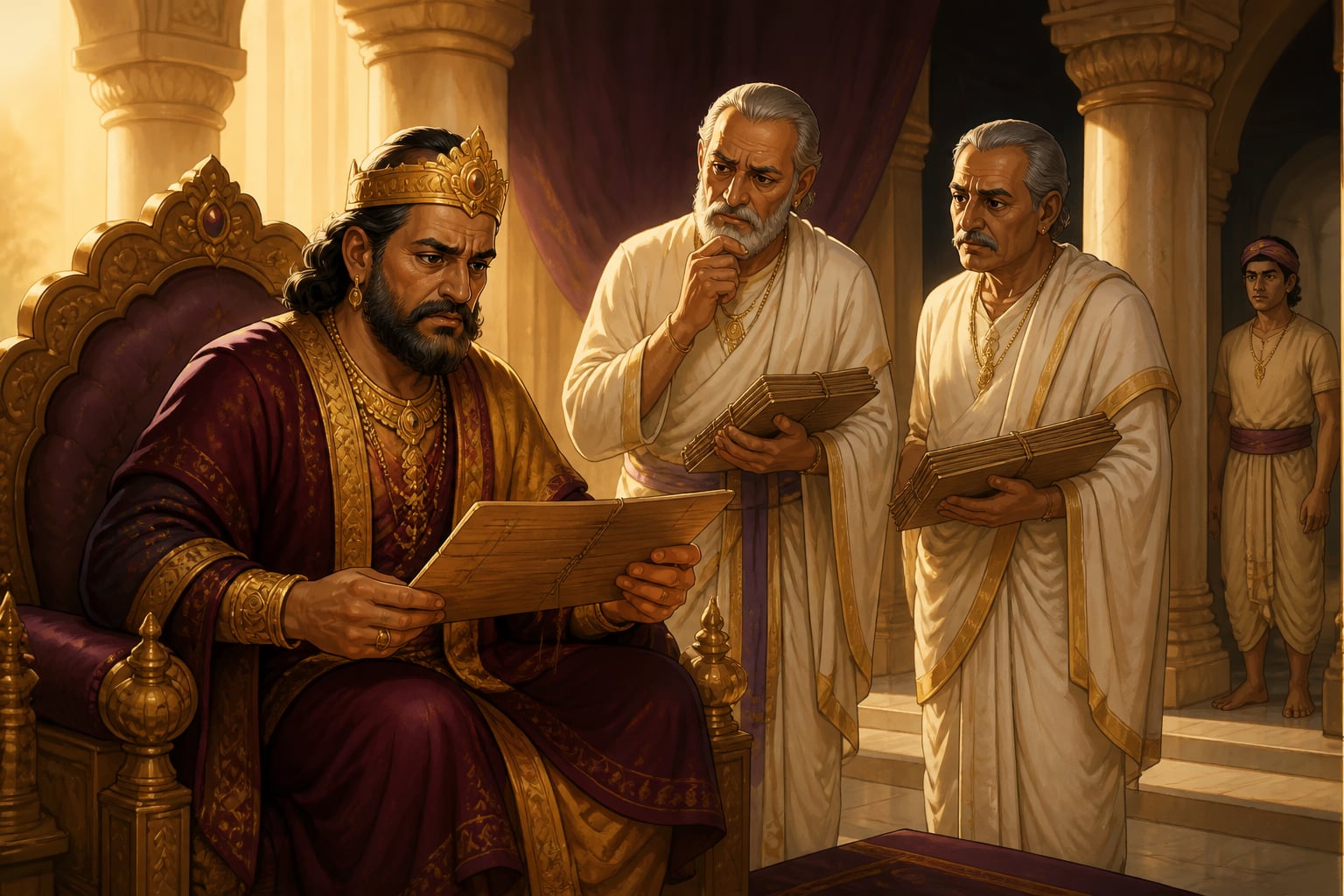
Daksha in his court refusing the match with Shiva

Daksha was not cruel. The Shiva Purana is careful here. Daksha loved his daughter the way many fathers love their daughters. He wanted her safe. He wanted her respectable. He wanted her marriage to make sense to the cosmic court.

His worry was not invented. By the standards of his world, Shiva was an unreasonable choice. Look at the file:

What a respectable groom should have What Shiva had
A clear lineage and palace A mountain at the edge of the world
Ornaments and silks Ash and the skin of an animal
Wealth and household A begging bowl
A polished court manner A laugh that came from somewhere very deep
A father one could negotiate with None that the cosmic court recognised

From inside the file, Daksha's no makes sense. From inside his daughter, the file was not the question.

This is the most useful thing about the story for any 2026 reader. The voice that opposes you is often not malicious. It is loving you the way it knows how to love. It is asking the questions a parent, a community, an institution, a culture has been trained to ask. The trouble is not that the voice is evil. The trouble is that it is asking the wrong questions for your life.

The Word Sati

The Sanskrit word Sati means "the true one", "she who is real". It comes from sat, the root that means truth, what is, what does not pass away. Long before the word was wrenched into the colonial sense of widow-burning, the name on this girl meant only this: the one who is true.

The Shiva Purana is precise about why she carries this name. She is the part of Shakti, the cosmic feminine power, that has chosen to come into a body to make a single point. The point is that truth picks its own match. Shakti, the great female principle of the universe, is not married off by anyone. She marries the one she recognises.

In this lesson, the body Shakti has taken is a young woman in her father's house. She has the limits any young woman in any house has had through history: she does not control the gates, the dowry, or the guest list. She has one thing only. She has her own attention, and she can put it where she chooses.

Tapas: The Quiet Strategy

Young Sati gathering bilva leaves at dawn in her father's orchard

What she chooses is tapas. The word comes from a root that means "to heat". Tapas is the inner heat that builds when a person stays steady on one true thing without bargaining. Not anger. Not drama. A long, slow, honest fire.

The Shiva Purana describes her tapas in the seasons of her girlhood. In the cold of Magha (the deep winter month around January), she stands waist deep in the river before dawn, bilva leaves in her folded hands, the name Shiva on her breath. In the summer of Vaishakha (around April and May), when the air is dry enough to crack the lips, she sits in the open courtyard surrounded by four small fires, the sun above being the fifth. In the rains, she fasts on water and a single fruit a day. "Be what you are," she keeps repeating, in the silence of her own mind. "Let me have what is real."

This is the part of the story that 2026 most needs to read carefully. Sati's tapas is not protest. It is not a hunger strike. It is not designed to break Daksha. It is designed to build her own steadiness. By the time the swayamvara is announced, the girl who walks into the great hall is no longer the girl who began.

The Swayamvara

Daksha agrees to the marriage in the end, after Brahma himself comes to the palace and reasons with him. The Shiva Purana lingers on this scene. Brahma is Daksha's own father. Even a Prajapati must listen to his father. "The girl has chosen," Brahma tells him. "The Devi has chosen. You will give your consent, or you will fight the cosmos itself." Daksha consents with his mouth. His heart does not move.

The swayamvara (literally "self choice", the ancient ceremony in which a princess chooses her husband from a hall of suitors) is held in Daksha's court. Every prince and every god has come. Indra is there. Kubera is there. Each suitor has brought his finest ornaments. The hall is loud with the sound of a wealth that wants to be looked at.

Sati walks the length of the hall once. She looks at none of them. She reaches the centre, raises the garland to her chest, closes her eyes. Then, in front of the entire court, she throws the garland upward into empty air, calling the name "Hara" (one of Shiva's names, the one who takes away). For a moment the garland hangs in nothing.

Then Shiva appears. Ash on his body. The crescent moon in his hair. The garland settles around his neck.

Sati at her swayamvara lifts the garland into empty air as Shiva materializes before her in tiger skin and serpents.

The court is silent. The first Shakti has chosen. The chosen god is the one her father refused.

What This Story Is Actually About

It would be easy to read this as a love story. It is, but it is not only that. The Shiva Purana places this lesson at the door of its longest chapter on Shiva-Shakti for a reason. The story is teaching the reader something about the inner architecture of every life.

Inside each of us, there is a Daksha. The voice that wants you safe. The voice that has read the file. The voice that says "be reasonable, this will not look right, what will people say, are you sure this is sensible." It is not a villain. It is the loving, frightened, well-meaning voice of conditioning. It speaks in the language of respectability.

And inside each of us, there is a Sati. The part that already knows what is true for it. The part that built a small shrine in the corner of the orchard before anyone gave it permission. The part that does not need to argue because it has already chosen. The Shaiva tradition calls this part the inner Shakti.

The whole question of an honest life is which voice you build, day by day, by what you do with your attention. Daksha grows by every concession to respectability you make. Sati grows by every act of quiet, stubborn truth. Tapas is the name for the second kind of growing.

Modern Echoes

The American psychologist Carol Gilligan, whose 1982 book In a Different Voice changed the field of moral development, spent decades studying how girls in their early teens learn to substitute the voice of social approval for their own inner knowing. She called it the "loss of voice". Her later work at Harvard with Lyn Mikel Brown documented the same pattern across a hundred American adolescents: the girl who at nine could say what she actually thought, by fourteen had learned to say what others wanted to hear. Recovering her own voice was the work of an adult lifetime.

The research caught up later to what the Shiva Purana told centuries earlier. Sati does not lose her voice. She does not even raise it. She uses tapas, the slow daily heat of staying with what is true, until the world has to bend toward her instead of the other way around. Brené Brown's work at the University of Houston, the 2024 World Bank report on women's economic agency, the global rise of the protest in countries from Iran to South Korea where young women refuse imposed scripts of marriage and dress, all carry a single insight that this Purana puts under one name. Shakti is not given. Shakti chooses.

Back in the orchard before dawn, the bilva leaves are still being gathered, the cup of water is still being filled, the small fire is still being lit. The first Shakti is teaching every later Shakti how the work is done. Not with shouting. With heat. With time. With a name kept clean in the mouth until the name itself walks into the room.

Living traditions

The Shaiva tradition has continuously held the original meaning of Sati as the truthful woman, even as the colonial period in the eighteenth and nineteenth centuries narrowed the English use of the word to widow burning. Modern Indian feminist scholars including Madhu Kishwar in her 1991 essay collection and Veena Das in her work at Johns Hopkins have written about reclaiming the Sati of the Shiva Purana from the colonial reduction. The Daksheshwar Mahadev temple at Kankhal sees about ten million pilgrims through the wider Haridwar circuit each year, and Sati's swayamvara is read aloud there every Mahashivaratri. The Sati Khanda of the Shiva Purana is also part of the Shaiva sampradaya curriculum at the Sringeri and Kanchi mathas, where it is taught as a foundational text on the inner Shakti's discernment.

Reflection

More in Shiva-Shakti: The Eternal Dynamic

All lessons in Shiva-Shakti: The Eternal Dynamic · Shiva Purana course