Parvati's Tapas: The Mountain's Daughter Returns
She won him by austerity, not beauty
After Sati's fire, Shakti returns as Parvati, daughter of the mountain Himavan. Her parents try beauty to win Shiva back from his grief. Beauty fails. So she walks into the forest, gives up food and shelter, sits in pancha-agni, and outlasts the cosmos. The story of how love, when it is real, transforms the lover before it claims the beloved.
Before this lesson: At Daksha's great yajna, Sati, Shiva's first wife, was dishonored by her own father and walked into the sacrificial fire. Shiva's grief broke the world. Chapter 3 tells that story in full.
A Daughter Of The Mountain
In the high palace of Himavan, the king of mountains, a baby girl is born to Queen Mena. The household trembles with joy. The infant has dark eyes and a pull about her that the nurses cannot name. Sage Narada, passing through, takes one look at her and stops. He whispers a prediction to the parents: this child will marry Shiva. The mountain palace falls silent. They have heard the stories. Shiva is the ash-smeared yogi on Mount Kailasa, lost in grief. The match is impossible.
But a bridge to this story has to be laid first.
Sati's fire was not the end of Shakti. The same divine feminine returned to the household of Himavan and Mena as Parvati, the daughter of the mountain. The girl with dark eyes is the same Sati who once walked into her father's sacrificial fire. The work of love is starting again, in a new body, with a fresh chance.
When Beauty Was The Plan
Parvati grows. She becomes, by every account, the most beautiful woman the three worlds have ever held. Her hair is dark as monsoon clouds. Her step is light as a deer's. She is also, from childhood, in love with Shiva. While other girls play with dolls, she draws lingas in wet sand and bows to them.
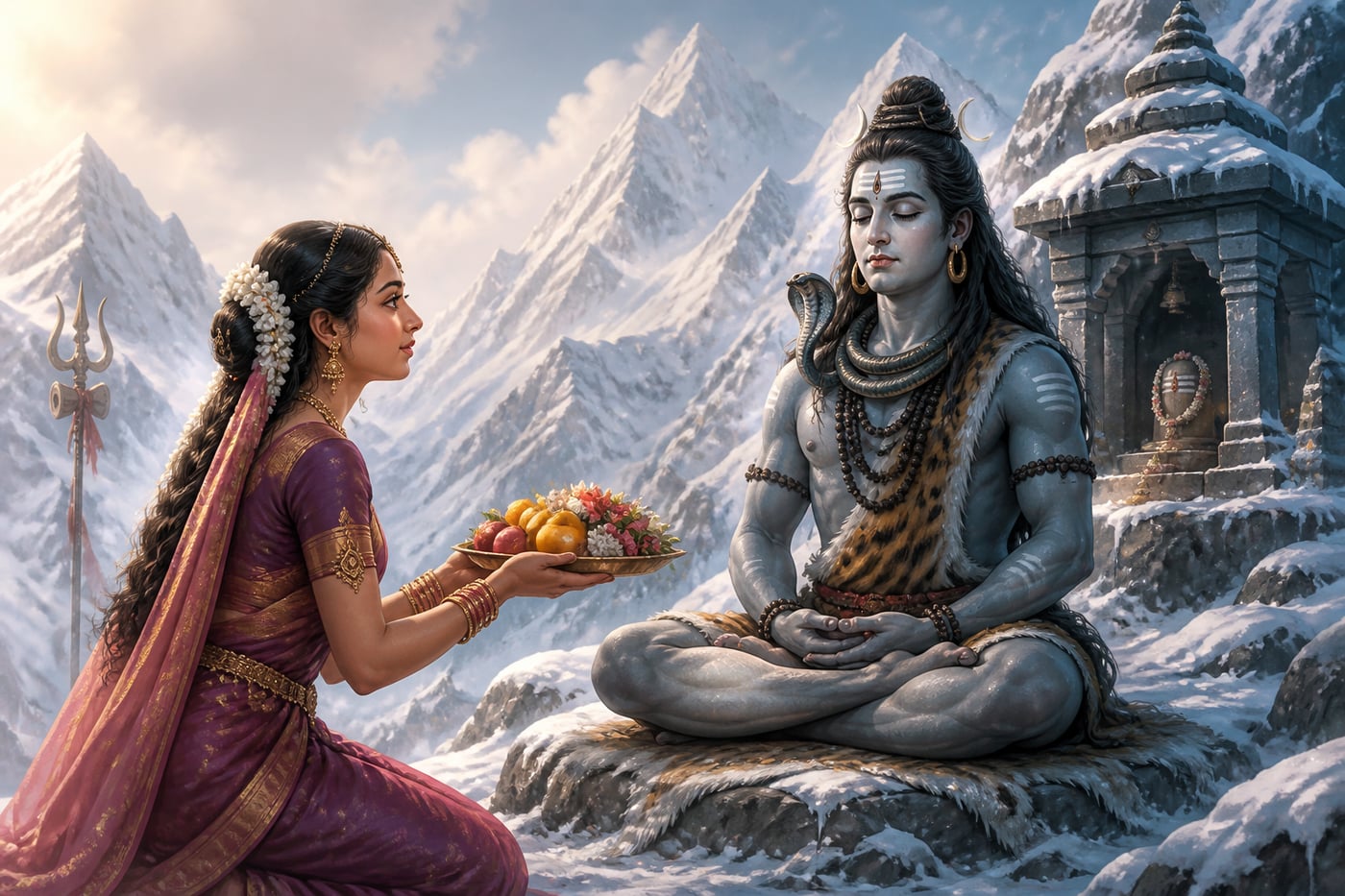
Meanwhile, on Mount Kailasa, Shiva sits unmoving. Sati's death has hollowed him out. He has gone deeper into meditation than the gods can follow. Snow gathers on his shoulders. His eyes do not open.
Himavan and Mena have a plan. They will offer their breathtaking daughter as a personal attendant to the meditating god. Surely beauty will reach him where nothing else has. Parvati is sent up the mountain with two friends. She brings him fresh water. She arranges flowers at his feet. She sweeps the snow from his platform. Day after day. Month after month.
Shiva does not open his eyes.
One day, he speaks one sentence and breaks her heart open.
'Why have you come here, daughter of the mountain? You think a god in this state can be reached by your face?'
The word face lands like a blade. Parvati walks down the mountain. She does not weep. She thinks.
The Walk Into The Forest
What she has been doing has not worked. Her parents' plan has not worked. Beauty, the currency she was born with, has not bought one glance.
But something else has been bothering her. She did not want to be loved for her face. She wanted to be worthy of him. She wanted, secretly, to do the work itself, the work he was doing on that mountain, and meet him as an equal.
The palace is no place for that work. So Parvati does what no princess of Himavan has ever done. She walks out of the palace gates and into the forest. She removes her silks and her jewels. She wears a single garment of bark. She lets her long hair tangle. She begins the practice the Shaiva tradition calls tapas (inner heat, austerity self-imposed for transformation).
The palace empties of laughter. Mena weeps. Himavan asks the gods to forbid it. They will not.
What Tapas Looked Like
Parvati's tapas is not symbolic. It is, by every Puranic account, ferocious. Across long stretches of time, her practice unfolds in stages:
- First, she lives only on fruits that fall from trees. She refuses to pluck.
- Then, she lives only on water and the leaves the wind brings down. The Purana gives her a new name here: Aparna, the leafless one, because in the next phase she stops eating even the fallen leaves.
- In summer, she sits in the pancha-agni posture. Four wood fires burn around her. The sun, unbearable, burns above. She does not move.
- In winter, she stands waist-deep in icy mountain water through the night. Snow gathers on her hair. She does not shiver.
- In monsoon, she sits in the open as the rain hammers down for days. She does not seek shelter.
Around her, the forest goes still. Tigers lie down at her feet and forget they are tigers. Birds nest in her matted hair. The animals of the forest become a kind of family. Her sankalpa (her resolute intention) burns so steady that the heavens themselves grow warm.

In time, the gods themselves cannot ignore the heat she is generating. They begin to fear that her tapas will tip the cosmic balance.
The Test Of The Seven Sages
The Saptarishis, the seven great sages, are sent down to test her resolve. They arrive in her clearing as old men. They see this thin princess in bark, sitting in a circle of fire. They sit with her, kindly, and try to talk her out of it.
'Daughter of the mountain,' they say, 'why are you doing this for that ascetic? Look at him. Matted hair. Body smeared with ash from cremation grounds. Snakes around his neck. He owns nothing. He gives nothing. He lives in a graveyard. Your father is the king of mountains. There are kings and gods who would marry you tomorrow. Indra. The lord of wealth himself. Choose any of them.'
Parvati, who had not spoken in months, opens her eyes. Her voice is quiet and very firm.
'Each thing you say against him is something I love about him. The ash is the dust of his renunciation. The snakes are the fears he has befriended. The graveyard is where he keeps watch over what the world has thrown away. I have not come here to choose a husband. I have come here to become the woman who can stand beside the one I have already chosen.'
The sages exchange a look. They bless her and leave.
The Brahmacharin At The Edge Of The Clearing
A few days later, a young brahmacharin (a celibate student-monk) enters her clearing. He is luminous. He carries the staff and water-pot of a wandering scholar. He sits down across from her, accepts her offering of water, and begins to talk.
He is curious about her practice. She tells him, in a few simple words, that she is doing tapas to win Shiva.
The young man laughs. Not cruelly. Conversationally. 'You? For Shiva? Do you actually know the man? He keeps company with ghosts and goblins. He dances naked in cremation grounds. He is unpredictable, possibly mad, certainly inappropriate. Princess, you can do so much better.'
He goes on. He is articulate. He is funny. He builds a careful, witty case against Shiva that any reasonable person would nod along to.
Parvati listens for a while. She does not argue. She does not raise her voice. She simply rises, gathers her bark robe, and begins to walk away from him.
'Where are you going?' the brahmacharin asks.
'Anywhere you are not,' she replies, without turning. 'A place where someone speaks ill of one I love is not a place I will sit in.'

At that moment the air shimmers. The young brahmacharin is gone. Shiva himself stands in the clearing, smiling. The matted hair, the ash, the calm depthless eyes.
'Daughter of the mountain,' he says, 'no one has loved me like this in a very long time. The test is over.'
What She Won, And What It Cost
This is the Shaiva tradition's quiet revolution. Parvati did not soften Shiva. She did not seduce him. She did not appeal to his pity or his loneliness. She underwent her own transformation. She built her own inner heat. She became someone the formless ascetic could not turn away from, because she had become a yogini in her own right.
The mountain that had given birth to her had also raised her up. She was no longer the princess of Himavan. She was Aparna. She was Tapasvini, the woman whose fire matches the fire of the god she loves.
The wedding that follows in the next lessons is not the wedding of a beauty queen and a reluctant husband. It is the union of two equal flames. That is what the icon of Ardhanarishvara, the half-woman half-man Shiva, will later make stone-visible. But the ground for that icon was laid here, in a forest clearing, by a girl in bark who would not move.
Modern Echoes
The modern psychologist Carl Rogers spent his life arguing that a person can only be truly received when she is being herself fully, not when she is performing for the receiver. Parvati's story is that argument written four thousand years earlier in the language of myth. The performance phase, the daughter sent to charm the god, did not work. The being-fully-herself phase, the woman in bark practising her own tapas, did.
More directly, the writer Brene Brown has spent two decades documenting what she calls wholehearted love: love that is not transactional, not strategic, not built on becoming what the other person wants. Wholehearted love begins with the work the lover does on herself. Parvati would have understood her exactly. The Shaiva tradition has been saying it through this story for fifteen centuries.
And the Indian poet Kalidasa, in the fifth century, wrote the most famous version of this episode in his Sanskrit epic Kumarasambhava. He devoted an entire canto, the fifth, to Parvati's tapas. Indian children in classical Sanskrit classrooms still memorise his lines about a princess in bark, leaning into the wind, refusing to look away from a snowy mountain. The poem is studied to this day in universities from Pune to Berkeley as one of the great love poems in any language. Its central insight is the central insight of this lesson: the lover transforms the lover, not the beloved.
Closing The Loop
The baby girl Narada had blessed in the high palace of Himavan grew up to refuse a plan, walk into a forest, and burn so steady that the gods themselves came down to see her. The mountain that gave her her name finally gave her her measure.
Next, we will meet what happens when desire itself, in the form of the love-god Kamadeva, walks into the field of her tapas with a flowery arrow.
Historical context
Puranic compilation period (c. 6th to 11th century CE), with the literary high point in Kalidasa's Kumarasambhava, c. 5th century CE.
The first millennium CE saw the rise and consolidation of Shakta worship across India, in conversation with the Shaiva tradition. Parvati emerged in Puranic literature (Shiva Purana, Skanda Purana, Devi Bhagavata) as a fully developed independent goddess, not merely Shiva's consort. The story of her tapas was foundational for that emergence, because it established her spiritual authority on her own terms. South Indian temple culture (Pallava, early Chola) gave her independent shrines; northern Puranic culture gave her the foundational narrative. The two strands meet in the Mahashivaratri kalyanotsava and in the Hartalika Teej vrat that survive to this day.
Every Hartalika Teej fast, every Mahashivaratri kalyanotsava, and every Sanskrit student reading Kumarasambhava Sarga 5 today is participating in a continuous tradition that begins in this lesson. Without Parvati's tapas, Indic spirituality would be missing the foundational image of a woman winning the divine through her own austerity, on her own terms, and would be poorer for it.
Living traditions
Parvati's tapas underwrites three of India's most living religious surfaces. Hartalika Teej is observed annually by tens of millions of women across the Hindi belt and the Indian diaspora, with formal recognition in the Government of India's official festival calendar. The Mahashivaratri kalyanotsava is performed in over a hundred thousand Shiva temples in India each year, with the Madurai Meenakshi Tirukalyanam alone drawing crowds estimated by the Tamil Nadu HR&CE department at over a million. And Kalidasa's Kumarasambhava, Sarga 5, the Sanskrit literary form of this very episode, is on the syllabus of Sanskrit departments at the University of Mumbai, the University of Pune, BHU, JNU, the University of Pennsylvania, the University of Chicago, and Berkeley, ensuring that the image of a princess in bark refusing to look away from a snowy mountain is read fresh by students every year. The story is also a foundational text of Indic feminine spiritual agency: the woman wins the divine through her own austerity, not through any man's gift or grace.
- Hartalika Teej Vrat: On Hartalika Teej, married and unmarried women across North India observe a 24-hour fast without food or even water (nirjala vrat) in conscious imitation of Parvati's tapas. The day is spent worshipping a small clay linga and an image of Parvati made from sand, and listening to the Hartalika Katha, which retells the very episode of Parvati's tapas this lesson narrates. The fast is broken at sunrise the next morning.
- Hariyali Teej And Kajari Teej: Across the Teej festival cycle (Hariyali Teej in Shravana, Kajari Teej in Bhadrapada, and Hartalika Teej shortly after), women dress in green, swing on rope swings hung from trees, sing folk songs whose subject is Parvati's wait for Shiva, and apply mehndi. The festival cycle as a whole is a months-long cultural meditation on Parvati's path: longing, austerity, and finally union.
- Mahashivaratri Marriage Vigil: On Mahashivaratri night, Shaiva tradition holds that Shiva and Parvati were married after her tapas. Devotees keep an all-night vigil with four prahara pujas, chant the Rudram, and offer bilva leaves to Shiva and red flowers to Parvati. In many South Indian temples, a small kalyanotsava (divine wedding) is enacted near dawn, retelling the conclusion of Parvati's tapas.
- Gauri Kund: Tradition identifies this small hot-water kund at 1,982 metres as the place where Parvati performed her tapas and where Shiva later met her. Pilgrims on the Kedarnath yatra stop here to bathe before the final 16-kilometre trek up to Kedarnath. There is a small Gauri Mata temple beside the kund and a Sirkata Ganesha temple linked to the legend of Ganesha's beheading nearby.
- Annapurna Devi Temple, Kashi: Dedicated to Parvati in her Annapurna form, the goddess who fed Shiva when he played the role of a wandering beggar. Built in its present form by Peshwa Baji Rao I in 1729 CE. Houses a famous golden image of Annapurna offering rice to Shiva, and is the centre of the annual Annakut feast at Diwali. Its placement next to the Vishvanath Jyotirlinga makes the Shiva-Parvati pair geographically inseparable for the Kashi pilgrim.
- Mansa Devi Temple, Haridwar: Dedicated to Mansa, a daughter-of-the-mountain form of Parvati who is said to fulfil sincere wishes of the heart. The temple sits 178 metres above the Ganges and is reached by a steep stairway or by a short cable car ride. Devotees tie threads to a sacred tree in the temple complex when making a wish, and return to untie the same thread when the wish is granted. One of the three Siddha Peethas of Haridwar, with Chandi Devi and Maya Devi.
Reflection
- Where in your life have you been trying to win something by appearance, charm, or networking when the real currency is inner work you have been avoiding?
- Why do you think Parvati's parents tried beauty first, and why was it the most natural and the most wrong move?
- What does it mean that the formless god accepts only tapas, not gifts, not flattery, not strategy?