Ardhanarishvara: Half Man, Half Woman, One Being
The icon of integration, not neutrality
On the south wall of an early Chola temple stands a stone image that has confused viewers for a thousand years. The right side is Shiva, ash-smeared. The left is Parvati, jewelled. One body. The Shiva Purana calls this Ardhanarishvara, and it is the tradition's clearest image of what wholeness actually looks like.
The Stone At Gangaikonda Cholapuram
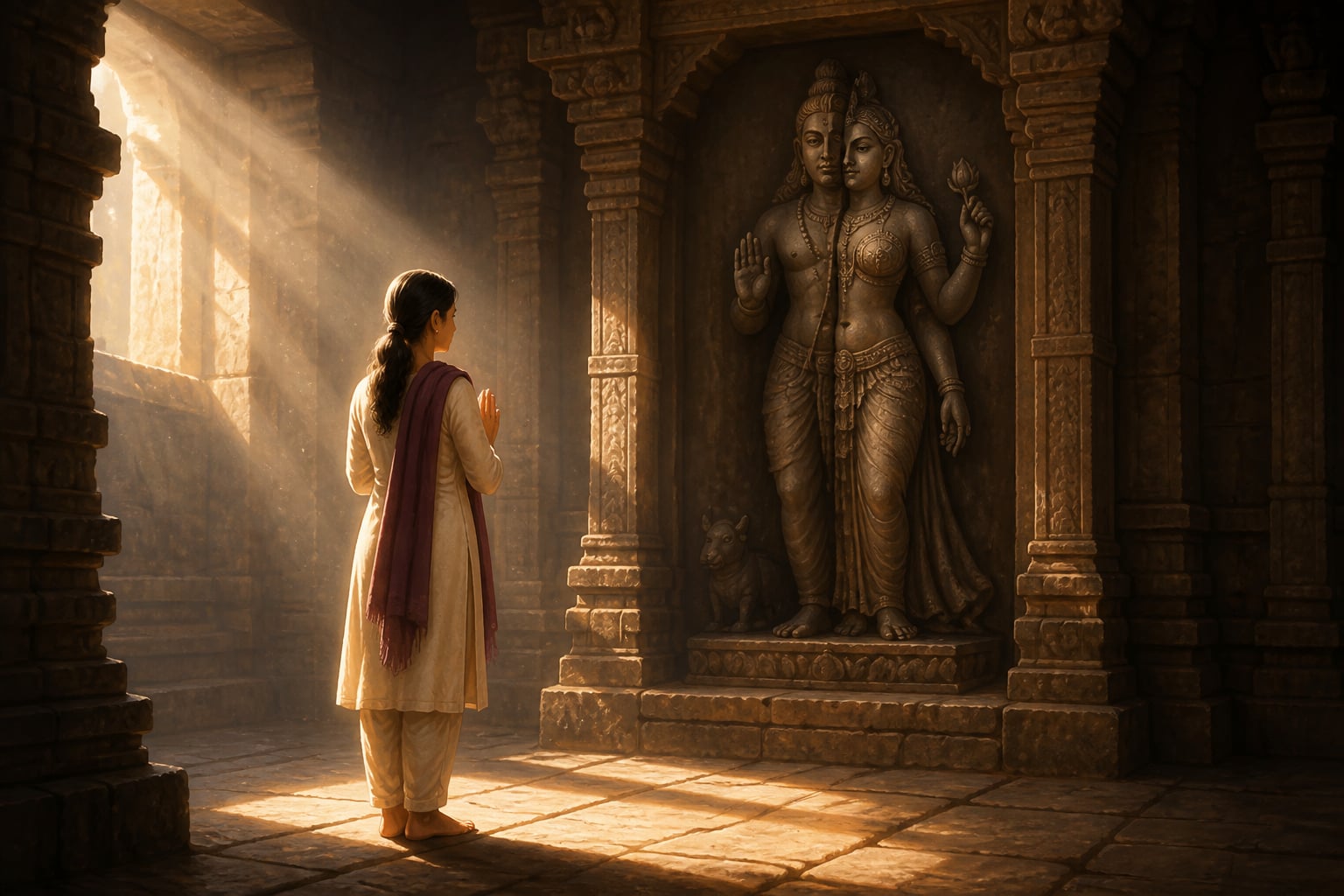
A visitor walks into the Gangaikonda Cholapuram temple in Tamil Nadu on a hot afternoon in 2026. The temple is a thousand years old, built by Rajendra Chola I after his armies marched to the Ganga and back. The granite is dark with age. Lamps flicker at the inner sanctum. The visitor turns left, moves along the outer wall, and stops in front of a niche.
In the niche stands a single figure carved from one block of stone. The right half is unmistakably Shiva. Matted hair piled high. A serpent at the neck. A tiger skin around the waist. The right hand holds a battle-axe.
The left half is unmistakably Parvati. Hair plaited and oiled. A heavy earring. A blouse and a sari fall down the left side. The left hip curves out the way temple sculptors carved goddesses for a thousand years. The left hand holds a flower.
Down the centre of the body, a vertical line. Two halves. One body.
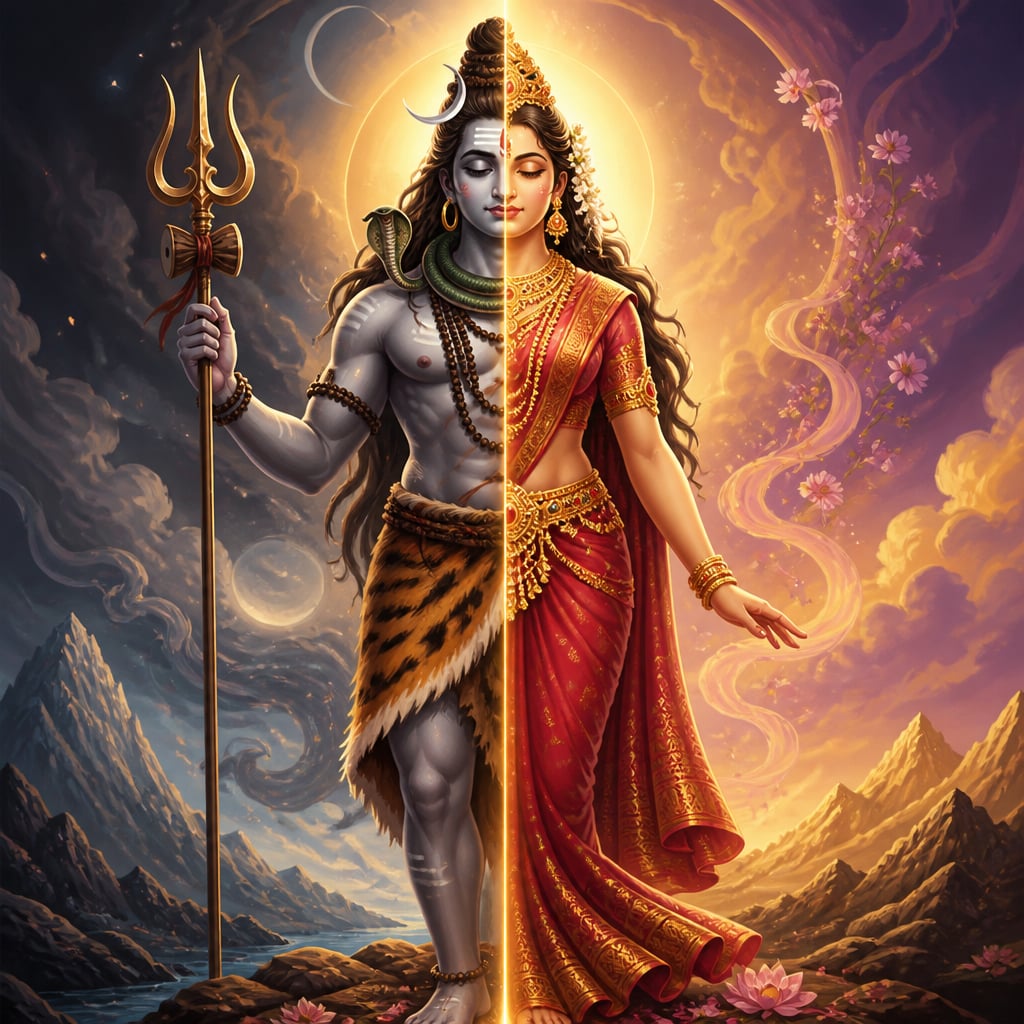
The visitor stops. The first reaction is almost always the same. Is this two gods stuck together. Is this a confused god. Is this some tantric symbol I am not supposed to understand. The temple priest, if asked, smiles and gives the answer the tradition has given for two thousand years. No. This is one being. He is called Ardhanarishvara. The Lord who is half woman. Look again.
The Story In The Shiva Purana
The Shiva Purana tells the story this way. Brahma, the creator, was busy. He had been told to fill the universe with beings. He made plants, animals, men. But the men he made could not reproduce. They simply existed and then stopped. Brahma sat down, troubled. The work was not working.
He turned to Shiva and prayed for help. And Shiva did something Brahma had not expected. He did not give Brahma a new technique. He revealed his own form. From his own body, Shiva manifested Ardhanarishvara. The right side himself, the left side the Goddess. He stood there, one being, two halves, and let Brahma look.
The Goddess then separated from his left side and stood beside him. Brahma understood. Creation needed two. Not because two gods were necessary, but because the one had two faces, and only when both faces moved together did anything new come into the world. Brahma went back to his work. The men he made now had a counterpart. The universe began to fill.
This is not a story about gender as we argue about it in 2026. It is a story about how anything at all gets made.
What The Two Halves Are Saying
The Shaiva tradition reads the two halves of Ardhanarishvara like a map. Each side carries a meaning, and the meanings are not interchangeable.
| The Right Side (Shiva) | The Left Side (Shakti) |
|---|---|
| Consciousness, the silent witness | Energy, the moving force |
| The seed | The field |
| Stillness | Activity |
| The unchanging | The changing |
| Knowing | Doing |
| Vairagya, detachment | Anuraga, devoted attachment |
Look at the columns for a moment. Pure consciousness, sitting alone, knows but does nothing. Pure energy, moving alone, does but knows nothing. The world we live in needs both. A scientist with insight but no instruments learns nothing. An engineer with instruments but no insight builds nothing useful. A parent with love but no boundaries raises a child who breaks. A parent with boundaries but no love raises a child who hides.
The icon is saying that wholeness is not a choice between the two columns. It is the two columns held in one body.
Why It Is Not Androgyny
A modern viewer often reaches for the word androgyny. The tradition gently refuses it.
Androgyny in the modern sense means neither. The androgynous figure has reduced both sides until they meet in the middle as a soft sameness. Ardhanarishvara is the opposite. The right side is fully male. The left side is fully female. Nothing has been blended. The masculine has not been softened. The feminine has not been hardened. Both are at full intensity, and then they are joined.
The tradition uses a sharp word for this. It is not bhinna, mixed. It is not eka, one in the sense of erased difference. It is advaita, not-two. The two are not collapsed. They are simply not separate.
This distinction matters. Wholeness is not the absence of poles. It is the presence of both poles in the same being. The icon stands at full stretch in two directions at once.
The Vedic Echo
The Shiva Purana did not invent this image out of nothing. The Brihadaranyaka Upanishad, composed many centuries earlier, had already said something similar.
स वै नैव रेमे तस्मादेकाकी न रमते। स द्वितीयमैच्छत्। स हैतावानास यथा स्त्रीपुमांसौ संपरिष्वक्तौ।
sa vai naiva reme tasmād-ekākī na ramate | sa dvitīyam-aicchat | sa haitāvān-āsa yathā strī-pumāṃsau saṃpariṣvaktau
He, alone, took no delight, for one alone takes no delight. He desired a second. He was as large as a man and a woman closely embraced.
Brihadaranyaka Upanishad 1.4.3
The Upanishadic sage is describing the original Self in the moment before creation. Not a male alone. Not a female alone. A man and woman in close embrace, one body, before separation. That is the seed of Ardhanarishvara. The Shiva Purana takes this Vedantic insight and gives it a face. The temple sculptor gives the face a stone.
Three thousand years from one line in the Upanishads to the niche at Gangaikonda Cholapuram. The argument has not changed.
The Uma Maheshwara Dialogue
This is also why most of the teaching in the Shiva Purana itself comes through dialogue. Parvati asks. Shiva answers. This pattern, called the Uma Maheshwara Samvada, runs through the Purana like a spine.
It is not because Shiva is the teacher and Parvati the student. It is because, in the tradition's reading, the question and the answer are also Shiva and Shakti. The question is the energy that reaches. The answer is the consciousness that receives. Without the question, the answer has nothing to land on. Without the answer, the question has nowhere to go. The dialogue itself is Ardhanarishvara in conversation.
When you sit with a difficult problem in your own life and turn it over and over in your head, you are doing the same thing. The asking is your Shakti. The listening is your Shiva. The insight comes when both are present in the same room.
What Wholeness Is Not
It is worth stating clearly what Ardhanarishvara is not teaching, because the icon gets pulled in many directions.
- It is not teaching that men should become more feminine and women more masculine. The icon is about the inner couple, not the outer one.
- It is not teaching that the difference between consciousness and energy is illusory. The vertical line down the body is real and stays.
- It is not teaching that the masculine and feminine are equal in the sense of being the same. They are equal in the sense that neither half can be removed without the body collapsing.
- It is not a political icon. The Puranic poets were not arguing about office representation. They were describing reality.
What it is teaching is simpler and harder. The world is held up by the marriage of opposites. Sit. Move. Know. Do. Receive. Reach. Hold. Release. None of these alone can carry a life. Held together, they can.
Modern Echoes
The Swiss psychiatrist Carl Jung, working in Zurich in the 1930s and 40s, wrote at length about what he called the anima and the animus. The anima was the inner feminine in a man. The animus was the inner masculine in a woman. Jung argued that psychological maturity required befriending the inner counterpart rather than projecting it onto a partner. He never saw an Ardhanarishvara stone. The Indian sculptors had carved his argument fifteen hundred years earlier, in granite, on the south wall of a temple.
More recent management research points the same way. Adam Grant, the Wharton organisational psychologist, has written across the 2010s and 2020s about what he calls givers and takers and about ambivalent leaders who can hold both assertion and humility. The leaders who burn out, in his data, are the ones who pick a single mode and live there. The ones who scale are the ones who can move between modes without losing themselves. That is the Ardhanarishvara teaching translated into a quarterly review.

The Indian classical dance tradition kept the icon alive most directly. Bharatanatyam dancers train in two registers, the tandava (the vigorous, masculine) and the lasya (the graceful, feminine), and the most senior dancers are praised when they can hold both inside a single piece. Rukmini Devi Arundale, who founded Kalakshetra in Chennai in 1936, used to tell her students that the dancer's body was itself an Ardhanarishvara, and that perfecting only one register was a half-finished art.
Back at Gangaikonda Cholapuram, the visitor steps closer to the niche. The vertical line is still there. The right side is still Shiva. The left side is still Parvati. Nothing has changed in the stone. What has changed is the way the visitor sees it. Not two gods. Not a confused god. One being, at full stretch in two directions, holding the world up by holding both.
In the next lesson, that one being begins to speak. The Goddess turns to him with her first question, and the Uma Maheshwara Samvada opens, the dialogue that carries most of the Shiva Purana from here on.
Key figures
Ardhanarishvara
The composite form of Shiva and Shakti, half god and half goddess, in one body
Brahma
The creator god of the Puranic trimurti, charged with populating the universe
Rukmini Devi Arundale
The 20th century reviver of Bharatanatyam who founded Kalakshetra in Chennai in 1936
Historical context
Late Vedic and Upanishadic seed (c. 1000-600 BCE) through the great age of Chola temple sculpture (c. 850-1280 CE)
Across roughly two thousand years, the Ardhanarishvara image moved from a verse in the Brihadaranyaka Upanishad to a sculptural form in the Gupta period, to the colossal relief at Elephanta under the Kalachuris in the 6th century, and finally to its highest refinement under the imperial Cholas of Tanjore in the 10th and 11th centuries. The Cholas were not only patrons of the form. They wove it into a state aesthetic that fused royal power, temple ritual, and dance, with Ardhanarishvara as the central theological image of integration.
Living traditions
The Ardhanarishvara form has crossed from sanctuary to stage to research lab over the last century. It anchors the Bharatanatyam repertoire through Rukmini Devi Arundale's Kalakshetra tradition (founded 1936). It has been the subject of multiple major art history monographs by scholars like Stella Kramrisch and Vidya Dehejia. Carl Jung's anima-animus framework is regularly compared to it in cross-cultural psychology curricula at universities like the California Institute of Integral Studies. The Tiruchengode temple, dedicated to Ardhanarishvara himself, draws over a million pilgrims annually, with a particular tradition of married couples climbing the 1206 steps together as a renewal of the marriage vow.
- Ardhanarishvara Stotra Recitation: Daily recitation of the Ardhanarishvara Stotra (sometimes called the Ardhanari Nateshvara Stotra), an 8-verse hymn attributed to Adi Shankaracharya. Each verse describes alternating attributes of the right half and the left half. Devotees chant it morning and evening, often in front of a small Ardhanarishvara image.
- Tandava-Lasya Training in Bharatanatyam: Bharatanatyam dancers train in two registers, the vigorous tandava and the graceful lasya. Senior performers are praised when a single piece holds both. The Ardhanarishvara stotra is itself a popular item in Bharatanatyam repertoire, performed with the dancer changing posture down a vertical centre line.
- Elephanta Caves: A UNESCO World Heritage rock-cut cave temple complex from the 6th century CE. The main cave's western wall holds one of the earliest and finest large stone Ardhanarishvara reliefs in India. The right half rests a hand on Nandi the bull. The left half holds a mirror, the classical attribute of Parvati. The form towers over the visitor at roughly twice human height.
- Gangaikonda Cholapuram Temple: Built by Rajendra Chola I around 1035 CE to commemorate his victorious Ganga campaign, this UNESCO World Heritage site is the lesser-visited sister of the Brihadeeswara temple at Thanjavur. The outer walls carry one of the most refined Chola Ardhanarishvara stone niches anywhere in India. The temple is generally uncrowded, allowing long uninterrupted contemplation of the form.
- Tiruchengode Ardhanareeswarar Temple: One of the very few major temples in India where the principal deity is Ardhanarishvara himself, here called Ardhanareeswarar or Ammayappan. The temple sits on a hill of red rock and dates back to early Chera and Chola patronage. Devotees climb 1206 steps to reach the sanctum. The temple is especially associated with prayers for healthy marriages and reconciliation between estranged spouses.
Reflection
- Which half of Ardhanarishvara, the still witnessing Shiva or the moving doing Shakti, do you most often refuse in yourself, and what has refusing it cost you so far?
- Why do you think the Shiva Purana introduces Ardhanarishvara as Brahma's solution to a creation that would not work, rather than as a free-standing theological image?
- If reality itself is Ardhanarishvara, advaita rather than eka, what does that say about the modern impulse to dissolve all differences in the name of equality?