Upamanyu: The Boy Who Asked for a Milk Ocean

Ask for the infinite. Shiva delivers.

A small boy named Upamanyu tastes milk at his uncle's house and refuses to go back to rice-water. His mother shapes milk from ground lotus petals. He finds her out and runs into the forest to do tapas. He asks Shiva for a river of milk and Shiva grants it. The lesson reads what the boy's hunger was actually for.

The Bowl of Rice-Water

In a small ashrama near the foothills of the Himalayas, sometime in the long Puranic stretch when the rishis still walked the forest paths and their children were raised on whatever the forest gave, a boy named Upamanyu sat in front of his mother holding a small wooden bowl. He was perhaps five years old. The bowl was full of a thin white liquid. He had eaten it every day of his life.

Upamanyu's father was the rishi Vyaghrapada, the one whose feet had become tiger-like from years of standing in the forest. The family was a Shaiva ascetic family. Their food was simple. Their house was a hut of leaves. The white liquid in the bowl was not milk. It was rice-water, the cloudy water left after rice had been boiled, which the mother had been giving the boy and calling milk because there had never been milk to give.

That morning was different. The day before, Upamanyu had walked with his mother to his maternal uncle's house some distance away. His uncle was wealthier. His uncle had cows. At lunch, Upamanyu had been given a small cup of warm cow's milk for the first time in his life. He had drunk it slowly. He had set the cup down very carefully. He had not said anything.

Now he was home. The bowl in front of him was rice-water, like every other morning. He looked at it. He looked at his mother. And he began to cry.

"Amma," he said. "This is not milk. I have tasted milk. This is not it."
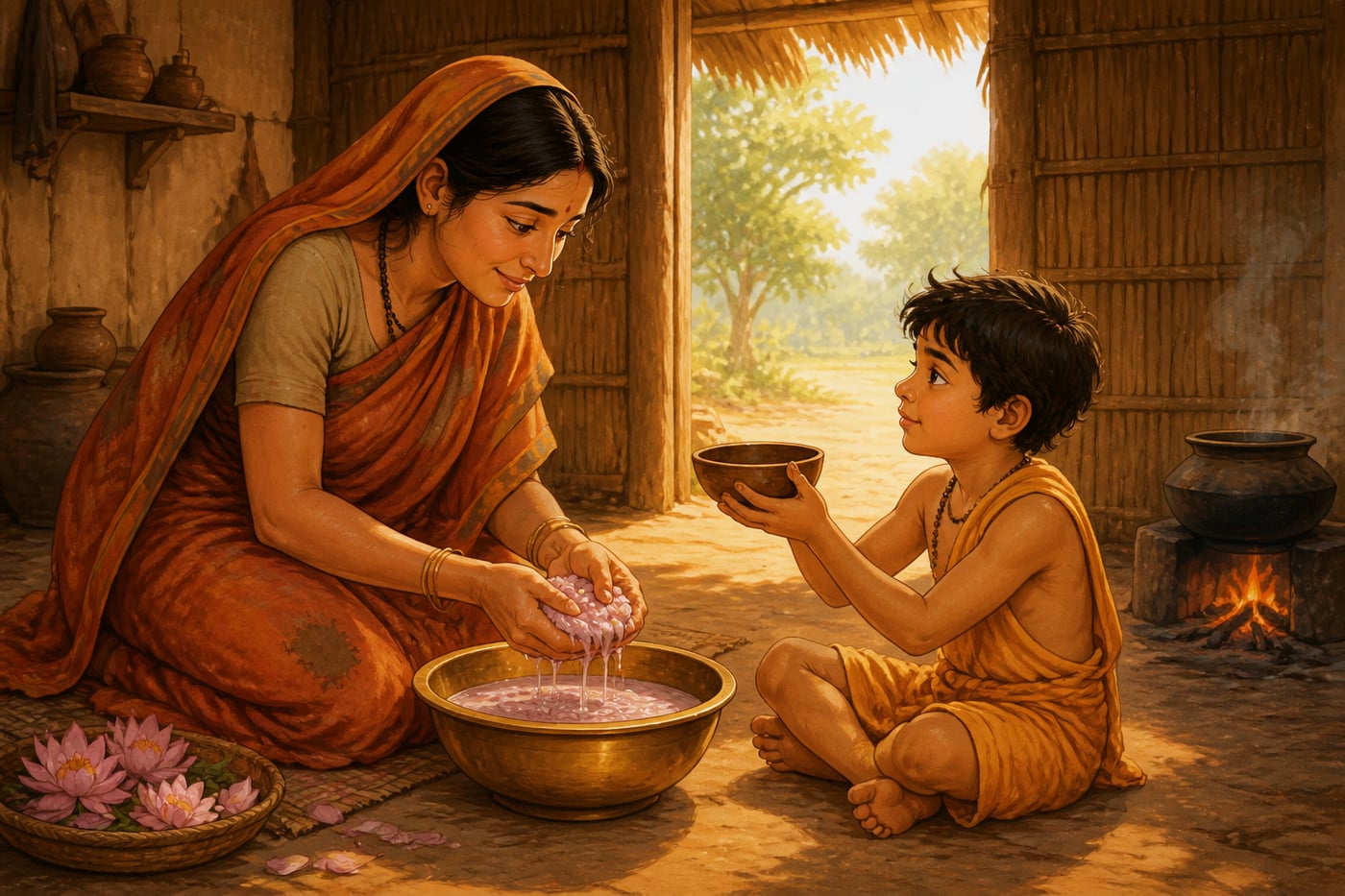
Upamanyu's mother kneading lotus-petal milk

The mother sat down in front of him. She did not lie a second time. She told him the truth. They were poor. They had no cows. The white drink she had been giving him was rice-water, and she had called it milk because she could not bear to tell a small child that he had never had milk.

The boy listened. Then he asked the question every Shaiva story eventually pivots on.

"Then who can give me milk, Amma. Real milk. Not from a single cow. Enough milk that I will never be hungry for it again."

The mother looked at her son for a long time. Then she said, very simply, the sentence that would change his life.

"Only Shiva can give that, my child. Not a cup. Not a jug. Not a single cow's worth. If you ask Shiva, he can give you an ocean of milk."

Into the Forest

The boy stood up. He walked out of the hut. He did not look back. The mother did not stop him, because she understood, in the way Puranic mothers in these stories always understand, that what had just woken in her son was not a tantrum. It was the beginning of a tapas.

Upamanyu walked into the forest. He was a child. He had no provisions. He had no map. He sat down under a tree, folded his small legs, closed his eyes, and began to chant the Panchakshari mantra, the five-syllable Shaiva mantra, Om Namah Shivaya, which his father had taught him at the age the family taught reading. He repeated it. He did not stop.

Days passed. The forest watched. The animals did not trouble him. Birds rested on his shoulders. His small body grew thin. The Shiva Purana lingers on this image because it is an image the tradition treasures: a tiny boy alone under a tree, eyes closed, repeating five syllables, asking the universe for an ocean of milk.

The boy's tapas grew so heated that the heavens noticed. The cosmic order is precise about tapas. When a discipline that intense reaches a certain temperature, the gods are obliged to respond.

The Test of Indra

The first to come was not Shiva. It was Indra.

Indra on Airavata testing the boy with gifts

Indra appeared in the forest in his full kingly form, riding the white elephant Airavata, surrounded by light. He stopped before the boy. He spoke kindly.

"Child, your tapas is great. I am Indra, king of the gods. I will grant you whatever you ask. Cattle, kingdoms, gold, long life. Name it."

Upamanyu opened his eyes. He looked at Indra. He shook his head.

"I have not been asking you," the boy said. "I have been asking Shiva."

Indra tested him further. He took the form of Shiva himself, standing before the boy with the trident and the matted hair and the third eye. He offered the boy a great boon, a cup of celestial milk, even a small herd of divine cows.

Upamanyu, even as a child, saw through it. The Shaiva tradition is precise about how he saw through it. He noticed that the figure in front of him was praising Indra and disparaging Shiva in subtle ways inside the offer. The real Shiva would never speak like that. Real Shiva does not need to compete.

The boy refused. He kept refusing. Indra grew impatient. In some retellings of the story, Indra threatens to strike the boy with the vajra. The boy does not flinch. He says, very calmly, that even if his body is destroyed, he will not stop asking Shiva for the ocean of milk. He has tasted milk once. He will not settle for less than the infinite version of it.

This is the moment the story turns.

Shiva Arrives

The Shiva Purana describes the next instant with restraint. The figure of Indra dissolves. In its place, the real Shiva stands, with Parvati beside him. The matted hair is real. The crescent moon is real. The ash-smeared body is real. The eyes are gentle, not testing.

Shiva looks at the boy. The boy looks at Shiva. Neither speaks for a moment. Then Shiva smiles.

"You did not flinch, child. You asked the right deity. You did not negotiate when the lesser god offered you a smaller version. You held the bow drawn at the right target. Now ask."

Upamanyu, in front of the actual Shiva, in front of the consort Parvati, did not become humble in the way most devotees are made to become in these stories. He was not asked to ask for less. The boy stood up. He bowed. Then he said, in the same childlike clarity he had brought to the rice-water bowl, what he had walked into the forest to ask.

"I want milk. Not a cup. Not a jug. A whole ocean of milk that I and my mother will never be hungry for again."

Shiva nodded. He raised one hand. And in front of the boy, in the small forest clearing where he had been sitting in tapas, the earth shifted. A vast white ocean appeared, stretching to the horizon. White waves of milk lapped against the boy's small feet. The smell of warm milk filled the forest. This was the Kshira-Sagara that Shiva gave Upamanyu, not in metaphor, in the literal Puranic sense, an ocean of milk created on the spot for a boy who had asked.

Shiva blessing the boy Upamanyu as an ocean of milk wells up

Shiva also made him immortal in his Shaiva line. He took the boy as his own. He gave him the full transmission of the Shaiva mantras, the secrets that great rishis spend lifetimes earning. Because the boy had asked for the infinite, Shiva gave him not only the milk but the path that produces all such oceans.

Why the Story Says Krishna Came Later

The Shiva Purana, in some recensions, and the Mahabharata's Anushasana Parva explicitly, carry a remarkable footnote to the Upamanyu story. Many ages later, Krishna himself walked to the Himalayas to seek a Shaiva guru. He had heard that Upamanyu was the keeper of the deepest knowledge of the Panchakshari and the Mahamrityunjaya. Krishna, who is Vishnu in human birth, sat as a student in front of Upamanyu, the rishi who had once been the boy with the rice-water bowl.

Upamanyu taught him. The Mahabharata records the teaching in some detail. Krishna performed tapas at Mount Munjavata under Upamanyu's guidance. He earned, through that practice, the Shaiva blessings that allowed his work in his own avatar to be completed.

This detail matters. The tradition wants the reader to notice that the boy who would not settle for rice-water grew into the rishi from whom even Krishna would learn. The size of what you ask for, when you are five, can shape what you become at five hundred.

The Size of the Asking

The Tripurantaka image is one cosmic teaching of the Shaiva tradition. The Upamanyu story is another. They are different in scale and tone, but they are the same teaching read from a different angle.

Most lives are spent asking for rice-water and being told it is milk. We negotiate with smaller deities. We accept Indra's cup when we should be waiting for Shiva's ocean. We are taught, gently, by people who love us, that the small thing in our bowl is the real thing, because the real thing was never on offer in the world they could give us.

The Shaiva tradition treats this as a soft tragedy. Not a moral failure. A simple loss. The mother in the Upamanyu story is not the villain. She gave her child what she had. The story turns not because the rice-water was wrong, but because the boy, for one accidental afternoon at his uncle's house, tasted what the actual thing was. After that, the rice-water could not pretend.

The 2026 Version

Most adult dissatisfaction is the felt weight of small askings. We ask for a slightly better job and we get it. We ask for a slightly nicer apartment and we get it. We ask for a relationship that is a little less painful than the last one and we get it. Each ask is reasonable. Each granting is real. And yet, year by year, something in us notices that we have never asked for the ocean.

The Shaiva teacher Ramana Maharshi, at his ashram at Tiruvannamalai in the twentieth century, once told a visitor who was asking for a small healing that the same effort it takes to ask for a small thing can be used to ask for the whole. Ramana, who died in 1950, was reading from the same Upamanyu lineage when he said this. The contemporary American teacher Adyashanti has phrased the same teaching in plainer English, that most spiritual seekers are asking for a slightly improved version of the self that is suffering, when the offer on the table is the dissolution of the self that is suffering. Same teaching, different century, same ocean.

The psychologist Abraham Maslow, in his late writings on what he called Being-needs, distinguished between deficiency-asking (asking for what you lack) and being-asking (asking for what you most fully are). The Upamanyu story is the tradition's much earlier version of the same insight. The boy was not asking for milk because he was hungry. He was asking for milk because he had tasted, once, what a complete fullness felt like, and he refused to forget it.

A Quiet Closing

The boy with the rice-water bowl did not cry because his mother had lied. He cried because he had remembered. The Shaiva path is, in its essence, a long apprenticeship in remembering. Once you have tasted the actual thing, even once, even by accident at your uncle's house when you were five, the small substitutes lose their power. You may still drink them, because life is long and milk is rare. But you will not, anymore, mistake them.

The ocean is still there. Shiva is still the deity who can give it. The bowl in front of you is not the question. The question is what you have been asking for, and whether the size of the asking matches the size of the thing you most need.

The boy walked into the forest. The mother let him go.

Living traditions

The Upamanyu story has had an unusually rich modern afterlife given the smallness of its protagonist. Mahatma Gandhi cited the story in his writings on swaraj as an early Indian model of asking for the entire thing rather than a negotiated lesser version, with self-rule playing the role of the milk-ocean and incremental dominion-status reform playing the role of Indra's cattle. Sri Aurobindo, in his commentaries on the Mahabharata, treats Upamanyu's transmission to Krishna as the textual model for what he called integral yoga, the refusal to accept partial liberations. The Tamil scholar Kamil Zvelebil, in his work on the Tirumurai, traced the boy in the story to the founding of the Chidambaram temple lineage through Vyaghrapada. In contemporary literature, the Tamil novelist Indira Parthasarathy adapted the Upamanyu story into a stage play in 1979 that ran for several seasons in Chennai and Madurai, casting Upamanyu's mother as the central figure rather than the boy. In Indian classical music, the Carnatic composer Gopalakrishna Bharati's nineteenth-century Nandanar Charitram refers to the Upamanyu story as the precedent for the lower-caste devotee's fearless ask; the lineage of fearless asking, in the Tamil Shaiva tradition, runs from Upamanyu through Nandanar to the modern bhakti movement. Perhaps most quietly, every household in India that gives a small child a cup of warm milk on a Shravan Monday is, whether they know it or not, performing a tiny Upamanyu rite. The boy's asking has shaped the daily texture of Shaiva domestic life for many centuries, and continues to.

Reflection

More in Devotees of Shiva

All lessons in Devotees of Shiva ยท Shiva Purana course