Chandesha: The Shepherd Who Struck His Father
Worship worth striking for
A boy in a Tamil village takes the community's cows and pours their milk on a sand Linga by a riverbank. When his own father comes to stop him, the boy strikes him with a stick. The Shiva Purana does not flinch at the violence. Chandesha is made the chief of Shiva's ganas, and every Shaiva temple ritual still ends with an offering to him.
The Sand Linga at the Riverbank
In a small village called Seynalur, on the banks of the Manni river in present-day Tamil Nadu, sometime in the early centuries of the Common Era, a Brahmin boy of about five or six was sent out each morning to graze the village cows. His name was Vichara Sarma. The cows belonged to the village. The grass belonged to the floodplain. The boy belonged, by every measure his father had set, to the duties of his caste.
The boy had a different intention. Each morning, after he led the cows to the meadow, he would walk to the edge of the Manni, scoop up wet sand, and shape it into a small linga. He would gather flowers from the bank, leaves from the bilva tree at the meadow's edge, and a small clay pot of water. Then he would do something the village had not authorised. He would take the milk of the village cows, the milk that was meant for the morning offerings of the householders, and pour it over the sand linga as abhisheka.
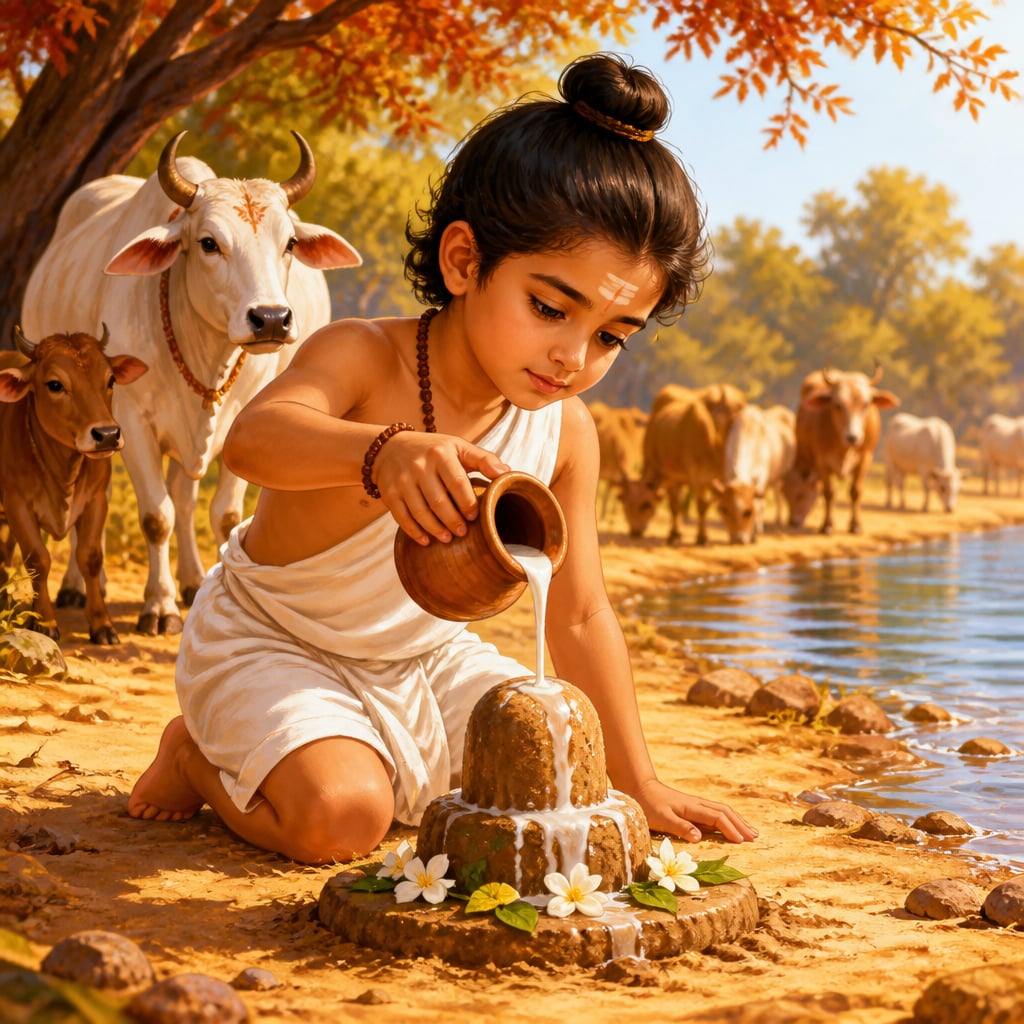
The linga was the size of a child's fist. The cows did not protest. The river kept moving. The boy, alone at the edge of a meadow, conducted his small worship with the absorption of someone who had forgotten that the world was watching. He was about to discover that the world was, in fact, watching, and that the world's first response to a child's worship is rarely tenderness.
The Father Arrives
Word travelled. The villagers, missing milk in the evening pots, began to ask where it had gone. A neighbour saw the boy at the riverbank and reported it to the boy's father, Echchadattan, a strict Brahmin who held his household and his caste duties with the gravity of a man who had been taught that gravity was the whole of religion.
Echchadattan came to the meadow at dawn the next morning. He hid behind a tree. He watched his son lead the cows to the grass, walk to the river, scoop the sand, build the small linga, and then, calmly, milk the cows directly into a clay pot and pour the entire pot over the sand. The father's reaction was immediate and unambiguous. This was theft. This was the wasting of food the village depended on. This was a child usurping a ritual that, by every rule the father knew, belonged to the trained and initiated, not to a six-year-old at a riverbank with no formal sanction.
Echchadattan stepped out from behind the tree. He shouted at the boy. The boy did not hear. He was, by this point, in deep absorption, eyes closed, repeating the Panchakshari mantra with each pour of milk. The father walked to the linga. The boy did not see him approach. The father drew back his foot and kicked the small sand linga over.
The Periya Puranam records the next moment with a stillness that has unsettled readers for fifteen centuries. The boy opened his eyes. He saw the linga in pieces in the wet sand. He saw his own father standing over it. His face did not crumple in childlike grief. It hardened into something the village had never seen on a child's face before.
The boy reached for the wooden staff he carried for the cows. He swung it.
The Strike

The Periya Puranam is careful here. It does not soften the moment. The boy struck his own father with the staff. The blow severed his father's foot at the ankle. The father fell.
This is the moment that has made every careful reader of the Nayanmar canon stop and breathe. The Shaiva tradition is not flinching from what it is showing. A son has just maimed his father. By every standard of ordinary dharma, by the law of the Manusmriti, by the village's understanding of right and wrong, the boy has just committed one of the most catastrophic acts a child of his time could commit. Striking a parent was a sin so heavy that the lawbooks placed it among the mahapatakas, the great sins for which atonement could be lifelong.
The Periya Puranam holds the moment open. The boy did not strike in confusion. He did not strike in childhood tantrum. He struck because, in the ordering of his interior world, the linga was his father, and his biological father had become, in the moment of the kick, the obstructor of that deeper father. He struck because the worship was the relationship that, for him, contained every other relationship.
A pillar of light rose from the broken sand. Shiva, in his Chandeshvara form, stepped out of the light. He walked to the boy. He embraced him. He spoke a sentence that the Periya Puranam has held as one of the most controversial and most loved declarations in the entire Shaiva canon.

From this day, you are my son. You have left the lineage of Echchadattan. You will be called Chandesha, the Fierce One. You will be the first servant of my household. The leaves and flowers of every offering, after I have received them, will pass into your hand. What I leave on the plate is yours.
Shiva turned to the fallen father. He restored the foot. He restored Echchadattan to wholeness. He did not punish him. The Periya Puranam is precise about this too. The father had acted from the only understanding he had. He was not the villain of the story. He was the boundary the boy's bhakti had to break through.
What the Story Is Refusing to Smooth Over
Most traditions, faced with a story like this, would soften it. They would make the boy's blow accidental. They would have the father survive the kick by some cosmic deflection. They would arrange for the conflict to dissolve without the child's hand actually rising against the parent.
The Shaiva tradition refused all of those exits.
The Periya Puranam holds the strike as the strike. It then asks the reader to sit with what the strike means. The story is not approving the act in any general sense. It is not telling the reader that children should hit their parents. It is making a much harder point, and the point is at the level of dharma's deepest hierarchy.
Ordinary dharma holds that a child must not strike a parent. This is true and binding for the householder.
Para-dharma, the higher dharma of one whose entire life has been turned toward a single absolute, has different obligations. When the absolute is in front of the devotee and is being actively desecrated, the devotee's hand rises in defence of the absolute even at the cost of every ordinary tie. The Shaiva tradition reads Chandesha's strike as an act of this kind. It is not a model for everyday life. It is a marker of how completely the boy had given his life to Shiva before the strike was ever needed.
The story is also making a structural argument that has been read carefully by every Shaiva acharya since the 12th century. Shiva's response, from this day you are my son, is the tradition's claim that there is a kind of bhakti so total that it constitutes a new birth. The boy has not killed his father. He has, however, left his father's lineage in the most absolute way the tradition has language for. He is now, in the temple's records, the son of Shiva. He has become, in a new and irreversible way, Mahadeva-putra, the son of the Great God.
This is also why every Shiva temple in South India has, to this day, a small shrine to Chandesha just outside the inner sanctum, and every devotee, on leaving the sanctum, claps their hands gently before passing him. The clap is the announcement to Chandesha that the devotee is leaving with nothing that does not belong to them. He is the keeper of Shiva's household. The story of his birth into that role has been preserved without softening for fifteen centuries.
The Periya Puranam Frame
Chandesha's story is not from the Shiva Purana proper. It is from the Periya Puranam, the 12th-century Tamil hagiography of the sixty-three Nayanmar saints, composed by Sekkizhar at the court of the Chola king Kulottunga II. Sekkizhar wrote the Periya Puranam to preserve the lives of the Tamil Shaiva bhaktas whose devotion had built the Shaiva landscape of the south. He included Chandesha as one of the sixty-three.
This is important. The Shiva Purana, composed in Sanskrit in the broad Puranic compilation period, holds the cosmic and the philosophical. The Periya Puranam, composed in Tamil at the height of the Chola empire, holds the human bhakta. The two streams meet in this chapter of the Talapatram course because the Shaiva tradition is, by design, the union of the Sanskrit cosmic and the regional human. Chandesha, Kannappa, and Karaikkal Ammaiyar arrive in this chapter not as Shiva Purana figures but as the Periya Puranam's gift to the broader Shaiva canon.
The lesson cites the Periya Puranam as its source for the same reason the Kannappa lesson before it does. The Talapatram tradition does not pretend that the Tamil Shaiva tradition is somehow secondary to the Sanskrit. They are equal sources of the Shaiva life. The Periya Puranam's literary register is plain, its moral register is fierce, and its psychological register is precise. The Chandesha story is one of its most uncompromising chapters.
The Inner Hierarchy of Loyalties
The story's hardest teaching, when it is finally lifted from the literal frame, is about the inner hierarchy of loyalties. Every life has many loyalties. Family. Work. Community. Tradition. The personal absolute, whatever the practitioner has named as the unbreakable centre of their life. Most days, these loyalties run together without conflict. The day they conflict is the day a person discovers what their actual hierarchy is.
For most householders, the answer the tradition gives is gentle. Family takes precedence. Community takes precedence. Personal sadhana adjusts to make room. The Shaiva tradition agrees with this for the householder.
The Chandesha story is about the boy whose interior hierarchy had already settled, before the moment of conflict, on a different order. For him, the linga at the riverbank was the centre. Everything else was the circumference. When the circumference came at the centre with a foot, the centre held. The centre's holding looked, to the village, like a child striking his father. To Shiva, it looked like a son finally being recognised.
The lesson is asking the reader to sit with the inner question, even if no outer act will ever follow from it. What is the centre of your life that, if it were threatened, would settle every other question without your needing to ask? Most modern lives, asked this question honestly, discover that they do not have a settled centre. That discovery is the first half of the lesson. The second half is the slow, unflashy work of giving one of the loyalties enough weight that, if the day ever came, the answer would be ready before the question arrived.
Modern Echoes
The Chandesha story has been read carefully by 20th-century thinkers who tried to understand bhakti as a psychological structure. A.K. Ramanujan, in his 1973 translations of the Vachanas of the Lingayat saints, returned repeatedly to the Chandesha episode as the sharpest example of what he called the bhakta's vertical loyalty, the loyalty to the divine that runs perpendicular to all the horizontal loyalties of family, caste, and community. He read Akka Mahadevi's walking away from her marriage and Karaikkal Ammaiyar's prayer to lose her beauty as later reformulations of the same Chandesha move. The horizontal tie is broken so the vertical tie can be honoured. The break is not casual. It is the cost the bhakta pays.
The American psychologist William James, in The Varieties of Religious Experience (1902), described what he called the divided self that finds, through religious conversion, a single new centre that reorganises all of life's prior loyalties. James did not know Chandesha, but his analysis of the converted self could have been written for him. The Chandesha story is the dharmic tradition's older and more uncompromising version of the same insight: the truly converted self does not negotiate with prior loyalties. It receives them, gently or sharply, into a new order.
In 2019, the Madras High Court heard a case concerning the Chandesha shrine at the Brihadeeswarar temple in Thanjavur. Pilgrims had complained that the customary clap before leaving the sanctum was being discouraged by a temple administrator who found it disruptive. The court ruled, citing the Periya Puranam directly, that the clap was a continuous fifteen-century-old practice that the temple administration had no authority to alter. The boy who struck his father with a staff in the early centuries of the Common Era is, in 2026, still being acknowledged by every devotee who leaves the inner sanctum of every major Shiva temple in Tamil Nadu, Andhra, Karnataka, and across the South Indian diaspora. The clap is the village's quiet, fifteen-century-old apology to the boy whose strike it once thought it understood.
Back on the riverbank at Seynalur, the milk has long since soaked into the sand, and the sand linga is gone. What remains is the shrine, the clap, and the question Shiva's embrace asked of every reader since: when the day arrives that asks you to choose, will you know what your centre is, and will you have given it enough weight in the years before to hold the moment?
Historical context
The historical setting of the Chandesha story is the early centuries of the Common Era in the Tamil country. The canonical literary record is the 12th-century Periya Puranam, composed by Sekkizhar at the Chola court of Kulottunga II in the late 1100s.
The Chandesha story is one of the cornerstones of the Tamil Shaiva canon and has been continuously preserved across all four South Indian languages for at least fifteen centuries. The story's textual history is unusual. It is not in the Sanskrit Shiva Purana proper, which holds the cosmic and philosophical material of the Shaiva tradition. It is in the Periya Puranam, the 12th-century Tamil hagiography that brings the regional human bhakta into the Shaiva canon. The two streams are read together by the modern Saiva Siddhanta tradition without hierarchy, a pattern that the Talapatram course follows. The Chola period (9th to 13th century) was the great age of the Chandesha story's institutionalisation: the construction of the Brihadeeswarar shrine, the composition of the Periya Puranam, the codification of the agamic abhisheka sequence, and the standardisation of the temple clap all date to this period. Subsequent Vijayanagara, Nayaka, and Maratha rulers maintained the institutional infrastructure, and the modern Tamil Nadu HR&CE Department now administers the major Chandesha shrines as part of the Devasthanam system. The story has also crossed into the Veerashaiva (Lingayat) tradition in Karnataka, where the Vachanas of Basavanna and Akka Mahadevi reference the Chandesha episode as canonical bhakti precedent.
Living traditions
Chandesha's legacy in 2026 lives more in the body of practising Shaivas than in the body of texts. The Chandesha clap remains the single most widespread living daily trace of the Periya Puranam in modern Shaiva ritual, performed millions of times each day across South India and the diaspora. The 2019 Madras High Court ruling that protected the practice at the Brihadeeswarar Temple has become a frequently-cited precedent in Indian temple-administration law, and the case is taught in the Saiva Siddhanta theological seminaries at Tiruchirapalli and Madurai. The Periya Puranam itself was published in a definitive critical edition by the Saiva Siddhanta Maha Samajam in 2014, and the Chandesha canto is among the most performed in the modern Periya Puranam katha tradition that continues at major Tamil temples. A 2022 Tamil-language film, Periya Puranam Padalgal, included a long sequence on the Chandesha episode that drew sustained public commentary on the moral complexity of the strike, with a notable defence published in Vikatan magazine arguing that the story remains the dharmic tradition's most uncompromising statement of the bhakta's interior priority. The Saiva Siddhanta Maha Samajam runs an annual Chandeshvara Bhakti Camp at the Seynalur temple every Chitra Pournami, drawing roughly two thousand young Tamil Shaivas each year for a three-day immersion in the Periya Puranam canon. The boy who struck his father at the Manni river is, fifteen centuries later, more institutionally alive than at any point since the Chola period, which is perhaps the longest commentary the tradition has ever offered on the embrace that followed the strike.
- The Chandesha Clap on Leaving the Inner Sanctum: The continuous fifteen-century-old practice of the gentle hand-clap performed by every devotee on stepping out of the inner sanctum of a South Indian Shiva temple. The clap is addressed to the small Chandesha shrine traditionally located on the north wall of the sanctum and is the devotee's announcement to Chandesha, the keeper of Shiva's household, that nothing of the temple is being carried out by mistake. The practice is taught informally from grandparents to grandchildren and is the most widespread daily living trace of the Periya Puranam in modern Shaiva life. Despite the rapid disappearance of many older temple practices, the Chandesha clap has remained remarkably resilient, partly because it is taught in the body before it is taught in words, and partly because the agama tradition of the Saiva Siddhanta priests has continued to embed it in temple manuals.
- The Chandeshvara Abhisheka Sequence: The traditional sequence of pouring abhisheka first on the main Shiva linga and then on the Chandesha shrine, performed by Saiva Siddhanta priests at major South Indian Shiva temples and also kept by some householders during the Pradosham evening worship at home. The sequence enshrines the Periya Puranam's teaching that Chandesha is the keeper of the nirmalya. After the priest pours milk, curd, ghee, honey, and water on the main linga, a small portion is poured on the Chandesha shrine to acknowledge his appointment as the consumer of the offering's remainder. The practice is most visible during the monthly Pradosham, when the entire abhisheka cycle is repeated twice in the same evening at most major temples.
- Chandeshvara Temple at Seynalur: The canonical birthplace of Chandesha and the small temple that preserves the riverbank tradition. The temple is rural, modest in scale, and built around a small sanctum housing a Shiva linga that tradition associates with the boy's original sand linga. The temple courtyard contains a small bronze utsava murti of Chandesha that participates in the regional Nayanmar festivals. The temple is part of the Saiva Padal Petra Sthalam circuit and is on the Periya Puranam pilgrimage route. A short walk leads to the bank of the Manni river where the canonical site of the boy's worship is marked by a small shrine.
- The Chandesha Shrine at Brihadeeswarar Temple: The most architecturally significant Chandesha shrine in India, located on the north wall of the inner sanctum of the Brihadeeswarar Temple, the 11th-century Chola masterpiece built by Rajaraja Chola I and a UNESCO World Heritage Site. The shrine is set into the vimana wall and contains a black granite seated image of Chandesha holding the wooden axe that, in the Saiva Siddhanta iconography, replaces the shepherd's staff of the original story. The image is one of the canonical models for Chandesha iconography across South India, and Saiva Siddhanta priests across Tamil Nadu cite this shrine as the standard for their own temple's Chandesha shrine dimensions and orientation. The clap practice is most visible here because the shrine is on the standard pradakshina route around the inner sanctum.
Reflection
- If a moment came tomorrow that asked you to choose between three of your deepest loyalties, which one would the answer come from before you had time to think?
- Why does the Periya Puranam refuse to soften the strike, when it would have been so easy to make the boy's blow accidental or the father's injury cosmically averted?
- What does it mean about the dharmic worldview that ordinary dharma and para-dharma can collide so completely that the resolution is not a synthesis but an embrace by Shiva himself?