Kirata: Arjuna Meets Shiva the Hunter
The hunter who was the god
Exiled in the forest, Arjuna walks alone into the Himalayas to do tapas. He needs the Pashupatastra, the great weapon of Shiva, for the war he can already see coming. Shiva tests him first as a hunter named Kirata, takes his arrows, and fights him hand to hand. The weapon is given only after Arjuna keeps fighting with bare hands.
A Bowman Alone in the Snow
Somewhere in the high reaches of the Himalayas, on a ridge above the Indrakila mountain, Arjuna stood alone. His brothers were far below, in the Kamyaka forest, eating roots and waiting out the years of exile. He had walked for weeks to reach this place. His feet were cracked. His lips were split from cold. His bow, the Gandiva, was wrapped in cloth and slung across his back, useless for now.
He had come to do tapas. He needed a weapon his brothers did not have. He needed the Pashupatastra, the weapon of Shiva himself, the one arrow in the cosmos that could end any enemy, any army, any age. The war with the Kauravas was thirteen years away, but he could already see it. He had been told, by the sage Vyasa himself, to come to this mountain and ask.
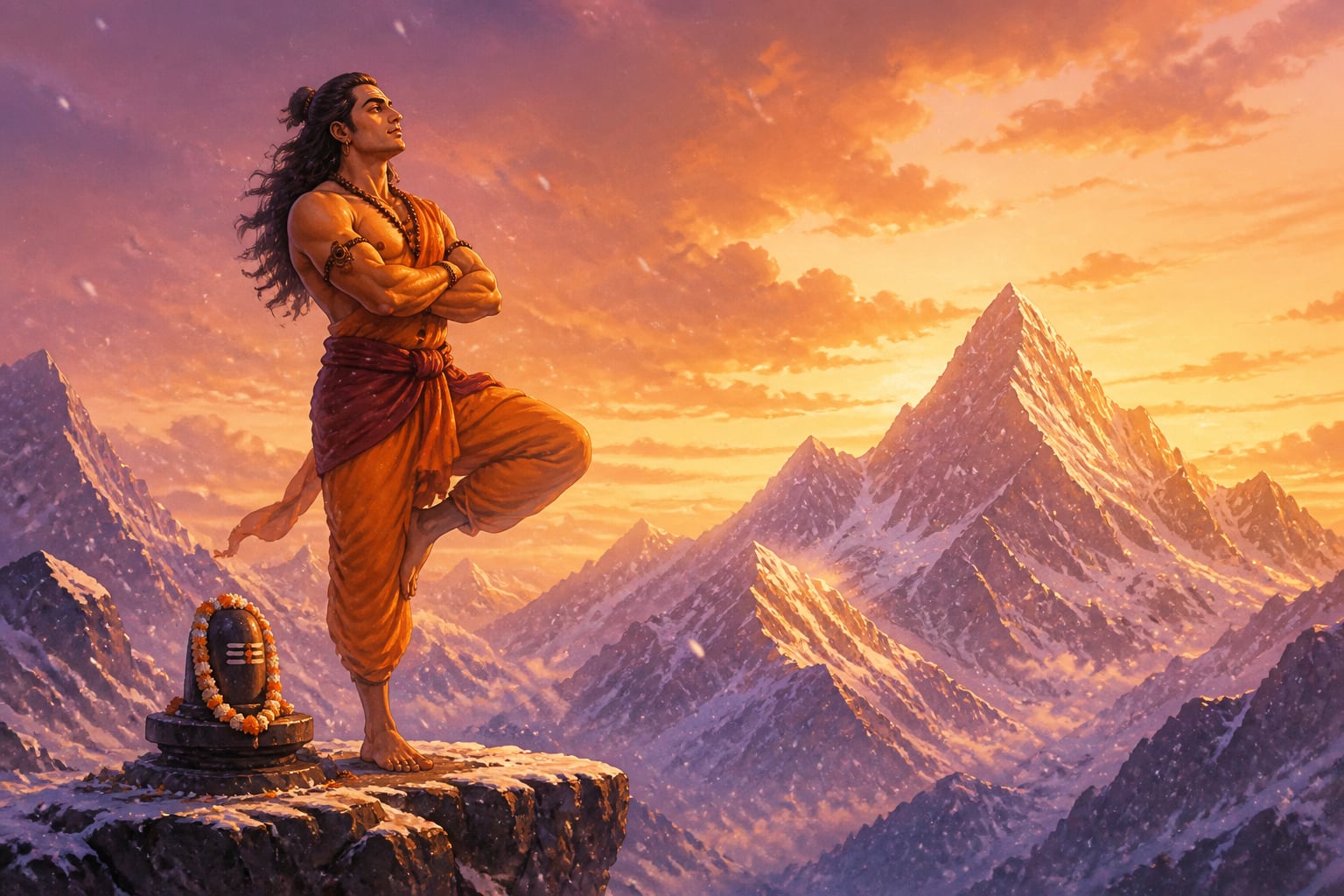
For months Arjuna stood on one foot, eating fallen leaves, then air, then nothing. The other rishis on the mountain grew worried. "This man's tapas is shaking the worlds," they said. They went, eventually, to Shiva.
Shiva listened. Then he smiled, in the way he sometimes does when he is about to test someone he loves.
The Boar in the Clearing
The story is told in the Mahabharata's Vana Parva, in a section called the Kairata Parva, the parva of the hunter. The Shiva Purana retells it in the Rudra Samhita, mostly the same way, with the same restraint.
One morning, while Arjuna was deep in his standing tapas, a great wild boar burst out of the forest. It was huge, black-bristled, eyes red, charging straight at him. The Mahabharata names it as a demon called Mukasura in disguise, sent to kill the meditating prince. Arjuna, eyes still half-closed, reached for his bow without thinking. He nocked an arrow. He shot.
At the same instant, another arrow struck the boar from a different direction. Both arrows went through. The boar fell, dead, with two shafts buried in its flank.
Arjuna opened his eyes fully. Across the clearing stood a man he had not seen before. A Kirata, a tribal hunter, dark-skinned, dressed in animal hides, a small woman beside him in similar dress. The hunter's bow was still drawn. His face was calm.
"This is my kill," the hunter said. "I tracked this boar for three days."
Arjuna, who had not spoken to a human in weeks, was annoyed.
"My arrow struck it first," he said. "Stand aside."
The hunter did not stand aside.
The Fight
The argument grew. Arjuna, son of Indra, prince of the Pandavas, the greatest archer of his age, was used to being deferred to. The hunter showed no sign of deferring. The Mahabharata records the exchange with a kind of dry humour. Arjuna gestured with his bow. The hunter shrugged. Arjuna threatened. The hunter laughed.
Finally Arjuna shot at him.
The arrow went, and went again, and went again. The Gandiva poured arrows like rain. The hunter caught them, broke them, side-stepped them, sometimes simply stood still and let them strike his chest where they fell at his feet without leaving a mark. Arjuna's quivers, the famous Akshaya tunira that never emptied, emptied. The Gandiva, the bow Agni had given him, splintered in his hands.
Arjuna threw down the bow. He picked up his sword. The hunter broke the sword. Arjuna lifted a tree. The hunter caught it. Eventually, with nothing left, Arjuna closed the distance and grappled the hunter bare-handed.

The wrestling match lasted hours. Arjuna was the strongest man of his generation. The hunter was stronger. He held Arjuna against his chest the way a father holds a struggling child. The strength drained out of Arjuna's body. He sank to the ground. He was, for the first time in his adult life, completely defeated.
A Garland on the Linga
When he could move again, Arjuna crawled to the small earthen Shivalinga he had been worshipping every morning at the edge of his clearing. He had a fresh garland of forest flowers in his hand. He laid it gently on the linga. He bowed. He sat back to recover his breath.
Then he looked up, and stopped breathing.
The garland was not on the linga. It was around the neck of the Kirata hunter, who stood a few feet away, smiling.
Arjuna's mind, in that single moment, did three things at once. It saw the hunter. It saw the linga. It saw the same flowers in two places that should have been one. The Mahabharata describes the recognition as a wave that begins in the chest and rises into the throat. Arjuna stood up. He walked, slowly, to the hunter's feet. He fell.
"Forgive me, Mahadeva," he said. "I did not know."
The hunter became Shiva. The small woman became Parvati. The clearing filled with the soft light the Puranas keep describing whenever a divine form is finally allowed to be seen.
What the Testing Was For
Shiva lifted Arjuna to his feet. He embraced him. The Mahabharata does not record the embrace at length. It records, instead, what Shiva said next.
"You fought me, Partha. You fought me as no man has fought me. You did not yield until your bow broke and your sword broke and your arms could not lift another tree. This is the discipline I came to see. The Pashupatastra is not for the man who only knows how to bow. It is for the man who knows how to fight, and who knows when to stop."
This is the line the Shaiva tradition has carried forward for two thousand years. The test was not whether Arjuna could recognise Shiva. The test was whether his bhakti could survive a fight with the very god he had come to worship.
Most devotees, in the tradition's reading, are tested by suffering. Markandeya was tested by death. Upamanyu was tested by hunger. Kannappa, in the next lesson, will be tested by the demand to give up his own eyes. Arjuna's test was different. He was tested by combat. By the embarrassment of losing. By the slow, unbearable revelation that the man he had been trying to kill was the god he had been trying to please.
The Shiva Purana and the Mahabharata both make the same point. Arjuna's bhakti was deepened by the fight in a way no easy darshan could have deepened it. If Shiva had appeared in his classical form, Arjuna would have bowed and asked for the weapon and gone home. Instead, Shiva fought him. He let Arjuna throw everything he had, and lose everything he had, and find that he was still standing in front of his Lord with empty hands. That emptiness was the qualification. The Pashupatastra was given because the hands were finally empty enough to receive it.
The Pashupatastra and Its Discipline
Shiva taught Arjuna the mantra of the Pashupatastra and the vidhi, the precise procedure for invoking it. The Mahabharata is careful here. It records that Shiva warned Arjuna at length. The weapon was not to be used against an ordinary opponent. It was not to be used against a man with less than equal strength. If used wrongly, it would burn the worlds, not just the enemy.
The rule reads, in plain terms, that the Pashupatastra works only when it is held by a person who could choose not to use it.

Arjuna received the weapon. He did not, in fact, use it during the great war at Kurukshetra. He carried it in his quiver for eighteen days. The chance to use it never quite came. The teaching, in the tradition's reading, is that the weapon's true purpose was the discipline of carrying it, not the act of releasing it. Arjuna won the war with the smaller arrows, the human-scale arrows, while the Pashupatastra slept. The Shaiva commentators love this detail. Shiva's deepest gifts are sometimes the ones the bhakta never has to spend.
Why the Hunter, and Not the God
The form Shiva chose for the test is the form the tradition keeps returning to. He came as a Kirata. Not as the master of yogis on Kailasa. Not as Mahadeva on his throne of skins. As a small forest hunter in animal hides, with a wife who looked exactly like an ordinary tribal woman, on the edge of a clearing where a boar had just fallen.
The Shiva Purana reads this choice as Shiva's deepest teaching about himself. The god of all yogis is also the god who dresses as the smallest forest dweller. The lord of all weapons is also the man arguing with you over a dead boar. The test is partly a test of whether the bhakta can see him in the form he has chosen, and partly a teaching that the form he most often chooses is the small, unimpressive, easily-overlooked one.
The Kiratarjuniya, a Sanskrit epic poem composed by Bharavi in the sixth century, devoted eighteen full cantos to this single episode. Bharavi's central insight, stated in the poem and quoted endlessly afterwards, was that Shiva tests his devotees by hiding the divine inside the ordinary. The hunter is the form most easily missed, which is exactly why it is the form Shiva chose.
A Quiet Note on Reading the Story
This is a story with a tribal hunter at its centre, and the tradition has always read that placement with care. The Kirata is not a foil. The Kirata is the form Shiva himself wears. The Mahabharata never frames the hunter's life as inferior. It frames it as the form most readily mistaken for unimportant by a kshatriya prince who has been raised inside palaces. The lesson the prince learns, in part, is to look more carefully at every forest dweller he ever meets. The hunter could, after all, be the god.
Modern Echoes
The Arjuna Kirata story has had a steady afterlife in the Indian imagination. Bharavi's Kiratarjuniya was studied by every Sanskrit student in the Pala and Chola academies and is still part of the Sanskrit honours syllabus at universities like Banaras Hindu University and Sri Sankaracharya University. The wrestling pose between Arjuna and the Kirata is sculpted on the south wall of the Kailasanatha temple at Kanchipuram, carved around 700 CE under the Pallava king Rajasimha, where you can still see the prince and the hunter locked in their fight. Mahabalipuram's Arjuna's Penance, the largest open-air bas-relief in the world, carries the meditating prince at its centre.
The psychological reading has continued in modern times. The contemporary scholar Devdutt Pattanaik has written that the Kirata episode is the Mahabharata's clearest statement of how the divine prefers to test the bhakta, by hiding inside the form most likely to provoke conflict, not the form most likely to inspire surrender. The novelist R.K. Narayan, in his retelling of the Mahabharata, kept the wrestling scene almost word for word from Bharavi, because he said no modern writer could improve on it. And in 2007, the choreographer Mallika Sarabhai staged a full evening of dance built around the Kirata episode at the National Centre for the Performing Arts in Mumbai, with the central question of the production being precisely Bharavi's question: how often, in a single day, does the divine pass us in the form of a stranger we are about to argue with?
Coming Down the Mountain
Arjuna left the Himalayas with the Pashupatastra, the friendship of Shiva, and a quiet that had not been in him before. He walked back to his brothers. He did not boast. The Mahabharata records that when Yudhishthira asked him what had happened on the mountain, he answered briefly and changed the subject. The deepest things he had learned were not the kind a man wants to repeat in a forest camp.
The garland was still in his hand when he started down. He had taken it from the linga, and from the neck of the hunter, when he left. He carried it home, dried, for the rest of his life.
Living traditions
The Arjuna-Kirata encounter has had an unusually rich modern afterlife. Bharavi's Kiratarjuniya remains a set text in the Sanskrit honours syllabus at every major Indian university, including Banaras Hindu University, the University of Madras, and the Sanskrit universities at Tirupati and Puri. The wrestling sequence between Arjuna and the Kirata is preserved as a complete movement in Kathakali, in Bharatanatyam, and in Mohiniyattam, with several twentieth-century choreographers including Mallika Sarabhai and Padma Subrahmanyam staging full-length productions around it. In contemporary Indian writing, the scholar Devdutt Pattanaik has returned to the Kirata episode repeatedly as the Mahabharata's clearest statement on how the divine prefers to test devotion through conflict rather than through ease, and the novelist Amish Tripathi cited the encounter as a structural inspiration for portions of his Shiva Trilogy. In cinema, the 2008 Telugu film Arjun starring Mahesh Babu drew its title and its central tapas-and-test arc directly from the Kirata story, and S.S. Rajamouli has spoken in interviews about the influence of Mahabalipuram's Arjuna's Penance on the visual composition of several scenes in his Baahubali films. Across all of these surfaces, the same teaching keeps surfacing in slightly new clothes. The divine arrives as a hunter. The bhakta is tested by combat. The weapon is given to the empty hand. The story has not aged in fifteen hundred years, and shows no sign of beginning.
- Indrakila Yatra: A pilgrimage walk to the Indrakila hill near Vijayawada in Andhra Pradesh, traditionally identified as the site of Arjuna's tapas. The walk is performed especially during the months of Karthika and Magha, with pilgrims climbing the hill at dawn, performing abhisheka at the small Kirata Shiva shrine at the summit, and reciting the Mahabharata's Kairata Parva at the base before descending. Local Shaiva families often combine the yatra with a vrata of single-meal eating for three days in the spirit of Arjuna's tapas, though no rigorous fasting is expected.
- Kiratarjuniya Pravachana: A traditional discourse format, typically held over five to seven evenings during the months of Shravan and Karthika at major Shaiva temples and Sanskrit pathshalas, in which a pandit recites and explains Bharavi's Kiratarjuniya canto by canto in front of an assembled audience. The discourse is usually accompanied by Sanskrit chanting of selected verses, simultaneous Hindi or regional language commentary, and a final summary on the last evening that ties the encounter back to the practitioner's daily life. The pravachana is one of the few classical Sanskrit poetry traditions that has survived into the present day in continuous form.
- Mahabalipuram Arjuna's Penance: The largest open-air bas-relief in the world, carved on the face of two enormous granite boulders during the reign of the Pallava king Narasimhavarman I in the seventh century. The relief depicts the standing tapas of Arjuna at its centre, with the Kirata Shiva carved beside him, and the entire cosmos arranged around the encounter, gods, sages, animals, the descending Ganga. Standing in front of this relief is the closest a contemporary visitor can come to seeing the lesson's central scene exactly as a thirteenth-century Shaiva pilgrim would have seen it. The Mahabalipuram complex was inscribed as a UNESCO World Heritage site in 1984 in significant part because of this single relief.
- Kirateshwar Mahadev Cave Temple: A cave shrine on the banks of the Rangit river, identified by the local Lepcha, Bhutia, and Nepali Hindu traditions as the very site of the Arjuna-Kirata encounter. The shrine is a natural cave with a Shivalinga at its centre and is one of the few major Shaiva sites in Sikkim. Local tradition holds that the river bend in front of the cave is where Arjuna bathed before beginning his tapas. The cave is small, simple, and atmospheric, and the surrounding forest still preserves the feeling of the encounter the Mahabharata describes.
- Indrakila Hill: A small hill on the banks of the Krishna river, traditionally identified as the site of Arjuna's tapas. The Kanaka Durga temple at the summit is one of the most visited Shakta shrines in southern India, and a small Kirata Shiva shrine nestled below it preserves the link to the Mahabharata episode. The climb up the hill takes about thirty minutes and offers a clear view of the Krishna river below. Local Shaiva families combine darshan at the Kanaka Durga temple with a quiet visit to the Kirata Shiva shrine, often pausing to recite the relevant verses of the Kairata Parva at the lower shrine before climbing to the goddess at the summit.
Reflection
- What is the test the universe has placed in front of you that you have been treating as an obstacle, when it may in fact be the curriculum that prepares you to hold what you have been asking for?
- Why does Shiva choose the form of a tribal hunter rather than appearing in his familiar Mahadeva form, and what does the choice say about how the divine prefers to meet a bhakta who has come asking for the deepest gifts?
- If the Pashupatastra is given only to a bhakta who can choose not to use it, what does this say about the relationship between power and the discipline that makes power safe to hold?