Markandeya: The Boy Who Defeated Death

Sixteen years and a stone pillar

Mrikandu and Marudvati ask Shiva for a son and are given a choice: a brilliant child for sixteen years, or a dull one for a hundred. They choose the sixteen. On the last morning of his sixteenth year, Markandeya wraps his arms around a Shivalinga and refuses to let go. Yama's rope cannot touch what Shiva's grace is holding.

A Childless Hermitage on the Saraswati

It is late afternoon on the upper Saraswati river, in a small hermitage of mud walls and a thatched roof. The river is shallow this season. The banks are pale with sun. A sage named Mrikandu is laying the evening's wood. His wife Marudvati is setting two small clay lamps in the shrine outside their hut.

She has been setting these lamps for many years now. Her hair has greyed. The shrine has aged. There is no child.

They have done what every couple in their position has done. They have sat in long tapas. They have whispered the names. They have offered bilva leaves to a small linga on a stone slab they themselves carved. And tonight, finally, the slab seems to open.

Shiva stands in front of them. Not in a vision, the texts insist. In presence. He is gentle. He tells the two old people, plainly, that their prayer has been heard. But he also tells them the rest of the truth.
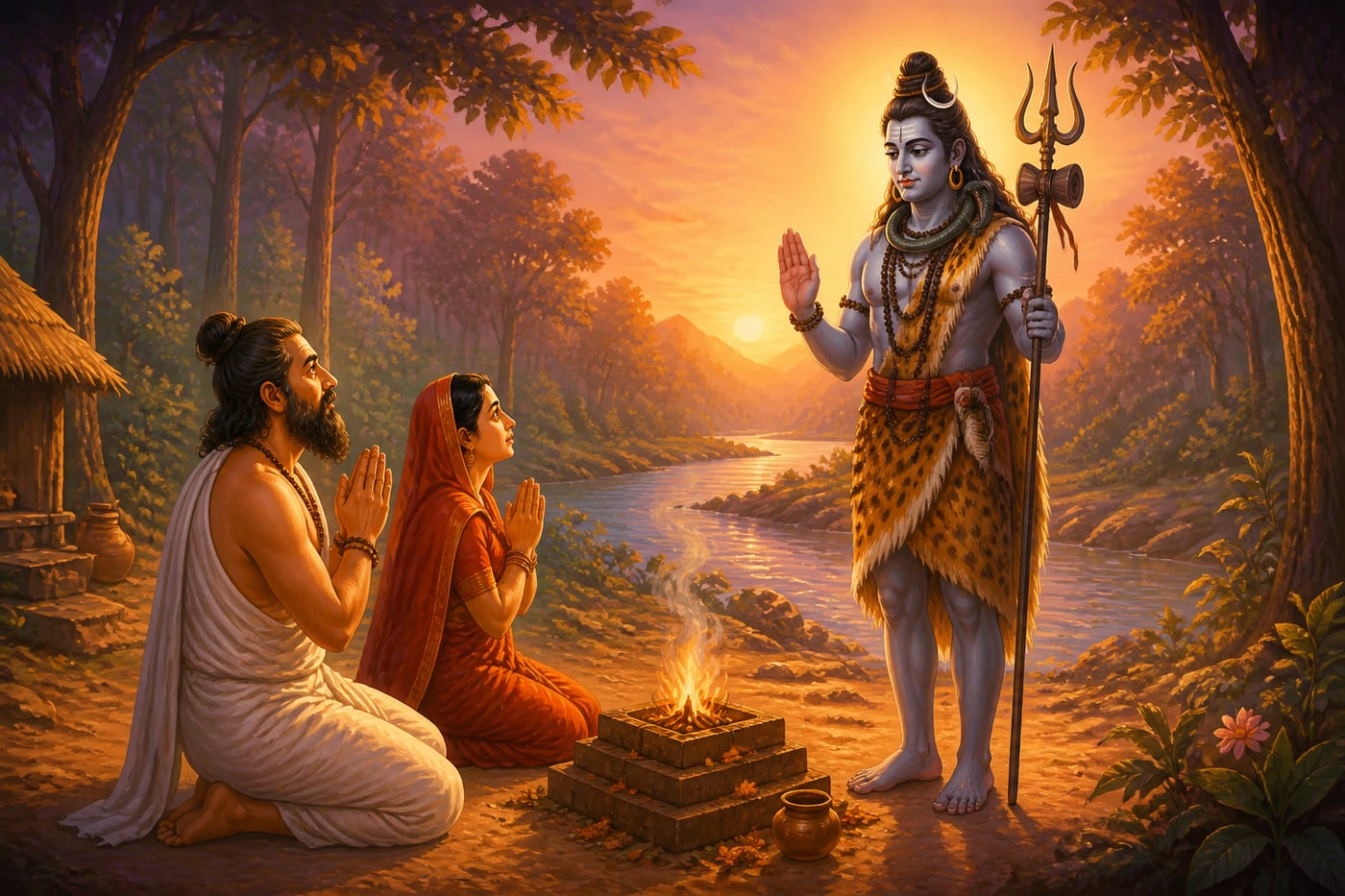
Mrikandu and Marudvati receiving Shiva's offer

I can give you only one of two sons. A brilliant boy who will live sixteen years. Or a dull boy who will live a hundred. Choose.

Mrikandu looks at Marudvati. The river moves quietly behind them. They do not take long. They choose the sixteen.

A Son Born Already Pointed

The boy is born. They name him Markandeya, which simply means of the line of Mrikandu. From the first year, the parents understand what they have asked for.

The child is unusually awake. He learns the Vedas before his peers can pronounce them. He sits in meditation, in the inner stillness called dhyāna, before he is old enough to be told what dhyana is. He is, the texts say, a child born already pointed at Shiva.

His parents teach him everything they know. They teach him the five face mantras of Shiva, the Pancha Brahma Mantras. They teach him the daily worship of the linga. They teach him, above all, that no calamity that arrives at a Shiva-devotee's door is final, because Shiva himself is the one who decides what is final.

What they do not tell him is the bargain. The boy grows up not knowing his clock.

He finds out, the Shiva Purana says, in his fifteenth year. He notices, one evening, that his mother is weeping in a way that is no longer occasional. He notices that his father will not look him in the eye for long. He sits down in front of them, in the way only a Shiva-devotee's son can sit, and he asks. They tell him.

The Choice the Boy Makes

Most children, given that information, would do what most adults would do. Curl inward. Travel. Eat well. Try, in some way, to spend the year.

Markandeya does the opposite.

He does not flinch. He does not collapse. He stands up and he walks, slowly, to the small linga shrine where his parents have spent their whole lives kneeling. He folds his arms around the cool stone. And he begins to chant.

Young Markandeya kneeling at a small Shivalinga at dawn, chanting

The verse he chants is the great prayer for release from death. The tradition calls it the Mahamrityunjaya, the great conqueror of death. It is older than the boy. Older than the Shiva Purana itself. It sits in the Rig Veda's seventh mandala, attributed to the rishi Vasishtha, preserved in unbroken oral transmission for thousands of years before this story took shape.

The verse goes like this:

त्र्यम्बकं यजामहे सुगन्धिं पुष्टिवर्धनम्। उर्वारुकमिव बन्धनान्मृत्योर्मुक्षीय माऽमृतात्॥

tryambakaṃ yajāmahe sugandhiṃ puṣṭi-vardhanam urvārukam-iva bandhanān mṛtyor mukṣīya mā'mṛtāt

We worship the three-eyed one, fragrant, who increases all nourishment. As a ripe fruit is loosened from its stem, may I be loosened from death, but not from the deathless itself.

Rig Veda 7.59.12

Read the verse twice. Notice what it does not ask. It does not ask never to die. It does not bargain. It asks for the right kind of release. A ripe fruit comes off the vine cleanly. It does not tear the plant. The chanter is not asking to evade the harvest. The chanter is asking to be ripe when the harvest comes.

The boy chants this verse for a year. He does not stop. The hermitage learns to walk around him. His parents learn to bring food and leave it untouched. They learn to wait.

And then, on the last day of his sixteenth year, the noose arrives.

The Pillar That Burst Open

Yama riding his black buffalo with the noose

Yama, the lord of death, comes himself. The Shiva Purana is precise about this. Death does not send a messenger for Markandeya. Death comes in person, on the back of his great buffalo, holding the noose in his right hand.

Yama, in this story, is not cruel. The Puranic Yama is a clean accountant. He has a list. The boy is on it. The hour is now. He swings the noose toward the small figure clinging to the stone, and the noose lands.

It lands on the boy. It also lands on the linga.

This is the moment the chapter has been building toward, and the moment every Shaiva painting in Bharat will return to. The cord of death loops around the stone pillar that the boy has refused to let go of. Here a small clarification matters. In the Shaiva tradition, the linga is not a body part and not a symbol of one. It is the axis of consciousness, the visible pillar of presence around which a temple is built. To press oneself against the linga is to press oneself against awareness itself.

And the pillar, the texts say, splits. Shiva bursts out from inside the linga, full-formed, fierce and luminous, the trishula already raised. He places his foot on Yama's chest. He kicks the lord of death to the ground.

The iconography that comes out of this scene is called Kalasamhara Murti, the form that destroyed time. The most famous sculpted version stands in the Kailasanathar temple at Kanchipuram, eighth century, Pallava work. Shiva mid-stride, one foot pinning Yama. The boy still kneeling at the linga, untouched. You can stand in front of it today.

Shiva does not kill Yama. Death is a function the cosmos still needs. He releases him. He sets him on his feet. He tells him quietly that this particular boy is no longer on his list. Markandeya is granted not a longer lifespan but an indefinite one. He becomes a Chiranjivi, one of the deathless ones. The Puranas list him alongside Hanuman, Vyasa, and Ashwatthama. He is still alive, the tradition says. Somewhere on a quiet bank, an old boy is still chanting.

What the Boy Was Actually Doing

A careful reader will notice something. Markandeya does not, in any version of this story, try to escape death. He does not run. He does not hide. He does not ask for a different fate. He does not even ask Shiva to remove the sixteen-year clock.

He does the one thing the Shaiva tradition says you can always do. He places himself at the foot of consciousness itself, and he refuses to detach.

This is the inner teaching the chapter wants you to take. The boy is not saved because he was good. He is not saved because he earned a longer ledger entry. The Shiva Purana is explicit. He is saved by anugraha, grace, the fifth of the five cosmic acts of Shiva that the first chapter of this course named. The chanting did not, by itself, snap the noose. The chanting put the boy in contact with the source of grace. The breaking of the noose was Shiva's act, not the boy's.

This is the Shaiva inversion of the spiritual marketplace. You do not buy grace by accumulating points. You receive grace by maintaining contact with what gives it.

Modern Echoes

The verse the boy chanted has had a long life. By streaming counts on Indian audio platforms, the Mahamrityunjaya is among the most-played Sanskrit chants in the world today. The Pandit Jasraj recording from the 1990s and the Anuradha Paudwal version from the early 2000s placed Markandeya's verse in millions of homes that no longer perform formal puja. Hospitals in Varanasi, Ujjain, Tirupati, and Madurai now routinely play soft recordings of the verse in palliative care wards, at the family's request. Surgeons in Tamil households have been known to ask for 108 repetitions of the verse before going under.

The cultural anthropologist Diana Eck, in her 2012 book India: A Sacred Geography, traced the Mrityunjaya devotion across north and south Bharat and concluded that it is the most widespread personal practice in the living Shaiva world. Twelve hundred years after the Pallavas carved the Kalasamhara at Kanchipuram, the verse the boy chanted still travels.

Closer to home, the palliative care physician Dr. Suresh Kumar in Kerala, founder of the Institute of Palliative Medicine in Kozhikode, has written that the dignity of dying depends not on extending life but on staying present to it. Stay ripe, his patients are told, in different language. The Mahamrityunjaya said it first.

The Closing Image

Return now to that small hermitage on the upper Saraswati. The river is still shallow, still pale. The boy is still sixteen. The parents are still old. The linga is still, in some sense, just a stone slab that the two of them carved many years ago, before the boy was even a hope.

What the story is finally telling you is the hardest of the dharmic teachings. There is a clock on every life and we are not always told when it runs out. The choices we make are smaller than we think. The time available is shorter than we want.

But there is one move that is always available. You can let go of the bargaining, you can stop asking the universe for endlessness, and you can simply put your weight down on what is not on the clock. The Shaiva tradition has a word for this move. It calls it surrender, śaraṇāgati, the act of taking shelter.

Markandeya is not a story about a clever boy who outsmarted death. He is a story about a boy who surrendered so completely, so early, that death could not find a place to land. That is the inner gate the chapter on devotees opens with. Every other devotee in this chapter, the ten-headed Ravana, the small Upamanyu, the silent hunter Kannappa, the women of fire, will walk through some version of the same gate.

The boy is still chanting. The question the story leaves with you is the only question that finally matters. When your sixteenth year arrives, in whatever form it arrives, what in your life are you willing to wrap your arms around and not let go of?

Historical context

Vedic to Early Medieval Bharat (roughly 4000 BCE to 1000 CE)

The Markandeya episode is a textbook example of the Puranic genius for textual fusion. The Vedic root is the Mahamrityunjaya verse of the Rig Veda's seventh mandala, attributed to the rishi Vasishtha and preserved in unbroken oral transmission since the Vedic period. For more than two millennia it circulated as a free-standing prayer for healing and longevity, used in domestic ritual and in formal yajnas, but not yet attached to any narrative. The Shiva Purana, in its Kotirudra Samhita section composed and edited between roughly 300 and 700 CE during the Gupta and post-Gupta period, fused the ancient verse to a fierce Puranic narrative: a sage's son, a sixteen-year clock, a stone linga, and a kicked-down Yama. The story crystallised at the same time the Pallava, Chalukya, and early Chola dynasties were sponsoring monumental Shiva temples across Bharat. By Rajasimha's reign in the early 8th century, the Kalasamhara Murti was already a standard temple panel at Kanchipuram. The Cholas under Rajaraja I, the Hoysalas, and the Vijayanagara dynasties continued to repeat the iconography across the next eight hundred years. The story's domestic afterlife, the bedside chanting and the household blessing 'Markandeya Aayushman bhava', runs in unbroken continuity into the present day. (Hindi: मार्कंडेय प्रसंग पुराणिक प्रतिभा के लिए पाठ्य संलयन का एक पाठ्यपुस्तक उदाहरण है।)

Living traditions

The Mahamrityunjaya verse the boy chanted is, by streaming counts on Indian audio platforms, among the most-played Sanskrit chants in the world today. The Pandit Jasraj recording from the 1990s, the Anuradha Paudwal version from the early 2000s, and recent classical renderings have placed Markandeya's verse in millions of homes that no longer perform formal puja. Hospitals in Varanasi, Ujjain, Tirupati, and Madurai routinely play soft recordings of the verse in palliative care wards at the family's request. The blessing 'Markandeya Aayushman bhava' (may you live as Markandeya lived) is still spoken over young children in North Indian and Marathi households. The Mrityunjaya Yantra, a geometric mandala based on the verse, appears on lockets worn by Shaiva families across the Indian subcontinent, particularly in Maharashtra, Gujarat, and Karnataka. The Pallava bronze tradition's Kalasamhara Murti has, since the 20th century, become one of the iconic images of Indian sculpture, with major examples held by the Government Museum at Chennai, the Metropolitan Museum of Art in New York, and the Cleveland Museum of Art. A boy who clung to a stone has become, two thousand years later, one of the most continuously invoked figures in the living Shaiva world.

Reflection

More in Devotees of Shiva

All lessons in Devotees of Shiva · Shiva Purana course