Bhakti: The Sand Linga and the Gold Linga

Why Shiva accepts both ritual and no ritual

After a chapter of devotees from Markandeya to Akka Mahadevi, the Shiva Purana closes with the simplest question: what decides whether worship is real? A king brings a gold Linga set with gems. A poor woman builds a Linga from wet sand. Shiva weighs them and the lesson gives the answer without ceremony.

Two Worshippers on the Same Riverbank

It is mid-morning on the bank of the Kaveri, in a small village where the river bends. The water is low. White herons stand in the shallows. About twenty paces apart, on the same stretch of warm sand, two people are worshipping Shiva.
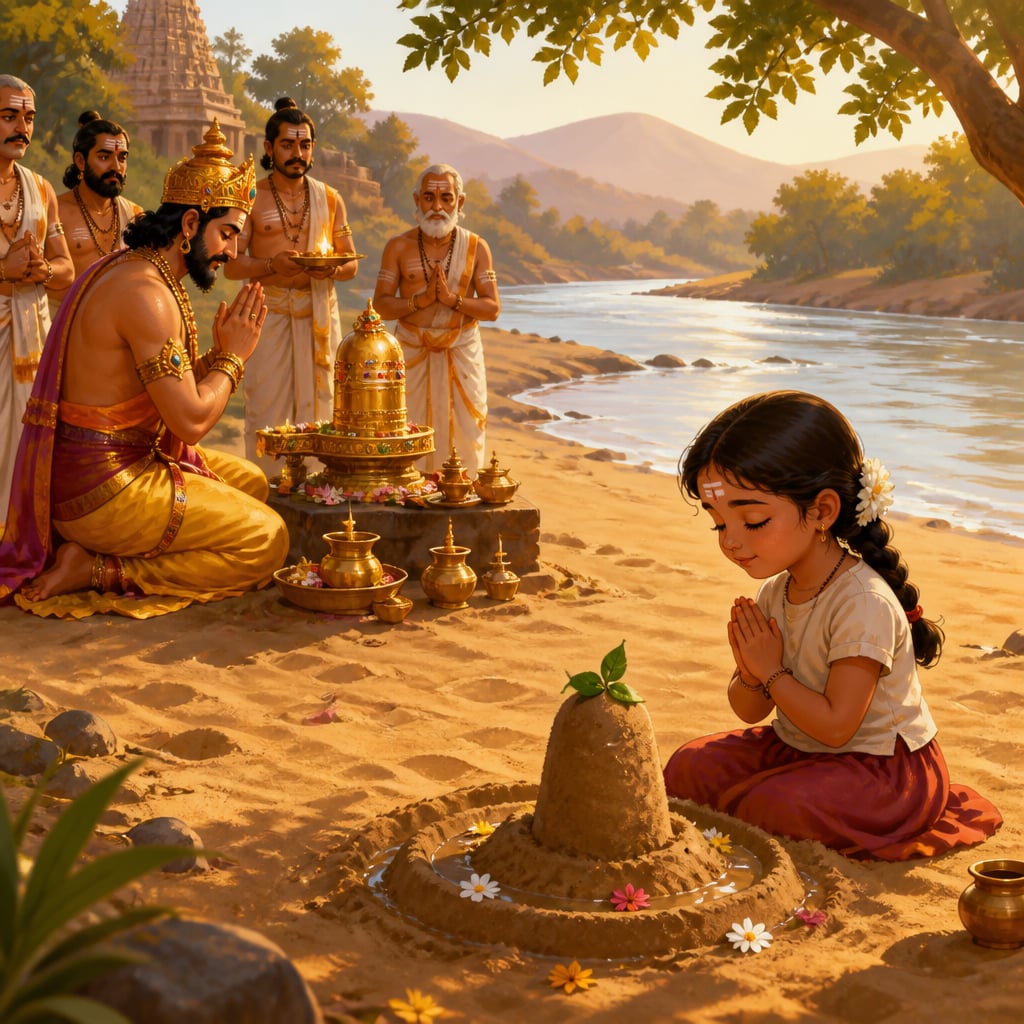
A Shaiva king and a small girl worshipping side by side on a riverbank

The first is a king. He has come with his court. A canopy of white silk shades a linga of solid gold the height of a child. The eyes of the linga are set with rubies. A hundred priests sit in three neat rows, chanting the Shri Rudram (the oldest Vedic hymn to Shiva) in one unbroken voice. Sandalwood paste, jasmine garlands, copper pots of milk, clay lamps of ghee, fresh bilva leaves on banana plates, turmeric marking the eight directions. At the centre, the gold linga catches the morning sun.

Twenty paces away sits a small girl. She is perhaps eight years old. Her cotton sari is the colour of old turmeric. She has come alone. She has scooped a handful of wet sand, patted it into a rough hump the size of her fist, and pressed a small dent into the top with her thumb. She has walked the shoreline, found one bilva leaf on a low branch, and placed it on her sand linga. Now she sits cross-legged in front of it, hands folded, whispering whatever she remembers of her grandmother's evening prayer. She does not know one word of Sanskrit. She knows one thing. This little heap of sand, with this one leaf, is, this morning, Shiva.

The king sees her. He is a good king. Devoted to Shiva. Generous with his offerings. Careful with his rituals. He calls his chief priest. He nods at the girl and asks, half-amused, half-troubled, is that worship at all? Will Shiva even accept it?

The priest is wiser than the king. He bows and says only, Your Majesty, let us finish our worship and ask Shiva himself.

What the river answered next is the closing teaching of this whole chapter.

The Question Every Devotee in This Chapter Has Answered Differently

Chapter 9 has walked through devotees of almost every kind a tradition can hold. Markandeya, the boy who hugged a stone pillar at sixteen and was saved from death. Ravana, the demon king pinned under Mount Kailasa, who composed the Shiva Tandava Stotram from beneath the rock. Upamanyu, the small boy who would not accept anything less than an ocean of milk. Arjuna, the prince who fought a tribal hunter without knowing it was Shiva. Kannappa, the hunter who pulled out his own eyes to stop a linga's bleeding. Chandesha, the shepherd boy who struck his own father for disturbing his worship. Karaikkal Ammaiyar, who asked to become bones so the world would stop seeing her body. Akka Mahadevi, who walked away from marriage and clothes and worshipped Shiva inside her own breath.

No two of them did the same worship. None of them did anyone else's worship. Each one offered Shiva exactly what their own life that day could carry in full.

The king on the Kaveri and the small girl on the sand are the chapter's last pair. They are the simplest version of the same question. Which is real worship, the elaborate ceremony or the simple offering? The Shaiva tradition's answer is more interesting than either side expects.

The Old Quarrel: Ritual or No Ritual

This quarrel is older than the Shiva Purana. It runs through every religious tradition humans have built. Each side has a real point.

Both sides are warning about the same disease, seen from opposite sides. Both are correct about the other.

The Shaiva tradition refuses to choose. It keeps the Shri Rudram with its hundred priests and the vachana of Akka Mahadevi that says I do not need a temple in the same canon. It puts a king with a gold linga and a small girl with a sand linga on the same riverbank. And it accepts both. The rest of this lesson is why.

How Shiva Answered the King

The king's worship ended at noon. He stood, took the tilaka from his priest, and walked over to the girl, who had finished her own much shorter offering and was watching the river.

He bent down and asked her gently, child, do you know who Shiva is?

She nodded.

And you believe this little heap of sand is him?

She nodded again. Grandmother said any place where one bilva leaf is offered with attention, that place is him.

The king was moved. He was still puzzled. He turned to his chief priest and asked, in front of everyone, which of our two worships, today, did Shiva accept more fully?

The priest only smiled. Let us ask the lord himself. He took a handful of sacred ash, bhasma, in his cupped palm and called aloud, O Mahadeva, of these two offerings on your bank this morning, which received your full attention?

A voice came from the air between the gold linga and the sand linga.

Both of you offered. Both were received. The king's gold reached me through the chant of a hundred priests and the labour of a hundred craftsmen, and I am there. The girl's sand reached me through one bilva leaf and one whispered grandmother's prayer, and I am there. The form is not the question. The fullness with which it was given is the question. Both were full. Both were given. I am present in both. Stop asking which I prefer.

Shiva Purana, Vidyeshvara Samhita

The king fell silent. The girl, who had not followed the Sanskrit, smiled at him as one smiles at a kind elder, and went home to help her mother grind rice. The Puranic editor closes the scene with one line that is the chapter's deepest teaching.

Where the offering is full, the form is enough.

A Third Worshipper: The Linga of Pure Air

The Puranas push the principle further with one more example. The story of an old ascetic, alone in a forest, who has neither gold nor sand. He is too poor to buy a metal linga. He is too far from any river to scoop one out of wet earth. He is too old to walk to a market. What he has is his breath, his attention, and the memory of his teacher's voice.

A forest ascetic performing vayu-linga puja

Every morning he sits in his small clearing and performs vayu-linga puja, the worship of Shiva as a linga of pure air. He cups his palms as if holding an invisible egg. He breathes the five-syllable mantra Om Namah Shivaya (the Panchakshari) onto his cupped palms. For the next hour, he treats the air between his hands as a linga. He does not bring water. His attention is the water. He does not bring milk. His attention is the milk. He does not bring a bilva leaf. His attention is the leaf.

When he dies, the forest does not find a body. Only a faint scent of camphor in the air where his palms had been. The Puranas hold that he was absorbed straight into Shiva, because he had already been worshipping Shiva as the formless, inside the form of cupped palms full of attention.

This is the chapter's final argument. The form of the linga can be gold. It can be sand. It can be the air between two cupped palms. The form is not the offering. The attention given to the form is the offering.

Why Shiva, Specifically, Accepts All Three

This synthesis is more characteristic of the Shaiva tradition than of almost any other. There are three reasons, all rooted in Shiva's own nature as this course has shown him.

The reason What it means
Shiva is form and formless together The Lingodbhava of Lesson 1.3 showed him as an infinite column of light with no top and no bottom. A god whose own symbol is form-and-emptiness will not demand that worship be one or the other.
The chapter's devotees cover every kind Markandeya, Ravana, Kannappa, Karaikkal, Akka and the rest sit at every point on the spectrum. The chapter cannot close by privileging any single style without contradicting itself.
The Shaiva home was built for both Most Shaiva families do a brief kacchi linga puja (a sand or clay linga made fresh and returned to water at evening) and also a full shodashopachara (sixteen-step worship) at the temple in the same week. Both are correct.

The One Thing That Is Not Negotiable

The form is open. The fullness is not. The Puranic editor's line cuts both ways.

Where the offering is full, the form is enough. Where the offering is empty, no form is enough.

A gold linga offered without attention is still gold, but it is no longer worship. A sand linga offered without attention is still sand, and it is no longer worship either. The form is permissive. The fullness is the practice.

This is why the chapter has spent eight lessons on devotees who, in their wildly different ways, were all full. Markandeya was not half-clinging to the linga. He was clinging with the whole of his sixteen years. Ravana was not half-composing. He was composing with the whole of his pinned body. Kannappa was not half-offering. He was offering with the whole of his eyes. Karaikkal was not half-walking. She was walking on her head because the whole of her body refused to walk on feet. The forms differed completely. The fullness was identical.

So when a modern Shaiva home asks the practical question of this chapter, should I do the elaborate ritual or the simple offering today?, the Shiva Purana answers with the king's lesson and the girl's lesson together. Do the form your life can hold in fullness today. If your life today supports a hundred priests and an unbroken chant, do that, with full attention. If your life today supports only a fistful of sand at a riverbank, or five minutes at a home shrine, or only cupped palms of air, do that, with full attention. The form is for you. The fullness is for him.

What This Asks of You

This closing is, quietly, a permission. Stop measuring your worship against someone else's. The king was not wrong to bring his hundred priests. The girl was not wrong to bring her sand. The old ascetic was not wrong to bring nothing but cupped palms. None of them were doing each other's worship. Each was doing the worship his or her own life could carry in fullness that day.

The permission is also a discipline. Because the form is open, the fullness is the only thing left to attend to. You can no longer hide behind elaborate puja or behind simple meditation. What is left, naked, in the middle of any Shaiva worship, is the question Shiva asked from the air between the gold and the sand. Were you full when you offered? Or were you somewhere else?

That is the only question this lesson wants to leave you with. Ask it once, on any morning, before you begin whatever form your life that day allows. If the answer is yes, the form is enough. If the answer is no, no amount of gold will fix it, and a single bilva leaf pressed onto a fistful of wet sand will, today, be more Shiva than any cathedral of priests.

Modern Echoes

The synthesis of this lesson is not a Puranic abstraction. It is a working principle in modern Shaiva life. The neuroscientist Cal Newport of Georgetown, in his 2016 book Deep Work, argues that undivided attention is the rarest and most valuable resource in the modern economy. Shaiva householders have known this for two thousand years. The 2021 Kashi Vishwanath Corridor restored an elaborate sixteen-step worship for over five million pilgrims a year. In the same years, the Isha Foundation under Sadhguru distributed millions of small linga pendants for personal home worship, in the lineage of the twelfth-century Lingayat reformer Basavanna, who put a small linga around every devotee's neck so that worship would no longer depend on a temple. Both ends of this lesson's spectrum are alive in 2026. A working professional in Bengaluru with a five-minute home arati and a temple priest at Trimbakeshwar with a three-hour abhisheka are, by the chapter's closing teaching, doing the same worship.

The river bend on the Kaveri is still there. The girl with the sand linga has long since gone home. The king with his gold linga has long since died. The bilva leaf she placed dissolved with the next tide. The lesson she taught the king is still being taught, every Sawan Monday, by every grandmother in every Shaiva household, to every grandchild who scoops a fistful of wet earth and asks if it is enough.

It is enough. It always was. The next chapter shows you how to carry that fullness into any minute of any day, with the smallest and most portable form of Shaiva worship the tradition has, the five syllables the old ascetic was breathing onto his cupped palms. Om Namah Shivaya. The bhakta canon of Chapter 9 ends here. The sadhana canon of Chapter 10 begins there.

Historical context

Late Vedic period through the modern Indian republic (roughly 800 BCE to the present)

The bhakta canon of the Shiva Purana is preserved across multiple Puranic locations: the Vidyeshvara Samhita, the Rudra Samhita, the Kotirudra Samhita, and the Vayaviya Samhita all contribute episodes. The closing synthesis between elaborate and simple worship is named in the Vidyeshvara Samhita explicitly and is implied throughout the Kotirudra Samhita's Jyotirlinga origin narratives (Lessons 8.1 to 8.6 of this course). The Bilvashtakam is preserved in the Skanda Purana's Kashi Khanda and in the Padma Purana's Bhumi Khanda. The kacchi linga tradition is documented in the Tamil Sangam corpus (the Pattuppaattu and the Ettuthokai), in the Periya Puranam (the canonical Tamil bhakta-canon by Sekkizhar, twelfth century, source of the Kannappa, Chandesha, and Karaikkal Ammaiyar narratives in this chapter), and in the Basava Purana of the Lingayat tradition (thirteenth century). The continuous practice of one-leaf worship and sand-linga worship across more than two thousand years, in households of every class, region, and language, is one of the longest-attended ritual practices in any living religion. The Adi Shankaracharya tradition of the eighth and ninth centuries crystallised the synthesis of this lesson into a doctrinal form, the Pashupata and the early Shaiva Siddhanta schools refined the ritual scaffolding, and the Lingayat reform of the twelfth century radicalised the personal-linga end of the spectrum.

Living traditions

The synthesis of this lesson, between elaborate ritual and simple offering, is the structural reason Shaiva tradition has remained so vibrantly alive in modern Indian life. A working professional in Bengaluru with a five-minute home arati at the household shrine, a retired schoolteacher in Mysore with a daily Bilvashtakam recitation, a temple priest at Kashi performing a full sixteen-upachara abhisheka, and a child in a Tamil village moulding a kacchi linga on the riverbank are all, by the chapter's closing teaching, doing the same worship. None of them is doing a lesser version. The Shaiva household has therefore retained its Shaiva identity across the disruptions of modernity, urbanisation, and migration far more robustly than many comparable traditions. The Sawan Monday observance now reaches diaspora households from Toronto to Sydney, with kacchi linga worship continuing on artificial sand or on rolled clay imported from Indian sources. The Bilvashtakam is taught to children in Hindu Sunday schools across Europe, North America, and the Caribbean. The synthesis between gold and sand has proven, in the modern age, to be the structural feature that has let the Shaiva tradition cross water without breaking. The girl on the Kaveri riverbank, in her own way, made the modern Shaiva household possible.

Reflection

More in Devotees of Shiva

All lessons in Devotees of Shiva ยท Shiva Purana course