Virabhadra: The Wrath Born of Love
Destruction that came from grief
Sati has walked into her father's sacrificial fire. The news reaches Shiva on Kailasa, and his grief becomes a different kind of force. He tears a matted lock from his own head, dashes it against the ground, and a colossal warrior rises out of it. Virabhadra and Bhadrakali ride down to Daksha's yajna and turn the most respectable ritual in the three worlds into the cremation of its host's own head.
The News Reaches Kailasa
On the white slopes of Mount Kailasa, Shiva is sitting in meditation. The wind carries the smell of pine and the small sounds of his attendants moving through the snow. Then a single figure climbs into the clearing, breathing hard. It is Narada, the wandering sage. His face is grey. He kneels in the snow at Shiva's feet.
He does not soften the words. 'Mahadeva, Sati is dead. She has walked into her father's sacrificial fire at Kankhal. Daksha had not invited you. He had insulted you publicly. She could not bear what was said about you in her own father's house. She gave her body back to the fire.'
Shiva does not move. The wind drops. The mountain itself seems to hold still. For a long moment, the most powerful being in the three worlds simply takes the news, the way any human takes the worst sentence of his life.
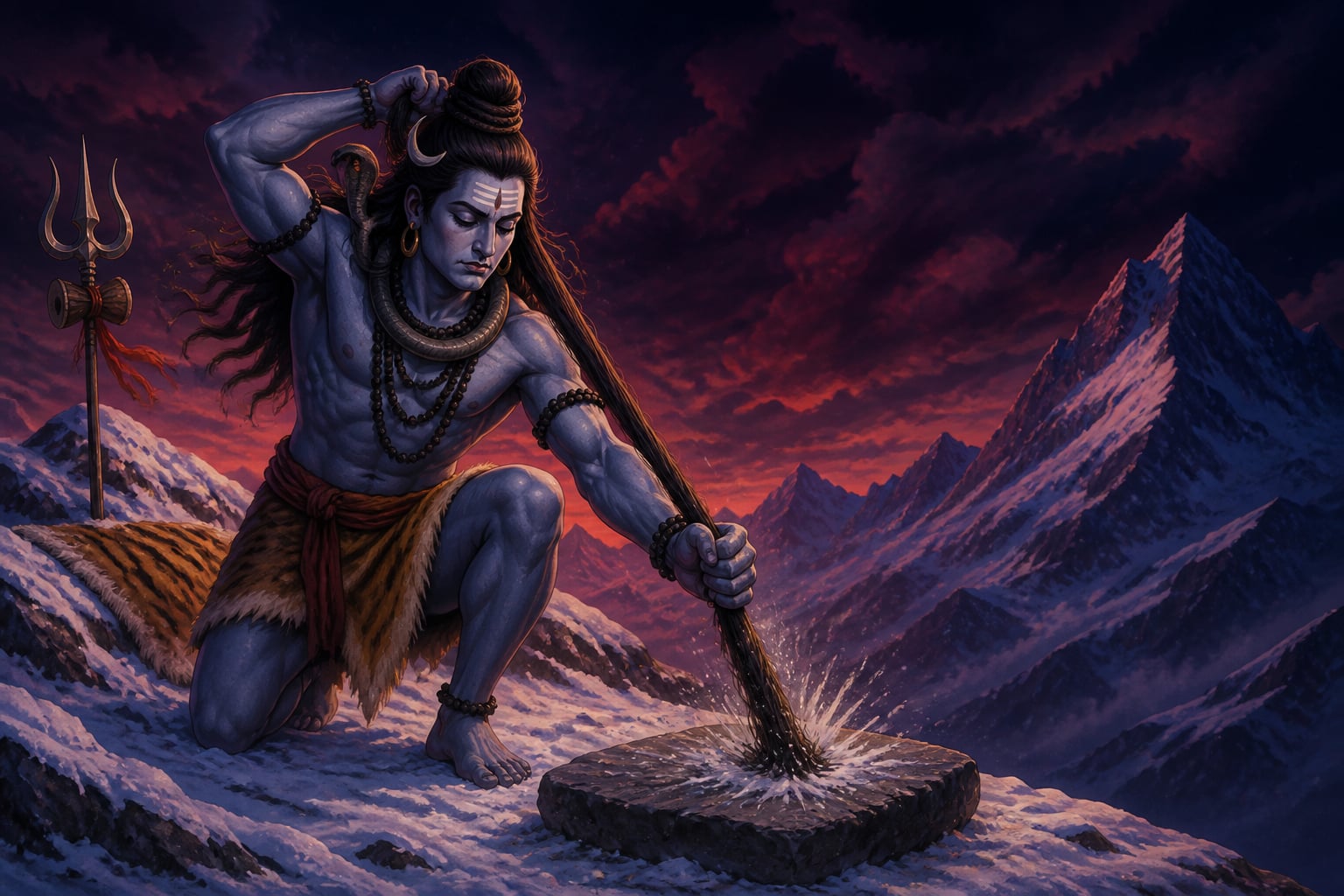
Then one hand rises slowly to the side of his head. He grips a single matted lock of his own hair. He pulls it from his head with a slow, deliberate strength. He raises it above the snow. He dashes it against the ground.
What rises from that lock is not a man.
What Rose Out Of The Lock
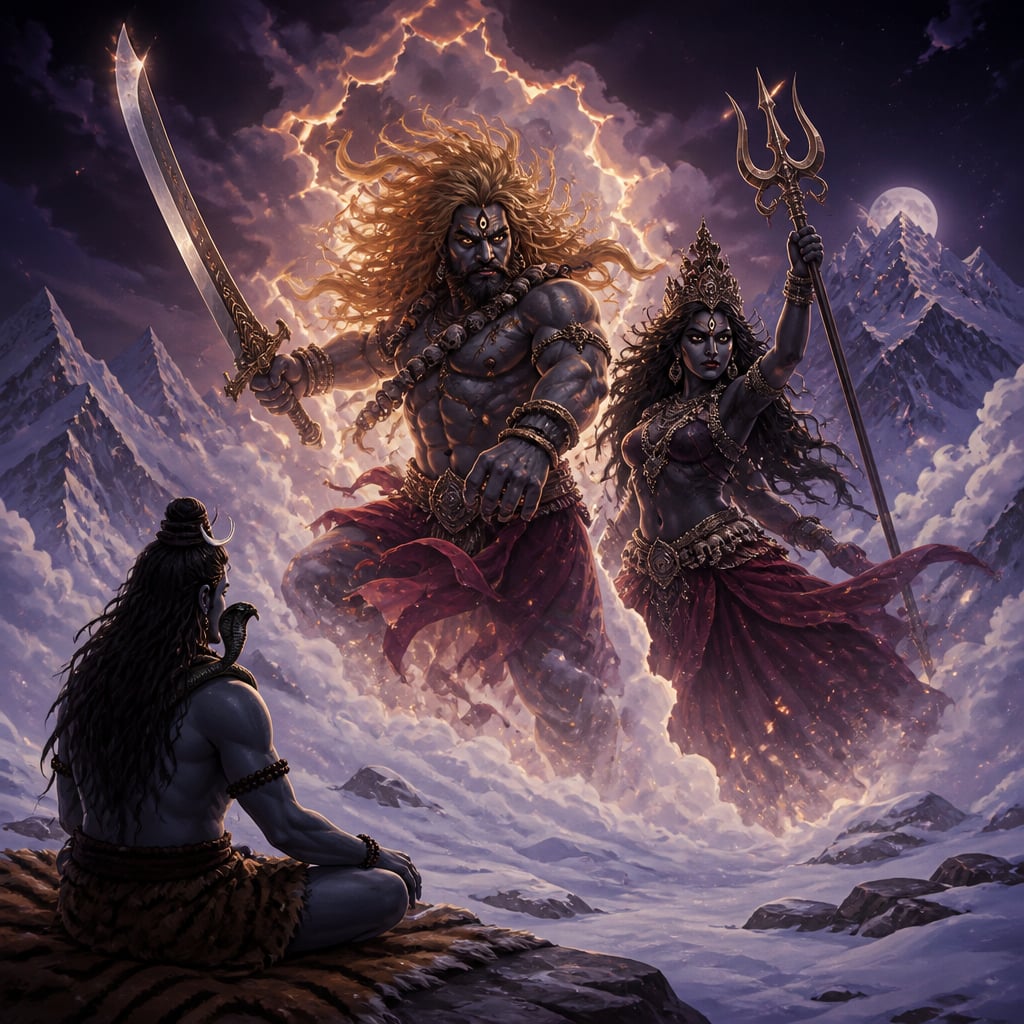
Virabhadra, the Auspicious Hero, stands up out of the broken lock as if the mountain itself has grown a body. His skin is dark as the storm that breaks over a peak. He has three eyes, and the middle one already burns. His hair is a forest of fire. He has fangs. He carries a thousand arms, each holding a weapon. Around his neck hangs a garland of skulls. He is taller than the trees. The ganas, Shiva's wild attendant troops, gather around him at once and recognise their commander.
From another part of Shiva's matter, a second figure rises beside Virabhadra. Bhadrakali, the Auspicious Dark One, the fierce form of the Goddess herself. She has the same red middle eye. She carries a sword. Her laugh fills the clearing.
Shiva opens his eyes. He looks at the warrior he has just made. His voice is quiet. Almost gentle. The Shiva Purana preserves the line.
'Go to Daksha's yajna. Destroy it utterly. Behead Daksha himself. Spare nothing of what was built on the insult to my Sati. Take the ganas. Take Bhadrakali. Do this and return.'
Virabhadra bows once. The ganas raise a sound that travels three worlds. The army leaves Kailasa.
The Wrath That Was Not Hate
It is important, before we follow the army down the mountain, to be clear about what just happened on the peak. Shiva did not destroy the yajna because Daksha had embarrassed him at a ritual. He did not destroy it for revenge against his father-in-law. He destroyed it because Sati was gone, and Sati had been killed by a sacred event built on a rotten foundation.
This distinction is the moral spine of the entire chapter. The Shaiva tradition is precise about it. There are two kinds of wrath in a human life:
- Krodha born of injury. My ego was bruised. I was insulted. I will retaliate. This is the small, dangerous wrath that the Bhagavad Gita warns produces sammoha (delusion) and finally the loss of buddhi (the discriminating mind).
- Krodha born of love. Something I love has been violated. The violation, if I let it stand, will harm more than the one already lost. This is the wrath the Shaiva tradition treats as sacred when it is bounded by purpose.
Virabhadra is the second kind, given a body. He is not Shiva's hatred. He is Shiva's love made into a weapon, sent for one task, and held under one command.
The Yajna At Kankhal
Meanwhile, at Kankhal on the bank of the Ganga, Daksha's great sacrifice is in full procedure. The yajna fire is roaring. Brahmin priests in fresh white robes are chanting. Royal guests are seated in order of rank. Vishnu is among them, taking the share that has been formally offered to him. The ritual implements are arranged with painful precision. Daksha himself is presiding, satisfied that the most respectable yajna of the age is going exactly to plan.
The sky above the enclosure goes dark. The chanting falters.
The ganas pour over the perimeter wall like a flood. They are not in formation. They do not need to be. Bhutas, pretas, ghouls, the wild attendants of Shiva that the respectable world has always pretended do not exist. At their head is Virabhadra, taller than any tree, three-eyed, garlanded with skulls. Bhadrakali rides beside him, sword in hand.
The sacrificial enclosure breaks apart in minutes. Pots of ghee are smashed and the sacred fires are scattered. The painted altar is trampled. The chanting stops.
The Faces That Could Not Be Spared
Virabhadra moves through the assembly with terrible precision. The Puranic narrators give us the list, because the list itself is part of the meaning. Each god who has come to lend his face to a ceremony built on an insult to Shiva pays a small price, marked on his body so that the cosmos cannot forget.
- Bhaga, the god whose name means good fortune, has his eyes torn out. He had watched the insult and said nothing.
- Pushan, the nourisher of the world, has his teeth knocked out. He had laughed at the wrong moment.
- Sarasvati, in some accounts, has her nose cut. Speech itself is marked.
- Daksha's own priests are scattered, their threads broken, their books thrown.
Vishnu rises and tries to defend the yajna. In the Puranic telling, his discus the Sudarshana Chakra strikes Virabhadra and rebounds, useless, because the wrath this time is not Vishnu's to oppose. Even the cosmic preserver has to step back from a destruction that arises from this particular love.
The Head In The Fire
Finally Virabhadra finds Daksha. The patriarch has tried to hide. The warrior drags him out by the hair from behind a pillar. He lifts him by the shoulders. The whole assembly goes silent.
Virabhadra does not give a speech. He does not list charges. He simply sweeps his weapon once across the patriarch's neck. Daksha's head comes free of his shoulders.

Then Virabhadra does something the Puranic narrators dwell on, because it is the precise image the lesson needs. He throws the head into Daksha's own sacrificial fire. The fire that had been lit for the most respectable yajna of the age now consumes the head of its host. The ritual that had been built on the insult to Sati becomes the cremation of the man who built it.
Virabhadra turns. Bhadrakali raises her sword once. The army leaves the yajna ground exactly as it came. The ganas climb the mountain again.
Back on Kailasa, Virabhadra bows once at Shiva's feet, sets down his weapons, and dissolves back into the matted lock he came from. The army is gone. The wrath has done its work and stopped.
What The Story Is Naming
The Shaiva tradition has spent fifteen centuries asking the reader to sit with this scene. The question is not whether destruction is good or bad. The question is when destruction is dharmic (sacred, in the right) and when it is merely violent.
Three things make the destruction at Kankhal dharmic in the Puranic reading:
- It arose from love, not from injury. The cause was the loss of Sati, not the bruising of Shiva.
- It had a precise purpose. Destroy this yajna, behead this patriarch. Not, teach the world a lesson, not make Daksha's family suffer for generations.
- It stopped. The moment the head was in the fire, Virabhadra dissolved. He did not roam the earth burning villages. The wrath returned to its source the instant its task was done.
The philosopher Hannah Arendt spent the middle decades of the twentieth century arguing that the most dangerous thing about violence in modern politics is precisely its tendency to overrun its own purpose, to keep going after the original cause has been answered. Virabhadra is the Shaiva counter-argument made flesh. Wrath, when it is real, is short. Rage, when it is petty, is long.
More recently the writer Pankaj Mishra in Age of Anger has documented how unhealed personal injury, dressed up as ideology, drives most of the violence of the modern world. The Shaiva tradition would say: that is krodha without love, and it is exactly what Virabhadra is not.
A Field Still Smoking
Back at Kankhal, the yajna ground is empty. The sacred fire still smoulders, with what is left of its host inside it. Daksha's body lies on the ground without its head. The priests who survive are silent. Vishnu has left. The ritual is over, but nothing is settled. Sati is still dead. Shiva is still in grief on his mountain.
The wrath is gone. The love that produced it is not.
What happens next is not forgiveness, not yet. What happens next is that Shiva himself comes down from Kailasa to gather what is left of his wife, and her body becomes the geography of India.
The Shakti Peethas are about to be made. We will walk that walk in the next lesson.
Historical context
Puranic compilation period (c. 6th to 11th century CE), with major temple worship and iconography flourishing under the Vijayanagara empire (14th to 17th century CE) and the Lingayat tradition (12th century CE onward).
The Daksha yajna narrative was consolidated in textual form across the Puranic period, with parallel tellings in the Shiva Purana (Rudra Samhita, Sati Khanda), the Bhagavata Purana (Skandha 4, chapters 4 to 7), the Vayu Purana, and the Mahabharata (Shanti Parva). The story spread alongside the rise of the Shakta tradition and the Shaiva consolidation of southern India. From the 12th century onward, Basavanna's Veerashaiva movement in Karnataka adopted Virabhadra as a clan deity, and from the 14th century the Vijayanagara empire made Veerabhadra worship a public, monumental affair across the Deccan, of which Lepakshi remains the great surviving witness.
Without the Daksha yajna episode and the figure of Virabhadra, Indic spirituality would lack its most precise narrative argument for the place of dharmic wrath in a sacred order. Every Veerabhadra temple a contemporary visitor walks into, every Lingayat boy named Veeranna, every Karnataka Kunitha dance, and every annual Mahashivaratri gathering at Kankhal is a continuation of the moral claim this lesson sits on: that some destruction can be auspicious when it arises from love and ends with its purpose.
Living traditions
Virabhadra is the kuladevata (clan deity) of millions of members of the Lingayat and Veerashaiva community in Karnataka and Andhra Pradesh, and the most popular masculine names in those communities (Veeranna, Veerabhadrappa, Veeresh, Veerappa) come directly from him. The Vijayanagara empire (14th to 17th centuries CE) made Veerabhadra a state deity and built monumental temples across the Deccan, of which Lepakshi is the most famous and the architecturally most studied. The Veerabhadra Kunitha folk dance of Karnataka is recognised by the Sangeet Natak Akademi as one of the state's principal ritual folk forms. The Daksha yajna scene itself is among the most carved episodes in Indian temple sculpture, found at Halebidu, Belur, Khajuraho, Konark, and on the gopuram tiers of dozens of major South Indian temples. And every Mahashivaratri across India, the Daksheshwara Mahadev Temple at Kankhal draws thousands of devotees who gather precisely on the ground where the story this lesson tells is believed to have unfolded.
- Veerabhadra Kunitha: A folk dance ritual of Karnataka in which a dancer, often from the Lingayat tradition, embodies Virabhadra during temple festivals. The dancer wears a heavy wooden mask, a garland of bells, a sword, and a metallic chest plate. After preparatory rites and chanting, he enters a trance state and dances in front of the village deity, embodying the wrath that destroyed Daksha's yajna. The dance is performed in a tightly bounded ritual space, and the dancer returns to ordinary consciousness when an elder priest calls him back, mirroring Virabhadra's own return to Shiva at the end of his task.
- Bhadrakali Aaradhana At Kodungallur: The annual Kodungallur Bharani festival in Kerala honours Bhadrakali, the fierce form of the Goddess who rode beside Virabhadra into Kankhal. Devotees, including women in traditional red, gather at the Kodungallur Bhagavathy temple in Thrissur district. The festival features kavu theendal (the entry into the sacred grove), the singing of fierce traditional songs, and the offering of flowers and turmeric. The temple's fierceness is mythologically traced back to Bhadrakali's role at Daksha's yajna.
- Mahashivaratri Vigil At Daksheshwara, Kankhal: On Mahashivaratri night, devotees gather at the Daksheshwara Mahadev Temple at Kankhal, traditionally identified as the very site of Daksha's yajna. The all-night vigil includes four prahara pujas, the chanting of the Rudram, and the recitation of the Daksha Yajna chapters of the Shiva Purana. Pilgrims also bathe at nearby Har-ki-Pauri on the Ganga, a few kilometres downstream, before the dawn darshan.
- Lepakshi Veerabhadra Temple: One of the great surviving Vijayanagara temple complexes, completed c. 1530 CE under the Vijayanagara governor Virupanna. Centred on a fierce Virabhadra murti carved with three eyes, fangs, and a garland of skulls. Famous for the giant monolithic Nandi (4.5 metres tall, carved from a single granite boulder), the hanging pillar (ākāśa stambham) that does not quite touch the ground, and the unfinished Kalyana Mandapa whose ceilings carry some of the most elaborate Vijayanagara-era frescoes anywhere in India. The Daksha yajna episode is depicted across multiple panels of the temple.
- Daksheshwara Mahadev Temple, Kankhal: Traditionally identified as the very site of Daksha's yajna. The current temple was rebuilt by Queen Dhankaur of Indore in 1810 CE on the foundations of much older shrines. Inside the complex are a Shiva linga, a small shrine to Sati, a yajna kunda preserved as a memorial of the original sacrifice, and a Vishnu murti commemorating the visit at which the destruction unfolded. Sadhus from many sampradayas gather here during Kumbh Mela years.
- Kuravi Veerabhadra Swamy Temple: One of the oldest and most revered Veerabhadra temples in southern India, dating in its present form to the Kakatiya period (12th century CE), with continuous worship since. The fierce Virabhadra deity here is roughly four metres tall, carved in black granite, with the standard iconography of three eyes, garland of skulls, and a thousand arms suggested by carved weapons. Major draw for Lingayat and Veerashaiva pilgrims from Telangana, northern Andhra, and Karnataka. The temple is a kuladevata (clan deity) shrine for many of the surrounding villages.
Reflection
- Think of the last time you were really angry. Honestly: was the wrath in service of someone or something you love, or in service of your own bruised image? How could you have told the difference in the moment?
- Why did Shiva need to make Virabhadra at all? Why didn't he simply go down to Kankhal himself? What is the Puranic tradition saying by making the wrath a separate being that he creates, commands, and then dissolves?
- Is there such a thing as sacred destruction, or is destruction always a failure of dharma? What three or four conditions, if any, would have to be true for an act of destruction to be sacred rather than merely violent?