Agnipravesha: Sati Walks Into the Fire
The refusal to negotiate
Sati goes to her father's yajna without an invitation. She finds not a missing share but a public insult of Shiva and through him of herself. She rises in the assembly, names the wound, and by her own yogic fire returns her body to its source. The Shakti Peethas marked across India begin here.
At The Threshold Of Kailasa
In the high silence of Mount Kailasa, in the morning after the news first reached the household, Sati, the first incarnation of Adi Shakti and the wife of Shiva, is standing at the edge of the courtyard. She has just told her husband, plainly, that she is going to her father's great yajna. She has not been invited. The cosmos is being asked to a sacrifice and her father has, deliberately, left her name off the list.
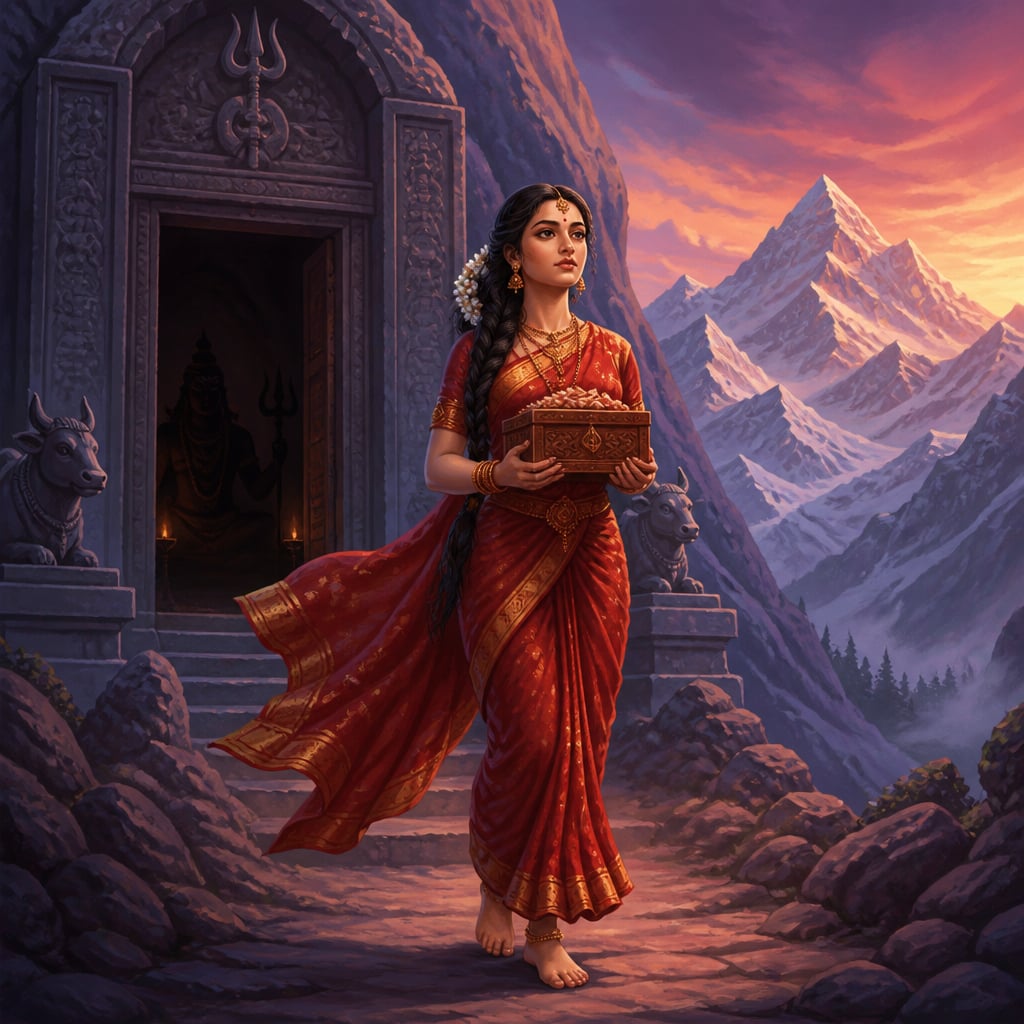
Shiva is seated on his tiger skin, very still. He has heard the news from the same messengers. The Shiva Purana, in the Rudra Samhita, gives him only a few quiet sentences here. He warns her. Daksha is your father, but the yajna he has called is not a homecoming. He has wished to wound. If you go, what waits for you may be a road from which you do not return as you came.
Sati listens. She does not argue with the warning. She also does not turn back. She tells him she goes not for an invitation but for the truth of what is happening in her father's hall. The Shiva Purana takes its time on this exchange because it is the hinge of the entire chapter. The lesson the rest of Chapter 3 will live through begins here, in a doorway, between two people who love each other, and one of them already knows.
The Pavilion She Walks Into
Daksha's yajnashala has been built on the open ground at Kankhal, near the Ganga at Haridwar. Banners. Conches. A high vedi where the sacred fire is already burning. Brahmin priests, the Saptarishis, the Adityas, the Vasus, the Maruts, kings of the cosmic court, all of them have come. Daksha sits at the head of the pavilion. The yajna of the year is in motion.
Sati arrives without an escort. The air in the pavilion changes the moment she enters. Some of the assembled rishis rise to honour her. A few of her sisters, married into other Prajapati households, look down at the floor. Daksha does not rise. He receives her with the cold formality of a host who has been given an unwelcome guest. He does not offer her a seat near the fire. He asks her, without warmth, why she has come uninvited.
This is not, yet, the wound. The wound comes when, in the open assembly, in front of the Saptarishis and the devas, Daksha begins to speak about Shiva. He does not just leave him out of the share. He insults him. He calls him a cremation-ground wanderer, smeared in ash, fit for ghosts and not for the daughter of a Prajapati. He calls him kapalin, the bearer of skulls. He calls him beneath the dignity of this fire.
Sati hears it standing.
What She Says, And Does Not Say
The Shiva Purana now makes a careful editorial choice, and the lesson rests on it. Sati does not defend Shiva. She does not list his greatness, recite his hymns, or argue his case before her father's court. Shiva does not need her defence. He is Mahadeva, lord beyond the cosmic court. He is not in this pavilion. He is on Kailasa. The court's verdict on him is the court's problem.

What Sati does instead is name what is happening, and to whom.
"You have insulted my husband," she says, in essence, in the Rudra Samhita, "and through him you have insulted me, because the body in which I stand before you is the body you and Prasuti gave me, and you have just declared that this body has lived as the wife of someone unworthy. Father, you have wounded the very dignity you gave."
The pavilion goes still. The brahmin priests hold the ladles half-raised. The fire continues, indifferent. Sati does not raise her voice. The Shiva Purana keeps her composure intact across the entire scene because the lesson is in the composure. She is not breaking. She is naming.
This distinction matters. The Sanskrit word for the wound she names is mānabhaṅga, the breaking of dignity. It is not the same as anger, not the same as hurt. It is the precise diagnosis of what a contract does when it asks one of its parties to absorb a public insult and stay seated in the front row. The ledger of every relationship that has ever broken slowly is in this word.
The Yogic Withdrawal
Sati does not stay in the pavilion to argue. She does not wait for an apology. She turns inward.
The Shiva Purana describes what happens next with great care, and it is important to read it carefully. She sits down. She closes her eyes. She invokes her own yogāgni, the inner fire that a yogi can light by the discipline of breath and intention. The fire is not a pyre lit by another. It is not a building set ablaze. It is the inner heat of yoga itself, withdrawn from the body and turned, by sovereign will, against the fabric of the body.
Her last words, in the Devi Bhagavata Purana version, name Shiva. Not Daksha. Not the assembly. Not the offence. Her last attention is on the one she came from and the one she is returning to. The body, the conditioned gift of a father whose conditions have just turned against her, is returned to its source. Adi Shakti withdraws her consent to occupy a body that has been declared, by its giver, beneath dignity.
The pavilion finds her gone. The fire of the yajna burns on. The cosmos changes shape in a way the cosmos does not yet know.
The Tradition's Reading
This scene is the most carefully read passage in the entire Shaiva tradition. Three things must be said about it before any other.
The act is not despair. A despairing person does not address an assembly first, does not name the wound with precision, does not turn last to the face she loves. Despair is collapse. Sati's act is sovereignty. She is not driven; she chooses.
The act is not a model for human action of the same form. The Shiva Purana does not, in any line, instruct human women to walk into fires. The act is performed by the Adi Shakti, who is not bound to a particular body in the way a human is. Sati does not end her existence; she withdraws from a particular form. She returns later in this very Purana as Parvati, daughter of the mountain Himavan, and walks into the same household at Kailasa. The lesson is the withdrawal of consent, not the form of withdrawal.
The act is not the colonial-era social practice that took the same name. The Hindu social practice of widow burning, banned in India by the Bengal Sati Regulation of 1829 under Lord William Bentinck and the reformer Raja Ram Mohan Roy, has nothing to do with this scene. Sati was not a widow. Shiva was alive. The act is yogic, not social. The Shaiva and Shakta traditions, when called to defend their saints against colonial confusion, have repeatedly distinguished the two for two centuries. We name the difference here so the lesson can be read clean.
What She Was Refusing
The deeper teaching of the lesson lives in the question of what Sati was refusing, not in the form of the refusal.
Daksha had offered his daughter a contract. Stay in the family. Accept that I will tolerate your husband but not respect him. Sit in the front row at my yajna and let the silence stand for the share you did not get. Versions of this contract are offered every day in lives smaller than Sati's. A job that pays well but quietly diminishes the worker. A relationship that stays warm only as long as one person agrees to be slightly less than they are. A community that loves you on the condition that you not name the parts of yourself it does not love. A family role that is given gladly only as long as you do not ask for the dignity that should come with it.
The Shaiva tradition uses the word svatantra for what Sati exercises in the pavilion. It means self-sovereign, one whose authority is her own and not derived. The Lalita Sahasranama, in name 723, calls the Goddess Svatantrā, the one who is her own warrant. To be svatantra is to retain the right to withdraw consent. Without that right, every other apparent freedom is conditional. Sati's act is not the celebration of fire. It is the demonstration that consent, in the dharmic understanding, was never a thing the contract could permanently own.
Modern Echoes
This is the place to be most careful in the lesson. The teaching is not a teaching about ending one's life. The teaching is about ending one's consent to a system that requires the slow erasure of who one is. The walk-out is the lesson, not the fire.
The poet Audre Lorde, addressing the Modern Language Association in Chicago on 28 December 1977, in a paper called The Transformation of Silence into Language and Action, said plainly: "Your silence will not protect you." She had just been told she might have breast cancer. The paper she chose to deliver was about the moment a person discovers that going along to get along is itself a form of harm. The Shaiva tradition had named the same moment two thousand years earlier. Sati at Daksha's pavilion is its dharmic prototype.
In current research, the philosopher Hannah Arendt, in her 1963 book Eichmann in Jerusalem, argued that the most important moral act available to a person inside a wrong system is often not a confrontation but a withdrawal. Refusal to take part. Refusal to lend the body to the contract. The Shaiva tradition agrees and adds a sharper line. There is a kind of presence that is itself participation. Sati's last act is to stop being present. She does not stay to give the wound her body to absorb.
Nothing in this lesson recommends harm to oneself. Everything in the lesson recommends the recognition, at the right moment, that you are being asked to negotiate something that was never on the table. The dignified moves available in 2026 are different. A resignation letter. The end of a friendship that has become subtractive. A boundary placed where there had only been silence. The Shaiva word for it is svatantra. The act is the same act. The form is the form your life can hold.
At The Doorway, Again
Back at Kailasa, the morning that began with Sati standing at the edge of the courtyard does not yet know how it will end. By the time word travels back up the mountain, Shiva will have heard, and Chapter 3 will have its second half. For now, the only thing the Shiva Purana is asking the reader to see is the door, and the woman who walked through it not because she was driven but because she was free.
What happens next, when grief and love arrive at Kankhal in the form of the god she left behind, is the story of the next lesson.
Living traditions
Sati's story is the seed of the entire Shakti Peetha geography across the Indian subcontinent, the Mahavidya tradition of advanced Shakta sadhana, and the autumn Durga Puja festival that draws hundreds of millions of devotees in India and the diaspora each year. The dharmic tradition has been careful, since at least the early 19th century, to distinguish the Puranic Sati's yogic withdrawal from the colonial-era social practice of widow burning, banned by the Bengal Sati Regulation of 1829 under Lord William Bentinck and the Indian reformer Raja Ram Mohan Roy. Contemporary Shakta institutions including the Belur Math (founded by Swami Vivekananda in 1898 around Sri Sarada Devi's living presence), the Kanchi Kamakoti Peetham, and the Sringeri Sharada Peetham continue to invoke Sati as the prototype of integrity, never of any social mandate. Calcutta's Durga Puja was inscribed by UNESCO in December 2021 as Intangible Cultural Heritage of Humanity, formally recognising the festival, and the Sati story at its root, as a living world tradition.
- Durga Puja As The Return Of Sati: In the Bengali Shakta tradition, the annual Durga Puja in autumn is read explicitly as the return of Sati to her parents' home. The four days of the festival, from Saptami through Vijayadashami, are imagined as the Goddess visiting Mena and Himavan, with Vijayadashami marking her return to Shiva's household. The Sati narrative is the seed. The festival is the annual repair of the rupture at Daksha's pavilion, performed by the community on the Goddess's behalf.
- Mahavidya Sadhana: The Ten Mahavidyas, ten forms of the Goddess used in advanced Shakta sadhana, are traditionally said to have first manifested at this exact moment in the Sati story. When Daksha refused her, Sati is said to have shown her ten ferocious forms to make Shiva consent to her going, an episode preserved in the Mahabhagavata Purana. Practitioners today take diksha into one or more Mahavidyas under a living guru and undertake their puja, mantra japa, and visualisation as a path to the integrity Sati embodied.
- Daksheshwar Mahadev Temple, Kankhal: Tradition marks this as the site of Daksha's great yajna. The current Daksheshwar Mahadev Temple, rebuilt by Queen Dhankaur of Indore in 1810 after earlier structures were destroyed in 18th-century conflicts, stands at the canonical location. The yajnashala (sacrificial hall) is preserved as a memorial to the cosmic story. Sati Kund, a small sacred pond a short walk from the temple, is held as the spot where Sati performed her yogāgni. Daksheshwar is one of the rare temples in India where Daksha himself, in his goat-headed post-redemption form, is worshipped alongside Shiva.
- Jwalamukhi Devi Shakti Peetha: Tradition holds Jwalamukhi as the Shakti Peetha where Sati's tongue fell. The temple has no idol in the conventional sense. The deity is a set of nine perpetual flames that burn from natural fissures in the rock, fed by a continuous emission of natural gas from the earth below. The shrine has been continuously worshipped for at least a thousand years and was famously visited by Emperor Akbar, who is said to have tried to extinguish the flames with diverted water from a canal and failed. The thematic resonance with this lesson is direct: the Shakta tradition reads the eternal flame as the very yogāgni Sati lit at Daksha's pavilion, kept burning here by the Goddess herself.
Reflection
- Where in your life are you currently negotiating your own dignity in installments, and what would it cost you to stop?
- Why does the Shaiva tradition insist that Sati's act is sovereignty rather than despair, and what is the difference between the two?
- When is staying the dharmic act and when is leaving? Sati walks out of her father's pavilion, while Krishna at Kurukshetra tells Arjuna to stay and fight. How does the tradition help you tell which of the two your situation is asking for?