Kshama: Forgiving Daksha, the Goat-Head Redemption
Ego humbled, not erased
After Virabhadra destroys the yajna, Daksha lies headless and the gods ask Shiva for something harder than destruction. They ask for forgiveness. Daksha is revived with a goat's head. The sacrifice is completed. A lesson on what real forgiveness looks like in the Dharmic tradition.
The Morning After The Yajna
It is dawn at Kanakhal, on the bank of the Ganga where it leaves the hills near Haridwar. The yajna ground is wrecked. The fire pits are cold. The pavilions are torn. Bodies of the priests and guests lie among the broken ritual vessels. The smell of smoke and blood hangs in the cold air. The river runs on, indifferent.
Daksha himself lies headless at the centre of the ground. His head is gone, taken by Virabhadra's blow. His body is still warm.
The gods who had attended the yajna, Brahma, Vishnu, Indra, Agni, and the other Adityas, have survived. They had been wounded but not killed. Now they walk slowly across the ground, looking at the damage. They have just seen what happens when a great patriarch insults the unconventional sacred. They have seen Sati walk into the fire. They have seen Virabhadra rise from a single hair of Shiva. They have seen the wrath. They have not yet seen the answer to it.
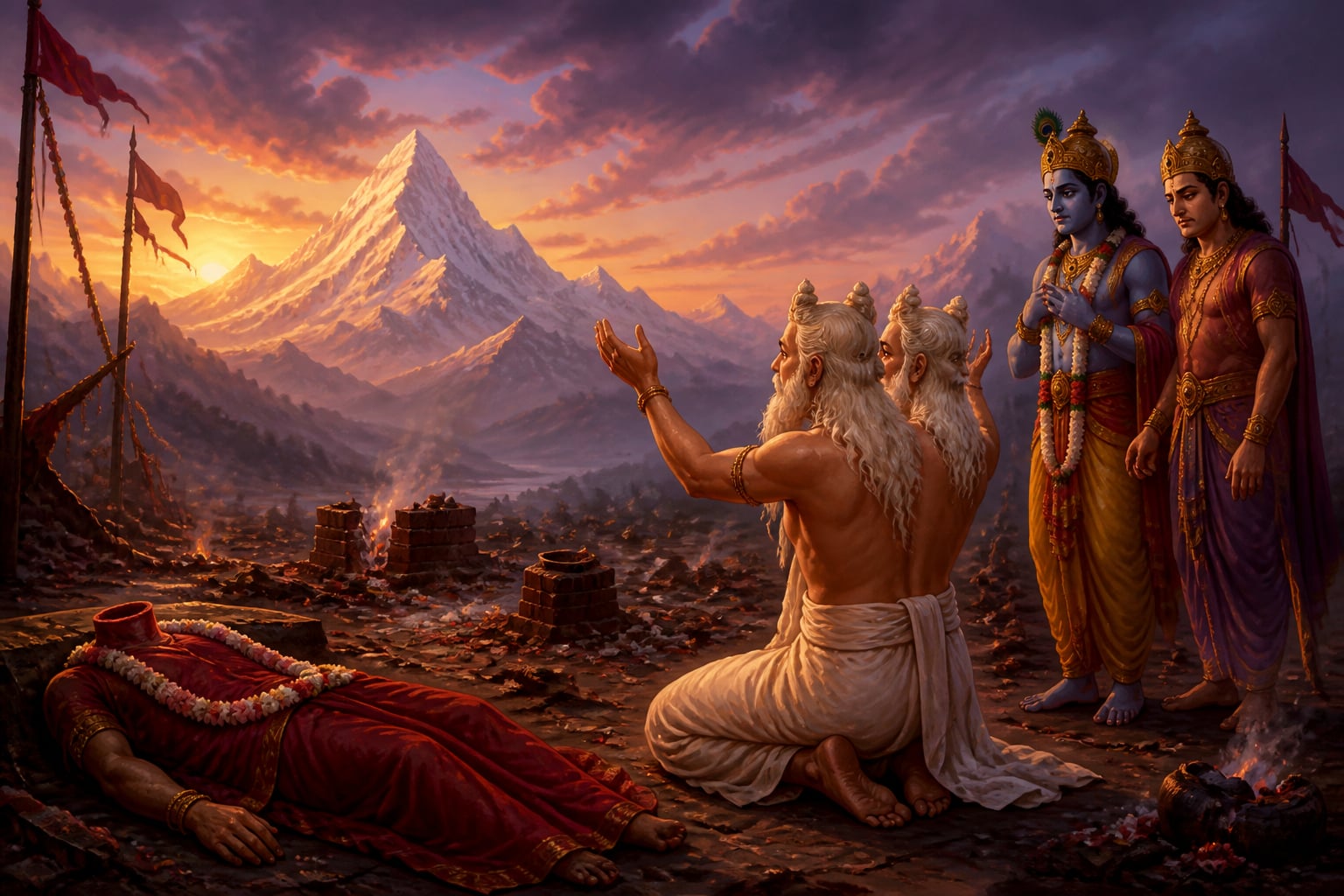
The answer comes when Brahma, the creator, the father of Daksha, kneels in the wreckage and turns toward Mount Kailasa. He folds his hands. He does not defend his son. He does what the Dharmic tradition holds as the highest act after a wrong has been done. He asks Shiva for kshama. Forgiveness.
The Plea Of The Gods
The Shiva Purana's Rudra Samhita gives the scene at length. Brahma travels to Kailasa with the surviving gods. He finds Shiva still in the cold weight of grief, Sati's body no longer in his arms (Vishnu's chakra has long since severed it across the sky into the fifty-one Shakti Peethas) but the loss still fresh on his face.
Brahma does not begin by defending Daksha. He begins by acknowledging the wrong.
Daksha was wrong, Mahadeva. He insulted the share. He insulted Sati. He insulted you. The yajna deserved what came to it. We do not ask you to undo your wrath.
Then, slowly, Brahma asks for the second movement.
But the yajna is also the world's continuance. Without the sacrifice, the rains do not come. Without the rains, the cattle die. Without the cattle, the people starve. We ask you, Mahadeva, to revive Daksha and complete the yajna. Not because he deserves life. Because the world deserves the sacrifice.
This is the structural point the Shiva Purana wants the reader to see. Brahma is not asking Shiva to forgive Daksha for Daksha's sake. He is asking for forgiveness because the world has work to do, and unfinished sacrifices stop the world. Forgiveness in the Dharmic sense is not a gift to the wrongdoer. It is a way of letting the world keep moving.
The Goat-Head
Shiva considers. The grief in his face does not lift. But he agrees.
He walks to Kanakhal with the gods. He stands over Daksha's body. The original head is gone, lost in the destruction, unrecoverable. The Shiva Purana is careful here. The text does not say Shiva restored the head. It says he replaced it.
A goat had been tied near the yajna ground for sacrifice. Shiva takes the goat's head and places it on Daksha's neck. The body stirs. Daksha breathes. Daksha sits up. Daksha sees, with the goat's eyes, what he has done.

The Shiva Purana's verse for this moment reads:
छागस्य शिरसा युक्तो दक्षः प्राणैः समन्वितः। ववन्दे शिवमीशानं भक्त्या परमया युतः॥
chāgasya śirasā yukto dakṣaḥ prāṇaiḥ samanvitaḥ | vavande śivam-īśānaṃ bhaktyā paramayā yutaḥ
Joined with a goat's head, restored to the breath of life, Daksha bowed to Shiva, the Lord, filled now with the highest devotion.
Shiva Purana, Rudra Samhita, Sati Khanda
Look at the verse. Daksha is not given his own head back. The pride that fired the insult is not restored. What is restored is his breath, his ability to act, his place in the world. The new head, the goat's head, will mark him for the rest of his life as a man who was once destroyed and who came back changed.

The sacrifice he had begun is then completed. Shiva himself receives his share of the offerings. The fires are relit. The mantras are chanted. The yajna that had been the trigger of all the destruction now becomes the place where the destruction is healed.
What Real Forgiveness Looks Like
The goat-head ending is the Shiva Purana's teaching on kshama put into one image. Look at what the tradition is refusing as much as what it is offering.
| What Daksha Did Not Get | What Daksha Did Get |
|---|---|
| His old head back | A new head, marked for life |
| The pride restored | The breath restored |
| The insult forgotten | The insult turned into devotion |
| Sati returned | The chance to bow at Sati's husband's feet |
| Innocence | Continuation |
Daksha is not innocent again. He cannot be. The story does not pretend he can. Forgiveness in this tradition is not amnesia. It is the gift of continuance after the wrong has been faced and the price has been paid.
Notice also that the price was real. Daksha did not get his old head back. Sati did not return. The yajna ground was scarred. Virabhadra's blow was not undone. The Shiva Purana refuses the cheap forgiveness in which the wrong is simply waved away. The wrong stayed. The price stayed. The bow at the end is the new thing.
Why The Goat
The choice of a goat's head is not random. The goat was the animal tied for sacrifice, the creature already marked to die at the yajna. By placing a sacrificed animal's head on Daksha, Shiva is saying something specific.
You who would have killed the goat, now wear its head. You who would have offered it to consume itself, now consume yourself in its place. The animal you were ready to sacrifice was always you.
The Vedic ritual tradition had long held that the animal sacrificed at the yajna was a stand-in for the one offering it. The Brihadaranyaka Upanishad says it directly. The yajamana, the performer of the sacrifice, gives himself through the substitute. Daksha had hidden behind the substitute. Shiva makes the substitute literal. Daksha now wears the head of the very thing he tried to make stand in for him.
The ego is not erased. It is humbled into wearing the truth. Every time Daksha sees his reflection in a vessel of water for the rest of his life, he will see the goat's eyes. He will remember. The marking is the lesson.
The Difference Between Erasing And Humbling
This is the chapter's quiet final teaching. The Shiva Purana could have ended the Daksha story in three other ways. It could have left him dead, the wrath complete. It could have given him his head back and called it grace. It could have erased the whole episode by undoing time. It does none of these.
It picks a fourth path. Daksha lives. Daksha is changed. Daksha bows.
A Sanskrit phrase carries this distinction. Ahankara (the ego, the I-maker) was not killed. It was namrita, bowed down. The same self continues, but now it walks at a different angle. Sati's father is now Shiva's devotee. The man who refused the share is now the one who hands the share over with both hands.
This is what the tradition asks of us when we forgive someone who has actually wronged us, and when we ask for forgiveness from someone we have actually wronged. Not amnesia. Not innocence. A new head, and a willingness to wear it.
Modern Echoes
The South African archbishop Desmond Tutu, who chaired the Truth and Reconciliation Commission from 1995 to 1998, wrote a book in 2014 called The Book of Forgiving that argues for almost exactly this structure. Tutu insisted, against the cheap-forgiveness reading common in popular culture, that real forgiveness has four steps. Tell the story. Name the hurt. Grant forgiveness. Renew or release the relationship. The third step is not a forgetting. It is an act done after the first two have been honoured. Tutu had read no Shiva Purana. He had spent his life next to apartheid's victims and perpetrators and had arrived at the same shape Brahma did at Kanakhal.
The American social psychologist Everett Worthington, who has researched forgiveness for over thirty years at Virginia Commonwealth University, has found the same pattern in clinical data. Forced premature forgiveness, what he calls the fast-food forgive, predicts relapse and ongoing anger. Forgiveness that follows acknowledgement, accountability, and a marking of the harm produces the durable healing. The goat-head is the marking.
In 2026, in any Indian household where a son has hurt his father badly, or a partner has betrayed a partner, or a colleague has stolen a chance, the question that comes after the wrath is the same question Brahma asked at Kanakhal. Can the world keep moving without my being right. When the answer is yes, kshama becomes possible. Not because the wrong is forgotten, but because the world has more work to do than the wound can hold.
Back at Kanakhal, the yajna fires are crackling again. The gods receive their shares. Shiva, on a high seat, receives his. Daksha kneels at the edge of the ground with a goat's head and folded hands. The river runs on. The work of the world begins again. Sati does not return, and yet, in another way, the husband she chose has been honoured at the very ground she once lit on fire. The destruction is whole. The redemption is whole. The chapter ends.
In the next chapter, that same Shiva walks down from Kailasa to meet his family, and the household stories begin: Ganesha at the door, Kartikeya born of the six fires, Ayyappa in the forest. The ash-smeared ascetic, who has just reduced one yajna to wreckage and rebuilt it with a goat's head, will now teach us what fatherhood looks like.
Key figures
Brahma
The creator god, father of Daksha, who kneels in the wreckage to ask Shiva for kshama
Daksha
The patriarch whose insult began the story and whose goat-head bow ends it
Mahadeva
The Great God who held the wrath, who held the grief, and who now holds the redemption
Historical context
Puranic age (c. 300-1400 CE), with deeper roots in late Vedic and Upanishadic teaching on kshama
The Daksha story sits at the intersection of two Indic preoccupations. The first is the Vedic concern with the unfinished sacrifice, the yajna that fails because of an interruption. The second is the Smriti tradition's listing of kshama as a foundational virtue. From the Mahabharata's Bhishma teaching Yudhishthira on the bed of arrows that forgiveness is dharma, sacrifice, the Vedas, and the heard scripture all at once, to the Shiva Purana's goat-head ending, the same idea is being reworked. The civilisation that produced Kanakhal, Kashi, and Lepakshi has been rehearsing the goat-head bow for over two thousand years.
Living traditions
The Daksha story has become the touchstone Indic narrative for restorative justice. Indian Supreme Court judgments on reconciliation and rehabilitation have at times invoked the Kshamasagara title for Shiva and the goat-head pattern as a model that punishment without reintegration is incomplete dharma. The Truth and Reconciliation framework that Desmond Tutu chaired in South Africa from 1995 to 1998 has been compared in cross-cultural justice studies to the Kanakhal arc. In modern wellness and therapy circles in Bharat, the phrase ahankara namrita (ego humbled, not erased) has begun to appear as an alternative to imported ego-death language, recognising that the tradition's goal is the changed posture, not the obliterated self.
- Kshama Prarthana: A short forgiveness prayer recited at the close of every traditional puja in Shaiva and other Hindu households. The worshipper asks the deity to forgive any errors of mantra, action, or attention during the ritual just performed. The prayer ends with the line yat krtam tat ksamasva, whatever has been done, please forgive. The Daksha story is the implicit backdrop. Every yajna is a small re-enactment of the Kanakhal arc.
- Kshamavani in the Jain Tradition: Although a Jain rather than Shaiva observance, Kshamavani Parva, the festival of forgiveness held the day after Paryushana ends in Bhadrapada (August or September), is the closest living parallel to the goat-head teaching. Devotees ask forgiveness from every person they may have hurt, in person where possible, with the formula michhami dukkadam, may the wrongs done be in vain. The Shaiva tradition often speaks of Kshamavani approvingly as a sister practice to its own Daksha-rooted kshama prarthana.
- Daksha Mahadev Mandir: The traditional site of Daksha's yajna. The temple complex includes the main Shiva shrine, a small Daksha shrine where Daksha is shown with the goat's head, and a Sati Kund believed to mark the spot of her self-immolation. Pilgrims circumambulate the kund before entering the main temple. The atmosphere is unusually quiet for a major Shaiva site, partly because the story it carries is a sober one.
- Virabhadra Temple at Lepakshi: A 16th century Vijayanagara temple dedicated to Virabhadra, the form of Shiva who destroyed Daksha's yajna. The temple's painted ceilings, hanging pillar, and large monolithic Nandi outside make it a major heritage destination. Visiting Lepakshi alongside Kanakhal completes the geographic arc of the Sati Khanda, the wrath at one end and the redemption at the other.
- Daksha Yajna Murti at Lepakshi: Inside the Virabhadra temple at Lepakshi, the Vijayanagara-period painted ceiling carries one of the most detailed surviving visual narrations of the Daksha story, including the goat-head revival. Pilgrims who have visited Kanakhal often complete the loop here, moving from the geography of the yajna ground to the most lavish artistic record of the same event.
Reflection
- Where in your life are you currently choosing between leaving a wrong unforgiven or pretending it never happened, and what would the third path of marked continuance look like?
- Why do you think the Shiva Purana refuses to give Daksha back his original head and insists on a goat's head instead, even though Shiva clearly has the power to restore the original?
- If forgiveness in this tradition is defined as the world being allowed to keep moving rather than as the wrong being erased, what does that say about the modern equation of forgiveness with letting go and moving on?