Shakti Peethas: Grief Made into Sacred Geography
Where Sati's body fell, shrines arose
After Sati walks into the fire of Daksha's yajna and Virabhadra destroys the sacrifice, Shiva lifts her body onto his shoulder and walks. He cannot stop. Vishnu, watching the worlds tilt under that grief, releases his Sudarshan Chakra and severs Sati's body, piece by piece, across the land. Where each piece falls, a temple rises. The map of India becomes the map of a god's mourning.
A God Who Will Not Put Her Down
The yajna grounds at Kankhal, just outside Haridwar, in the late afternoon after the destruction. The fire pits are smoking. The priests are scattered or dead. Daksha's headless body has not yet been revived. The sacred ground is a wreckage of overturned vessels and torn banners. In the centre of all of it, Shiva is kneeling.
In his arms is Sati, his wife, her body lifted out of the yajna fire by Virabhadra and laid here for him. Her skin is unmarked. Her eyes are closed. The fire that consumed her was the inner fire of her own tapas, not the flame she walked into; she chose her own way out and the body has come back almost intact. Shiva is not weeping in the loud way. He is silent. The silence is worse.
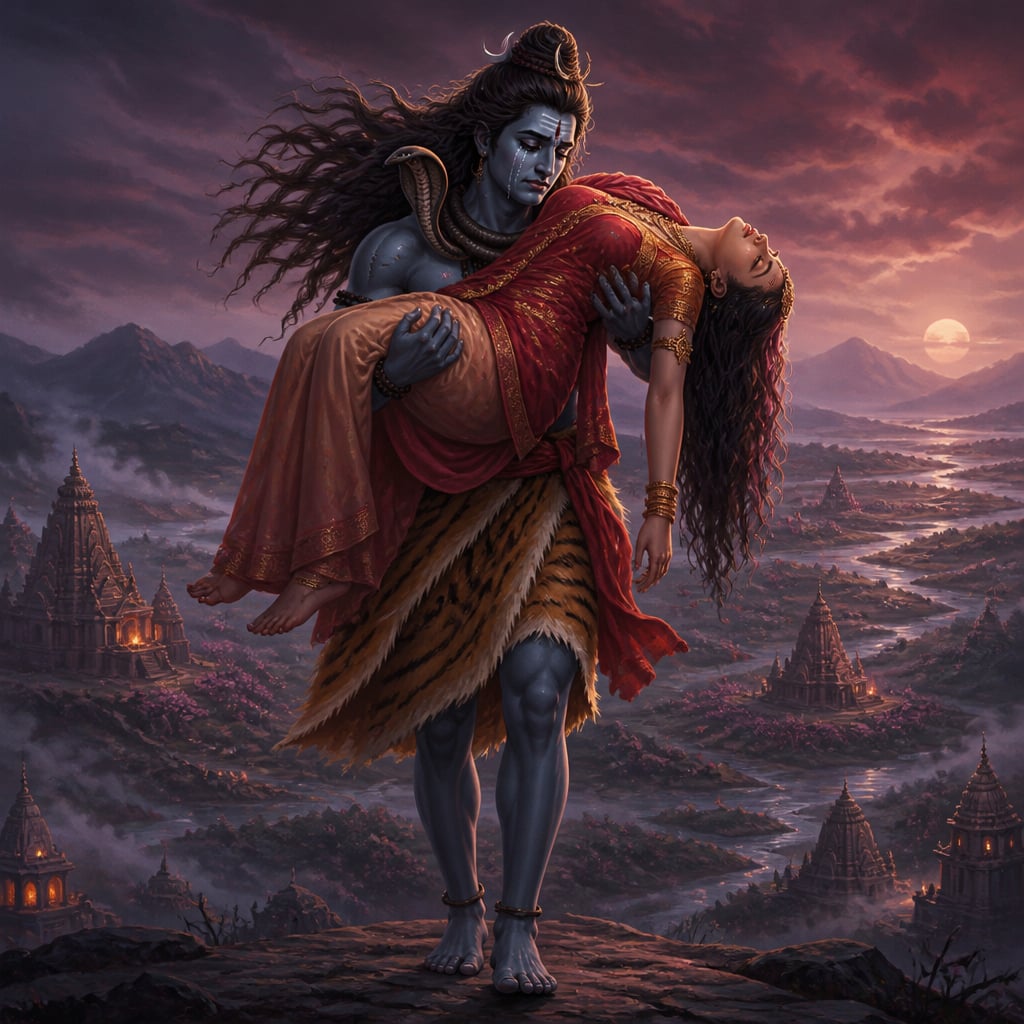
He stands. He lifts her. He places her across his shoulder, the way a husband would carry a sleeping wife to a bed. And then he begins to walk. He walks out of the yajna grounds. He walks past the river. He walks past the foothills. He keeps walking. The Puranas say he does not know where he is going. The Puranas also say it does not matter, because wherever he walks, the worlds tilt to follow him.
The Tandava Of Grief
This is not the cosmic dance Shiva does at the end of an age. This is the slow dance of a man who cannot stop moving because stopping would mean accepting what has happened. His matted hair has come loose. Ash falls from his shoulders. The drum at his hip is silent. He walks across forests. He walks across mountain passes. He walks across rivers that part to let him through. Sati's body stays on his shoulder, getting heavier with every league because grief has its own weight that does not belong to the body itself.
The gods watch from above. Indra is afraid. Brahma is silent. The other devas understand what is happening. The longer Shiva walks like this, the less the cosmos can hold its shape. The fundamental marriage of Shiva and Shakti has come undone in the wrong direction, and a husband carrying his wife's body across the worlds is not a story creation can survive for very long.
They turn to Vishnu.
Vishnu's Decision
Vishnu sees what is needed. He has known Shiva for ages. He knows that a god will not put his wife down because asked. The grief must be lifted out of the body that holds it. The body must be released, gently, piece by piece, into the land.

He summons his Sudarshan Chakra, the discus that Shiva himself once gave him, the same chakra from the Kamalalochana lesson earlier in this course. He sends it ahead of Shiva, invisible, calibrated. The chakra does not strike. It cuts only what cannot continue to be carried.
As Shiva walks, the chakra touches the body on his shoulder. A finger detaches. It falls behind him into the forest below. Shiva does not notice. He keeps walking. A toe falls. An eye. A breast. A piece of cloth. A piece of skin. The chakra works for many hours, then many days. The body grows lighter on Shiva's shoulder. The leagues he covers grow longer. Slowly, inevitably, what he is carrying becomes less than what he can put down.
Finally, on a peak somewhere in the south, the last fragment falls. Shiva's shoulder is empty. He stops. He sits. The walking is over. The grieving is not over, but the form of the grief has changed. He has been brought back, gently, to the world.
Where Each Piece Fell
What happened on the ground beneath that walk is the story Indian sacred geography has lived inside ever since.
Wherever a piece of Sati fell, the land took it in. A spring opened. A grove darkened. A rock cracked open and a small natural shape, like a face or a foot or a yoni, appeared in the stone. Local people found these places. They felt the heat of the fragment still in the ground. They built a small shrine. They gave the goddess of that shrine a name fitting the fragment that had fallen there. They called her by the body part the place had received.

Where her jihva (tongue) fell at Jwalamukhi in Kangra, eternal blue flames burn out of the rocks to this day, and the temple has no idol because the flame is the goddess. Where her yoni fell at Kamakhya in Guwahati, a natural cleft in the rock is worshipped as the womb of the world, and the temple closes for three days each summer when the goddess is held to be in her menstrual cycle. Where her heart fell at Kalighat in Kolkata, the goddess is dark and four-armed, and the city of Kolkata itself is named after her shrine. Where her netra (eye) fell at Manibandh, the goddess is Gayatri. Where her anguli (finger) fell at Karnat in Kashmir, the goddess is Devi. The list runs to fifty-one in the most widely accepted enumeration, with several Puranas adding more.
The Sanskrit word for these sites is Shakti Peetha, the seat of Shakti. Each one is treated as a complete shrine in its own right. Each one is also treated as a fragment of the same body. A devotee who has walked the full circuit of fifty-one peethas, the way an old Bengali tantric or a Kashmiri pilgrim might do across a lifetime, has reassembled Sati's body in his own footsteps. The pilgrimage is the body returning.
The Bhairavas: Shiva Stays With Her
The Shaiva tradition is precise about something easy to miss. At every Shakti Peetha, there is also a small Shiva shrine, never large, often a step away from the main goddess sanctum. The Shiva enshrined there has a specific name at each site. He is the Bhairava of that peetha. At Kamakhya he is Umananda. At Kalighat he is Nakuleshvara. At Jwalamukhi he is Unmatta Bhairava.
The theology in this is gentle and exact. Shiva did not walk away from Sati after the chakra worked. Wherever a piece of her fell, he stayed nearby. The Bhairava at every peetha is the part of Shiva that did not finish grieving. He sits beside her, not in the centre. He guards the door. He leaves her the central seat. The marriage that came apart at Daksha's yajna has been put back together across the geography of an entire subcontinent, in fifty-one pairs of small twin shrines.
What This Story Did To India
The Shakti Peetha story is one of the oldest Indian inventions and one of the most practical. It took the most private form of grief, the loss of a beloved by a god who could not stop walking, and it converted that grief into a shared map. Long before there was a state called India, the Shakti Peetha network connected Hingula in present-day Pakistan to Lankan shrines in Sri Lanka to Tibetan border peethas to the temples of Kerala and Tamil Nadu. A pilgrim walking the circuit knew the boundaries of her civilisation by the boundaries of one goddess's body.
This matters in 2026 in a way the Puranas did not predict. The Indian historian Diana Eck, in her 2012 book India: A Sacred Geography, argued that the Shakti Peethas were the first imagined community of the subcontinent, an India before there was an India, held together by ritual and not by empire. The poet Kapil Kapoor has written that the peetha network is what made north and south, east and west, mutually recognisable to each other long before any common language linked them. The map of Sati's body is, in this reading, the first political map of Bharat.
Modern Echoes
The psychologist William Worden, in his work on bereavement, identified four tasks of mourning: accept the reality, process the pain, adjust to a world without the loved one, and find an enduring connection with them in the midst of a new life. The Shaiva tradition built these four tasks into the Shakti Peetha story before any psychologist named them. Shiva accepts the reality only when the chakra has done its work. He processes the pain by walking. He adjusts to a world without Sati when his shoulder is empty. He finds the enduring connection by becoming Bhairava at every peetha, beside her forever, in fifty-one places at once.
The writer Sherwin Nuland, in How We Die, observed that the deepest grief is rarely cured by the passage of time alone. It is cured, when it is cured, by being given a shape, a place to put it, a ritual to perform. The Shakti Peetha story did this for an entire civilisation. The temples are not just shrines to a goddess. They are the shape Indian culture gave its own grief.
What We Carry, What We Put Down
The Shiva Purana ends this episode without flourish. Shiva sits in the south, his shoulder empty. The chakra returns to Vishnu. The pieces are scattered across the worlds, and pilgrims for thousands of years to come will walk to find them. The body is gone. The marriage is not.
In the next lesson, we will see what happens to Daksha, Sati's father, after the yajna. The wrath of Virabhadra cost him his head. The grace of Shiva will give him another, an unexpected one, and a chance to finish the sacrifice he began with so much pride. Ego is not destroyed in the Shaiva tradition. It is pruned, humbled, and asked to begin again.
Historical context
Puranic compilation period (c. 7th to 12th century CE), with peetha lists evolving through the medieval Tantric period (c. 9th to 14th century CE).
The peetha tradition crystallised in a period of sustained Tantric flowering across the subcontinent, from Kashmir to Kerala, from Sindh to Assam. Pala Bengal in the east, the late Pratiharas and early Chandelas in central India, the Cholas in the south, and the Karkota and Utpala dynasties in Kashmir all patronised Shakta worship at peetha sites. The Tantric texts of this period, particularly the Pithanirnaya Tantra, the Kalika Purana, and the Mahabhagavata Purana, give parallel and sometimes overlapping lists of the peethas, settling around the canonical fifty-one. The peetha network was the substrate underneath much of the medieval pilgrimage economy of the subcontinent and one of the strongest arguments against the Western academic frame of India as a colonial-era construction.
Without the Shakti Peetha story, the geography of pilgrimage in India is a series of separate temples. With it, the entire subcontinent becomes a single body, of one goddess, scattered. Every peetha visit is a small reassembly. The civilisational coherence of Bharat across language, region, and dynasty rests significantly on this shared map of remembered limbs.
Living traditions
The Shakti Peetha network is one of the oldest and most consequential geographic facts about the subcontinent. The historian Diana Eck, in *India: A Sacred Geography* (2012), argues that the peetha map predates and underlies every later political map of India and helped create the felt sense of a single land long before any state existed to enforce it. Eighteen of the canonical fifty-one peethas lie outside the present borders of the Republic of India: Hingula in Balochistan (Pakistan), Sharada Peetha in Pakistan-occupied Kashmir, Sugandha in Bangladesh, Manas in Tibet, Lankan peethas in Sri Lanka, Devikoop in Pakistan. Restoration projects for several of these have become diplomatic touchpoints in the past decade, with Sharada Peetha access being a particularly active subject of India-Pakistan cultural diplomacy. The Government of India's Ministry of Tourism in 2018 launched a Shakti Peetha pilgrimage circuit under the PRASHAD scheme, and the Ministry of Culture maintains a digitised list. In contemporary Indian English literature, the peethas appear extensively in Devdutt Pattanaik's retellings, in Stephen P. Huyler's *Meeting God: Elements of Hindu Devotion*, and as the structuring thread of Talapatram's own dedicated Shakti Peethas course on the Gurukul platform.
- Shakti Peetha Pilgrimage Circuit: Many traditional Shakta households undertake to visit the four most-revered peethas across a lifetime: Kamakhya in Guwahati (yoni), Kalighat in Kolkata (right toes), Vimala at Puri (feet), and Tara Tarini in Odisha (breasts). A smaller number of serious tantric and Shakta sadhakas attempt the full fifty-one circuit, often across many years. The practice is to begin and end at the same peetha, treating the whole circuit as a single act of reassembling the goddess's body in the pilgrim's own footsteps.
- Ambubachi Mela At Kamakhya: Each summer, around the second week of Ashadha (mid-June), the Kamakhya Temple closes for three days. Tradition holds that the goddess is in her menstrual cycle. On the fourth day, the temple reopens with the Angodak puja, in which the red cloth that was placed over the rock cleft is distributed in tiny fragments as the most powerful prasad of the year. The festival draws roughly five lakh pilgrims and tantric sadhus from across India and Nepal.
- Bhairava Darshan At Every Peetha: A traditional Shakta pilgrim never takes darshan of the goddess at a peetha without also taking darshan of the Bhairava at the same site. At Kamakhya the Bhairava is Umananda on the river island; at Kalighat he is Nakuleshvara within the same complex; at Jwalamukhi he is Unmatta Bhairava in a small shrine adjoining the flame sanctum. The pilgrim crosses to the Bhairava with bilva leaves after offering hibiscus to the goddess. The peetha visit is incomplete without both.
- Kamakhya Temple: The foremost of the fifty-one Shakti Peethas, where Sati's yoni fell. The garbhagriha holds no idol; instead, a natural cleft in the rock, kept moist by an underground spring, is worshipped as the goddess herself. The complex also includes shrines to the ten Mahavidyas on the same hill and the Umananda Bhairava temple on a midstream island in the Brahmaputra.
- Kalighat Temple: The peetha where Sati's right toes (and, in some traditions, additional fragments of the face) fell. The deity is worshipped as Kali in her four-armed form, and the city of Kolkata takes its name from this shrine. The Bhairava enshrined within the same complex is Nakuleshvara. The temple is one of the most active places of daily worship anywhere in India, with footfall above twenty thousand on ordinary days and above two lakh on Kali Puja.
- Jwalamukhi Temple: The peetha where Sati's tongue fell. The temple has no idol. Eternal blue and yellow flames burn out of fissures in the rocks of the sanctum, fed by underground natural gas, and these flames are themselves worshipped as the goddess. Akbar is recorded as having tried to extinguish the flames with a stream of water in 1573 and failed; he later donated a gold parasol to the shrine which is preserved there.
Reflection
- What is the body you have been carrying on your shoulder, refusing to set down? A grief, an old anger, a relationship that ended badly, a version of yourself that died?
- Why does the Shaiva tradition keep Shiva beside the goddess at every peetha as a smaller Bhairava, instead of letting him return to his own life?
- If sacred geography is grief made into a map, what does that say about the relationship between civilisation and loss?