Apamana: The Insult at Daksha's Yajna
The politics of respect, cosmic version
Daksha holds a great yajna and invites every god and sage in the cosmos. He pointedly leaves out his daughter Sati and her husband Shiva. The omission is not an oversight. It is a strategy to deny the sacred its rightful place at the table.
The Empty Seat
In the great hall of Kanakhal, on the morning of Daksha's Brihaspatisava yajna, eleven thousand pots of clarified butter sit ready beside the fire pit. The air smells of sandalwood smoke and crushed bilva. Brahma is seated in the south. Vishnu is seated in the north. Indra, Kubera, Yama, Varuna, the Maruts and the Adityas, the rishis and the rivers, are all seated by name. The list of guests has been read aloud. Two names are missing.
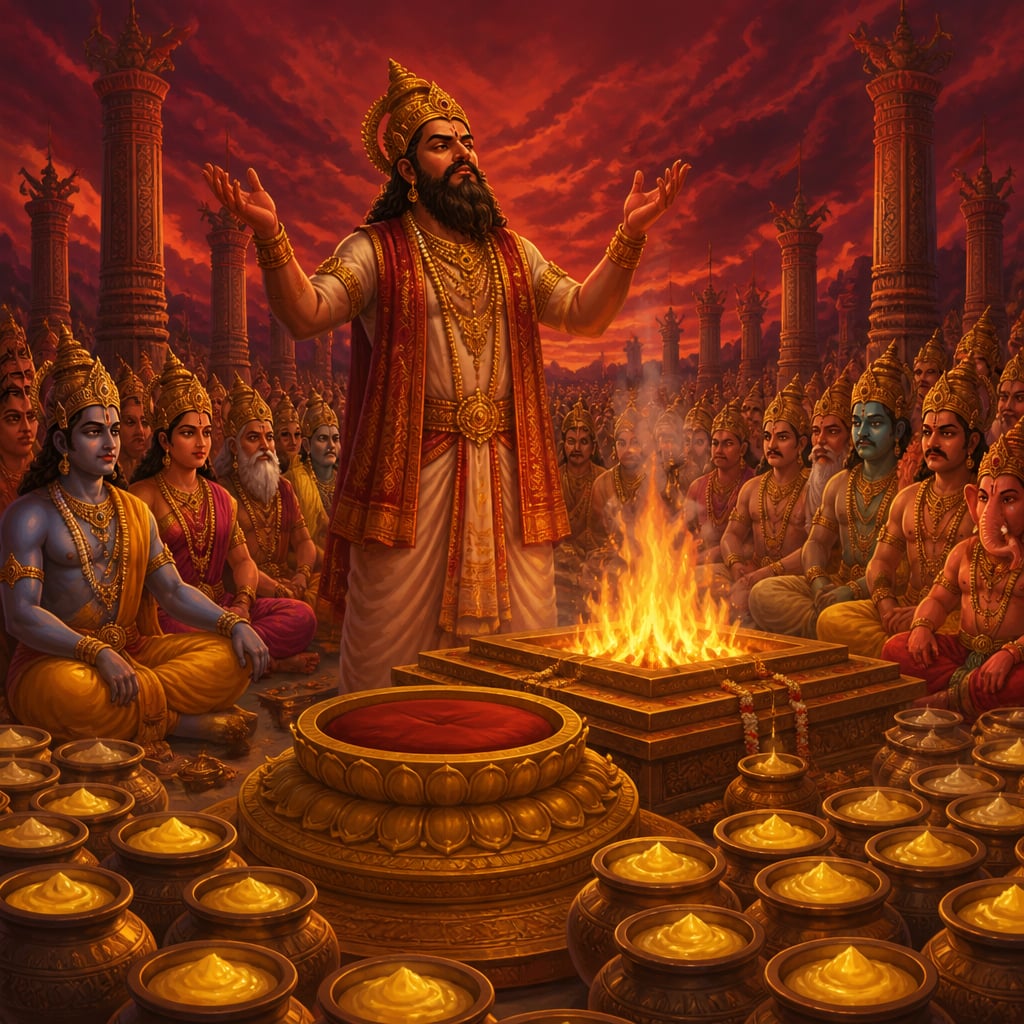
Daksha smiles when the omission is pointed out to him. He does not call it an oversight. He calls it policy. "There is no share in this yajna for that ash-smeared yogi," he tells the priests, loud enough for the front rows to hear. "And there is no seat for the daughter who chose him over her father's house."
Far to the north, on the slope of Kailasa, his daughter has just heard.
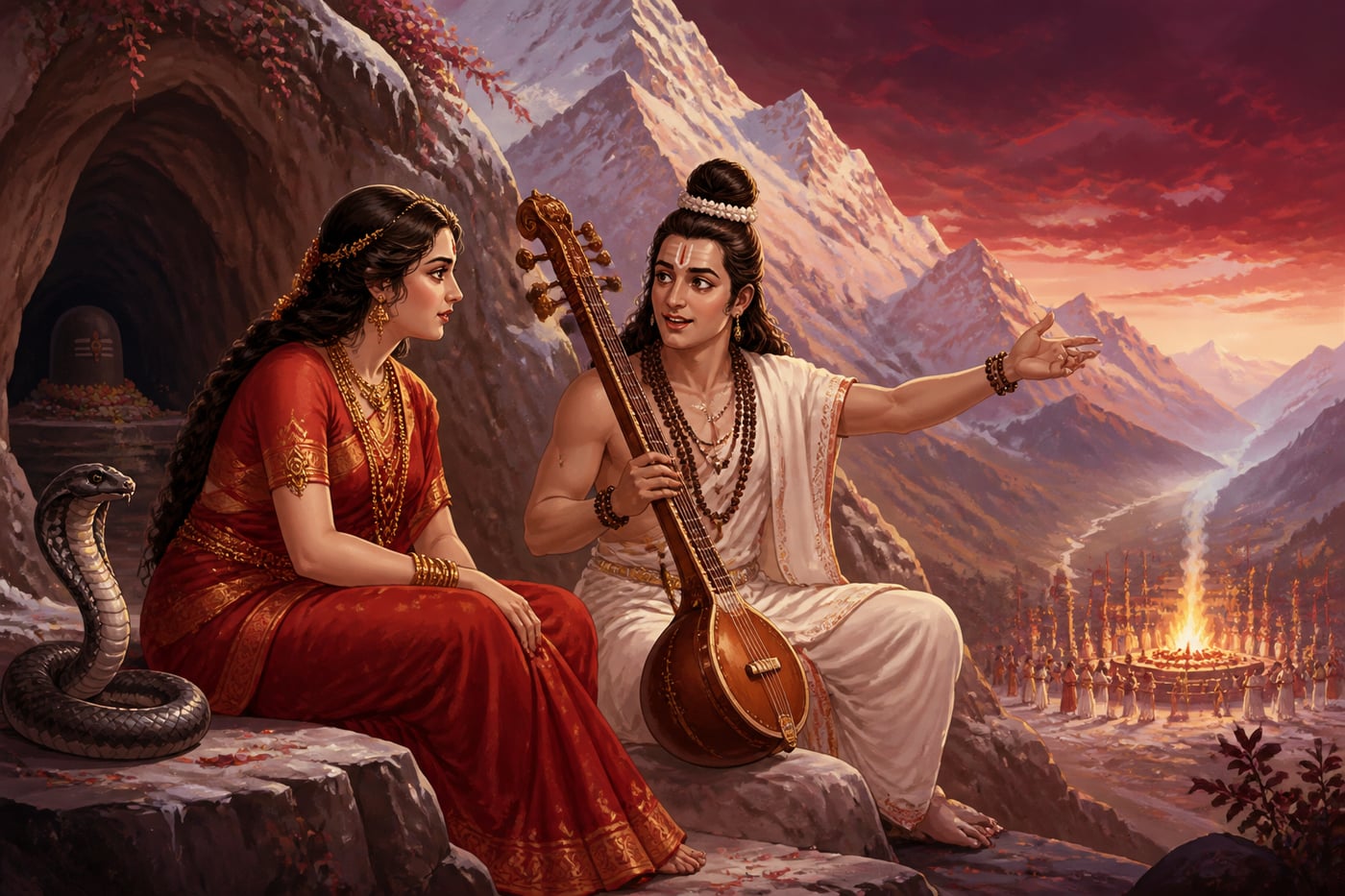
Sati is sitting on a flat stone outside Shiva's cave when Narada (the wandering sage who carries news between worlds) finishes telling her what is happening at her father's house. She does not move for a long time. Then she rises and walks inside. The stake is precise: not only her god has been excluded, her own father has erased her name from the family. What follows is the choice she made, and the choice that made the rest of the Shiva Purana.
Why a Yajna Cannot Skip Shiva
A yajna (a ritual fire sacrifice in which offerings are placed in the flames for the gods) is not a private dinner party. The Vedas treat it as a small reconstruction of the cosmos itself. Every part of the cosmos must have its share. The sun has a share. The waters have a share. The ancestors have a share. Rudra, the older Vedic name of Shiva, has a share.
The Shatapatha Brahmana, one of the oldest Vedic ritual texts, is plain about this. A yajna without Rudra's portion is not a small lapse. It is structurally incomplete. The ritual hole left by the missing share will, the text says, swallow the yajna and its host both.
Daksha has been a Prajapati for a long time. He knows this. The Shiva Purana is careful not to call him stupid. He knows exactly what he is doing.
| What Daksha's yajna had | What it did not have |
|---|---|
| Every god of the upper court | The god of the cremation ground |
| Eleven thousand pots of clarified butter | A share for Shiva |
| The blessing of every river | Sati's name on the guest list |
| The presence of Brahma and Vishnu | The principle that holds the whole rite together |
This is the first thing the lesson asks the reader to see. The most damaging exclusions are never accidental. They are choreographed. Daksha is not forgetting Shiva. He is performing his refusal of Shiva, in front of every other god, as a political act.
The Word Apamana
The Sanskrit word apamana is built from two parts. Apa means away from, against, the opposite of. Mana means honour, regard, the act of being measured fully and counted in. Apamana is therefore the active withdrawal of being counted. It is not absence. It is presence-with-erasure.
This is exactly what Daksha is doing. He is not ignoring Shiva. He is making sure every god in the cosmos sees that Shiva is being not-counted. He has chosen the day, the format, the audience, the missing share, with care. The apamana is the message.
This is also what makes the wound so precise for Sati. She has not been forgotten by accident. She has been formally written out of her father's family, in front of all her sisters, on a day designed to be witnessed.
The Conversation on Kailasa
The Shiva Purana lingers on this scene. Sati is brittle. Shiva is gentle.
She says, in the Purana's words, "My father is performing a great sacrifice. My sisters will be there. My mother will be there. I want to go."
Shiva does not refuse. He warns. "They have not invited us, Devi. To go to a yajna where you have not been called is not the same as visiting a father's house. The mood at Kanakhal is not what your love thinks it is. The fruit of going will not be sweet."
She answers with the line that defines her in this Purana: "He is my father, and a father's house needs no invitation."
The Shaiva tradition reads this answer with great care. Sati is not naive. She knows what Daksha has done. She is choosing to honour the relationship of daughter even after the father has refused the relationship of father. She is testing whether love still recognises love when respectability has burned the bridge.

She leaves Kailasa. Shiva sends two of his ganas, Nandi the bull and a small attendant, to walk with her. He does not stop her.
The Missing Share Inside Us
It is easy to read this story as ancient family drama. The Shiva Purana is asking the reader to read it inwardly as well.
Every life has a yajna. The yajna is your day. The fire is your attention. The pots of clarified butter are your hours. Every yajna has a guest list. Health, work, money, friendships, family, learning, rest, love, all line up to be invited or not invited.
Most lives, somewhere on the list, have a Shiva-amsha that has not been invited. The share of the sacred. The share of the silence. The share of the part of yourself that does not perform. The share of the truth you keep saying you will get to next month. We do not skip this share by accident. We skip it the way Daksha skips Shiva. With a small, public, repeated act of not-counting.
The yajna without Rudra's share will, sooner or later, swallow the yajna. The Shiva Purana means this literally about the cosmos. It means it inwardly about a life. A life without its sacred share looks impressive for a long time. The pots of butter are real. The guests are real. The smoke is real. Then one morning the floor of the hall opens.
Modern Echoes
The sociologist Pierre Bourdieu, working at the College de France in the second half of the twentieth century, gave the modern world a name for what Daksha is doing. He called it symbolic violence, the kind of harm that travels through the official guest list, the seating chart, the polite no-reply, rather than through any visible blow. His point was that the most lasting injuries in any community come from being formally not-counted.
Researchers in organisational psychology have measured this in offices. Kipling Williams at Purdue University has spent three decades studying social ostracism, the silent exclusion of one team member from a group's circle. His 2009 paper called the experience "the kiss of social death" and showed, in fMRI studies, that the brain processes ostracism through the same anterior cingulate cortex pathway that processes physical pain. The Sanskrit word apamana names what brain scans now confirm.
Brene Brown, at the University of Houston, draws the practical line in her 2021 book Atlas of the Heart. She separates belonging, where you can be your full self in the room, from fitting in, where you change yourself to be allowed in the room. Daksha's yajna is the highest form of fitting in. Every god in the hall is ranked, costumed, seated, and approved. Sati and Shiva would not fit in. So they are not let in. The cost of that exclusion is the rest of the Purana.
The Sati Khanda ends, two chapters from now, with a fire and a self-immolation. Before that fire is lit, the Shiva Purana wants the reader to see the smaller fire that has been lit already. The fire of what gets quietly excluded from a life that looks, on the surface, very impressive.
Back on Kailasa, Sati has begun to walk. The pots of butter at Kanakhal are still warm. The list of names has been read once. It is about to be read again, this time by a daughter no one expected to come.
Living traditions
The Daksha-Sati story has shaped Indian conversation about social exclusion for centuries and is increasingly cited in contemporary work. Madhu Kishwar's writing in the Manushi journal in the 1990s drew on the Sati Khanda to argue against the colonial collapse of the word sati. More recent organisational psychology, including Kipling Williams' 2009 work on ostracism at Purdue and Brene Brown's 2021 book Atlas of the Heart, names in modern terms what the Shiva Purana calls apamana. The Daksheshwar Mahadev temple at Kankhal is a regular destination for pilgrims who feel quietly written out of family or community circles, and continues to perform the Daksha yajna recitation on every major Shaiva day, holding both the wound of exclusion and the repair in living memory.
- Daksha Yajna Recitation at Kankhal: Priests at the Daksheshwar Mahadev temple in Kankhal read the Daksha Yajna episode of the Shiva Purana on Mahashivaratri, on every Sawan Monday in the Shravan month, and on the Magha new moon. The recitation begins with the insult covered in this lesson, walks through Sati's choice to attend, and ends with Daksha's later redemption with the goat-headed revival, holding both the wound and the repair in one continuous reading.
- Pradosham at the Shiva-Amsha: Pradosham is a twice-monthly Shaiva observance on the thirteenth day of each lunar fortnight, between roughly 4:30 and 6:00 PM. Devotees visit a Shiva temple, offer a bilva leaf, and sit in front of the linga during this window. Many lineages connect pradosham specifically to the restoration of apamana. The ritual is the steady fortnightly act of offering Shiva his share, the share that Daksha refused, so that no missing share is allowed to build up in the devotee's own life.
- Daksheshwar Mahadev Temple, Kankhal: The canonical site of Daksha's yajna. The current temple complex includes a Daksha Mahadev shrine on the location traditionally identified as the yajna fire pit, the Sati Kund nearby, and a Bhairava shrine that recalls Virabhadra's later destruction of the rite. Walking the small parikrama of the complex is a way to walk the geography of this lesson directly. The temple sees its largest crowds on Mahashivaratri, on Sawan Mondays in Shravan, and on the Magha and Phalguna new moon days when the Daksha yajna recitation is held.
- Sati Kund, Kankhal: A stone-rimmed pool inside the Daksheshwar Mahadev complex, identified by tradition as the spot where Sati gave up her body in the chapter that follows this lesson. Visiting the kund as part of this lesson plants the geography of the consequence in the body of the pilgrim. Pilgrims commonly offer a single bilva leaf and a moment of silence at the kund before stepping into the main Daksha Mahadev shrine.
Reflection
- Where in your own daily yajna is the Shiva-amsha being quietly withheld, and what would it cost you to give it a real share starting this week?
- Why do you think Sati chooses to walk into a yajna where she has not been invited, even after Shiva has clearly warned her of the cost?
- What does the Vedic principle that a yajna without Rudra's share is no yajna at all teach us about the relationship between completeness and the inclusion of what we would rather exclude?