The Kashi-Rameshwaram Cycle
The Skanda Purana, Hiuen Tsang's 635 CE Witness, and the $600 Million Camino Built on an Unattributed Walking Logic
Why a Hindu, at the end of a long life, walks two thousand kilometres from the Ganga at Kashi to the sea at Rameshwaram and exchanges a pot of one for a pot of the other. Why the same body that washes daily and lights a lamp at sandhya also crosses the entire subcontinent on foot. The Skanda Purana's Kashi Khanda codified the Kashi pilgrimage by the twelfth century. The Chinese pilgrim Hiuen Tsang documented Varanasi as the world's oldest continuously inhabited pilgrimage city in 635 CE. Luchins 1942 and the Einstellung-effect literature vindicated the cognitive mechanism of long-distance walking. The same logic now sells as a $600 million Camino tourism industry, attributed to Christianity.
The Pot of Ganga and the Pot of Sea
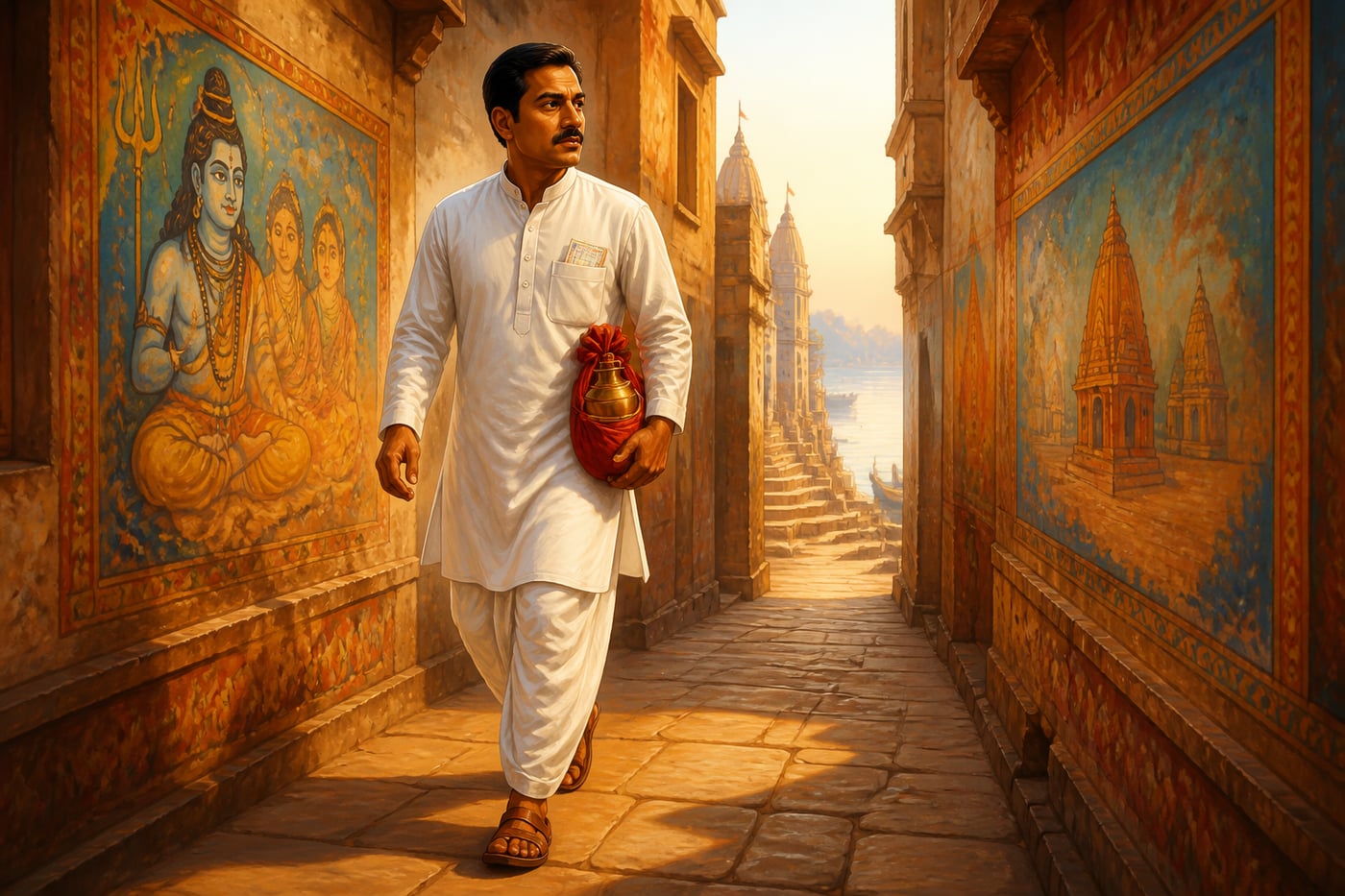
A narrow lane in Varanasi, on a September morning in 1996. A retired Telugu schoolteacher, age sixty-eight, in a clean white dhoti and a small cotton bag on his shoulder, has just stepped out of the Ganga at Dashashwamedh Ghat. He has been bathing here every morning for the last six days. In the bag, wrapped in a clean white cloth, is a small brass kalasha, sealed at the top with red wax and tied with a yellow thread. Inside the kalasha is approximately one hundred millilitres of Ganga water, scooped that morning from the river while reciting the Sankalpa his family priest had given him at home in Vijayawada twelve days earlier.
The schoolteacher has a return train ticket to Chennai, then a connecting bus to Rameshwaram. The journey will take three days. At Rameshwaram, on the southern tip of Tamil Nadu where the Indian peninsula reaches into the Bay of Bengal toward Sri Lanka, he will pour the Ganga water into the sea at the Agni Tirtham. He will then take a fresh kalasha, fill it with sea water, and carry it back. The return journey will take another three days. At Kashi, he will pour the sea water into the Ganga at the same Dashashwamedh Ghat where he is standing this morning.
What he is doing has a name. The Saurashtra-Kashi exchange, also called the Kashi-Rameshwaram cycle, is one of the most sustained pilgrimage practices in any civilisation. The exchange has been performed continuously for at least a thousand years, possibly longer. The schoolteacher is not the first member of his family to do it. His father did it in 1962. His grandfather did it in 1928. The water in the brass kalasha at his shoulder will, by the time it reaches the sea at Rameshwaram, have travelled approximately two thousand kilometres on a body that has, in the same body, walked the same direction at every age for the last hundred years of his lineage.
What the Cycle Actually Is
The Kashi-Rameshwaram cycle is the prescribed pilgrimage exchange between the holiest city of the Ganga (Kashi, the modern Varanasi, in Uttar Pradesh) and the holiest temple of the southern sea (Rameshwaram, in Tamil Nadu). The cycle binds the four corners of the subcontinent into a single ritual geography. It is one of the Char Dham, the four-direction pilgrimage circuit attributed in its mainland form to Adi Shankaracharya in the eighth century: Badrinath in the north, Puri in the east, Dwarka in the west, and Rameshwaram in the south.

The specific Kashi-Rameshwaram exchange has three procedural elements. The first is the Kashi snan: at least three days of bathing in the Ganga at Varanasi, with the prescribed sequence of the Manikarnika Ghat, the Dashashwamedh Ghat, and the Asi Ghat. The second is the Setu Bandhan: the bath at the sea at Rameshwaram, at the Agni Tirtham where Rama, in the Ramayana, is said to have built the bridge to Lanka. The third is the water exchange: a pot of Ganga water is carried from Kashi to Rameshwaram and poured into the sea, and a pot of sea sand or sea water is carried back from Rameshwaram to Kashi and offered at the river.
The exchange is not symbolic. It is the structural binding of the subcontinent's two ends into a single ritual loop. The Hindu civilisational geography is not abstract. It is a body that has walked the route, carrying water in a pot, with a story to tell at every village along the way. The pilgrim returns home not with a souvenir but with a continent in his body.
The Scripture Names the Geography
The Skanda Purana, the largest of the eighteen major Puranas, devotes an entire Kashi Khanda to the Varanasi pilgrimage and its prescribed sequence. The Kashi Khanda, datable to the twelfth century in its surviving recension, names Kashi as the moksha-puri, the city that grants liberation, and codifies the bathing sequence, the temple-circuit, the death-rituals at the Manikarnika cremation ghat, and the prescribed connection to the southern Setu. The text's claim is direct: dying at Kashi grants liberation regardless of the conduct of the previous life, and the pilgrimage to Kashi is the structural equivalent of dying at Kashi for those who cannot remain at the city.
काशी काशी इति ब्रूयात् मरणे जन्मनि स्थितौ। काशीवासी सदा मुक्तः इति शास्त्रस्य निर्णयः॥
kāśī kāśī iti brūyāt maraṇe janmani sthitau kāśī-vāsī sadā muktaḥ iti śāstrasya nirṇayaḥ
Say 'Kashi, Kashi' at the moment of death, at birth, and in life's continuance. The dweller at Kashi is forever liberated. This is the verdict of the shastra.
Skanda Purana, Kashi Khanda 4.18
The verse is the textual root of the Kashi-vasa tradition: the practice of retired elders moving to Varanasi for the final years of life, intending to die at the city. The Kashi-Rameshwaram cycle is the parallel practice for those who cannot or will not relocate: the body completes the circuit, returns home, and carries the city in itself. The schoolteacher in the Varanasi lane has, by the verse's own reasoning, secured the same merit for himself and a portion of it for his ancestors.
The Ramayana carries the southern half of the geography. The Setu Bandhan at Rameshwaram is the bridge Rama is said to have built across the strait to Lanka, with the help of the vanara army, in pursuit of Sita. The temple at Rameshwaram, with its twenty-two sacred wells (the bavithirthams), is the institutional anchor of the southern pilgrimage. The Hindu pilgrim who carries Ganga water from Kashi to the Rameshwaram sea is, in narrative terms, performing a small completion of Rama's mission: the river of the north meets the sea of the south at the same point where the bridge once met the island.
Hiuen Tsang's Witness

The Chinese Buddhist pilgrim Xuanzang, in the Indian record traditionally called Hiuen Tsang, arrived at Varanasi in 635 CE during his seventeen-year journey through the Indian subcontinent. His detailed account of the city, recorded in the Da Tang Xiyu Ji (the Great Tang Records on the Western Regions), is the oldest surviving non-Hindu external witness to the Kashi pilgrimage tradition. Xuanzang described Varanasi as a fully functioning pilgrimage city with thirty Buddhist monasteries housing roughly three thousand monks alongside an extensive Hindu temple infrastructure, a population of foreign and domestic pilgrims, and a continuous bathing tradition at the river. The combined impression in the account is of a city already old in 635 CE, already institutionally continuous, already the destination of pilgrims from across the subcontinent and beyond.
The Xuanzang witness is significant for one reason: it confirms the Kashi pilgrimage tradition as fully institutionalised at least by the early seventh century, four centuries before the Skanda Purana's Kashi Khanda was compiled. The Skanda Purana's twelfth-century codification is the textual peak of an oral and ritual tradition that was already mature when the Chinese pilgrim arrived. The combination of internal scriptural codification and external pilgrim witness gives Kashi a documented continuous pilgrimage record of at least fourteen hundred years, possibly longer. No comparable city in any other civilisation carries an equivalent record.
Why the Body Responds
The practice does measurable work on the cognitive structure of the pilgrim, not only on the ritual ledger. Abraham Luchins at McGill University, in a 1942 paper that became foundational for cognitive psychology, established the Einstellung effect: the experimentally documented finding that habitual mental patterns trap the cognitive system into solving every new problem with the same approach, even when a simpler approach is available. The Einstellung effect is the cognitive name for what older traditions call rigidity, dullness, or lack of vairagya. The literature on the Einstellung effect has, in the eighty years since Luchins, identified physical displacement as one of the most reliable single interventions for breaking the effect.
More recent research by Marily Oppezzo and Daniel Schwartz at Stanford, in a 2014 paper in the Journal of Experimental Psychology: Learning, Memory, and Cognition, documented that walking improves creative ideation by an average of sixty percent compared to seated thinking. The improvement holds whether the walking is on a treadmill or outdoors, but the effect is largest when the walking takes the subject through a physically novel environment, such that the spatial-mapping system is engaged in mapping new ground. Stuart Buswell and the wider cognitive-flexibility literature have established that long-distance walking, especially walking that crosses a gradient of climate, language, food, and architecture, produces the maximum possible reset of the Einstellung-induced rigidity.
The combination of the findings is precise. The Hindu Kashi-Rameshwaram cycle prescribes a journey of approximately two thousand kilometres that crosses the entire continent's gradient: from the Hindi-belt north to the Tamil south, from the Ganga's alluvium to the Coromandel coast, from one cuisine to a different one, from one architectural register to another, from temperate winter to tropical summer. Luchins 1942 documented the rigidity the journey breaks. Oppezzo and Schwartz 2014 documented the creative-ideation gain the walking produces. The schoolteacher in the Varanasi lane, by the time he returns from Rameshwaram, will have run the maximum possible Einstellung-break protocol the modern literature can describe. The Skanda Purana described the same intervention in the language of moksha eight hundred years earlier.
What the World Calls It Now
The largest modern industry built on the structural impulse of the Kashi-Rameshwaram cycle is the Camino de Santiago, the Way of Saint James in northern Spain. The Camino is a pilgrimage of approximately eight hundred kilometres from the French Pyrenees to the cathedral at Santiago de Compostela on the Galician coast. By 2023, the Camino received approximately four hundred and forty-six thousand registered pilgrims a year (a Compostela record), and the Spanish tourism economy attributable to the Camino was approximately six hundred million euros. The Camino's modern revival is dated to roughly 1987, when the Brazilian writer Paulo Coelho published his book The Pilgrimage (Portuguese: O Diário de um Mago), which catalysed the global popular interest. The Camino's contemporary marketing presents the walk as a Christian pilgrimage tradition in unbroken continuity, with the philosophy of walking-for-transformation attributed to medieval European Christianity alone.
The Camino's structure is, in nearly every respect, the structure of the Kashi-Rameshwaram cycle. Eight hundred kilometres on foot. A scriptural anchor at the destination. A ritual bath or sequence at the arrival. A return journey. A community of pilgrims along the route. Inns, food stalls, and small temples (or churches) at each stage. A visible body that has walked the route. The contemporary literature on the Camino does not mention Kashi, the Skanda Purana, the Setu Bandhan at Rameshwaram, or the Saurashtra-Kashi exchange. The pilgrimage's older, longer, and continuously-walked subcontinental ancestor is invisible to the modern revival.
The wider modern pilgrimage-tourism industry, including the Shikoku 88-Temple Pilgrimage in Japan, the Camino Portugués, the modern Way of Saint Francis in Italy, and the various American long-trail thru-hikes (the Pacific Crest Trail, the Appalachian Trail), all run the same structural impulse the Kashi-Rameshwaram cycle named first. None cite the Hindu corpus. The thru-hike literature attributes the philosophy of long-distance walking-for-transformation to John Muir, Henry David Thoreau, or Cheryl Strayed (whose 2012 memoir Wild on the Pacific Crest Trail is the best-selling modern thru-hike text), with no acknowledgement of the older institutional tradition.
What to Call It Yourself
The renaming is small and exact. When the Camino brochure says the original walking pilgrimage, you point at the Skanda Purana's Kashi Khanda, the year 1100 CE for the textual peak, and Hiuen Tsang's 635 CE witness for the institutional continuity. When the New York Times travel section calls a thru-hike transformative, you say tirtha-yatra or Setu-Kashi yatra. When a friend describes Cheryl Strayed's PCT memoir as the genre's foundational text, you point at the Kashi Khanda chapter on the Manikarnika ghat sequence. When the Spanish tourism office cites Paulo Coelho's 1987 book as the modern revival, you point at the schoolteacher in the Varanasi lane carrying a brass kalasha that his grandfather carried in 1928.
The practice itself is portable. The full Kashi-Rameshwaram cycle remains accessible to any committed pilgrim, with a typical itinerary of fourteen to twenty-one days at a cost of forty to seventy thousand rupees including travel, accommodation, and offerings. The smaller-scale equivalent, for those who cannot complete the full subcontinental walk, is any extended pilgrimage with the same procedural elements: at least three days at the destination, a ritual bath or equivalent, a kalasha exchange (water carried from a sacred site at home to the destination, and a token of the destination carried back), and a return journey on foot or by public transport rather than by personal vehicle. Two specific weeks of life, once or twice a decade, walking the gradient of an unfamiliar geography.
Modern Echoes and the Receipts on the Other Side
The convergence is documented. Luchins 1942 names the Einstellung effect that the journey breaks. Oppezzo and Schwartz 2014 in the Journal of Experimental Psychology names the creative-ideation gain that the walking produces. The Skanda Purana's Kashi Khanda codified the Kashi pilgrimage by the twelfth century. Hiuen Tsang witnessed the city's institutional continuity in 635 CE. The Ramayana provided the southern half's narrative anchor at the Rameshwaram Setu.
The market has noticed and rebranded. The Camino de Santiago receives over four hundred thousand pilgrims annually and supports a six hundred million euro Spanish tourism economy. The thru-hike literature has built a global cottage industry on the philosophy of long-distance walking-for-transformation, attributed to American naturalists rather than to the older institutional tradition.
The Hindu Kashi-Rameshwaram cycle runs free across an estimated several hundred thousand pilgrims a year on the same two-thousand-kilometre subcontinental loop, with the Skanda Purana's Kashi Khanda, Hiuen Tsang's 635 CE Da Tang Xiyu Ji, the Ramayana's Setu narrative, the 1942 Luchins paper, and the 2014 Oppezzo and Schwartz paper all in the supporting literature.
Back in the Varanasi lane, the schoolteacher has reached the small chai shop near the ghat. The brass kalasha is on his shoulder. The Chennai train leaves at four in the afternoon. The Rameshwaram bus the day after. The pot of Ganga water, sealed at the top with red wax, is approximately one hundred millilitres of the river that the Skanda Purana, the Ramayana, the Kashi Khanda, the Chinese pilgrim, and three generations of his own family have placed at the centre of the world. In four days, it will be poured into the sea two thousand kilometres south. The same body will then carry a fresh kalasha of sea water back. The Einstellung effect has not yet been named here. It will be broken anyway.
Case studies
The Skanda Purana and Hiuen Tsang: Two Witnesses to the World's Oldest Pilgrimage City
By the seventh century CE, Varanasi was already a fully functioning pilgrimage city with an institutionalised infrastructure of monasteries, temples, ghats, and pilgrim accommodation. The Chinese Buddhist pilgrim Hiuen Tsang, in his 635 CE account in the Da Tang Xiyu Ji, described thirty Buddhist monasteries housing roughly three thousand monks alongside an extensive Hindu temple infrastructure, a continuous bathing tradition at the river, and pilgrims arriving from across the subcontinent and beyond. The account is the oldest surviving non-Hindu external witness to the Kashi pilgrimage tradition. Five centuries later, the Skanda Purana's Kashi Khanda, in its surviving twelfth-century recension, codified the institutional pilgrimage protocol: the bathing sequence at the Manikarnika, Dashashwamedh, and Asi Ghats, the temple circuit, the death rituals at the cremation ghat, and the prescribed connection to the southern Setu at Rameshwaram. The text's central claim is the moksha-puri verse: dying at Kashi grants liberation regardless of the conduct of the previous life, and the pilgrimage to Kashi is the structural equivalent for those who cannot remain at the city. The combination of internal scriptural codification and external pilgrim witness gives Kashi a documented continuous pilgrimage record of at least fourteen hundred years, possibly longer.
The dharmic frame did not separate the pilgrimage from the institutional geography that supports it. The Kashi pilgrimage works because the city sits at a specific bend of the Ganga where the river flows north (a geographically rare orientation, treated in the tradition as cosmologically significant), because the institutional infrastructure (the ghats, the temples, the priest lineages, the cremation grounds, the pilgrim guest-houses) has been continuously maintained for at least fifteen hundred years, and because the pilgrim who arrives is entering a tradition with documented narrative-and-procedural continuity to the seventh century and beyond. The Skanda Purana's twelfth-century codification did not invent the tradition; it documented a tradition that was already mature when the Chinese pilgrim arrived in 635 CE.
The Kashi pilgrimage tradition has remained continuously operational from the seventh century to the present at full scale. Modern Varanasi receives over six million pilgrims annually, with the Kashi-Rameshwaram cycle serving as the most narrative-rich subset for retirees and senior pilgrims completing a structured spiritual closure. The Skanda Purana's Kashi Khanda remains the canonical textual reference, recited at every Sankalpa for the journey. Hiuen Tsang's 635 CE account remains the canonical external witness, cited in every academic history of the city. The combination is unique in the pilgrimage literature of any civilisation.
Kashi is, by the combination of internal scripture and external witness, the world's oldest documented continuously inhabited pilgrimage city. The claim is not a Hindu nationalist boast. It is a fact established by two independent traditions of testimony, the Skanda Purana and the Da Tang Xiyu Ji, separated by both geography and religion, agreeing on the same continuity. No comparable city in any other civilisation carries an equivalent record. The Camino de Santiago's medieval discontinuity, the Mecca pilgrimage's seventh-century start, and the Western Christian pilgrimage routes' nineteenth- and twentieth-century revivals all begin or restart inside the window during which Kashi has run continuously.
Hiuen Tsang's 635 CE account in the Da Tang Xiyu Ji: Varanasi as a fully functioning pilgrimage city with 30 Buddhist monasteries, ~3,000 monks, extensive Hindu temple infrastructure, continuous bathing tradition. Skanda Purana, Kashi Khanda, c. 12th century CE: codifies the moksha-puri verse and the prescribed Kashi-Rameshwaram water exchange. Modern Varanasi: over 6 million annual pilgrims, continuously operating ghat and temple infrastructure, unbroken priest lineages.
The Camino de Santiago and the $600 Million Spanish Tourism Economy: Pilgrimage Without the Skanda Purana
The Camino de Santiago, the Way of Saint James, is a pilgrimage of approximately eight hundred kilometres from the French Pyrenees to the cathedral at Santiago de Compostela on the Galician coast of Spain. By 2023, the Camino received approximately 446,000 registered pilgrims a year (a Compostela record), and the Spanish tourism economy attributable to the Camino was approximately €600 million. The Camino's modern revival is dated to 1987, when the Brazilian writer Paulo Coelho published O Diário de um Mago (The Pilgrimage), which catalysed the global popular interest. The Camino's contemporary marketing presents the walk as a Christian pilgrimage tradition in unbroken continuity, with the philosophy of walking-for-transformation attributed to medieval European Christianity alone. The wider modern long-distance-walking culture (the Pacific Crest Trail, the Appalachian Trail, the Shikoku 88-Temple Pilgrimage in Japan, the Way of Saint Francis in Italy) all run the same structural impulse the Kashi-Rameshwaram cycle named first. None cite the Skanda Purana, the Setu Mahatmya, or Hiuen Tsang's 635 CE witness.
The dharmic frame did not separate the impulse to walk for transformation from the institutional geography and the scriptural anchor that support it. The Kashi-Rameshwaram cycle works because the Skanda Purana named the prescribed exchange, the Ramayana provided the southern narrative anchor at the Setu, Adi Shankaracharya built the institutional matha-network that holds the geography together, and a thousand years of pilgrim families kept the practice in continuous operation. To extract the impulse (walk eight hundred kilometres for transformation), brand it as the Camino, and attribute the philosophy to medieval European Christianity is permitted, but the lineage is what gave the impulse its civilisational reach. A €600 million tourism economy running on the impulse without a single citation to the Skanda Purana is the cleanest available illustration of how form travels faster than name.
The Camino de Santiago continues to grow. Pilgrim arrivals have risen consistently since the 1987 revival, with 2023 setting a Compostela record. The wider long-distance-walking culture has built a global cottage industry on the philosophy of walking-for-transformation. The underlying lineage is invisible to almost all of the participants. The asymmetry is one of the clearest illustrations in the modern travel-and-wellness economy of how an institutional pilgrimage tradition can run for fourteen hundred years and still not be cited, even when the modern industry's foundational text (Coelho 1987) and its dominant memoir (Strayed 2012) describe the same transformation the Skanda Purana already named.
The right response to the asymmetry is not to dismiss the Camino. The walk genuinely produces what its participants describe. The right response is articulation. Walk the Camino if you want the iconography. Walk the Kashi-Rameshwaram cycle, or any focused subset of the mainland Char Dham, if you want the protocol with its full scriptural and institutional anchor. The Camino is approximately €1,000-1,500 for a thirty-day pilgrim itinerary including modest accommodation. The Kashi-Rameshwaram cycle is approximately ₹40,000-70,000 ($500-800) for a fourteen-to-twenty-one-day itinerary including travel, accommodation, and offerings. Both produce real cognitive and emotional shifts. The Hindu cycle has the Skanda Purana, the Ramayana, Hiuen Tsang's 635 CE witness, the 1942 Luchins paper, and the 2014 Oppezzo and Schwartz paper all in the supporting literature.
Camino de Santiago: ~800 km route, 446,000 registered pilgrims (2023, Compostela record), ~€600 million Spanish tourism economy, modern revival dated to Paulo Coelho's 1987 The Pilgrimage. Kashi-Rameshwaram cycle: ~2,000 km full subcontinental loop, continuously walked since at least 7th century CE (Hiuen Tsang witness), ~₹40,000-70,000 modern pilgrim itinerary, codified in the Skanda Purana's Kashi Khanda and Setu Mahatmya by 12th century CE.
Luchins 1942 and Oppezzo-Schwartz 2014: Two Studies That Vindicate the Pilgrim's Walk
In 1942, Abraham Luchins at McGill University published 'Mechanization in Problem Solving' in Psychological Monographs, establishing the Einstellung effect: the experimentally documented finding that habitual mental patterns trap the cognitive system into solving every new problem with the same approach, even when a simpler approach is available. The paper became the foundational text of modern cognitive-flexibility research and has been cited in over fifteen thousand subsequent studies. In 2014, Marily Oppezzo and Daniel Schwartz at Stanford published in the Journal of Experimental Psychology: Learning, Memory, and Cognition a paper documenting that walking improves creative ideation by an average of sixty percent compared to seated thinking. The improvement holds whether the walking is on a treadmill or outdoors, but the effect is largest when the walking takes the subject through a physically novel environment, such that the spatial-mapping system is engaged in mapping new ground. The combined finding across the Einstellung literature and the walking-cognition literature is precise: long-distance walking through a continent's gradient of climate, language, food, and architecture produces the maximum possible reset of cognitive rigidity. Neither paper cites the Skanda Purana, the Setu Mahatmya, or any element of the Hindu pilgrimage corpus.
The Hindu Kashi-Rameshwaram cycle prescribes a journey of approximately two thousand kilometres that crosses the entire continent's gradient: from the Hindi-belt north to the Tamil south, from the Ganga's alluvium to the Coromandel coast, from one cuisine to another, from one architectural register to another, from temperate winter to tropical summer. The dharmic frame names the cognitive-and-spiritual outcome as the breaking of the karmic accumulation and the gain of merit toward moksha. The modern frame names the same outcome as the maximum-strength Einstellung break and a sixty-percent gain in creative ideation. The Skanda Purana described the intervention in the language of liberation eight hundred years before Luchins named the cognitive mechanism.
Luchins 1942 has become the foundational citation for the modern cognitive-flexibility literature. Oppezzo and Schwartz 2014 has been cited in over four thousand subsequent studies on walking, cognition, and creativity, and is the empirical foundation for the modern walking-meeting trend in corporate cultures. Neither line of research has incorporated the Hindu pilgrimage corpus into its citation network. The Camino de Santiago and the wider thru-hike literature that built on the same disposition cite American naturalists (John Muir, Henry David Thoreau, Cheryl Strayed) and medieval European Christianity rather than the older institutional tradition.
When the labs vindicate a pilgrimage, the right response is not surprise. It is recognition. The schoolteacher in the Varanasi lane did not need Luchins 1942 or Oppezzo and Schwartz 2014 to know that the two-thousand-kilometre walk to Rameshwaram and back would produce something measurable in his cognitive structure. He had the Skanda Purana, the Ramayana, his father's 1962 journey, his grandfather's 1928 journey, and the institutional infrastructure of the Char Dham. The journals catching up are welcome, and they make the case to a generation that trusts the citation more than it trusts the family example. The Kashi-Rameshwaram cycle is, in this frame, the most-walked and best-vindicated long-distance Einstellung-break protocol in the literature.
Luchins, Psychological Monographs 1942: experimental documentation of the Einstellung effect, the cognitive rigidity that habitual mental patterns produce. Oppezzo and Schwartz, J Exp Psychol 2014: walking improves creative ideation by ~60% compared to seated thinking, with the largest effect in physically novel environments. Skanda Purana, Kashi Khanda, c. 12th century CE: codifies the Kashi pilgrimage. The Hindu cycle institutionalises both findings as a single ritual loop walked across the continent's gradient.
Historical context
From Adi Shankaracharya's establishment of the Char Dham circuit (8th century CE) and Hiuen Tsang's witness of Varanasi as a mature pilgrimage city (635 CE), through the Skanda Purana's Kashi Khanda codification (12th century CE), to the 1942 Luchins Einstellung-effect paper, the 1987 Paulo Coelho catalysation of the Camino de Santiago revival, the 2012 Cheryl Strayed PCT memoir, and the 2014 Oppezzo and Schwartz Stanford paper on walking and creative ideation.
The Kashi-Rameshwaram cycle is one of the most institutionally continuous pilgrimage circuits in any civilisation, running unbroken from at least the seventh century (Hiuen Tsang's witness) and almost certainly earlier to the present. The continuity across regional context (the Telugu schoolteacher from Vijayawada, the Tamil retired clerk from Madurai, the Marathi farmer from Pune, the Bengali professor from Kolkata all complete the same cycle), across class context (the labourer's three-week pilgrimage and the industrialist's chartered route are the same circuit), across the diaspora (Indian-origin retirees in the US, the UK, and Singapore complete the cycle on family visits), and across the modernisation of the transport infrastructure (the cycle was once entirely on foot; it now combines train, bus, and walking, but the procedural elements remain the same) is the proof that the protocol survives because the cognitive and metaphysical work it does is real. The Skanda Purana, the Ramayana, and Hiuen Tsang's external witness give the cycle a documented institutional record no comparable pilgrimage tradition can match.
Living traditions
The Camino de Santiago, with approximately 446,000 registered pilgrims a year (2023, a Compostela record) and a Spanish tourism economy of approximately €600 million, runs on the same long-distance walking-for-transformation impulse the Kashi-Rameshwaram cycle named first. The modern Camino revival is dated to Paulo Coelho's 1987 The Pilgrimage; the wider thru-hike literature (the Pacific Crest Trail, the Appalachian Trail, Shikoku 88-Temple Pilgrimage, the Way of Saint Francis) cites American naturalists and medieval European Christianity. None cite the Skanda Purana, the Setu Mahatmya, or Hiuen Tsang's 635 CE witness. Luchins 1942 and Oppezzo-Schwartz 2014 vindicate the underlying cognitive mechanism without citing the Hindu corpus. Re-Sanskritize: when the Camino brochure says 'the original walking pilgrimage', you point at Hiuen Tsang's 635 CE Da Tang Xiyu Ji and the Skanda Purana's Kashi Khanda. When the New York Times travel section calls a thru-hike 'transformative', you say tirtha-yatra or Setu-Kashi yatra. When a friend describes Cheryl Strayed's PCT memoir as the genre's foundational text, you point at the Kashi Khanda chapter on the Manikarnika ghat sequence. The full Kashi-Rameshwaram cycle remains accessible to any committed pilgrim, with a typical itinerary of fourteen to twenty-one days at a cost of approximately ₹40,000-70,000 including travel, accommodation, and offerings. The smaller-scale equivalent, for those who cannot complete the full subcontinental walk, is any extended pilgrimage with the same procedural elements: at least three days at the destination, a ritual bath, a kalasha exchange (water from a sacred site at home to the destination, and a token back), and a return journey by foot or public transport rather than by personal vehicle. Two specific weeks of life, once or twice a decade, walking the gradient of an unfamiliar geography.
- Manikarnika Ghat and the Kashi Vishwanath Temple, Varanasi: The Manikarnika Ghat is the principal cremation ghat of Varanasi and one of the two ghats (with the Harishchandra Ghat) where cremation has been continuously performed since at least the seventh century CE (Hiuen Tsang's witness). The ghat is the canonical death-site for the Kashi-vasa tradition: retired elders moving to Varanasi for the final years of life, intending to die at the city. The Kashi Vishwanath temple, immediately adjacent to the ghat, is the central institutional anchor of the entire Kashi pilgrimage and one of the twelve Jyotirlingas of Shiva. The temple has been continuously operational, in various physical forms across centuries of reconstruction, since at least the eleventh century CE. The combination of the ghat and the temple is the institutional heart of the Skanda Purana's Kashi Khanda.
- Ramanathaswamy Temple and the Agni Tirtham, Rameshwaram: The Ramanathaswamy temple at Rameshwaram is one of the twelve Jyotirlingas of Shiva and the southernmost of the mainland Char Dham. The temple complex includes the Agni Tirtham (the Setu beach where Rama is said to have built the bridge to Lanka) and the twenty-two bavithirthams (sacred wells) within the temple's three concentric circumambulatory corridors. The prescribed pilgrim sequence is the bath at the Agni Tirtham, the bath sequence at the twenty-two wells, the worship at the main sanctum, and (for those completing the Kashi-Rameshwaram cycle) the pouring of the Kashi-carried Ganga kalasha into the sea at the Agni Tirtham. The temple's main corridor is the longest in any Hindu temple at approximately 1,200 metres.
- Adam's Bridge (Rama Setu) and the Dhanushkodi Beach: The geological formation in the Palk Strait between Rameshwaram and Mannar Island in Sri Lanka, traditionally identified as the residue of the Setu Bandhan that Rama is said to have built in the Ramayana. The Dhanushkodi beach, at the southeastern tip of Pamban Island, is the closest accessible mainland point to the bridge formation and is the canonical location for the Setu darshan. The 1964 cyclone destroyed the original Dhanushkodi town, and the modern site is a pilgrim and tourism location with a small temple, a few shops, and the long beach with views toward Sri Lanka. The Sethu Bandhan project (a controversial proposed shipping channel through the bridge formation) has made the site a flashpoint of contemporary Hindu pilgrimage politics; the formation itself is, by satellite imagery and geological analysis, a real chain of shoals running between the two islands.
Reflection
- If you had three weeks of uninterrupted time and approximately ₹50,000-70,000 to spend on a structured pilgrimage, would you walk the Kashi-Rameshwaram cycle? What stops you, what enables you, and what would you carry as your kalasha?
- Why might the Skanda Purana have prescribed a water exchange (Ganga water poured into the sea at Rameshwaram, sea water poured into the Ganga at Kashi) rather than a simpler one-way pilgrimage? What is the Purana saying about the relationship between the two ends of the subcontinent that the round trip encodes and a one-way trip would not?
- If Hiuen Tsang's 635 CE account in the Da Tang Xiyu Ji corroborates the Kashi pilgrimage tradition as fully institutionalised by the early seventh century, and if the Skanda Purana's Kashi Khanda codified the prescribed sequence by the twelfth century, why has the modern academic literature on pilgrimage and the modern Camino-de-Santiago revival not yet incorporated either source into its citation network? What would have to change, in academic norms or in the framing of the source material, for the older citation to enter the literature?