Parikrama: Walking Around the Sacred

Govardhan, Narmada, Vrindavan, Tirupati: how walking around a sacred object, river, hill, or town became one of the deepest forms of Hindu prayer, and how the world is now relearning circumambulation under different names

The course closes with the practice that gathers all the others into a single act. The body that has bowed at sandhya, sat for japa, kept the chaturmas, fed the unexpected guest, and walked to the four corners of the Himalaya now does the deepest pilgrimage of all: it walks around the sacred. Around a hill at Govardhan. Around a river for two thousand six hundred kilometres along the Narmada. Around a town at Vrindavan. Around a temple at Tirupati. The walking is not movement to a destination. The walking is the destination. This is parikrama, the oldest and slowest of all Hindu disciplines, the practice in which the foot itself becomes the prayer.

A Barefoot Walker on the Banks of the Narmada
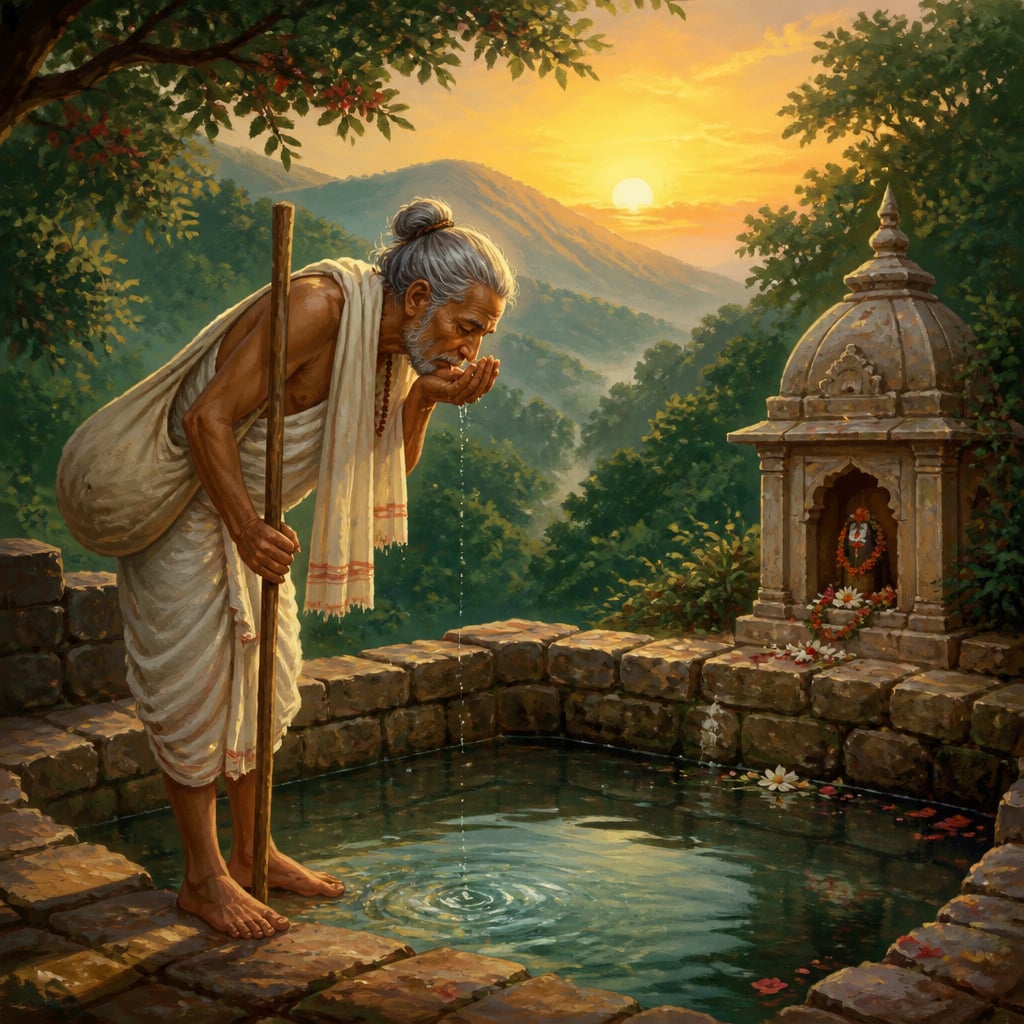
A barefoot Narmada parikrami sipping kund water at the source at Amarkantak

It is just before sunrise on a December morning at Amarkantak, the small town in the Maikal hills of Madhya Pradesh where the Narmada river rises. A man of fifty two is standing at the source kund, the small stone tank where the river emerges from the earth. He has not put on shoes. He will not put on shoes for the next three years. He has a small cotton bag over one shoulder. Inside the bag are a brass tumbler, a thin cotton dhoti, a tulasi mala, and a hand-drawn map of the Narmada's course from the source to the mouth at the Arabian Sea and back along the other bank. The map is two thousand six hundred kilometres long. The walker will follow it on foot, on the right bank going down, on the left bank coming back, never crossing the river except at its source and at its mouth. He will sleep at ashrams and at the homes of strangers who will, by tradition, feed him without question. He will eat one meal a day. He will reach the same kund somewhere between three and four years from now.

He takes a sip of the kund water. He says one sentence. Narmade har. Hail the Narmada. He turns clockwise. He starts walking.

The practice has a name. It is called the Narmada Parikrama. The world's longest continuously performed river-circumambulation pilgrimage. Hindu civilisation has produced longer scriptures and larger temples than any other tradition on earth. But this practice, of walking around a river for two and a half thousand kilometres, sleeping where you arrive, returning to the exact stone where you began, in three or four years, on bare feet, may be the strangest and the most beautiful thing this civilisation has ever asked anyone to do.

This is the last lesson of the course. The course began with the body, the day, the kitchen, the home. It moved through the protection layer, the life cycle, the temple, the calendar, the social order, the learning of the first letter, and the four corners of the Himalaya. It ends with the foot. The Hindu civilisation, when it has named all the rituals it can name, returns at the very end to the simplest gesture available to a human being. It walks around what it loves.

The Practice, Across India

Parikrama is the clockwise circumambulation of a sacred object, place, or being. The body keeps the sacred to its right side, the auspicious side, the side associated with light and growth. Counterclockwise, prasavya, is reserved for funerary rites where the order of the world is being deliberately reversed. The choice is not aesthetic. It is operational.

The smallest scale is the temple sanctum. The pradakshina path around the garbhagriha at every classical Hindu temple is structurally a parikrama. The course covered this in chapter seven.

Devotees circumambulating the Govardhan hill on the morning after Diwali

The medium scale is a sacred natural object. Govardhan is the hill near Mathura that Krishna lifted on his little finger to shelter the cowherds from the rains of Indra. The classical Govardhan parikrama is twenty one kilometres around the hill, performed barefoot, on the morning of Govardhan Puja, the day after Diwali. By 2024, the annual loop was drawing approximately one and a half million pilgrims in a single twenty four hour period. The road is closed to motorised traffic for the day. The barefoot pilgrims walk shoulder to shoulder. The hill is in the middle. The walking is the prayer.

The town scale is Vrindavan, the small town along the Yamuna where Krishna spent his childhood. The classical Vrindavan parikrama is about eleven kilometres along the inner ring road that loops around the Banke Bihari temple, the Radha Raman temple, the Iskcon temple, Seva Kunj, Nidhivan, and the Yamuna ghats. Tukaram, Mirabai, Surdas, and Chaitanya all walked this parikrama in their own time, named the same temples, drank from the same ghats. The parikrama is the architecture by which the town stays sacred.

The river scale is the Narmada. Two thousand six hundred kilometres along the right bank from the source at Amarkantak to the mouth at the Arabian Sea, then two thousand six hundred kilometres back along the left bank. Three to four years on foot. He carries no money. He sleeps where he arrives. The practice has been institutionalised since at least the eleventh century under Raja Bhoja of the Parmar dynasty. By 2024, an estimated five thousand pilgrims complete the full loop every year.

Barefoot pilgrims ascending the Tirumala hill path before sunrise

The city scale is Tirupati. The Alipiri-to-Tirumala foot path is the eleven kilometre barefoot ascent from the foothills to the temple of Lord Venkateswara at the top of the seven hills. By 2024, the path was carrying approximately fifteen to twenty thousand barefoot ascents every single day. The Tirumala temple itself is held to be the most visited place of worship in any tradition globally, with approximately one hundred thousand pilgrims arriving every day.

There are larger circuits: the Banaras Panchakroshi yatra, the eighty kilometre walk around Kashi in five days; the Gokarna Mahabaleshwar Kshetra parikrama in coastal Karnataka. Each scale lights up the same logic. The body keeps the sacred to its right. The walking is the prayer. The return to the starting point closes the circle.

The Scripture Says

The scriptural authorisation for parikrama begins in the Rigveda's instruction that the fire altar is to be circumambulated clockwise during every yajna. The Yajurveda's Apastamba Shrauta Sutra, dated to roughly the seventh century BCE, contains procedural detail on the pradakshina around the agni. The pradakshina of the temple sanctum is the descendant of the pradakshina of the fire altar.

The Skanda Purana's Reva Khanda, the section on the Narmada, runs to nearly five hundred chapters and is one of the longest Purana sections devoted to a single river anywhere in the canonical literature. The Reva Khanda codifies the parikrama as a complete spiritual discipline, prescribes the procedural details, names the principal tirthas along the route, and defines the closing ritual at the source kund. It is the operating manual that the eleventh-century Raja Bhoja institutionalised at imperial scale.

The Padma Purana's Patala Khanda carries the Govardhan parikrama tradition. Krishna himself, after lifting Govardhan, instructed the cowherds that the hill was an object of worship and that to walk around it was to walk around him. The Bhagavata Purana, in the tenth canto, records the daily parikrama of the Vrindavan landscape by Radha and the gopis. To do the Vrindavan parikrama today is, in the bhakti reading, to retrace the steps of the Goddess herself.

The foundational verse on pradakshina, recited at every Hindu temple before circumambulation, comes from the Skanda Purana.

यानि कानि च पापानि जन्मान्तरकृतानि च। तानि तानि विनश्यन्ति प्रदक्षिणपदे पदे॥

yāni kāni ca pāpāni janmāntara-kṛtāni ca tāni tāni vinaśyanti pradakṣiṇa-pade pade

Whatever sins have been committed, in this birth or in lives gone before, all of them are destroyed at every step of pradakshina.

Skanda Purana

Step by step. Pade pade. The walking is the cleaning. The walker who completes the Narmada parikrama has taken approximately five million footsteps. The shastra is unsentimental about the arithmetic.

The Symbolism

Why clockwise. The right side of the body, in the Hindu reading, is the auspicious side. To keep the sacred on the right is to honour it as one honours an elder. The same orientation governs the way a household guest is led around the home, the way the priest moves around the fire altar, and the way the bride walks around Agni at the Saptapadi.

Why circumambulation rather than direct approach. The sacred is not a point but a centre with a field around it. To circumambulate is to acknowledge the field. The pradakshina traces the field at the radius the practitioner can hold.

Why the foot rather than any other part of the body. The foot is the part that touches the earth. To walk barefoot is to keep the body in continuous contact with the ground. The Narmada parikrami removes his shoes at Amarkantak and does not put them back on for three years. The earth is not separate from the worship. It is the worship.

Why the long form. The discipline scales to the object. The hill at Govardhan is small. The walk is small. The river is enormous. The walk is enormous. The practice respects the size of what is being honoured.

Why the Body Responds

Layer four, habit architecture. Parikrama is the textbook example of a somatic ritual in which the entire discipline runs in the body and only in the body. There is no chant required. There is no scripture to memorise. There is no equipment to carry. The walker simply walks. The simplicity is not minimalism. It is what makes the discipline durable. Wendy Wood, in Good Habits Bad Habits, names the most reliable habits as those that load the smallest possible cognitive overhead onto the practitioner. The parikrama loads almost nothing. One foot in front of the other. The cognitive system is freed for prayer, contemplation, or the bare attention of the next step.

The second mechanism is embodied rhythm. The walker who has been on the Narmada path for thirty days is no longer thinking about walking. The body has settled into the gait. The mind has settled into the silence the body has produced. Long-distance walkers across cultures, from the pilgrims of Santiago de Compostela to the kora-walkers around Mount Kailash to the Appalachian Trail thru-hikers, report the same shift. After enough days on foot, the walking becomes the meditation. The Hindu tradition has been running this finding for three thousand years.

The third mechanism is community synchronisation. The Govardhan parikrami on the morning after Diwali is not walking alone. He is one of one and a half million pilgrims walking the same loop on the same day in the same direction. Robin Dunbar's research at Oxford on synchronised group movement, published across the 2010s, established that walking, singing, and moving together in groups produces measurable elevations in oxytocin and endorphin. The Govardhan parikrama, the Tirumala foot path, the Vrindavan loop in Kartik, are all synchronised mass walks. The biology is doing exactly what the lineage has always claimed.

What the Labs Found

The most striking research vindication of the parikrama tradition comes from a different angle than the one most readers expect. Earthing, the contact between bare feet and the earth, has been studied for measurable physiological effect since the early 2000s. Chevalier and colleagues, writing in the Journal of Environmental and Public Health in 2012, conducted a controlled study showing that forty five to sixty minutes of grounded walking, bare feet on natural earth, produced measurable reductions in inflammatory markers, improvements in heart rate variability, and reductions in pain scores. The Narmada parikrami, walking barefoot for three years on the riverside earth, is running the same protocol the lab measured at clinical scale.

The research on long-distance walking and well-being is even larger. Mitten and colleagues, writing across the 2010s in journals including the International Journal of Wilderness Therapy, established that multi-day walking immersions in natural environments produced significant reductions in cortisol, improvements in subjective well-being, and durable changes in autonomic nervous system regulation. Kühn and colleagues, in Scientific Reports in 2017, used MRI to demonstrate that high-altitude trekking produced measurable increases in gray matter density in the prefrontal cortex and the hippocampus.

The research on synchronised group movement is the third strand. Cohen and Dunbar, working at Oxford in the 2010s, established that synchronised walking, dancing, and singing in groups produced significant elevations in pain threshold, oxytocin release, and self-reported group bonding. The Govardhan parikrama on the morning after Diwali is, by these measures, the largest synchronised group walking event in any culture.

The three strands together vindicate the practice at three layers: the barefoot earthing of the Narmada walker, the long-distance immersion of any sustained parikrama, and the synchronised group bonding of Govardhan and Tirumala. The lab is downstream of the practice in every case. The lineage chose the structures on the basis of what they produced. The instruments confirm the choice.

What the World Calls It Now

The Camino de Santiago, the eight hundred kilometre walking pilgrimage to Santiago de Compostela, is the most widely known modern parallel. By 2024, the Camino was drawing approximately four hundred and fifty thousand registered pilgrims annually and generating roughly six hundred million United States dollars in pilgrimage tourism revenue. The Hindu lineage of circumambulation does not appear in the Camino's marketing. The walking-as-prayer principle is presented as a Christian medieval inheritance.

The Continental Divide Trail, the Appalachian Trail, the Pacific Crest Trail are the secular American descendants of the same impulse, drawing tens of thousands of thru-hikers annually over routes of three to five thousand kilometres. The American thru-hikers are running, in secular form, the same distance discipline the Reva Khanda codified a thousand years ago.

The wellness retreat industry's silent walking programmes in Bhutan, Bali, and the Italian Cinque Terre retail at three to ten thousand United States dollars a week. The Narmada parikrami is doing three years of the same practice for the cost of his one daily meal.

The earthing wellness market, with grounding mats, conductive bedsheets, and grounding shoes, crossed approximately one hundred and fifty million United States dollars by 2024. The product replaces the bare foot on the earth with a shoe insert. The Narmada parikrami's bare foot, for three years, on the riverside earth, is the original. The mat is the rebrand.

What to Call It Yourself

From this lesson onward, the vocabulary changes. Call it parikrama, not pilgrimage walk. Call the act around the temple pradakshina, not circumambulation. Call the Govardhan loop the Govardhan parikrama, not the hill walk. Call the Narmada walk the Narmada parikrama, not the river pilgrimage. Call the Tirumala climb the Alipiri foot path, not the temple trek. The next time the Camino de Santiago is called the original walking pilgrimage, name the older form. The Reva Khanda was being walked by the Parmar dynasty's pilgrims a thousand years before the Camino reached its medieval form.

The man at Amarkantak who turned clockwise at the kund three years ago has just returned to the same kund. He has walked five million steps. He is barefoot. The cotton bag is more frayed than it was. The map has been rolled and unrolled so many times that the paper has begun to soften. He sets the bag down. He bends to the kund water. He says the same sentence he said at the start. Narmade har. Hail the Narmada. He sits down on the stone for the first time in three years.

The course began with a child watching a grandmother in a cane chair in Mylapore. It ends with a parikrami at the source of the Narmada in Amarkantak. Between the two are one hundred and eighty rituals, eleven chapters, and three thousand years of unbroken practice. The grandmother's japa and the parikrami's walk are the same lineage. The same operating system. The same Sanatan Dharma. You have walked through the course. The lineage is now yours to carry. The next steps, like the parikrami's next steps, are yours to take. The course closes. The walking does not.

Key figures

Raja Bhoja

Eleventh-century Parmar dynasty king ruling from Dhar in central India; institutionaliser of the Narmada parikrama as a royal pilgrimage; patron of Sanskrit learning and author of the Samarangana Sutradhara on architecture and the Yuktikalpataru on statecraft.

Sri Krishna

The eighth avatar of Vishnu in the dasavatara tradition; central figure of the Mahabharata, the Bhagavad Gita, and the Bhagavata Purana; the cowherd of Vrindavan who lifted Govardhan hill on his little finger to shelter the cowherds from the rains of Indra, instituting the parikrama tradition at the hill that bears the lifting's memory.

Clint Ober

American researcher and former cable television executive; principal popular advocate of the earthing or grounding hypothesis since the late 1990s; co-author of the 2010 book Earthing and the 2012 Chevalier paper in the Journal of Environmental and Public Health on grounded walking and inflammatory markers.

Case studies

Raja Bhoja and the Eleventh-Century Royal Institutionalisation of the Narmada Parikrama

Sometime in the early eleventh century, in the court of the Parmar dynasty at Dhar in central India, a king who was simultaneously a poet, a philosopher, an architect, and a statecraft theorist took up the institutional patronage of the Narmada parikrama. Raja Bhoja, ruling from approximately 1010 to 1055 CE, was the author of the Samarangana Sutradhara on architecture, the Yuktikalpataru on statecraft, and significant Sanskrit poetry. His court at Dhar was one of the most active centres of Sanskrit learning in eleventh-century India. Under his patronage, the Skanda Purana's Reva Khanda was studied as the operating manual for the Narmada parikrama. Procedural detail was systematised. The principal tirthas along the route were mapped. The closing ceremonies at Amarkantak were standardised. Temple records at Amarkantak surviving from the eleventh century document continuous parikrama completion ceremonies under his protocols. The institutionalisation under Raja Bhoja is the reason the Narmada parikrama survived the next thousand years intact, through Mughal disruption, colonial restructuring, and post-independence rapid urbanisation. A king's institutional patronage in the eleventh century is the documentary anchor of what is now the world's longest continuously performed river-circumambulation pilgrimage.

In the Hindu reading, what Raja Bhoja did was not innovation. The parikrama tradition long predated him. The Reva Khanda already existed. The pilgrims were already walking. What the king added was institutional scaffolding. Royal patronage of temple infrastructure. Documented completion ceremonies. Standardised procedural protocols. The Hindu civilisational pattern of king-as-patron-of-tradition, rather than king-as-innovator-of-tradition, is at its clearest in this case. The king does not invent the practice. The king ensures the practice can survive him.

The Narmada parikrama has continued without interruption from the eleventh century to the present. By 2024, approximately five thousand pilgrims complete the full two thousand six hundred kilometre loop annually. Tens of thousands more complete partial sections. The temple records at Amarkantak continue to document closing ceremonies in protocols traceable to the Parmar institutional period. Ahilyabai Holkar's eighteenth-century restoration of the Narmada tirthas drew on the same Reva Khanda foundation. The institutionalisation under Raja Bhoja is what made the practice durable across the next thousand years.

A practice that is institutionalised by a serious patron in one century survives the next ten. Raja Bhoja did not invent the parikrama. He built the institutional scaffolding that allowed the parikrama to outlast every disruption that followed. The pattern is the Hindu civilisational pattern. The temples Adi Shankaracharya organised in the eighth century are still running. The pilgrimage Raja Bhoja institutionalised in the eleventh century is still being walked.

When the Camino de Santiago is held up as the original long-distance walking pilgrimage, the receipts include Raja Bhoja. The institutionalised Narmada parikrama predates the Camino's medieval consolidation by several centuries.

Raja Bhoja, Parmar dynasty, ruling from approximately 1010 to 1055 CE, court at Dhar in central India, author of Samarangana Sutradhara and Yuktikalpataru, patron of the institutionalised Narmada parikrama. Temple records at Amarkantak surviving from the eleventh century continue to document continuous parikrama completion ceremonies. Approximately five thousand full parikrama completions annually as of 2024.

Chevalier and the Earthing Vindication of Three Years on Bare Feet

In 2012, Gaétan Chevalier and colleagues published a controlled study in the Journal of Environmental and Public Health titled Earthing: health implications of reconnecting the human body to the Earth's surface electrons. The study demonstrated that forty five to sixty minutes of grounded walking, bare feet on natural earth, produced measurable reductions in inflammatory markers including C-reactive protein, improvements in heart rate variability, and reductions in self-reported pain scores. The research was part of a larger programme that included Brown and colleagues' earlier work on grounded sleep and Sokal and Sokal's research on cortisol and HRV during overnight grounding. The research has had a contested reception in some quarters of mainstream medicine, but the Chevalier paper itself remains a peer-reviewed publication with replicable protocols and measurable outcomes. The Narmada parikrami who walks barefoot for three years on the riverside earth is not running the protocol the Chevalier paper measured. He is running a far more intense version of it. Three years rather than forty five to sixty minutes. The earth of the Vindhyan riverside rather than a controlled lab setting. The continuous immersion rather than the discrete intervention. The lab measured the minimum effective dose. The Hindu tradition has been running the maximum tolerable dose for a thousand years.

The Hindu tradition has always treated the bare foot on the earth as a discipline rather than an inconvenience. The Narmada parikrami removes his shoes at Amarkantak and does not put them back on for three years. The Govardhan parikrami removes his shoes at the start of the loop. The Tirumala pilgrim climbs the seven hills barefoot. The Banaras Panchakroshi pilgrim walks the eighty kilometre circuit barefoot. The earth, in the dharmic reading, is not a passive surface to be insulated from. It is the body of the goddess Bhumi. To walk barefoot is to maintain continuous physical contact with the same body that the kolam is drawn on at the threshold every morning, that the Sandhya is performed on at sunrise, that the dead are committed to at the cremation ghat. The Chevalier 2012 paper measures, in clinical scale, what the dharmashastra has always claimed in metaphysical scale.

The Chevalier paper has been cited extensively in the alternative and complementary medicine literature. The earthing product market has crossed approximately one hundred and fifty million United States dollars by 2024, with grounding mats, conductive bedsheets, and grounding shoes marketed at premium prices in the wellness retail channel. The mainstream medical reception remains contested. The Hindu parikrama tradition continues, in its full form, on the riversides of central India and the foot paths of Tirumala, with the maximum dose of barefoot earth contact running every day for tens of thousands of pilgrims. The lab is downstream of the practice. The receipts are on the older side.

The barefoot requirement of the parikrama tradition is not an aesthetic flourish. It is a measurable physiological discipline. The lab confirms what the lineage has been running. The Narmada parikrami's three-year barefoot walk is the maximum dose of a protocol the Chevalier paper measured at minimum-effective-dose scale.

When you next encounter a marketed earthing mat or grounding bedsheet, recognise the rebrand. The Narmada parikrami's bare foot, for three years, on the riverside earth, is the original. The mat is the rebrand.

Chevalier, G. et al, 2012, Journal of Environmental and Public Health, Earthing: health implications of reconnecting the human body to the Earth's surface electrons. Brown, R. et al, on grounded sleep and inflammation. Sokal, K. and Sokal, P., on overnight grounding and cortisol. Earthing product market: approximately one hundred and fifty million United States dollars in 2024.

The Camino, the Continental Divide, and the Great Loop: Three Modern Echoes of an Older Walking

By 2024, the Camino de Santiago in Spain was drawing approximately four hundred and fifty thousand registered pilgrims annually, generating roughly six hundred million United States dollars in pilgrimage tourism revenue. The walking pilgrimage runs from southern France to Santiago de Compostela in northwestern Spain over approximately eight hundred kilometres. The Continental Divide Trail in the United States, running from the Mexican border to the Canadian border along the spine of the Rockies, attracts thousands of long-distance thru-hikers annually over approximately five thousand kilometres. The Pacific Crest Trail draws similar numbers over four thousand two hundred kilometres. The Appalachian Trail runs three thousand five hundred kilometres along the eastern American mountain spine. The Great Loop, a four thousand mile boating circumnavigation of the eastern United States, is completed by several thousand boaters annually as a circumambulation in water rather than on foot. The premium wellness retreat industry sells multi-day silent walking programmes in Bhutan, Bali, and the Italian Cinque Terre at three thousand to ten thousand United States dollars a week. Each of these is, structurally, a fragment of the parikrama tradition. A defined route. A defined endpoint. A defined community of fellow walkers. A defined transformation expected at the close. The Camino is sold as the Christian medieval inheritance. The Continental Divide is sold as the American thru-hike movement. The wellness retreat is sold as the silent walking experience. The Hindu lineage of circumambulation as spiritual discipline does not appear in any of the marketing materials. The Reva Khanda was being walked under royal Parmar patronage in the eleventh century, three centuries before the Camino consolidated into its medieval form.

The course's response is the same as for japa, daana, and the seasonal vrats. Not litigation. Not anger. Naming. Parikrama is parikrama. Pradakshina is pradakshina. The Govardhan loop is the Govardhan loop. The Narmada loop is the Narmada loop. The Camino is a real pilgrimage carrying real medieval Christian inheritance. The Continental Divide is a real walking discipline carrying its own American outdoor lineage. None of these needs to be displaced. The course's job is to name the parikrama tradition that has been running, at population scale, on Hindu rivers and hills, for at least three thousand years. The two trajectories run in parallel. The user is allowed to see both.

The Camino, the Continental Divide, the Great Loop, and the wellness walking retreat industry all continue to grow. The Narmada parikrama, the Govardhan parikrama, the Vrindavan parikrama, the Tirumala foot path, and the Banaras Panchakroshi continue to run at population scale on the rivers, hills, and foot paths of India. The two sets of practices are now visible to each other through the global wellness conversation. The Hindu lineage is, in this conversation, almost always absent from the marketing materials but present in the actual operating practice of tens of millions of pilgrims every year.

The impulse to walk around something sacred keeps appearing across cultures and centuries, always reattributed to whichever tradition is doing the rediscovering. The Hindu parikrama tradition is the deepest and longest continuous form of this practice in any culture. The course names the lineage so that the reader who encounters any modern walking pilgrimage knows that the older form exists, has run continuously for three thousand years, and is still running today on the Narmada, around Govardhan, through Vrindavan, and up the Tirumala hills.

From this lesson onward, when you encounter any modern long-distance walking pilgrimage, name the older form. Parikrama. Pradakshina. The Reva Khanda. The hill at Govardhan. The town at Vrindavan. The hills at Tirumala. The vocabulary is the lineage. The lineage is yours.

Camino de Santiago: approximately four hundred and fifty thousand registered pilgrims (2024); roughly six hundred million United States dollars in pilgrimage tourism revenue. Continental Divide Trail: roughly five thousand kilometres. Pacific Crest Trail: four thousand two hundred kilometres. Appalachian Trail: three thousand five hundred kilometres. Great Loop boating circumnavigation: four thousand miles. Wellness walking retreat industry: three thousand to ten thousand United States dollars per week at premium pricing. Compare: Narmada parikrama, two thousand six hundred kilometres on foot, three to four years, approximately five thousand full completions annually.

Historical context

Vedic to modern: Yajurveda's Apastamba Shrauta Sutra on pradakshina around the fire altar (c. 7th century BCE); Skanda Purana's Reva Khanda codification of the Narmada parikrama (c. 8th to 12th century CE); Padma Purana's Patala Khanda on the Govardhan parikrama (c. 8th to 11th century CE); Raja Bhoja's institutionalisation of the Narmada parikrama under the Parmar dynasty (11th century CE); Ahilyabai Holkar's restoration of the Narmada tirthas (18th century CE); Camino de Santiago revival as a global walking pilgrimage (late 20th century CE); Chevalier earthing research and the modern long-distance walking movement (2000s to 2020s).

Living traditions

The parikrama tradition is alive at every scale today. The pradakshina around the temple sanctum performed by every traditional Hindu pilgrim before darshan. The twenty one kilometre Govardhan loop walked by one and a half million on the morning after Diwali. The eleven kilometre Vrindavan inner ring walked by tens of thousands daily through Kartik. The eleven kilometre Tirumala foot path climbed barefoot by fifteen to twenty thousand pilgrims every day. The two thousand six hundred kilometre Narmada loop walked by approximately five thousand pilgrims to completion every year. The lineage has not skipped a footstep since the late Vedic period.

Call it parikrama, not pilgrimage walk. Call the temple round pradakshina, not circumambulation. Call the Govardhan loop the Govardhan parikrama, not the hill walk. Call the Narmada walk the Narmada parikrama, not the river pilgrimage. Call the Tirumala climb the Alipiri foot path, not the temple trek. The vocabulary is the inheritance. The grandmother in the Pune kitchen kept Shravan. The grandfather at Dadar kept gupt-daan. The walker at Amarkantak keeps the Narmada parikrama. Each is a node in the same operating system. From this lesson on, you know the names. The course closes. The walking does not.

Reflection

More in Yatra: The Pilgrimage Tradition

All lessons in Yatra: The Pilgrimage Tradition · Samskaras: The Sanatan Operating System course