Sabarimala: The 41-Day Vow
Ayyappa deeksha, the irumudi, and the eighteen sacred steps: how a forty-one-day vow taken by tens of millions of devotees in southern India runs the same neurological-consolidation window that habit-formation research has documented as the midpoint of deep habit formation, and how Andy Frisella's 75 Hard challenge has, since 2019, attracted five million participants doing operationally the same discipline without naming the source
On the first day of the Malayalam month Vrischikam (mid-November), a man in his forties in a town near Coimbatore sits before the household altar to receive the rudraksha mala from the family priest. The mala is a chain of one hundred and eight black rudraksha beads with a single pendant bearing an image of Lord Ayyappa. The priest places the mala around the man's neck. From this moment for the next forty-one days, the man will follow a structured discipline: black or saffron clothing only, two daily baths in cold water, vegetarian food cooked by his own hand or by another mala-wearer, no shoes, no shave, no haircut, abstinence from intoxicants, abstinence from intimate contact, daily Ayyappa namajapa, and the cultivation of a state of mind in which every other person he encounters is addressed as Swami, the embodiment of the lord. On the forty-first day, he will gather his irumudi, the two-pouched cloth bundle carrying the offerings, and travel with his fellow pilgrims to the Pamba river at the foot of the Western Ghats. He will trek the seven kilometres up the forest path to the Sabarimala shrine. He will climb the eighteen sacred steps with the irumudi balanced on his head. He will see the Ayyappa idol and complete his deeksha. The lesson opens the forty-one-day discipline, the irumudi protocol, the eighteen-step ascent, the Vavar dargah and the seven-hundred-year-old Hindu-Muslim co-practice, the Lally 2010 habit-formation research, and Andy Frisella's five-million-participant 75 Hard challenge alongside the deeksha that ran the same protocol for centuries before it.
A Family Altar in Coimbatore, the Day the Mala Goes On
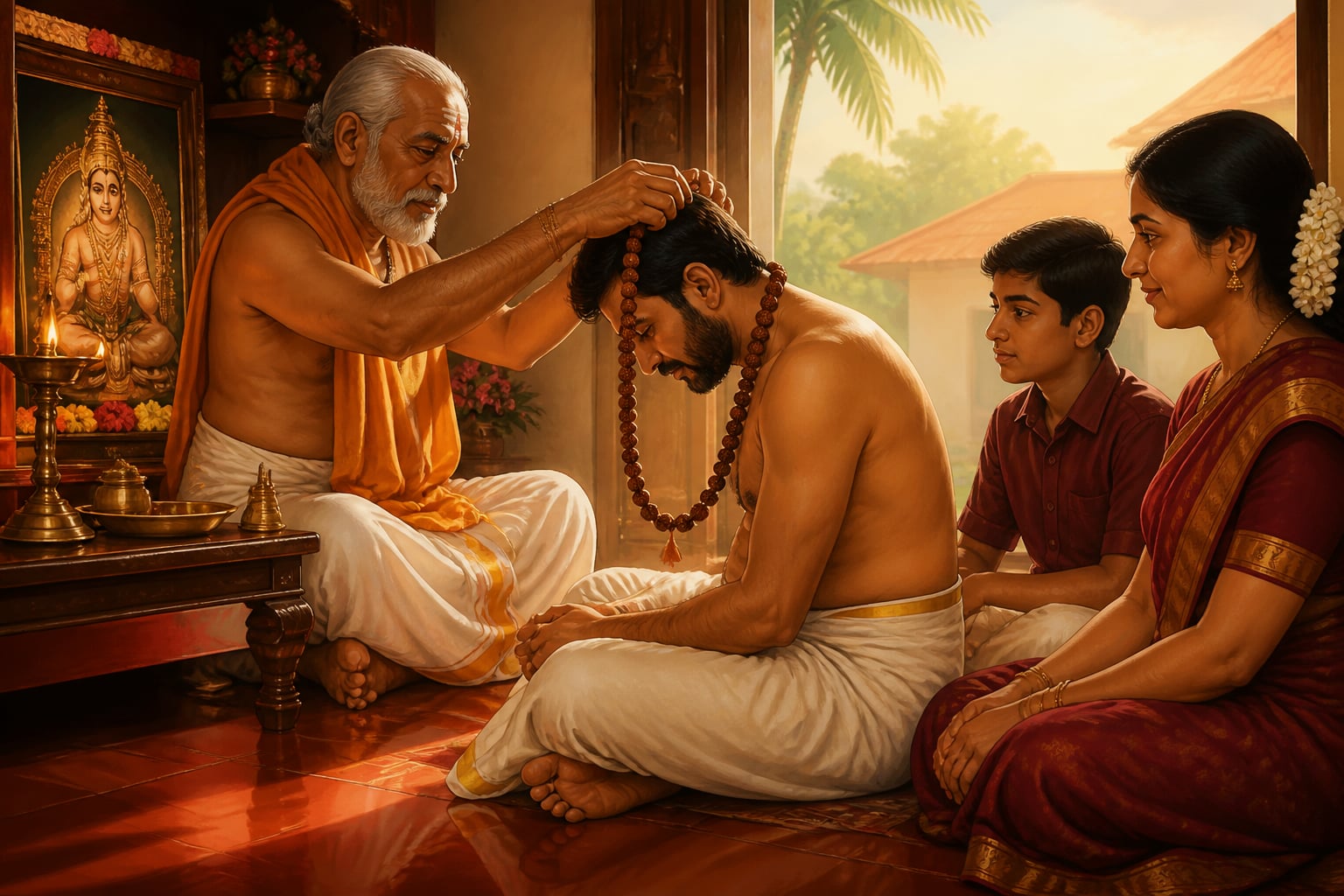
In a small town near Coimbatore in Tamil Nadu, on the first day of the Malayalam month Vrischikam in mid-November, a man named Subramanyan sits in front of the family altar at six in the morning. He is forty-three years old, a textile-mill supervisor with two teenage children. He has bathed in cold water at five-thirty. He wears a freshly washed black mundu and a black towel across his shoulder. His wife stands behind him with the household priest. The priest holds a chain of one hundred and eight black rudraksha beads with a single oval silver pendant bearing the image of Lord Ayyappa, the lord seated in yogic posture with the right hand in chinmudra and the left holding a small staff.
The priest recites the sankalpa. He names the date, the lunar tithi, the nakshatra, the donor's gotra, and the duration of the vow: forty-one days, ending on the makara jyoti night at the Sabarimala shrine in mid-January. He places the mala around Subramanyan's neck. The mala has been blessed at the morning archana. From this moment, Subramanyan is under deeksha. He is no longer simply Subramanyan the textile-mill supervisor. He is Ayyappa-swami, the lord-bearer. Every other mala-wearer he encounters in the next forty-one days will address him as Swami, and he will address each of them as Swami in return. The deeksha has begun.
The forty-one days that follow are structurally specified. Black or saffron clothing only. No shoes. No haircut. No shave. Two daily baths in cold water. Vegetarian food cooked by his own hand or by another mala-wearer at a fellow swami's house. No onion, no garlic, no eggs, no fermented or stale food. No intoxicants of any kind. Abstinence from intimate contact. Sleeping on a mat on the floor, not on a bed. Daily Ayyappa namajapa using the mala, with at least one full mala-cycle in the morning and one in the evening. Daily darshan at the household altar or at the local Ayyappa temple if one is accessible. The maintenance of a state of mind in which every other person is addressed as Swami, the embodiment of the lord, with the hierarchical and transactional categories of ordinary social life suspended for the duration.
In 2019, in Bartlett, Tennessee, an entrepreneur named Andy Frisella will publish a podcast episode titled 75 Hard. The challenge will prescribe a seventy-five-day discipline: two workouts of forty-five minutes each per day with one outdoors in any weather, strict adherence to a chosen diet, no alcohol or cheat meals, ten pages of non-fiction reading, one gallon of water, a daily progress photo, and zero exceptions across all seventy-five days. By 2024, over five million participants will have completed or attempted the challenge, with the Instagram hashtag accumulating tens of millions of posts. The challenge will be marketed as a productivity and physical-transformation program. The Sabarimala deeksha tradition will not be named in any of the marketing material.
The Discipline, The Bundle, The Ascent
The Ayyappa deeksha is structurally a single integrated discipline with three phases. The first phase is the forty-one-day household discipline: the mala on the neck, the structured diet, the structured sleep, the daily japa, the maintenance of the swami-mode in all encounters. The second phase is the irumudi-katta, the ceremonial preparation of the two-pouched cloth bundle that the pilgrim will carry to the shrine. The bundle has a front pouch (mun-mudi) holding the offerings to Ayyappa (ghee in a coconut, betel leaves, jaggery, camphor, sugar candy, vibhuti) and a back pouch (pin-mudi) holding the pilgrim's own provisions for the journey (rice, salt, sugar, the cloth and small items the pilgrim will use). The bundle is tied with the family priest's blessing on a specified day in the final week of the deeksha and is balanced on the pilgrim's head from the moment of the tying through the trek and the climb of the eighteen sacred steps. The third phase is the trek and the ascent: the journey to the Pamba river at the foot of the Western Ghats, the bath in the Pamba, the seven-kilometre trek through forest path up the slope, the climb of the eighteen sacred steps to the sanctum, the darshan of the Ayyappa idol, and the breaking of the coconut at the close.
The three phases together constitute the deeksha. The pilgrim does not simply travel to the shrine; he prepares for forty-one days, then carries the prepared bundle to the shrine, then completes the ascent under the conditions established by the preparation. The structural integration of the household discipline, the bundle, and the ascent is what distinguishes the Sabarimala deeksha from any other Hindu pilgrimage. The pilgrim's body, mind, and material offerings are all brought to the shrine in a single coordinated movement.
The number forty-one is not arbitrary. The Hindu numerology of vrata duration prescribes specific multiples for specific intensities of discipline: a single day for an Ekadashi or a Chaturthi, a week for a smaller seasonal vrata, twenty-one days for a moderate intensification, forty-one days for the major life-transformation vrata, and ninety days or one hundred and eight days for the most rigorous lifelong disciplines. The forty-one-day window is, in modern habit-formation research (Lally 2010, European Journal of Social Psychology), the documented midpoint of the average sixty-six-day complex-habit-consolidation window, and the Sabarimala deeksha's social-accountability and ritual-intensity layers are held to accelerate the consolidation into the forty-one-day frame for highly motivated practitioners.
The Practice, Across India
The Sabarimala deeksha runs primarily in the southern Indian states of Kerala, Tamil Nadu, Andhra Pradesh, Karnataka, and Telangana, with substantial diaspora participation from the Tamil and Malayalam communities in the Gulf, Singapore, Malaysia, the United Kingdom, and North America. The deeksha is open in tradition to male practitioners of all ages and to female practitioners outside the menstruating age range (traditionally pre-puberty and post-menopause). The 2018 Supreme Court of India verdict on the Sabarimala temple's gender-restrictions and the popular movement that followed are a matter of public record; the lesson presents the tradition as it has been observed in the deeksha lineage for centuries and lets the reader form her own view on the contemporary debates.
The pilgrim's deeksha begins on a specified day in the Malayalam month Vrischikam (mid-November), with the most common starting day being the first day of the month or the day after the local Mandalam puja begins. The deeksha runs through Vrischikam and into the early part of the Malayalam month Dhanu (mid-December to mid-January), with the canonical end-day being the makara jyoti night at the Sabarimala shrine on January 14, the eve of Makara Sankranti. The makara jyoti is the celestial light visible from the Sabarimala shrine on the evening of January 14, traditionally interpreted as the divine signal that the lord has accepted the year's deekshas; the contemporary explanation involves a ritual fire lit at a designated hill peak, with the tradition's interpretation of the light's nature continuing to be debated.
The pilgrim's preparation in the final week of the deeksha includes the irumudi-katta ceremony at the household altar or at a fellow-swami's home. The bundle is tied with a specified knot pattern, with the front pouch and the back pouch tied separately and joined at the centre. The pilgrim balances the bundle on his head from the moment of the tying. He is not to set the bundle down, except at specified ritual stations along the route. He travels with a group of fellow pilgrims, often led by a guru-swami who has completed the deeksha eighteen times or more (the title of guru-swami being conferred after eighteen completions). The group's collective name for the leader and the journey are part of the deeksha's social-accountability structure: the guru-swami knows each pilgrim's preparation level, has visited each pilgrim's home in the final week of the deeksha, and certifies the pilgrim's readiness for the trek.

The trek begins at the Pamba river, a tributary of the Pampa river system in the Western Ghats. The pilgrim bathes in the Pamba, performs the Pamba puja, and begins the ascent. The path is forest path, climbing roughly seven kilometres through dense Western Ghats vegetation to the Sannidhanam, the shrine complex at the top. The path includes specified ritual stations: the Neelimala viewpoint, the Appachimedu and Sabaripeedam stations associated with Sabari, the elderly woman who waited for Rama in the Ramayana and who is held in the Ayyappa tradition to have lit the original Sabarimala fire. The pilgrim arrives at the Sannidhanam, climbs the eighteen sacred steps with the irumudi on his head (the eighteen steps representing variously the eighteen Puranas, the eighteen yogic principles of the Bhagavad Gita's chapters, the seventeen virtues plus the unnameable eighteenth, depending on the interpretive school), and reaches the sanctum. He breaks the coconut at the sanctum, offers the irumudi's contents, has darshan of the Ayyappa idol, and completes the deeksha.
The Vavar dargah at Erumeli, at the foot of the trek, is a mandatory waypoint for many traditional pilgrim routes. Vavar, in the traditional Sabarimala mahatmya, is Ayyappa's Muslim friend and companion, a warrior who fought alongside Ayyappa in the lord's pre-deification life as the prince of Pandalam. The pilgrim visits the Vavar dargah, offers respects, and proceeds to the Pamba. The arrangement has been continuous for over seven hundred years and is one of the most documented examples of structured Hindu-Muslim ritual co-practice in South Asia. The pilgrim addresses the dargah's caretakers and visiting Muslim faithful as fellow pilgrims at the same waypoint of the same lord's journey.
The Scripture Says
The Bhuthanatha Gita, a regional Kerala Sanskrit text dated to the medieval period (between the 11th and the 14th century CE) and preserved in the libraries of the Kerala temples, is the foundational scriptural source for the Sabarimala deeksha. The text describes the forty-one-day discipline in protocol form, with the dietary, behavioural, and sleep prescriptions named explicitly. The text is recited by the family priest at the moment of the mala-tying and by the guru-swami at intervals during the deeksha period.
The Sabarimala Mahatmya, a parallel medieval Kerala source, narrates the foundational mythology of the Sabarimala shrine and the lord Ayyappa, including the lord's dual descent from Shiva and Vishnu (in the Mohini avatar) as the Hari-Hara putra, his upbringing at the court of Pandalam king Rajashekhara, his slaying of the demoness Mahishi at the future site of the Sabarimala shrine, his friendship with Vavar and the granting of the dargah's permanent place at the trek's foot, his establishment of the eighteen sacred steps, and his final ascent into the divine state at the Sabarimala summit. The Sabarimala Mahatmya is recited in the deeksha period and at the Sannidhanam during the principal festival nights.
The Kotirudra Samhita of the Shiva Purana describes the broader category of structured forty-one-day vratas in the Shaiva tradition, with the Ayyappa deeksha named explicitly as the most rigorous lay-person discipline in the southern Shaiva tradition. The text prescribes the dietary, behavioural, and sleep protocols and notes the social-accountability layer of the swami-collective as the discipline's structural distinguishing feature. The Kotirudra Samhita is one of the foundational Puranic sources for the Hindu vrata tradition and is consulted at the institutional level by the temple administrators of the Sabarimala shrine.
The Bhagavad Gita's chapter six, the Dhyana Yoga, names the structural conditions for sustained yogic discipline: a clean place, a stable seat, the regulation of food and sleep, the steadiness of the mind across days and weeks, the absence of attachment to specific outcomes, and the equanimity of the practitioner across the full range of encounters. Yukta-ahara-viharasya yukta-cheshtasya karmasu. Yukta-svapna-avabodhasya yogo bhavati duhkhaha. For one whose food and recreation are regulated, whose effort in actions is regulated, whose sleep and waking are regulated, the yoga becomes the destroyer of suffering. The verse, recited at the start of the deeksha by the family priest, names the structural conditions that the forty-one-day Ayyappa discipline operationalises in its specific protocol form.
The canonical mantra for the Ayyappa namajapa, recited in continuous repetition during the deeksha period and at the moment of the eighteen-step ascent, is the verse Swamiye Saranam Ayyappa. I take refuge in the lord, swami; I take refuge in Ayyappa. The verse is recited in continuous japa, often using the rudraksha mala to count, with the recitation rising in volume and frequency as the pilgrim approaches the Sannidhanam and reaching its loudest at the moment of the eighteen-step climb. The verse is one of the most universally recognised devotional refrains in the Sabarimala tradition and is recited in the millions of cumulative repetitions during each pilgrimage season.
The Symbolism
The forty-one days of the deeksha are, in the cosmological frame, the structural duration required for the practitioner's ordinary identity to be temporarily set aside and the swami-identity to be established. The mala is not a decorative element; it is the physical marker of the identity transformation. The pilgrim is not Subramanyan-the-textile-mill-supervisor for the duration of the deeksha; he is Ayyappa-swami, the lord-bearer, with the social hierarchies and transactional categories of ordinary life suspended. The forty-one-day duration is held to be the minimum time required for the new identity to be established stably enough to support the trek and the climb of the eighteen steps.
The black or saffron clothing is the visual marker of the deeksha state. Black is the colour of austerity, of the renunciate's cloth, of the absence of decorative concern. Saffron is the colour of the renunciate's robe in the Hindu tradition. The colour signals to other mala-wearers and to the broader public that the wearer is in deeksha, with the consequent social adjustment in how the wearer is addressed and engaged. The colour also signals to the wearer himself, in every visible reflection, that he is in the disciplined state.
The irumudi is the symbolic and material centre of the deeksha. The two pouches (the front pouch for the lord, the back pouch for the pilgrim) represent the structural balance of the deeksha: the offerings to the lord and the pilgrim's own provisions are equal halves of the bundle. The bundle's balance on the pilgrim's head represents the pilgrim's commitment to carrying the lord's offering with the same care as his own provisions. The bundle is tied at the household altar with the family priest's blessing and remains balanced on the pilgrim's head until the moment of the eighteen-step climb, when the bundle is offered at the sanctum.

The eighteen sacred steps are the symbolic and physical culmination of the deeksha. The eighteen represent variously the eighteen Puranas, the eighteen chapters of the Bhagavad Gita, the seventeen yogic virtues plus the unnameable eighteenth, the eighteen days of the Mahabharata war, and the eighteen specific deeksha-completion criteria depending on the interpretive school. The pilgrim climbs the steps with the irumudi balanced on his head. The climb takes between thirty seconds and several minutes depending on the pilgrim's intensity. The climb is the moment of the deeksha's culmination and the structural transition of the pilgrim's identity from the swami-mode of the forty-one days to the post-deeksha integrated state.
The Vavar dargah at Erumeli is the symbolic recognition that the lord's circle of relationships includes the friend across the religious boundary, and that the pilgrim's deeksha includes the visit to the friend's shrine before the visit to the lord's shrine. The arrangement is not theological accommodation; it is the dharmic recognition that the lord himself maintained the friendship and that the pilgrim's deeksha includes the recognition of the friendship. The arrangement has been continuous for over seven hundred years and is the most documented example of structured Hindu-Muslim ritual co-practice in South Asia.
Why the Body Responds
Layer four, habit architecture. The Ayyappa deeksha is one of the most precisely structured complex-habit-consolidation protocols in any tradition. The cue is the daily morning bath; the routine is the day's structured sequence (the bath, the namajapa, the food preparation, the work or study, the evening bath, the evening namajapa, the floor-sleep); the reward is the day's completion within the discipline and the social recognition of the swami-mode by the fellow-pilgrim collective. James Clear's Atomic Habits framework names exactly this kind of multi-channel daily routine, sustained for the consolidation window, as the strongest form of identity-based-habit installation. BJ Fogg's Tiny Habits framework names the social-accountability layer (the fellow-swami collective, the guru-swami's tracking, the family priest's blessing) as one of the most reliable accelerators of habit consolidation. The Sabarimala deeksha encodes both mechanisms in its forty-one-day protocol.
The identity-transformation layer is the second behavioural effect. The mala, the black or saffron clothing, the swami-name, the swami-mode of address, the structured diet, the structured sleep, and the daily japa together constitute a multi-channel identity-anchoring environment in which the pilgrim's ordinary identity is, for the duration, suspended. The wearer is reminded by every visible reflection, every food choice, every interpersonal interaction that he is in the deeksha. The structural identity-transformation is, in modern social-psychology terms, the strongest form of self-concept change documented in the literature on identity-based interventions. The deeksha is, in this frame, a forty-one-day institutionally-supported self-concept-change protocol.
The community-witness and social-accountability layer is the third behavioural effect. The deeksha is not performed in isolation. It is performed in a swami-collective that meets at the local Ayyappa temple or at the home of the guru-swami, with daily or weekly group japa, group cooking, and group preparation. Robin Dunbar's research on collective ritual has documented that synchronised group ritual produces measurable increases in oxytocin, decreases in cortisol, and increased in-group bonding, with the effects sustained for hours after the ritual concludes. The deeksha's daily group japa and the trek's collective structure together provide a sustained group-ritual environment that anchors the individual pilgrim's discipline in the collective's accountability. The 75 Hard challenge's lower completion rate compared to the Sabarimala deeksha's reliable completion is, in part, a function of the deeksha's institutional community-witness layer that the individualised 75 Hard challenge does not provide.
What the Labs Found
The research record on habit-formation duration is now substantial. Lally and colleagues, in a 2010 paper published in the European Journal of Social Psychology, conducted a definitive empirical study of habit formation across multiple complex behavioural targets. The study established that complex habit formation requires sixty-six days on average, with substantial variation across individuals and across habits. The forty-one-day Ayyappa deeksha duration corresponds to approximately the sixty-percent point of the average consolidation window, which is widely held in the habit-formation literature to be the structural midpoint at which the new behavioural pattern is sufficiently established to be self-sustaining if the social-accountability layer is maintained. The deeksha's daily ritual intensity, social-accountability layer, and identity-anchoring multi-channel environment together accelerate the consolidation into the forty-one-day window for highly motivated practitioners.
BJ Fogg, in his 2019 book Tiny Habits and his broader behaviour-design research at Stanford, has documented the structural elements that distinguish reliable behaviour change from short-term behaviour change. The principal elements are the clear cue (a specific external trigger), the small initial action (a behaviour small enough to perform reliably), the celebration of completion (a reinforcement loop that anchors the behaviour), and the gradual scaling (the behaviour's progressive integration into broader life patterns). The Ayyappa deeksha encodes all four elements in its protocol: the morning bath as the cue, the daily japa as the small initial action, the social recognition of the swami-mode as the celebration, and the trek and the eighteen-step ascent as the scaled completion. The deeksha is, in Fogg's behaviour-design terms, a textbook example of integrated reliable-behaviour-change design.
The broader literature on community-based behavioural interventions has consistently documented that the social-accountability layer is one of the strongest predictors of completion in any structured discipline. Studies on Alcoholics Anonymous, Weight Watchers, group fitness programs, and structured retreat programs have all documented that the community-witness layer increases completion rates by factors of two to five compared to individual-only attempts. The Sabarimala deeksha's swami-collective layer, with the guru-swami's tracking and the family priest's blessing, provides one of the strongest community-accountability structures documented in any voluntary discipline globally. The deeksha's reliable completion rate for prepared pilgrims (estimated at over ninety percent in major-pilgrim-route studies) compared to the 75 Hard challenge's typical completion rate (estimated at five to ten percent in independent studies) reflects the community-accountability differential.
The deeper finding is that the forty-one-day Ayyappa deeksha is not, as a casual modern observer might suppose, simple religious endurance. It is a structured complex-habit-consolidation protocol with documented behavioural-design elements, encoded in a forty-one-day window that maps to the empirical midpoint of the habit-formation consolidation curve, supported by a community-accountability structure that has been institutionally maintained for centuries. The medieval Kerala authors of the Bhuthanatha Gita and the Sabarimala Mahatmya operated on the basis of the cosmological and dharmic outcomes; the modern researchers image the behavioural-design mechanisms. Both name the same protocol.
What the World Calls It Now
The modern echoes are precise.
The 75 Hard challenge, founded by Andy Frisella in 2019 and accumulating over five million participants by 2024, sells the structural logic of the Ayyappa deeksha as a generic productivity and physical-transformation program. The challenge prescribes a seventy-five-day discipline: two workouts of forty-five minutes each per day with one outdoors in any weather, strict adherence to a chosen diet, no alcohol or cheat meals, ten pages of non-fiction reading, one gallon of water, a daily progress photo, and zero exceptions across all seventy-five days. The structural elements (the fixed duration, the multi-channel daily discipline, the social-accountability layer through the Instagram hashtag, the identity-transformation framing) are operationally identical to the Ayyappa deeksha's protocol. The challenge is marketed as a productivity and physical-transformation program with no attribution to the deeksha tradition; the Sabarimala deeksha has been observed by tens of millions annually for centuries.
The Whole30 dietary reset, founded by Melissa Hartwig and Dallas Hartwig in 2009 and accumulating over two million annual participants, prescribes a thirty-day strict-elimination diet with operationally identical structural elements to the Ayyappa deeksha's dietary protocol: the fixed duration, the strict food-group exclusions, the no-cheat-day rule, the social-accountability layer through the dedicated forum and the Instagram community, and the identity-transformation framing as a reset of the body's relationship with food. The Whole30 has spawned the broader thirty-day-reset genre, including the Sugar Smart Express, the Reset30, and dozens of regional variations. The structural template is the deeksha's structural template applied to the dietary domain only.
The noom and the broader behaviour-change-app market, with Noom alone exceeding one billion dollars in cumulative revenue and over forty-five million downloads by 2024, sells the structural logic of the deeksha's multi-channel daily discipline at the smartphone-app scale. The Noom's prescribed daily check-ins, structured food logging, daily reading lessons, daily community-coach interaction, and progressive scaling of the behaviour-change targets are operationally the same daily multi-channel discipline that the Sabarimala deeksha runs in its non-app form. The app charges between sixty and two hundred dollars for a multi-month program; the deeksha charges nothing.
The silent retreat market, with brands including the Vipassana retreats (free at the source, with global infrastructure), the Esalen Institute (with weekly programs at fifteen hundred to four thousand dollars), and the One Medical-affiliated wellness retreats (at five thousand to twenty thousand dollars per week), sells the structural logic of the deeksha's structured-pause discipline as a high-end wellness product. The retreat structure (the fixed duration, the multi-channel discipline, the absence of ordinary social interactions, the daily ritual sequence) is operationally a one-week or two-week version of the deeksha's forty-one-day protocol, applied without the irumudi, the trek, or the eighteen-step ascent.
The "thru-hiking" culture, including the Appalachian Trail (3,500 km), the Pacific Crest Trail (4,265 km), and the Continental Divide Trail (5,000 km), prescribes long-distance walking as identity-transformation rather than as physical achievement, with the trail-name tradition (where the hiker takes a new name on the trail) operationally similar to the deeksha's swami-name tradition. The American thru-hiking community has independently arrived at the identity-transformation logic of the deeksha, with no acknowledgment of the Sabarimala lineage. The thru-hiking gear market alone exceeds one-point-two billion dollars annually.
What to Call It Yourself
From this lesson onward, when the 75 Hard challenge accumulates five million participants, name the older protocol. Ayyappa deeksha. When the Whole30 dietary reset prescribes a thirty-day strict-elimination diet, name the older window. The deeksha's dietary protocol. When the Noom app prescribes the daily multi-channel behaviour-change discipline, name the older discipline. The deeksha's daily japa-and-discipline structure. When the silent retreat market sells the high-end structured-pause discipline at thousands of dollars per week, name the older protocol that is performed at no cost. The deeksha. The Sabarimala tradition has run the forty-one-day complex-habit-consolidation protocol, with the irumudi-and-eighteen-steps culmination, for at least seven centuries in continuous documented operation. The protocol is supported by the most institutionally robust community-accountability structure documented in any voluntary discipline globally. The contemporary wellness market is selling fragments of the protocol at consumer prices; the Hindu tradition has been providing the full integrated protocol at no cost, with the lineage-anchoring of the swami-collective and the irumudi-tradition included rather than collapsed into the generic productivity framing of the wellness market. The course names the protocol so the practitioner can recognise the structural architecture and carry forward the deliberate adaptation of its elements into her own life-pattern, with the dharmic frame intact and with the structural depth of the seven-century institution recognised.
Key figures
अयप्पा
Traditional dating: pre-Pandalam dynasty (medieval Kerala); textual establishment: Sabarimala Mahatmya and Bhuthanatha Gita (11th to 14th century CE)
शबरी
Traditional dating: late Treta Yuga (Ramayana period); textual establishment: Valmiki Ramayana, Aranya Kanda
Case studies
The Vavar Dargah and Seven Centuries of Hindu-Muslim Ritual Co-Practice
At Erumeli, at the foot of the trek to the Sabarimala shrine, a small Muslim shrine has stood continuously since at least the 13th century CE. The shrine is the Vavar dargah, dedicated to Vavar, traditionally identified as Ayyappa's Muslim friend and companion in the lord's pre-deification life as the prince of Pandalam. The Sabarimala mahatmya tradition includes the Vavar dargah as a mandatory waypoint for pilgrims following the traditional route, with the pilgrim visiting the dargah, offering respects, and proceeding to the Pamba river. The dargah is maintained continuously by Muslim caretakers, and the pilgrim's visit and offering are part of the Sabarimala deeksha protocol. The arrangement has been continuous for over seven hundred years across multiple regimes (the Pandalam kingdom, the Travancore kingdom, the British colonial administration, the modern Kerala state) and through periods of significant religious conflict in the broader Indian subcontinent.
The Sabarimala mahatmya tradition recognises the friendship between Ayyappa and Vavar as a foundational element of the lord's pre-deification life, with the lord granting the dargah's permanent place at the trek's foot as a perpetual recognition of the friendship. The pilgrim's visit to the dargah is not theological accommodation; it is the dharmic recognition that the lord himself maintained the friendship and that the deeksha includes the recognition of the friendship. The arrangement embodies the dharmic principle that the divine recognises devotion across community boundaries and that the pilgrim's devotion is incomplete without the recognition of the lord's own relational integrity.
The Vavar dargah arrangement has been continuous for over seven hundred years and is the most documented example of structured Hindu-Muslim ritual co-practice in South Asia. The arrangement has survived periods of significant religious conflict in the broader Indian subcontinent, including the Mughal expansion into southern India, the colonial-era religious framings, and the modern post-Partition tensions. The continuous operation of the arrangement demonstrates that institutional structures of inter-faith ritual co-practice, when grounded in foundational mythological and dharmic recognition rather than in theological accommodation, can sustain across centuries through significant external pressure.
The Vavar dargah arrangement is the worked historical example of structured inter-faith ritual co-practice grounded in foundational dharmic recognition. The arrangement demonstrates that the Hindu tradition's structural framing of community boundaries is not exclusionary by structural design and that the integration of cross-community relationships into foundational pilgrimage protocols can produce institutional structures of remarkable longevity. The contemporary global discourse on inter-faith relations, often framed in terms of theological tolerance or political accommodation, has a worked alternative reference in the Sabarimala arrangement, which grounds the inter-faith integration in the foundational mythology of the deity himself.
The Vavar dargah arrangement provides the worked institutional reference for any contemporary attempt at structured inter-faith ritual co-practice. The arrangement's seven-century continuous operation demonstrates that structures grounded in foundational dharmic recognition can sustain across centuries through significant external pressure, in contrast to inter-faith arrangements grounded in political accommodation or theological tolerance, which have generally not demonstrated comparable longevity. The historical record is on file.
Vavar dargah at Erumeli: continuous operation since at least the 13th century CE; over 700 years of structured Hindu-Muslim ritual co-practice; mandatory waypoint for traditional Sabarimala pilgrim routes
The Lally 2010 Habit-Formation Research and the Forty-One-Day Window
In 2010, Lally and colleagues at University College London published a definitive empirical study in the European Journal of Social Psychology on the formation of complex habits. The study tracked ninety-six volunteers across twelve weeks as they attempted to establish new daily behaviours and measured the time required for the new behaviour to become automatic. The study established that complex habit formation requires sixty-six days on average, with substantial variation across individuals (eighteen days for the fastest consolidator and over two hundred and fifty days for the slowest). The forty-one-day duration of the Ayyappa deeksha corresponds to approximately the sixty-percent point of the average consolidation window. BJ Fogg's behaviour-design research at Stanford has independently identified the four structural elements of reliable behaviour change: the clear cue, the small initial action, the celebration of completion, and the gradual scaling. The Ayyappa deeksha encodes all four elements in its protocol.
The Sabarimala Mahatmya and the Bhuthanatha Gita prescribe the forty-one-day deeksha duration on the basis of the cosmological and dharmic frame, with the duration held to be the structural minimum for the practitioner's ordinary identity to be temporarily set aside and the swami-identity to be established. The traditional account does not describe the deeksha in terms of habit-formation curves or behaviour-design elements. The traditional account describes the protocol in terms of identity transformation, dharmic discipline, and the structural conditions for the trek and the eighteen-step ascent. The two perspectives describe the same protocol from different angles.
The Lally 2010 research and the broader Fogg behaviour-design literature confirm that the forty-one-day Ayyappa deeksha encodes the empirical midpoint of the complex-habit-consolidation window and incorporates all four structural elements of reliable behaviour change. The deeksha's daily ritual intensity, the social-accountability layer through the swami-collective, and the identity-anchoring multi-channel environment together accelerate the consolidation into the forty-one-day window for highly motivated practitioners, with the deeksha's reliable completion rate (estimated at over ninety percent for prepared pilgrims) compared to the 75 Hard challenge's typical completion rate (estimated at five to ten percent in independent studies) reflecting the institutional differential.
The habit-formation research is a worked case for the broader thesis of the Sanatan Operating System course. A traditional discipline, transmitted across centuries on the basis of cosmological and dharmic reasoning, encodes empirically valid behavioural-design protocols that the modern research images but did not need to invent. The deeksha tradition is, in modern behaviour-design terms, a textbook example of institutional behaviour-design with documented mechanisms in habit-consolidation, identity-transformation, and community-accountability.
The habit-formation research validates the structural design of the Ayyappa deeksha. The deeksha is not religious endurance; it is a structured complex-habit-consolidation protocol with documented behavioural-design mechanisms and a community-accountability structure of remarkable institutional robustness. The contemporary 75 Hard, Whole30, and Noom programs are operationally fragmenting and re-marketing the deeksha's structural elements at consumer prices; the Hindu tradition has been providing the full integrated protocol at no cost for centuries.
Lally et al, European Journal of Social Psychology, 2010: complex habit formation requires 66 days on average; 41-day Ayyappa deeksha corresponds to 60% of the consolidation window; BJ Fogg behaviour-design research identifies the four structural elements that the deeksha encodes
Andy Frisella's 75 Hard Challenge and the Five-Million-Participant Discipline Market
In 2019, the American entrepreneur Andy Frisella published the 75 Hard challenge through his podcast and his Instagram-and-YouTube ecosystem. The challenge prescribes a seventy-five-day discipline: two workouts of forty-five minutes each per day with one outdoors in any weather, strict adherence to a chosen diet, no alcohol or cheat meals, ten pages of non-fiction reading, one gallon of water, a daily progress photo, and zero exceptions across all seventy-five days. By 2024, over five million participants had completed or attempted the challenge, with the Instagram hashtag accumulating tens of millions of posts. The challenge is marketed as a productivity and physical-transformation program. The structural elements (the fixed duration, the multi-channel daily discipline, the social-accountability layer through the Instagram hashtag, the identity-transformation framing) are operationally identical to the Ayyappa deeksha's protocol. The Sabarimala deeksha tradition is not named in the marketing material.
The Ayyappa deeksha provides the same structural function (the multi-channel structured discipline, sustained for the consolidation window, with social-accountability and identity-transformation framing) through a different operational implementation grounded in foundational dharmic and devotional framing. The deeksha's swami-mode of address, the Hari-Hara-suta theology, the irumudi protocol, the trek and the eighteen-step ascent are all structurally absent from the 75 Hard challenge, which retains the discipline's structural mechanics while collapsing the dharmic, devotional, and institutional layers into a generic productivity framing. The two protocols address the same behavioural-design target through different operational and philosophical frames.
The 75 Hard challenge's five-million-participant scale demonstrates that the structural function of the multi-channel structured discipline is in active global cultural and commercial demand. The challenge's typical completion rate (estimated at five to ten percent in independent studies) compared to the Ayyappa deeksha's reliable completion rate (estimated at over ninety percent for prepared pilgrims) reflects the structural difference: the deeksha's institutional community-accountability layer through the swami-collective is operationally absent in the individualised Instagram-hashtag accountability of the 75 Hard challenge. The structural collapse of the protocol from a community-witnessed, lineage-anchored, devotionally-framed practice to an individual-consumer, app-anchored, productivity-framed program is the standard pattern of the wellness market's coopt of the Hindu deeksha tradition.
The 75 Hard challenge is the strongest contemporary evidence that the structural function of the Hindu deeksha is in global cultural and commercial demand. The challenge's five-million-participant scale demonstrates the function's mass appeal. The challenge's lower completion rate compared to the deeksha demonstrates the value of the institutional community-accountability layer that the Hindu tradition has maintained for centuries. The course's central claim is that the modern world is rediscovering the structural function of the deeksha, with the wellness market's individualised version losing the institutional and devotional depth that the Hindu tradition's seven-century continuous operation provides.
The 75 Hard challenge is the most measurable contemporary evidence of the global market demand for the deeksha's structural function. The next time the 75 Hard challenge is encountered, the practitioner of this course will recognise the function as the older Ayyappa deeksha, will name the older sources (the Sabarimala Mahatmya, the Bhuthanatha Gita), and will see the structural value of the institutional community-accountability layer that distinguishes the deeksha from the individualised wellness-market version. The naming is the lesson's central practical outcome.
75 Hard challenge: launched 2019 by Andy Frisella; 5M+ participants by 2024; tens of millions of Instagram hashtag posts; 5-10% typical completion rate; structurally identical to the 41-day Ayyappa deeksha protocol; zero attribution to the deeksha tradition in marketing
Historical context
11th to 14th century CE (textual establishment) to the present, with Puranic and Ramayana substrate
Living traditions
The wellness market sells the deeksha's structural function at retail. The next time the 75 Hard challenge accumulates millions of participants, name the older protocol. Ayyappa deeksha. The next time the Whole30 dietary reset prescribes a thirty-day strict-elimination diet, name the older window. The deeksha's dietary protocol. The next time the Noom app prescribes the daily multi-channel behaviour-change discipline, name the older discipline. The deeksha's daily japa-and-discipline structure. The next time the silent retreat market sells the structured-pause discipline at thousands of dollars per week, name the older protocol. The Sabarimala tradition has run the forty-one-day complex-habit-consolidation protocol with the irumudi-and-eighteen-steps culmination for over seven centuries, supported by the most institutionally robust community-accountability structure documented in any voluntary discipline globally. Share what you learn from this Gurukul lesson back to the wider Sanatan Operating System course at Talapatram.
Reflection
- What is the longest structured discipline you have undertaken voluntarily, and how did its protocol compare to the Ayyappa deeksha's five institutional design elements (empirical-anchoring, structural-design, community-accountability, certification, codification)?
- When you encounter the 75 Hard challenge, the Whole30 dietary reset, the Noom behaviour-change app, or the silent retreat market, can you name the older Hindu protocol whose structural function is being marketed?
- What does the Vavar dargah arrangement, with its seven centuries of continuous Hindu-Muslim ritual co-practice, suggest about how cross-community friendships and ritual structures can be sustained across centuries?