Char Dham, North and South

Why Adi Shankaracharya placed four monasteries at the four compass points of Bharat in the 8th century, why the Himalayan Char Dham is the highest-altitude pilgrimage tradition in the world, and how the same circuit became a hundred-and-fifty-crore helicopter industry

Adi Shankaracharya, in the eighth century, did one of the most strategically calculated geographical acts in the history of any continuous tradition. He selected four sites at the four compass points of Bharat. He established a matha (monastery) at each. He placed one of his four principal disciples at the head of each matha. He assigned each matha one of the four Vedas as its principal scriptural anchor. He named the four together as the Char Dham, the four divine abodes, and instituted the pilgrimage that has run continuously for twelve hundred years. Sringeri at the southern compass-point. Dwarka at the western. Puri at the eastern. Jyotirmath (Joshimath) at the northern. The four mathas have, across more than a thousand years of regime change, preserved the unbroken acharya succession (the parampara) and the institutional governance of the principal temples at each site. The smaller Himalayan Char Dham (Badrinath, Kedarnath, Gangotri, Yamunotri), at altitudes of three to four thousand metres, is the highest-altitude pilgrimage tradition in the world. The 2023 Char Dham helicopter package industry, at approximately one hundred and fifty crore rupees, is the latest absorption of the tradition into adventure tourism. Simone Kühn at the Max Planck Institute, in 2017, measured increases in grey-matter density in the prefrontal cortex and hippocampus from high-altitude trekking. The grandmother knew. She had walked to Kedarnath when she was forty.

A Bus Stand in Haridwar, the Morning Before Yamunotri
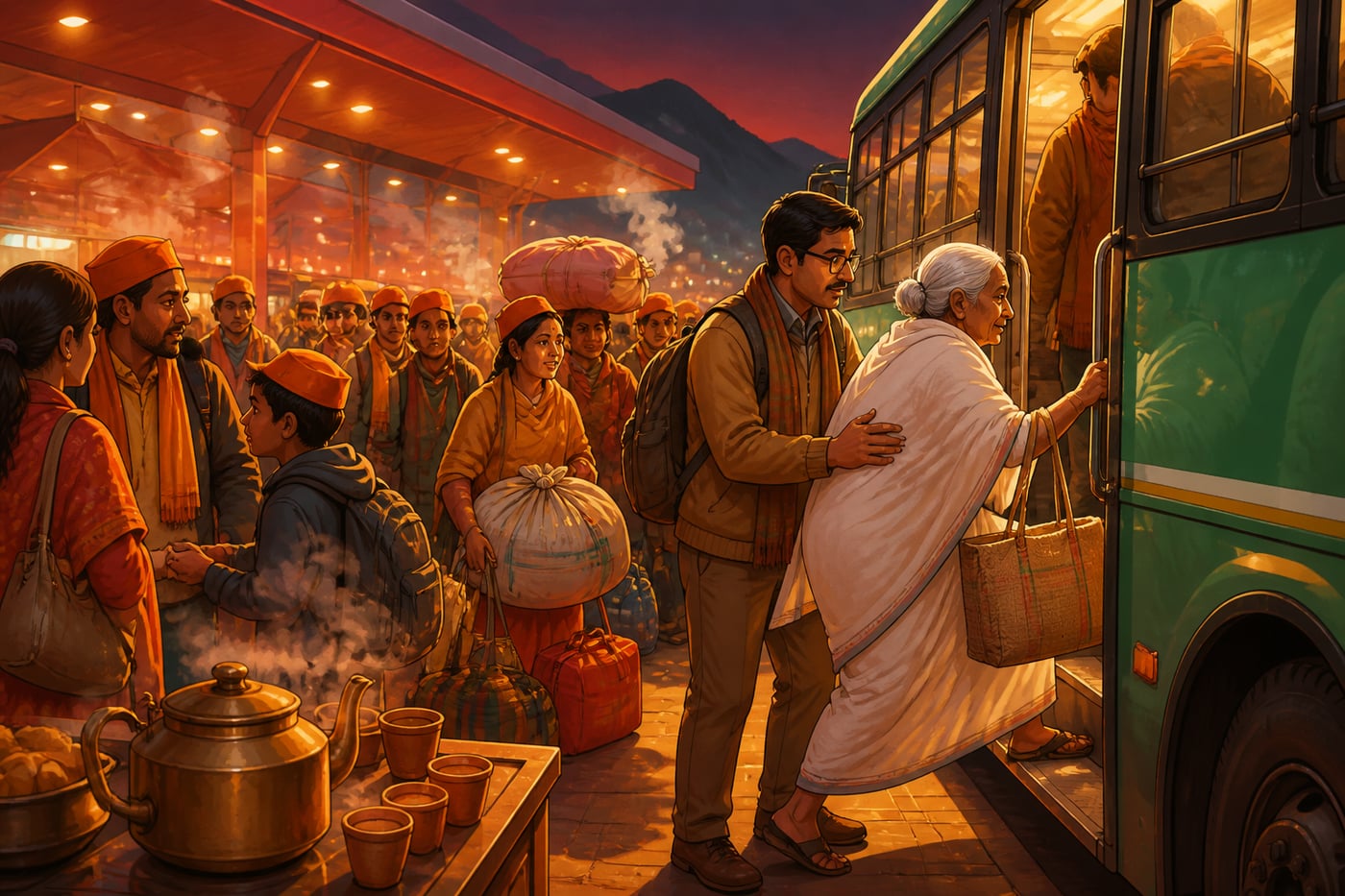
An elderly pilgrim grandmother boarding the Char Dham yatra bus at Haridwar before dawn

It is four in the morning at the bus stand in Haridwar at the start of the Char Dham yatra season. The temperature is approximately ten degrees. A grandmother of sixty-eight is sitting on her cloth-wrapped bedroll, with a small steel tiffin and a brass lota of Ganga water at her side. Her son is checking the bus-driver's papers. Her granddaughter, a girl of nineteen who has come along for the trip, is shivering in a fleece pulled over her thin sweatshirt. The bus to Yamunotri leaves at four-thirty. From there the route runs through Gangotri, Kedarnath, and finally Badrinath. Twelve days. Approximately four thousand kilometres of mountain road. Altitudes from one thousand metres at Haridwar to three thousand five hundred metres at Yamunotri, three thousand one hundred metres at Gangotri, three thousand five hundred metres at Kedarnath, and three thousand three hundred metres at Badrinath. The grandmother has done this trip twice before. The girl has never left the plains.

The grandmother does not say much during the bus loading. She reaches into the cloth bundle, takes out a small folded paper, and shows it to the girl. The paper is a photograph. The girl recognises her great-grandmother in the photograph, with a small group of women in white, standing in front of a snow-clad mountain. The girl asks who took the photograph. The grandmother folds the paper back into the bundle. "Meri amma. 1972 mein. Kedarnath ki yatra par." My mother. In 1972. On the Kedarnath yatra. The girl realises that this trip is the third time the women in her line have walked this circuit. She does not understand why it matters. She will, by the end of the twelve days.

This lesson is about that bus stand and the twelve hundred years of institutional architecture that placed it there. The dharmic tradition of yatra, the structured pilgrimage to specific sacred sites, is one of the most carefully engineered geographical and institutional systems in any continuous tradition. The principal architecture has two layered tiers. The mainland Char Dham, established by Adi Shankaracharya in the eighth century, places four mathas (monasteries) and four principal temples at the four compass points of Bharat: Sringeri in the south, Dwarka in the west, Puri in the east, and Jyotirmath at Badrinath in the north. The Himalayan Char Dham, the smaller circuit established later as a regional Garhwal pilgrimage, places four sites in the Garhwal Himalayas: Yamunotri, Gangotri, Kedarnath, and Badrinath. The two architectures together, the pan-Bharat compass-point Char Dham and the Himalayan altitude Char Dham, form the institutional backbone of the dharmic pilgrimage tradition. The lesson is the explanation the grandmother did not stop to give the nineteen-year-old at the bus stand.

Adi Shankaracharya's Geographical Strategy

Adi Shankaracharya planning the four mathas at the four compass points of Bharat

The practice. Adi Shankaracharya, in the eighth century (traditional dates 788 to 820 CE), undertook one of the most strategically calculated geographical acts in the history of any continuous tradition. He travelled the entire subcontinent on foot in a relatively short lifetime (the traditional thirty-two years), engaged in formal philosophical debate with the principal scholars of every region he visited, established the institutional architecture of Advaita Vedanta as the integrative framework of the dharmic tradition, composed the principal commentaries on the prasthana-trayi (the Brahma Sutras, the Upanishads, the Bhagavad Gita), and at the end of his life established the four mathas at the four compass points of Bharat. The four are: Sringeri Sharada Peetham at the southern compass-point, on the bank of the Tunga river in Karnataka, anchored to the Yajur Veda; Dwarka Sharada Peetham (Kalika Peetham) at the western compass-point, on the coast of Gujarat at the legendary site of Krishna's capital, anchored to the Sama Veda; Govardhana Peetham at Puri at the eastern compass-point, on the coast of Odisha at the site of the Jagannath temple, anchored to the Rig Veda; Jyotirmath at the northern compass-point, in the Garhwal Himalayas at the gateway to Badrinath, anchored to the Atharva Veda.

The four-matha architecture was not a regional decentralisation. It was an integrative geographical act with several structural functions in one operation. First, the four mathas placed the institutional anchor of the dharmic tradition at the four compass points of the subcontinent, ensuring that no single regional geography could claim to be the centre of dharma. Second, the assignment of one Veda to each matha distributed the scriptural responsibility across the four institutional centres, with each matha preserving and transmitting its assigned Veda as the principal scriptural lineage. Third, the four principal disciples (Sureshwaracharya at Sringeri, Hastamalakacharya at Dwarka, Padmapadacharya at Puri, Totakacharya at Jyotirmath) provided the founding parampara (succession) at each centre, with the unbroken acharya-line preserved continuously from the eighth century to the present. Fourth, the four sites' connection to existing principal temples (Sringeri's Sharada temple, Dwarka's Dwarakadhish temple, Puri's Jagannath temple, Joshimath's Narsimha temple and the linked Badrinath temple) gave the mathas direct institutional control over the principal pilgrimage destinations of each region. The single geographical act of the four-matha establishment is the structural backbone of the dharmic tradition's institutional continuity across twelve hundred years.

The scripture. The principal anchors are the Madhaviya Shankara Vijayam (the principal hagiography of Shankara, composed by Madhava in the fourteenth century), the Brihat Shankara Vijayam (the larger hagiographical compilation), the matha-specific records preserved continuously at each of the four centres, and the doctrinal corpus of Shankara himself (the commentaries on the Brahma Sutras, the principal Upanishads, the Bhagavad Gita, and the Vivekachudamani and other independent works).

चतुर्धा स्थापिता मठाश्चतुर्दिक्षु महात्मना।

caturdhā sthāpitā maṭhāś caturdikṣu mahātmanā

Four mathas were established by the Mahatma in the four directions.

Madhaviya Shankara Vijayam

The verse is one of the most-cited from the principal Shankara hagiography. The grammar is direct: the four mathas (caturdha mathah) were established by the Mahatma (Shankara) in the four directions (caturdikshu). The single sentence encodes the strategic geography: the four directions, the four mathas, the institutional architecture that the subsequent twelve hundred years have preserved.

The symbolism. The four-direction geography is structurally consistent with the Vedic cosmological architecture, in which the four directions (purva-east, dakshina-south, paschima-west, uttara-north) form the canonical compass-orientation of every dharmic ritual act. The household altar faces east; the Vidyarambha rice tray is placed before the altar facing east; the cremation pyre is laid in a specific directional alignment; the temple's principal sanctum faces a calibrated direction. The Char Dham architecture extends this household-scale directional consciousness to the subcontinental scale, with the four mathas at the four directions providing the geographical anchor for the entire dharmic tradition. The pilgrim who undertakes the four-matha yatra walks the four directions of Bharat as a single integrated dharmic act, embodying the cosmological geography in the body's traversal.

The assignment of one Veda to each matha is also structural. The four Vedas (Rig, Yajur, Sama, Atharva) are not interchangeable; each preserves a distinct ritual and theological domain, and the assignment to specific geographical mathas distributed the scriptural responsibility across the four institutional centres. The Rig Veda's hymn-tradition at Puri, the Yajur Veda's ritual-tradition at Sringeri, the Sama Veda's chant-tradition at Dwarka, and the Atharva Veda's protection-and-householder tradition at Jyotirmath gave each matha a distinct doctrinal specialisation. The four together preserved the entire Vedic corpus across the institutional architecture, with no single matha holding the entire scriptural responsibility.

The Himalayan Char Dham

The practice. The smaller Himalayan Char Dham, the regional Garhwal pilgrimage circuit, places four sites in the Uttarakhand Himalayas at altitudes of three to four thousand metres. Yamunotri (3,293 metres), the source of the Yamuna river, is dedicated to the goddess Yamuna, daughter of Surya. Gangotri (3,100 metres), the source of the Ganga river, is dedicated to the goddess Ganga, who descended from heaven through Shiva's matted hair to bring water to earth. Kedarnath (3,583 metres), one of the twelve Jyotirlingas, is dedicated to Shiva in his Kedara form. Badrinath (3,300 metres), one of the four mainland Char Dham, is dedicated to Vishnu in his Badri-Narayana form. The four are conventionally visited in this order, anti-clockwise around the principal Garhwal Himalayan range, in a yatra that takes ten to twelve days by road and several months by foot in the classical pilgrimage tradition. The pilgrimage season is approximately April or May to October or November, with the temples closed during the winter months when the high-altitude passes are snowed in.

Kedarnath temple at first light beneath the snow-capped Kedardome peak

The Himalayan Char Dham is the highest-altitude pilgrimage tradition in the world in continuous institutional preservation. The four temples are above the tree line for substantial portions of the approach. The route from Gaurikund to Kedarnath alone is sixteen kilometres of trek with an altitude gain of approximately one thousand five hundred metres, traditionally walked in one day by the experienced pilgrims and in two days by the elderly and the children. The route from Govindghat to Badrinath, from Janki Chatti to Yamunotri, and from Bhaironghati to Gangotri each involve comparable altitude and distance. The pilgrimage is, in its classical form, a sustained physical and contemplative effort across two weeks at high altitude, with the body's limits genuinely tested.

The scripture. The principal anchors are the Skanda Purana's Kedar Khanda and Badri Khanda (which preserve the foundational narrative-and-ritual frame for Kedarnath and Badrinath), the Brahma Purana (which preserves the Yamuna and Ganga narratives), the Vishnu Purana (which preserves the broader Vaishnava pilgrimage frame), and the Mahabharata's Vana Parva (which preserves the early references to the Garhwal pilgrimage routes that the later Skanda Purana would codify). The classical hagiographies of Shankara include the narrative of Shankara's establishment of the Badrinath temple after recovering the murti from the Alaknanda river, anchoring the Badrinath site as part of the broader Char Dham architecture.

The Garhwal regional tradition preserves the institutional governance of the four temples through specific lineages: the Rawal of Kedarnath is traditionally a Veerashaiva Lingayat from Karnataka, the Rawal of Badrinath is traditionally a Namboodiri Brahmin from Kerala (preserving Shankara's southern lineage at the northern shrine), the priestly traditions at Gangotri and Yamunotri are Garhwali. The mixing of southern and Garhwali lineages in the institutional governance of the four temples is the structural embodiment of Shankara's pan-subcontinental integration.

The symbolism. The Himalayan altitude is not incidental. The dharmic frame treats the high mountains as the structural site at which the body's ordinary limits are encountered and the contemplative orientation is, by physical necessity, intensified. The pilgrim at three thousand five hundred metres breathes harder, walks slower, sleeps less, and is structurally returned to the body's basic functions in a way that the plains do not require. The cold, the thin air, the sustained physical effort, the days away from home, the simplicity of the diet (the household kitchen is replaced by the dhaba meal of dal-rice-roti), and the visual immensity of the snow-clad peaks together produce the contemplative orientation that the dharmic frame holds to be the natural fruit of the yatra. The mountain is not the obstacle to the pilgrimage; it is the pilgrimage.

Why the Body Responds

The Habit Architecture of the yatra is structurally distinct from the daily and monthly practices the previous chapters have covered. The cue is calendar-locked at the seasonal scale: the Himalayan Char Dham temples open in late April or early May (Akshaya Tritiya and Vasant Panchami are common opening dates) and close in October or November (Diwali and Bhai Dooj are common closing dates). The routine is a sustained two-week effort at high altitude with structured daily practice (the morning bath in the river or the temple kund, the morning aarti, the daily journey segment, the evening aarti, the simple dhaba meal, the early sleep). The reward is the integrated felt-sense of having completed the four-direction or four-altitude circuit, with the body's limits encountered, the contemplative orientation deepened, and the institutional honour of the line of pilgrims (the grandmother in 1972, the great-grandmother before her) extended into the next generation.

Wendy Wood, in Good Habits Bad Habits (2019), documents that physically demanding sustained efforts produce stronger long-term identity-formation than easier daily practices; the yatra's two weeks of sustained high-altitude effort produces an identity-anchoring effect that the daily Saraswati Vandana cannot supply. Csikszentmihalyi, in his work on flow (1990, Flow: The Psychology of Optimal Experience), documents that high-skill-high-challenge sustained activity produces the optimal-experience state; the Himalayan Char Dham's combination of physical demand, contemplative orientation, and institutional ritual frame is structurally a flow-producing architecture across multiple weeks. Kelly McGonigal, in The Joy of Movement (2019), documents the neurobiological mechanisms by which sustained group physical activity produces oxytocin elevation, social bonding, and long-term well-being; the yatra's group-walking architecture (the family, the village pilgrimage party, the broader yatra cohort encountered at each site) is structurally a sustained-group-movement protocol.

What the Labs Found

The modern research on high-altitude trekking, nature-immersion, and sustained contemplative practice has, in the last twenty years, slowly approached what the dharmic yatra tradition has held continuously. Simone Kühn, at the Max Planck Institute for Human Development in Berlin, and her collaborators, in their 2017 paper in Scientific Reports, used MRI to document that high-altitude trekking produces measurable increases in grey-matter density in the prefrontal cortex and the hippocampus, with the effect proportional to the duration and altitude of the exposure. The findings establish that the Himalayan trekking environment produces neurologically measurable structural brain changes, not merely transient mood-elevation. Frances Kuo and Andrea Faber Taylor (2004, American Journal of Public Health) documented that natural environments (mountains, rivers, forests) restore directed-attention capacity more than any urban environment, with the effect lasting hours to days after the exposure. The dharmic yatra's two-week immersion in the Himalayan natural environment is structurally the most extended directed-attention restoration intervention in any continuous tradition. Roger Ulrich (1984, Science) had earlier documented the broader nature-and-health connection with the now-classic hospital-window study (patients with views of trees recovered faster than patients with views of brick walls), establishing the foundational case for the broader nature-immersion research base.

The Yoshifumi Miyazaki Forest Bathing research (2007 onwards, Chiba University) has documented that immersion in forest environments produces measurable cortisol reduction, parasympathetic activation, and immune-cell elevation; the dharmic yatra's traversal through the Garhwal Himalayan forests at altitudes below the tree line is structurally an extended forest-bathing intervention, with the higher-altitude segments adding the additional structural-brain-change effects the Kühn 2017 paper has documented.

The converging research base is unambiguous. The Himalayan Char Dham yatra is precisely the integrated nature-immersion, high-altitude-exposure, sustained-physical-effort, group-bonding, and contemplative-orientation protocol that the modern neuroscience and wellbeing research has, in the last twenty years, begun to document as optimal for long-term cognitive, emotional, and physical health. The dharmic tradition has been running the protocol continuously for at least twelve hundred years.

What the World Calls It Now

The principal modern echo is the Char Dham helicopter package industry. The Uttarakhand state and private operators have, since approximately 2010, developed helicopter-based pilgrimage packages that compress the twelve-day road-and-foot yatra into a two-day or three-day air-and-walk circuit. The packages are priced approximately at seventy thousand to one hundred and twenty thousand rupees per person and have grown into an estimated one hundred and fifty crore rupee annual industry by 2023. The structural insight (the four-site circuit, the calibrated route, the institutional pilgrimage frame) is preserved. The two-week sustained physical effort, the high-altitude trekking exposure, the dhaba-meal simplicity, the family-and-community walking-bonding, and the Kühn 2017 grey-matter-density-producing physical immersion are largely or entirely removed. The pilgrimage's structural insight has been absorbed into the adventure-tourism category.

The second modern echo is the spiritual travel market. The Lonely Planet pilgrimage-travel guides, the broader spiritual-bucket-list publishing genre, the wellness-retreat industry's pilgrimage-and-retreat packages, and the broader spiritual-travel category (estimated at over five hundred million dollars globally as of 2023) are downstream of the same recognition the dharmic yatra tradition has held continuously. The Camino de Santiago in Spain, the Kumano Kodo in Japan, the Inca Trail to Machu Picchu in Peru, the Israel National Trail, the Way of St James, and the broader long-distance-pilgrimage tourism category are each contemporary expressions of the same structural insight: the sustained walking pilgrimage to a sacred destination produces a contemplative integration that the airplane-and-resort vacation cannot supply. The dharmic yatra tradition's twelve-hundred-year institutional preservation, the Shankara-era four-matha architecture, and the Himalayan Char Dham's continuous regional institutional governance are, in the broader spiritual-travel category, generally not referenced as the antecedent.

The third modern echo is the Outward Bound and broader wilderness-immersion category. The Outward Bound programme, founded by Kurt Hahn in 1941 in Wales, is the principal Western institutional embodiment of the multi-week wilderness-immersion as a personal-development protocol. The National Outdoor Leadership School (NOLS) in the United States, the Tromso Centre for the Study of the Environment in Norway, and the broader expedition-leadership training category are downstream institutional developments. None of these traditions explicitly reference the dharmic yatra tradition as the antecedent; the wilderness-immersion structural insight has been independently developed in the Western institutional context with no acknowledgement of the twelve-hundred-year institutional precedent.

What to Call It Yourself

Yatra in Sanskrit. Char Dham for the four-direction architecture. Mainland Char Dham (Sringeri, Dwarka, Puri, Jyotirmath) and Himalayan Char Dham (Yamunotri, Gangotri, Kedarnath, Badrinath) for the two layered tiers. Tirtha for the sacred site itself. Tirtha-yatra for the pilgrimage to the sacred site. The Western spiritual travel preserves the structural insight and removes the institutional architecture. The Camino de Santiago and the Kumano Kodo are the parallel-tradition pilgrimage circuits with different theological framings. When the conversation reaches for the spiritual-travel market, the Camino de Santiago, the Outward Bound programme, or the broader wilderness-immersion industry, the response is one calm sentence. That is the yatra. Adi Shankaracharya established the four-matha architecture in the eighth century. The Skanda Purana codifies the Himalayan Char Dham. The household has been running the pilgrimage tradition for at least twelve hundred years in continuous institutional records. The naming is the lineage. The lineage is the receipt.

Key figures

Adi Shankaracharya

8th century CE (traditional dates 788 to 820 CE; some scholars place him slightly earlier)

Sureshwaracharya

8th century CE (a direct disciple of Adi Shankaracharya, with traditional dates approximately 770 to 850 CE)

Case studies

Adi Shankaracharya's Four-Matha Establishment (8th century CE)

Adi Shankaracharya, in the late eighth century CE (traditional dates 788 to 820 CE, with the four-matha establishment concentrated in the final years of his life), undertook one of the most strategically calculated geographical acts in the history of any continuous tradition. He selected four sites at the four compass points of Bharat, established a matha (monastery) at each, placed one of his four principal disciples at the head of each matha, and assigned each matha one of the four Vedas as its principal scriptural anchor. The four mathas are: Sringeri Sharada Peetham at the southern compass-point in Karnataka, anchored to the Yajur Veda, founded by Sureshwaracharya as the first acharya; Dwarka Sharada Peetham (Kalika Peetham) at the western compass-point in Gujarat at the legendary site of Krishna's capital, anchored to the Sama Veda, founded by Hastamalakacharya; Govardhana Peetham at Puri at the eastern compass-point in Odisha at the site of the Jagannath temple, anchored to the Rig Veda, founded by Padmapadacharya; Jyotirmath at the northern compass-point in the Garhwal Himalayas at the gateway to Badrinath, anchored to the Atharva Veda, founded by Totakacharya. The four-matha architecture provided the institutional anchor for the integration of the dharmic tradition's regional, scriptural, and theological diversity into a single coordinated institutional design. Each matha received direct institutional control over the principal regional temple at its compass-point (Sringeri's Sharada temple, Dwarka's Dwarakadhish temple, Puri's Jagannath temple, Joshimath's linkage to the Badrinath temple) and the broader regional pilgrimage architecture. The unbroken parampara at each matha has been preserved continuously from the eighth century to the present, with the current Shankaracharyas at each of the four centres being the most recent in lines of more than thirty-five successive generations of acharyas.

The Western framing of religious institutions as evolving organically over centuries through bottom-up community development is structurally inconsistent with the Shankara four-matha evidence. The architecture is a top-down strategic geographical act, with the four directions, the four Vedic assignments, the four founding disciples, and the integration with the principal regional temples all calibrated as a single coordinated design. The receipts for this strategic-design status are in the Madhaviya Shankara Vijayam, in the matha-specific records preserved continuously at each of the four centres, and in the contemporary continuing institutional governance that the four mathas continue to provide for the principal regional temples and pilgrimages. The household pilgrim who undertakes the Char Dham yatra is walking through twelve hundred years of continuous institutional governance, with the four mathas providing the textual lineage, the priestly succession, the ritual codification, and the broader institutional infrastructure that the modern commercial Char Dham helicopter package preserves the geographical sites of without preserving the institutional architecture.

The four-matha architecture has been preserved continuously since the eighth century, with the unbroken parampara at each centre, the continuing institutional governance of the principal regional temples, and the broader regional pilgrimage architecture all maintained across more than twelve hundred years through Pala, Chola, Pallava, Vijayanagara, Cheraman Perumal, Mughal, Maratha, and colonial periods. The current Shankaracharyas at each of the four mathas are the most recent in lines of approximately thirty-five to forty successive generations. The Sringeri Sharada Peetham received Vijayanagara royal patronage and continues to function as one of the principal Advaita centres globally. The Dwarka, Puri, and Jyotirmath mathas have similarly preserved continuous governance, with the Puri Jagannath temple in particular drawing several million pilgrims annually for the Ratha Yatra and the broader temple festival calendar. The colonial period imposed administrative restrictions but did not displace the matha governance, which has continued to function as the institutional anchor of the dharmic tradition across the entire colonial and post-independence period.

The Char Dham is twelve hundred years of continuous institutional governance by a single founding system. The dharmic four-matha architecture is one of the most documented cases of single-act institutional design producing continuous governance across a thousand-year horizon, with the eighth-century Shankara establishment, the unbroken parampara at each centre, and the contemporary continuing governance all preserved in continuous textual and institutional records. The receipts for this status are in the Madhaviya Shankara Vijayam, in the matha-specific records preserved continuously at each of the four centres, and in the contemporary household pilgrim's encounter with the same institutional architecture the eighth-century pilgrim encountered.

When the conversation reaches for the spiritual-travel market, the Camino de Santiago, or the broader pilgrimage-tourism category as the canonical example of long-distance spiritual journey, the dharmic response is one calm sentence: Adi Shankaracharya established the four-matha architecture in the eighth century. The Char Dham is twelve hundred years of continuous institutional governance by a single founding system. The Skanda Purana codifies the Garhwal Char Dham. The Mahabharata's Tirtha Yatra Parva preserves the early canonical pilgrimage routes. The household has been running the yatra for at least three thousand years.

Adi Shankaracharya established the four mathas at the four compass points of Bharat in the late eighth century (traditional dates 788 to 820 CE). The unbroken parampara at each centre has been preserved continuously across more than twelve hundred years, with the current Shankaracharyas at the four mathas being approximately the thirty-fifth to fortieth in line at each centre. The four-matha architecture is one of the most documented cases of single-act institutional design producing continuous governance across a thousand-year horizon in any continuous tradition. The mathas continue to govern the principal regional temples (Sringeri Sharada, Dwarka Dwarakadhish, Puri Jagannath, Joshimath linked to Badrinath) and the broader regional pilgrimage architecture in the twenty-first century.

The Char Dham Helicopter Package Industry: 150 Crore Rupees of Adventure-Tourism Absorption (2010 to present)

The Uttarakhand state and private operators have, since approximately 2010, developed helicopter-based Char Dham pilgrimage packages that compress the twelve-day road-and-foot Garhwal yatra into a two-day or three-day air-and-walk circuit. The packages are priced approximately at seventy thousand to one hundred and twenty thousand rupees per person and have grown into an estimated one hundred and fifty crore rupee annual industry by 2023, served by approximately a dozen operators (Pawan Hans, Heritage Aviation, Aryan Aviation, Trans-Bharat Aviation, Global Vectra, and others) with helipads at Phata, Sersi, Guptkashi, and the principal valley access points. The structural insight (the four-site circuit, the calibrated Yamunotri-Gangotri-Kedarnath-Badrinath route, the institutional pilgrimage frame) is preserved. The two-week sustained physical effort, the high-altitude trekking exposure, the dhaba-meal simplicity, the family-and-community walking-bonding, the Kühn 2017 grey-matter-density-producing physical immersion, and the Kuo and Faber Taylor 2004 directed-attention-restoration nature-immersion are largely or entirely removed. The pilgrimage's structural insight has been absorbed into the adventure-tourism category. Lonely Planet's pilgrimage-travel guides, the broader spiritual-travel publishing genre (estimated at over five hundred million dollars globally as of 2023), the wellness-retreat industry's pilgrimage-and-retreat packages, and the broader spiritual-bucket-list publishing genre have similarly absorbed the dharmic yatra tradition into the broader adventure-tourism and spiritual-travel categories. The Camino de Santiago in Spain, the Kumano Kodo in Japan, the Inca Trail to Machu Picchu in Peru, the Israel National Trail, and the broader long-distance-pilgrimage tourism category receive substantially more international media coverage and academic attention than the Char Dham, despite the Char Dham's twelve-hundred-year institutional preservation and the Himalayan Char Dham's status as the highest-altitude pilgrimage tradition in the world.

The Char Dham helicopter package industry is the cleanest documented modern case of the dharmic yatra tradition's structural insight being absorbed into the adventure-tourism category. The four-site circuit, the calibrated geographical anchors, and the institutional pilgrimage destination are preserved. The two-week sustained physical effort, the high-altitude exposure that the Kühn 2017 research documented as producing measurable structural brain changes, the nature-immersion that the Kuo and Faber Taylor 2004 research documented as the most effective directed-attention restoration, and the community-walking-bonding that the McGonigal 2019 research documented as oxytocin-elevating are removed. The dharmic household's job is not to argue with the helicopter operators; the structural recognition of the four-site circuit as a worthwhile pilgrimage is broadly aligned with the tradition. The job is to use the original tradition. Walk the Garhwal Char Dham. Spend the two weeks at altitude. Eat the dhaba meals. Sleep in the simple yatri-niwas. Encounter the institutional pilgrimage architecture as the household has encountered it for at least twelve hundred years. The Skanda Purana's Kedar Khanda is the architectural anchor; the household practice is the contemporary instrument.

The Char Dham helicopter package industry has helped a generation of time-constrained pilgrims maintain at least the structural connection to the Char Dham yatra tradition, with the four-site darshan preserved even when the two-week sustained yatra is not feasible. The Indian household that has always preserved the integrated walking yatra was not made worse by the helicopter packages; it was, indirectly, validated by the broader Indian appetite for the structural insight. The integrated Char Dham yatra continues to be performed by several million pilgrims annually who undertake the road-and-foot version, with the helicopter packages serving the additional time-constrained segment that would not otherwise be able to make the yatra. The continuing institutional governance of the four sites by the priestly traditions, the continuing presence of the four Shankara mathas as the broader regional anchors, and the continuing publication of the panchanga-aligned yatra calendar each preserve the underlying institutional architecture even as the commercial packages multiply.

The market preserves the destination and removes every layer of preparation. The one-hundred-and-fifty-crore-rupee Char Dham helicopter package industry and the five-hundred-million-dollar global spiritual-travel market are the modern cultural appetite for the structural occasion the dharmic yatra has always provided. The dharmic household's job is small and direct: walk the yatra when the body and the calendar permit. Use the helicopter only when the alternative is not making the yatra at all. Use the original Sanskrit and regional names in conversation: Char Dham, Yatra, Tirtha-yatra, Kedarnath, Badrinath, Gangotri, Yamunotri. The naming is the lineage. The lineage is the receipt. Talapatram's Sanatan Operating System course, in this lesson, is filing the receipt.

Use the original word in conversation. When the friend says she is taking the Char Dham helicopter package, you say she is doing the compressed version of the twelve-hundred-year Char Dham yatra tradition. When the magazine cover names the Camino de Santiago as the world's principal pilgrimage tradition, you name the Adi Shankaracharya four-matha architecture and the Himalayan Char Dham. When the spiritual-travel guide names the bucket-list pilgrimages, you name the Mahabharata's Tirtha Yatra Parva and the Skanda Purana's Kedar Khanda as the textual antecedents. The market is preserving the destinations; the dharmic tradition is the source of the integrated pilgrimage architecture. The naming completes the loop.

The Char Dham helicopter package industry was estimated at approximately one hundred and fifty crore rupees in annual revenue as of 2023, served by approximately a dozen operators with helipads at the principal Garhwal valley access points. Package prices range approximately seventy thousand to one hundred and twenty thousand rupees per person for the two-day or three-day compressed circuit. The broader global spiritual-travel market is estimated at over five hundred million dollars annually as of 2023. The Lonely Planet pilgrimage-travel guides and the broader spiritual-travel publishing genre receive substantial international media coverage. The dharmic Char Dham yatra tradition has continuous institutional preservation across more than twelve hundred years since the Adi Shankaracharya establishment, with the unbroken matha-acharya succession at each of the four mainland sites continuing to provide the institutional governance.

Kühn 2017 and Kuo-Taylor 2004: The Neuroscience Vindication of the Himalayan Char Dham

The modern research on high-altitude trekking, nature-immersion, and sustained contemplative practice has, in the last twenty years, produced converging instrumented confirmation of the Himalayan Char Dham yatra's underlying mechanisms. Simone Kühn at the Max Planck Institute for Human Development in Berlin, and her collaborators, in their 2017 paper in Scientific Reports (Cancer-Free Activity, Wellbeing and Brain Plasticity After 12-Day High-Altitude Hiking Tour), used MRI to document that high-altitude trekking produces measurable increases in grey-matter density in the prefrontal cortex and the hippocampus, with the effect proportional to the duration and altitude of the exposure. The findings establish that the Himalayan trekking environment produces neurologically measurable structural brain changes, not merely transient mood-elevation. Frances Kuo and Andrea Faber Taylor (2004, American Journal of Public Health) had earlier documented that natural environments (mountains, rivers, forests) restore directed-attention capacity more than any urban environment, with the effect lasting hours to days after the exposure. Roger Ulrich (1984, Science) had earlier still documented the broader nature-and-health connection with the now-classic hospital-window study (patients with views of trees recovered faster than patients with views of brick walls), establishing the foundational case for the broader nature-immersion research base. Yoshifumi Miyazaki at Chiba University (2007 onwards) has documented that immersion in forest environments produces measurable cortisol reduction, parasympathetic activation, and immune-cell elevation; the dharmic yatra's traversal through the Garhwal Himalayan forests at altitudes below the tree line is structurally an extended forest-bathing intervention. Mihaly Csikszentmihalyi (1990, Flow: The Psychology of Optimal Experience) documented that high-skill-high-challenge sustained activity produces the optimal-experience flow state; the Himalayan Char Dham's combination of physical demand, contemplative orientation, and institutional ritual frame is structurally a flow-producing architecture across multiple weeks. Kelly McGonigal (2019, The Joy of Movement) documented the neurobiological mechanisms by which sustained group physical activity produces oxytocin elevation, social bonding, and long-term well-being; the yatra's group-walking architecture is structurally a sustained-group-movement protocol. Together, this body of work is the modern instrumented confirmation of what the Himalayan Char Dham yatra has held continuously: the integrated nature-immersion, high-altitude-exposure, sustained-physical-effort, group-bonding, and contemplative-orientation protocol produces measurable cognitive, emotional, and physical health outcomes that the airplane-and-resort vacation cannot supply.

The Kühn 2017 grey-matter-density documentation, the Kuo and Faber Taylor 2004 directed-attention-restoration documentation, the Ulrich 1984 nature-and-health documentation, the Miyazaki forest-bathing research, the Csikszentmihalyi flow research, and the McGonigal sustained-group-movement research are, line for line, the modern instrumented confirmation of the Himalayan Char Dham's structural design. The high-altitude exposure is met (the four sites at three to four thousand metres). The nature-immersion is met (the two-week traversal through the Garhwal Himalayan forests, rivers, and snow-clad peaks). The sustained physical effort is met (the road-and-foot travel between the four sites, including the substantial trek segments). The flow-producing high-skill-high-challenge architecture is met (the institutional pilgrimage frame, the priestly worship at each site, the calibrated daily routine). The sustained-group-movement is met (the family pilgrimage party, the broader yatra cohort encountered at each site, the village pilgrimage parties that traditionally undertake the yatra together). The research vindication is total: the substance is correct, the structure is correct, the integrated multi-mechanism architecture is correct. The Skanda Purana specified each of these by experience approximately a thousand years before the experimental neuroscience could measure them.

The high-altitude trekking neuroscience research, the nature-immersion research base, the forest-bathing research, the flow research, and the broader sustained-contemplative-practice literature have grown into a substantial cross-disciplinary research field across neuroscience, psychology, medicine, and wellbeing science. The research has driven significant changes in clinical practice, with nature-immersion interventions now formally prescribed in some healthcare systems (Japan's forest-bathing protocols, the Scottish nature-prescription programme, the broader green-prescribing movement). The Himalayan Char Dham yatra tradition's continuous twelve-hundred-year institutional preservation has, throughout this entire period of Western neuroscience and wellbeing research development, been running the same integrated multi-mechanism protocol the modern research has now begun to document piece by piece.

The case for the tradition does not need to wait for the lab. The lab, when it arrives, will confirm what the tradition recorded. The Mahabharata's Tirtha Yatra Parva preserved the early canonical pilgrimage routes approximately two thousand years ago. The Skanda Purana's Kedar Khanda codified the Himalayan Char Dham approximately a thousand years ago. Adi Shankaracharya established the four-matha architecture twelve hundred years ago. Roger Ulrich published the hospital-window study in 1984. Frances Kuo published the directed-attention-restoration paper in 2004. Simone Kühn published the high-altitude trekking grey-matter-density paper in 2017. Three independent research records, two thousand years apart, point to the same integrated multi-mechanism nature-immersion-and-high-altitude protocol. The neuroscience research and the Himalayan Char Dham yatra are not in competition. They are the same insight, two thousand years apart.

Two thousand years of household practice, twelve hundred years of institutional preservation, and over thirty-five years of modern nature-and-health and high-altitude-trekking research all point to the same integrated multi-mechanism nature-immersion-and-high-altitude protocol for sustained cognitive, emotional, and physical wellbeing. The grandmother does not need to read Kühn or Kuo. She has walked to Kedarnath when she was forty. The neuroscience research and the Himalayan Char Dham yatra are not in competition. They are the same insight, two thousand years apart, with one of them carrying the integrated whole the other is reassembling, piece by piece. The Himalayan Char Dham is not a scenic tourist attraction. It is optimal cognitive-and-physical-and-emotional-wellbeing hardware.

Simone Kühn et al (2017, Scientific Reports) documented that high-altitude trekking produces measurable increases in grey-matter density in the prefrontal cortex and the hippocampus, with the effect proportional to the duration and altitude of the exposure. Frances Kuo and Andrea Faber Taylor (2004, American Journal of Public Health) documented that natural environments restore directed-attention capacity more than any urban environment. Roger Ulrich (1984, Science) documented the foundational nature-and-health connection. Yoshifumi Miyazaki's forest-bathing research (2007 onwards) documented measurable cortisol reduction and parasympathetic activation from forest immersion. The Skanda Purana's Kedar Khanda codified the Himalayan Char Dham approximately a thousand years earlier; the Mahabharata's Tirtha Yatra Parva preserves the early canonical pilgrimage routes approximately two thousand years earlier.

Historical context

Vedic to present (the underlying tirtha-yatra tradition continuously documented from the Mahabharata's Tirtha Yatra Parva, c. 200 BCE to 200 CE; the Char Dham architecture established by Adi Shankaracharya in the 8th century CE; the Skanda Purana codification of the Garhwal Char Dham, 9th to 10th century CE; modern instrumented confirmation in the Kühn 2017 high-altitude trekking neuroscience research; commercial absorption into helicopter packages, 2010 to present)

The Char Dham yatra tradition is one of the most stable institutions in Indian civilisation. Across more than twelve hundred years since the Adi Shankaracharya establishment, through the Pala, Chola, Pallava, Vijayanagara, Cheraman Perumal, Mughal, Maratha, and colonial periods, the four Shankara mathas have preserved continuous institutional governance of the principal regional temples and pilgrimages. The Sringeri Sharada Peetham, the Dwarka Sharada Peetham, the Govardhana Peetham at Puri, and the Jyotirmath have each maintained the unbroken parampara, with the current acharyas as the most recent in the line of more than thirty-five successive generations of acharyas at each centre. The Himalayan Char Dham at Yamunotri, Gangotri, Kedarnath, and Badrinath has preserved continuous institutional governance through the Garhwali priestly traditions, with the southern Namboodiri Rawal at Badrinath and the Veerashaiva Lingayat Rawal at Kedarnath embodying Shankara's pan-subcontinental integration. The colonial period imposed travel restrictions and administrative reorganisations but did not displace the household yatra, which continued in continuous practice across the colonial period and remains in active use across India in the twenty-first century, with the Garhwal Char Dham receiving several million pilgrims annually and the four Shankara mathas continuing to function as the institutional anchors of their respective regional pilgrimage traditions. The 2010-present Western and commercial absorption of the Char Dham into helicopter packages, spiritual-travel marketing, and adventure-tourism categories is the documented modern case of an integrated indigenous pilgrimage architecture being commercially repackaged, with the institutional governance and the matha lineages functioning continuously alongside the commercial absorption. The dharmic household's job is small and clear: keep running the yatra, every Char Dham, every Garhwal pilgrimage, every regional tirtha, in every house that still keeps the calendar.

Living traditions

The Char Dham yatra tradition is no longer a Hindu pilgrimage tradition that the modern world is unaware of. The one-hundred-and-fifty-crore-rupee Char Dham helicopter package industry, the five-hundred-million-dollar global spiritual-travel market, the Lonely Planet pilgrimage-travel guides, the broader spiritual-bucket-list publishing genre, the Outward Bound and NOLS wilderness-immersion category, and the broader pilgrimage-tourism market are each modern commercial echoes of the dharmic yatra tradition with the institutional architecture and the matha governance surgically removed. The Kühn 2017 high-altitude trekking grey-matter-density research, the Kuo and Faber Taylor 2004 directed-attention-restoration research, the Ulrich 1984 nature-and-health research, the Miyazaki forest-bathing research, the Csikszentmihalyi flow research, and the McGonigal sustained-group-movement research are the modern instrumented confirmations of what the Himalayan Char Dham yatra has held continuously. The Indian household that has always preserved the integrated walking yatra was not made worse by the helicopter packages or by Lonely Planet; it was, indirectly, validated by the global appetite for the structural insight. The dharmic tradition's job is small and clear. When the conversation reaches for the Camino de Santiago, you say the Adi Shankaracharya four-matha architecture was established in the eighth century with twelve hundred years of continuous institutional governance. When the conversation reaches for the spiritual-bucket-list genre, you say the Mahabharata's Tirtha Yatra Parva preserved the canonical pilgrimage routes two thousand years ago. When the conversation reaches for the high-altitude trekking neuroscience research, you say the Skanda Purana codified the Himalayan Char Dham approximately a thousand years before the modern brain-imaging instruments could measure the structural changes. The Mahabharata's Tirtha Yatra Parva, the Skanda Purana's Kedar Khanda and Badri Khanda, the Bhagavata Purana's pilgrimage-geography corpus, the Madhaviya Shankara Vijayam, and the matha-specific records preserved continuously at each of the four Shankara centres are the textual anchors; the four-matha continuous parampara is the institutional anchor; the contemporary household pilgrim's encounter with the same architecture the eighth-century pilgrim encountered is the embodied continuity. Use the names. The labs have arrived. Talapatram's Sanatan Operating System course, in this lesson and in the broader Gurukul, is the manual for the household and the dharmic pilgrimage tradition the integrated Char Dham architecture belongs to. Every Akshaya Tritiya, every Ratha Yatra, every yatra, every receipt.

Reflection

More in Yatra: The Pilgrimage Tradition

All lessons in Yatra: The Pilgrimage Tradition · Samskaras: The Sanatan Operating System course